Introduction to the
    Microscope
     Care
     Parts
     Focusing
Bringing Out Your Microscope

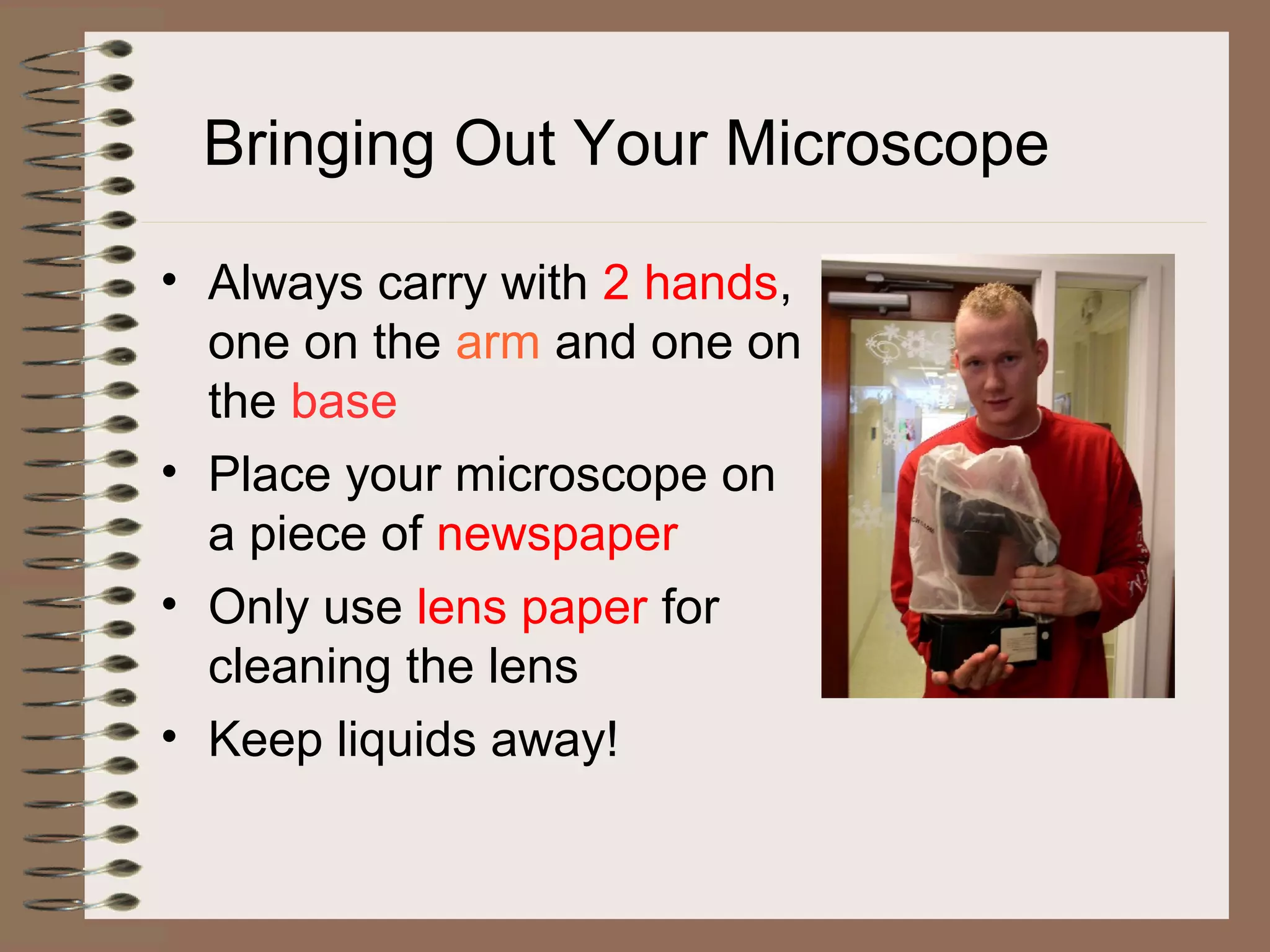
• Always carry with 2 hands,
  one on the arm and one on
  the base
• Place your microscope on
  a piece of newspaper
• Only use lens paper for
  cleaning the lens
• Keep liquids away!
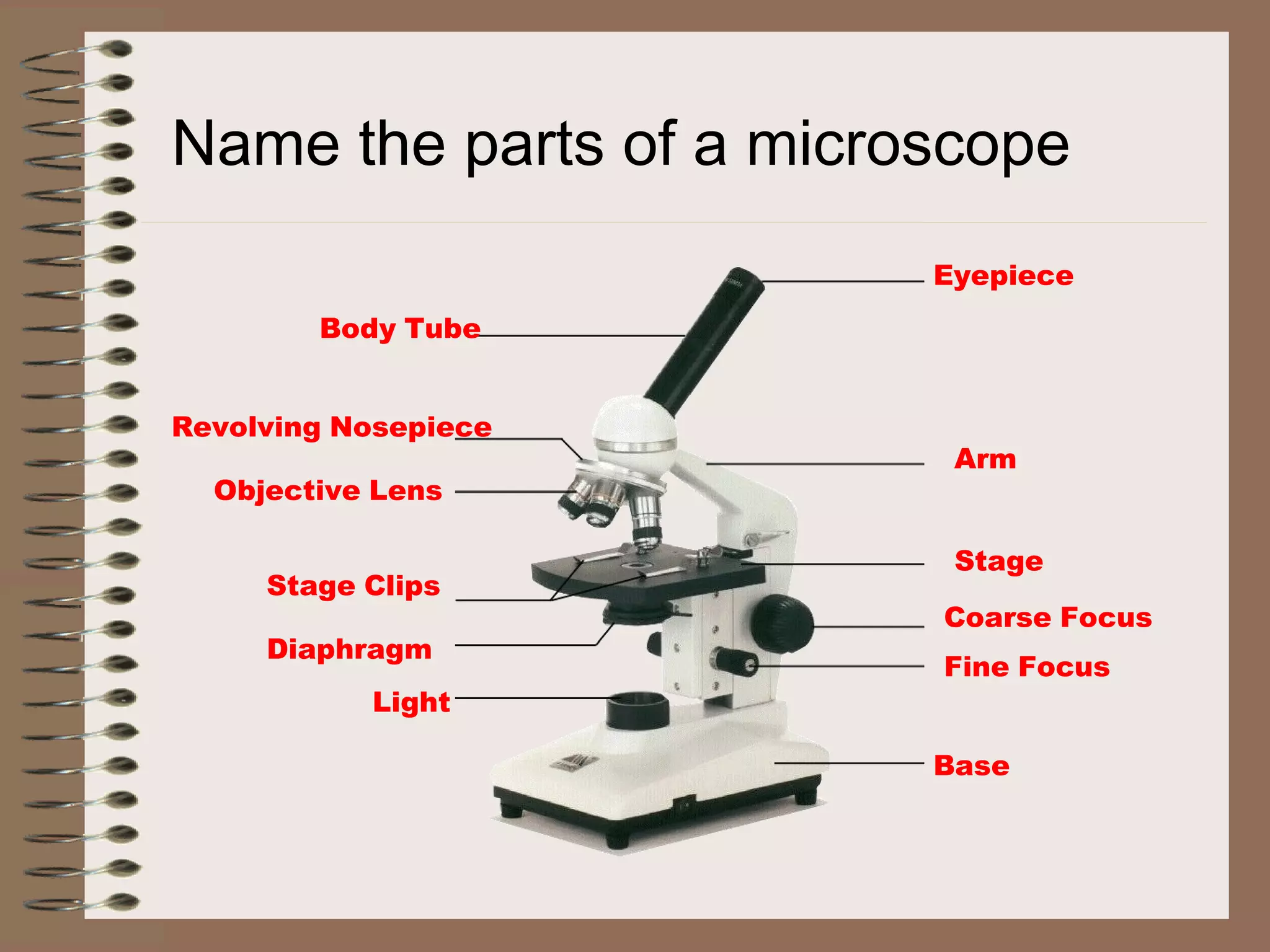
Name the parts of a microscope
                         Eyepiece
        Body Tube


Revolving Nosepiece
                          Arm
  Objective Lens

                          Stage
     Stage Clips
                         Coarse Focus
     Diaphragm
                         Fine Focus
           Light

                         Base
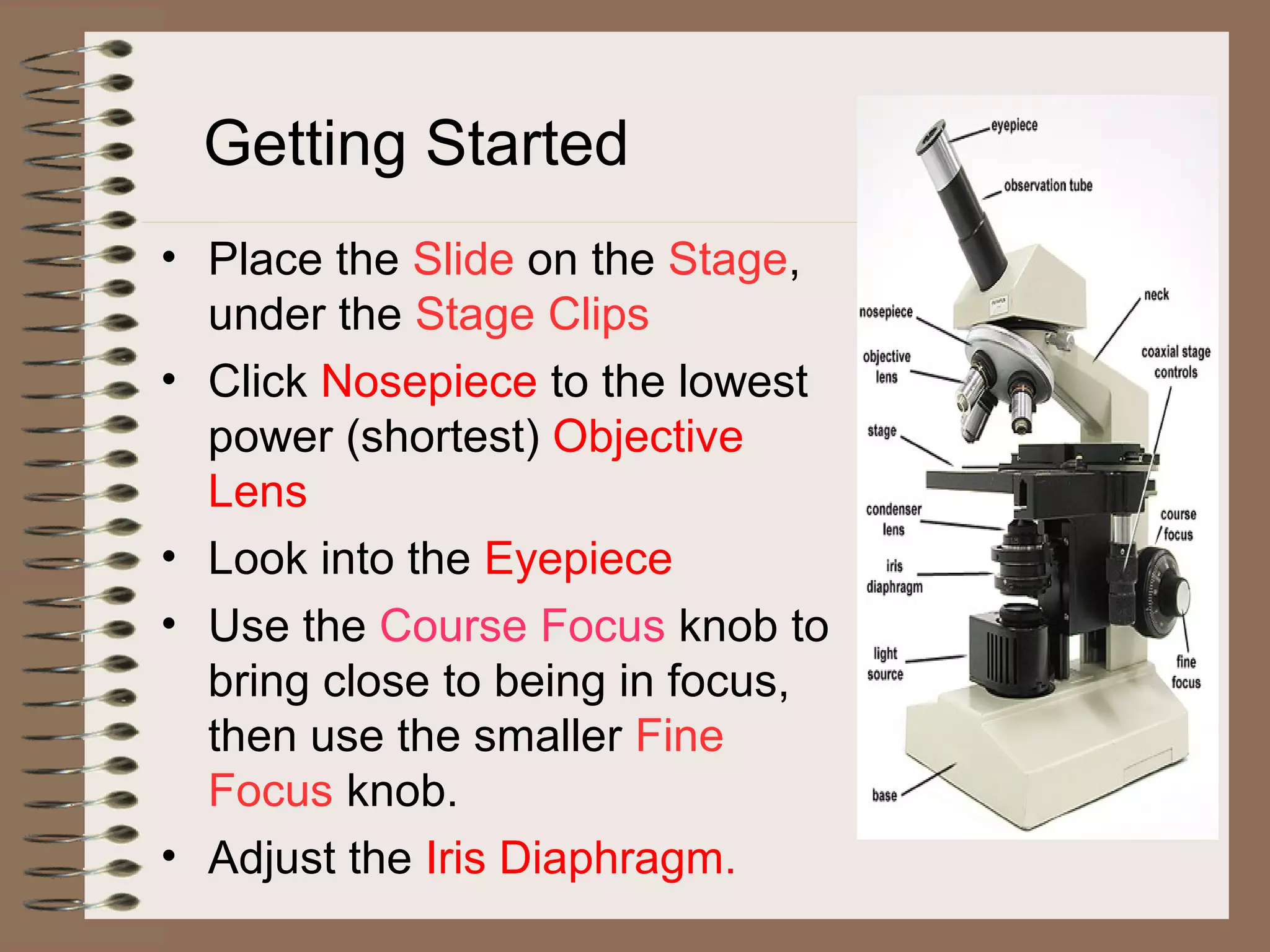
Getting Started
• Place the Slide on the Stage,
  under the Stage Clips
• Click Nosepiece to the lowest
  power (shortest) Objective
  Lens
• Look into the Eyepiece
• Use the Course Focus knob to
  bring close to being in focus,
  then use the smaller Fine
  Focus knob.
• Adjust the Iris Diaphragm.
Increasing Magnification
• Click the Nosepiece to a longer Objective
• Do NOT use the Coarse Focusing Knob
• Use the Fine Focus Knob to bring the slide
  into focus


               What can you find on your slide?
Putting Your Microscope Away

• Remove and return your Slides.
• Click the Nosepiece to the lowest
  power Objective
• Always carry back to the cart with 2
  hands, one on the arm and one on the
  base
• Fold your newspaper and
  place in recycle stack
Name the parts of a microscope
                         Eyepiece
        Body Tube


Revolving Nosepiece
                          Arm
  Objective Lens

                          Stage
     Stage Clips
                         Coarse Focus
     Diaphragm
                         Fine Focus
           Light

                         Base
Name the parts of a microscope
                         Eyepiece
        Body Tube


Revolving Nosepiece
                          Arm
  Objective Lens

                          Stage
     Stage Clips
                         Coarse Focus
     Diaphragm
                         Fine Focus
           Light

                         Base
Bringing Out Your Microscope

• Always carry with 2 hands,
  one on the arm and one on
  the base
• Place your microscope on
  a piece of newspaper
• Only use lens paper for
  cleaning the lens
• Keep liquids away!
Getting Started
• Place the Slide on the Stage,
  under the Stage Clips
• Click Nosepiece to the lowest
  power (shortest) Objective
  Lens
• Look into the Eyepiece
• Use the Course Focus knob to
  bring close to being in focus,
  then use the smaller Fine
  Focus knob.
• Adjust the Iris Diaphragm.
Increasing Magnification
• Click the Nosepiece to a longer Objective
• Do NOT use the Coarse Focusing Knob
• Use the Fine Focus Knob to bring the slide
  into focus


               What can you find on your slide?
Putting Your Microscope Away

• Remove and return your Slides.
• Click the Nosepiece to the lowest
  power Objective
• Always carry back to the cart with 2
  hands, one on the arm and one on the
  base
• Fold your newspaper and
  place in recycle stack
Name the parts of a microscope
                         Eyepiece
        Body Tube


Revolving Nosepiece
                          Arm
  Objective Lens

                          Stage
     Stage Clips
                         Coarse Focus
     Diaphragm
                         Fine Focus
           Light

                         Base
Thank you.

Microscope powerpoint

  • 1.
    Introduction to the Microscope Care Parts Focusing
  • 2.
    Bringing Out YourMicroscope • Always carry with 2 hands, one on the arm and one on the base • Place your microscope on a piece of newspaper • Only use lens paper for cleaning the lens • Keep liquids away!
  • 3.
    Name the partsof a microscope Eyepiece Body Tube Revolving Nosepiece Arm Objective Lens Stage Stage Clips Coarse Focus Diaphragm Fine Focus Light Base
  • 4.
    Getting Started • Placethe Slide on the Stage, under the Stage Clips • Click Nosepiece to the lowest power (shortest) Objective Lens • Look into the Eyepiece • Use the Course Focus knob to bring close to being in focus, then use the smaller Fine Focus knob. • Adjust the Iris Diaphragm.
  • 5.
    Increasing Magnification • Clickthe Nosepiece to a longer Objective • Do NOT use the Coarse Focusing Knob • Use the Fine Focus Knob to bring the slide into focus What can you find on your slide?
  • 6.
    Putting Your MicroscopeAway • Remove and return your Slides. • Click the Nosepiece to the lowest power Objective • Always carry back to the cart with 2 hands, one on the arm and one on the base • Fold your newspaper and place in recycle stack
  • 7.
    Name the partsof a microscope Eyepiece Body Tube Revolving Nosepiece Arm Objective Lens Stage Stage Clips Coarse Focus Diaphragm Fine Focus Light Base
  • 8.
    Name the partsof a microscope Eyepiece Body Tube Revolving Nosepiece Arm Objective Lens Stage Stage Clips Coarse Focus Diaphragm Fine Focus Light Base
  • 9.
    Bringing Out YourMicroscope • Always carry with 2 hands, one on the arm and one on the base • Place your microscope on a piece of newspaper • Only use lens paper for cleaning the lens • Keep liquids away!
  • 10.
    Getting Started • Placethe Slide on the Stage, under the Stage Clips • Click Nosepiece to the lowest power (shortest) Objective Lens • Look into the Eyepiece • Use the Course Focus knob to bring close to being in focus, then use the smaller Fine Focus knob. • Adjust the Iris Diaphragm.
  • 11.
    Increasing Magnification • Clickthe Nosepiece to a longer Objective • Do NOT use the Coarse Focusing Knob • Use the Fine Focus Knob to bring the slide into focus What can you find on your slide?
  • 12.
    Putting Your MicroscopeAway • Remove and return your Slides. • Click the Nosepiece to the lowest power Objective • Always carry back to the cart with 2 hands, one on the arm and one on the base • Fold your newspaper and place in recycle stack
  • 13.
    Name the partsof a microscope Eyepiece Body Tube Revolving Nosepiece Arm Objective Lens Stage Stage Clips Coarse Focus Diaphragm Fine Focus Light Base
  • 14.

Editor's Notes

  • #2 Students will have their microscopes out, for reference as we go through each of the steps. As an introduction, students will be asked what kinds of things they can do with this tool.
  • #3 Teacher demonstrates how to hold the microscope, where the lens paper is located and how to use it. Students will be invited to turn the knobs and observe the stage as it moves up and down WITHOUT A SLIDE. Teacher will demonstrate how to store the microscope.
  • #4 This is the exact version of the microscope used in class. Students will be identifying the parts on the microscopes at their desks as we go along and what their functions are.
  • #5 Give students a slide from the “common things” set, each student will practice focusing and changing objectives.
  • #6 Have students exchange slides so they can look at different things, walk them through using the high power objective to focus slides. Emphasize not using the coarse objective during this process, as it will crack the slides.
  • #7 Have students exchange slides so they can look at different things, walk them through using the high power objective to focus slides. Emphasize not using the coarse objective during this process, as it will crack the slides.
  • #8 This is the exact version of the microscope used in class. Students will be identifying the parts on the microscopes at their desks as we go along and what their functions are.
  • #9 This is the exact version of the microscope used in class. Students will be identifying the parts on the microscopes at their desks as we go along and what their functions are.
  • #10 Teacher demonstrates how to hold the microscope, where the lens paper is located and how to use it. Students will be invited to turn the knobs and observe the stage as it moves up and down. Teacher will demonstrate how to store the microscope.
  • #11 Give students a slide from the “common things” set, each student will practice focusing and changing objectives.
  • #12 Have students exchange slides so they can look at different things, walk them through using the high power objective to focus slides. Emphasize not using the coarse objective during this process, as it will crack the slides.
  • #13 Have students exchange slides so they can look at different things, walk them through using the high power objective to focus slides. Emphasize not using the coarse objective during this process, as it will crack the slides.
  • #14 This is the exact version of the microscope used in class. Students will be identifying the parts on the microscopes at their desks as we go along and what their functions are.