




Week 32
                                          How life on
                                          earth
                                          changed over
                                          time

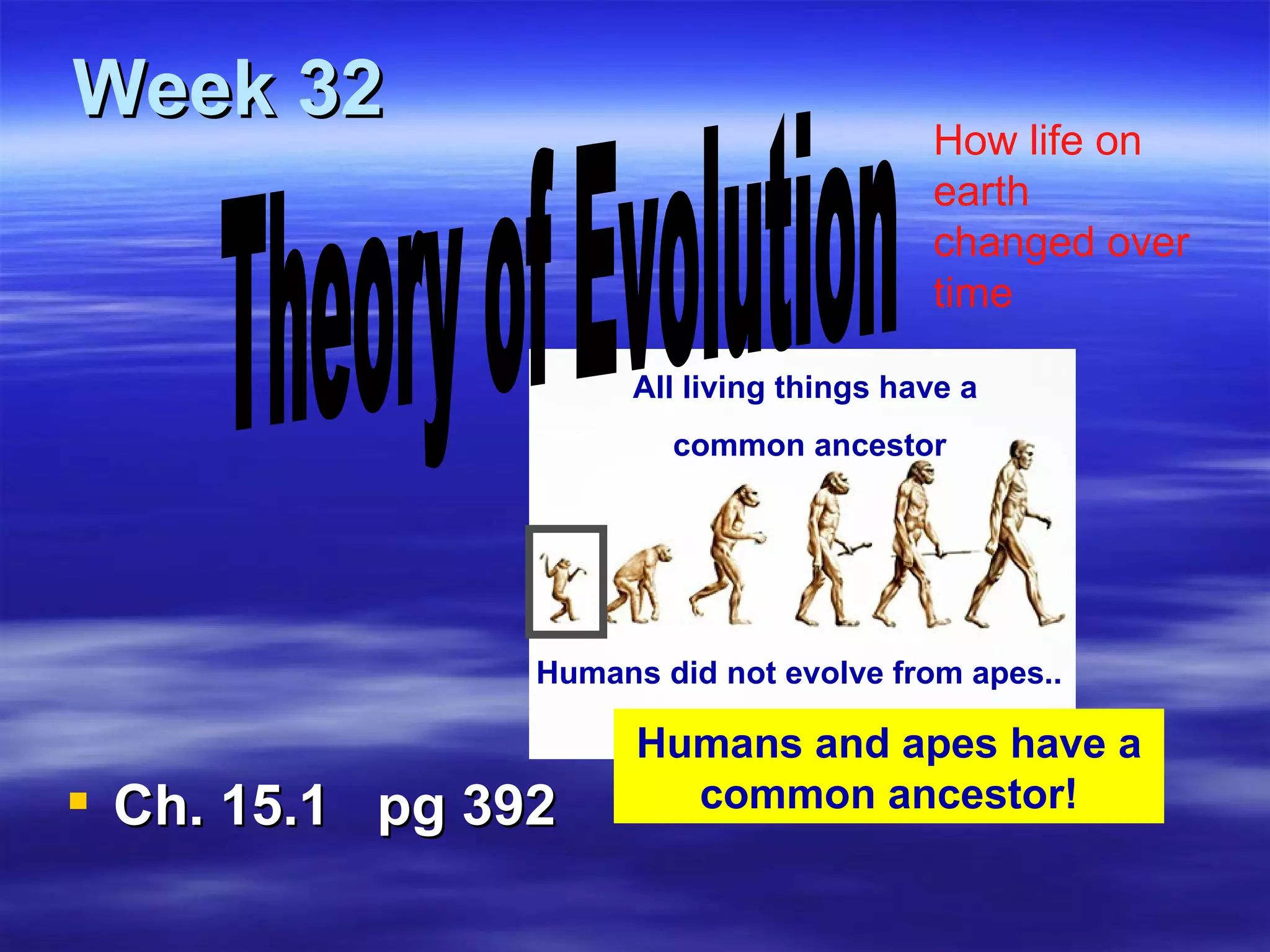
                      All living things have a
                        common ancestor


                Humans did not evolve from apes..

                      Humans and apes have a
 Ch. 15.1 pg 392       common ancestor!
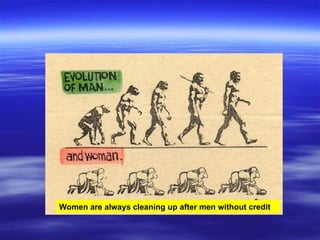
Women are always cleaning up after men without credit
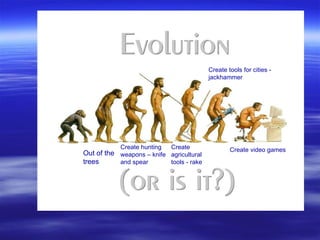
Create tools for cities -
                                          jackhammer


           Create hunting  Create                 Create video games
Out of the weapons – knife agricultural
trees      and spear       tools - rake
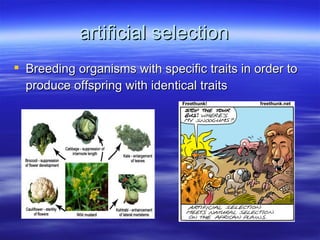
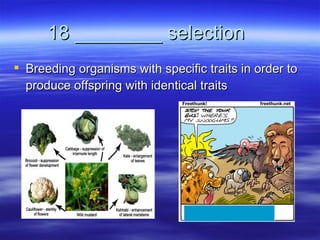
artificial selection
 Breeding organisms with specific traits in order to
  produce offspring with identical traits
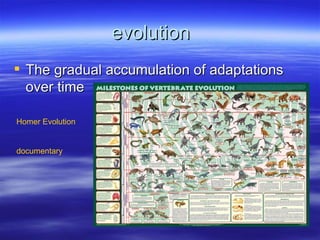
evolution
 The gradual accumulation of adaptations
  over time

Homer Evolution


documentary
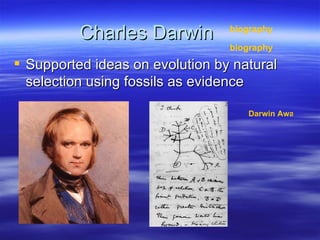
Charles Darwin         biography

                                 biography

 Supported ideas on evolution by natural
  selection using fossils as evidence

                                    Darwin Awards
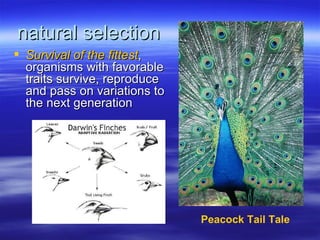
natural selection
 Survival of the fittest,
  organisms with favorable
  traits survive, reproduce
  and pass on variations to
  the next generation


                              Peacock Tail Tale
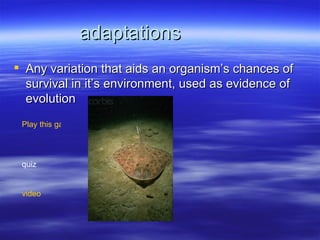
adaptations
 Any variation that aids an organism’s chances of
  survival in it’s environment, used as evidence of
  evolution
 Play this game


 quiz


 video
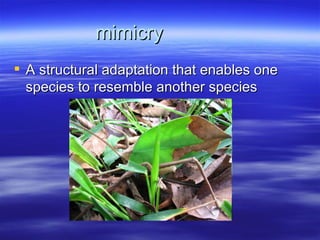
mimicry
 A structural adaptation that enables one
  species to resemble another species
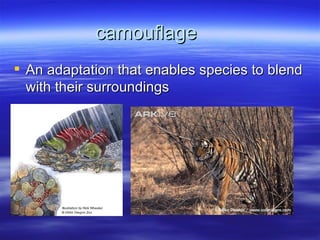
camouflage
 An adaptation that enables species to blend
  with their surroundings
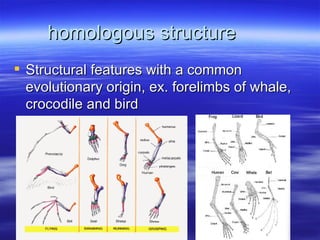
homologous structure
 Structural features with a common
  evolutionary origin, ex. forelimbs of whale,
  crocodile and bird
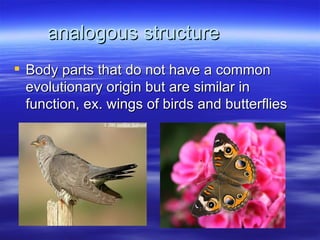
analogous structure
 Body parts that do not have a common
  evolutionary origin but are similar in
  function, ex. wings of birds and butterflies
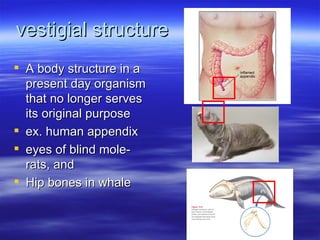
vestigial structure
 A body structure in a
  present day organism
  that no longer serves
  its original purpose
 ex. human appendix
 eyes of blind mole-
  rats, and
 Hip bones in whale
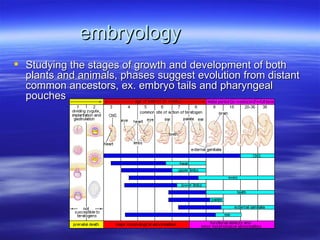
embryology
 Studying the stages of growth and development of both
  plants and animals, phases suggest evolution from distant
  common ancestors, ex. embryo tails and pharyngeal
  pouches
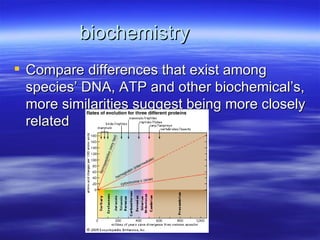
biochemistry
 Compare differences that exist among
  species’ DNA, ATP and other biochemical’s,
  more similarities suggest being more closely
  related
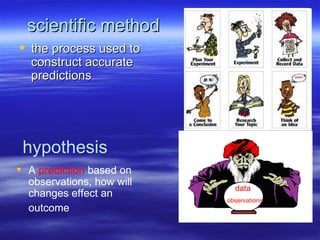
scientific method
 the process used to
  construct accurate
  predictions


 hypothesis
 A prediction based on
  observations, how will
                             data
  changes effect an
                           observations
  outcome
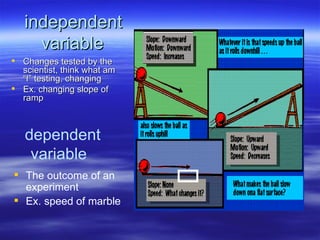
independent
     variable
 Changes tested by the
  scientist, think what am
  “I” testing, changing
 Ex. changing slope of
  ramp


   dependent
    variable
 The outcome of an
  experiment
 Ex. speed of marble
Quantitative data
 Numeric data – measured or
  counted


   Qualitative data
   described in terms of quality,
    using LANGUAGE
   Examples: color, small,
    smooth
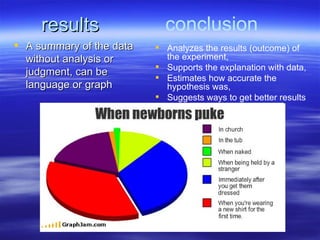
results                conclusion
 A summary of the data    Analyzes the results (outcome) of
  without analysis or       the experiment,
                           Supports the explanation with data,
  judgment, can be
                           Estimates how accurate the
  language or graph         hypothesis was,
                           Suggests ways to get better results
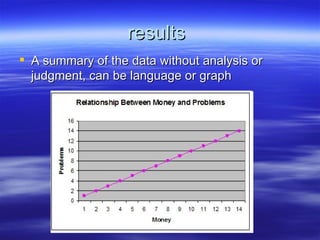
results
 A summary of the data without analysis or
  judgment, can be language or graph
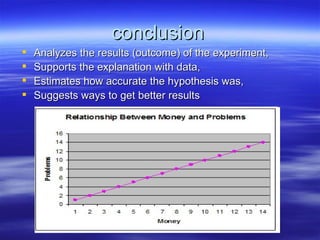
conclusion
   Analyzes the results (outcome) of the experiment,
   Supports the explanation with data,
   Estimates how accurate the hypothesis was,
   Suggests ways to get better results
And now the quiz…
 You may use your flashcards only!!
Ready?
1
 Using your outline notes-

 Name two types of adaptations
2
 2 types of evidence for evolution
3
 What did Darwin use to shape his ideas
  about evolution?
4
Name one of the organisms that Darwin
 noticed to have changed over time.
5
Using the lyrics of the song -
 The name of Darwin’s book
6
 How life changes over time
7
 The process by which organisms that better
  adapted survive and reproduce more
8
 How we’ll end up if we are not wise
9
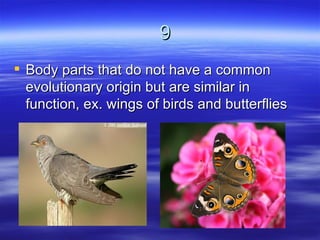
 Body parts that do not have a common
  evolutionary origin but are similar in
  function, ex. wings of birds and butterflies
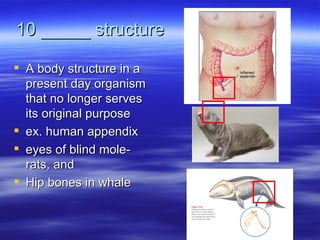
10 _____ structure

 A body structure in a
  present day organism
  that no longer serves
  its original purpose
 ex. human appendix
 eyes of blind mole-
  rats, and
 Hip bones in whale
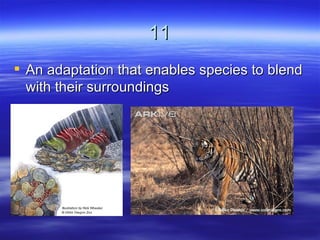
11
 An adaptation that enables species to blend
  with their surroundings
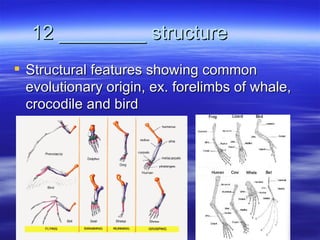
12 ________ structure
 Structural features showing common
  evolutionary origin, ex. forelimbs of whale,
  crocodile and bird
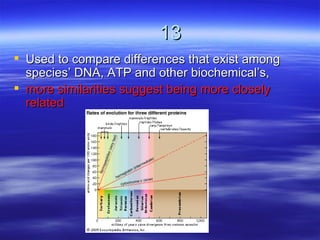
13
 Used to compare differences that exist among
  species’ DNA, ATP and other biochemical’s,
 more similarities suggest being more closely
  related
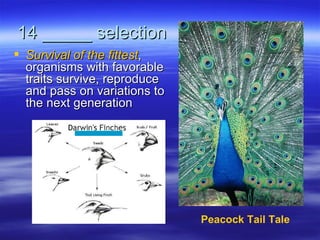
14 _____ selection
 Survival of the fittest,
  organisms with favorable
  traits survive, reproduce
  and pass on variations to
  the next generation


                              Peacock Tail Tale
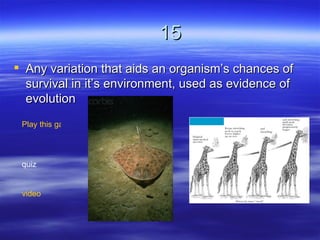
15
 Any variation that aids an organism’s chances of
  survival in it’s environment, used as evidence of
  evolution
 Play this game


 quiz


 video
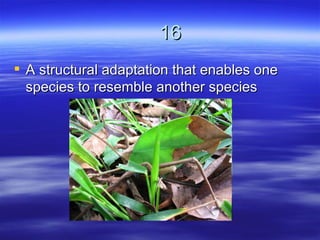
16
 A structural adaptation that enables one
  species to resemble another species
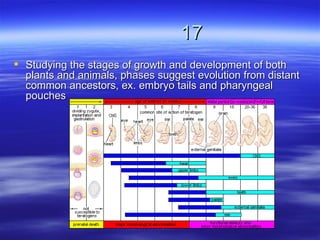
17
 Studying the stages of growth and development of both
  plants and animals, phases suggest evolution from distant
  common ancestors, ex. embryo tails and pharyngeal
  pouches
18 ________ selection
 Breeding organisms with specific traits in order to
  produce offspring with identical traits
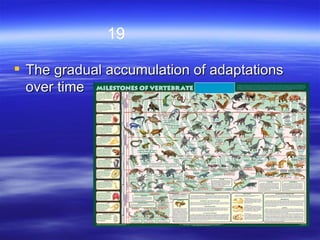
19

 The gradual accumulation of adaptations
  over time
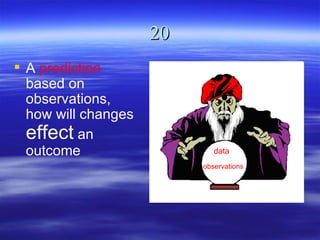
20
 A prediction
  based on
  observations,
  how will changes
  effect an
  outcome                    data
                          observations
Mahalo!
 Please do your homework!!
Chapter Review 15
1.   camouflage
2.   natural selection
3.   speciation
4.   punctuated equilibrium
5.   c
6.   c stabilizing
7.   d adaptive radiation – convergent evolution
8.   b convergent evolution
9.   d populations evolve, individuals don’t
    18. C directional selection
    19. A polyploidy
    20. C physiological adaptation
    21. B divergent evolution
    22. A Hawaiian honeycreepers and Galapagos finches

B32 ppt theory of evolution ch 15

  • 1.
    Week 32 How life on earth changed over time All living things have a common ancestor Humans did not evolve from apes.. Humans and apes have a  Ch. 15.1 pg 392 common ancestor!
  • 2.
    Women are alwayscleaning up after men without credit
  • 3.
    Create tools forcities - jackhammer Create hunting Create Create video games Out of the weapons – knife agricultural trees and spear tools - rake
  • 4.
    artificial selection  Breedingorganisms with specific traits in order to produce offspring with identical traits
  • 5.
    evolution  The gradualaccumulation of adaptations over time Homer Evolution documentary
  • 6.
    Charles Darwin biography biography  Supported ideas on evolution by natural selection using fossils as evidence Darwin Awards
  • 7.
    natural selection  Survivalof the fittest, organisms with favorable traits survive, reproduce and pass on variations to the next generation Peacock Tail Tale
  • 8.
    adaptations  Any variationthat aids an organism’s chances of survival in it’s environment, used as evidence of evolution Play this game quiz video
  • 9.
    mimicry  A structuraladaptation that enables one species to resemble another species
  • 10.
    camouflage  An adaptationthat enables species to blend with their surroundings
  • 11.
    homologous structure  Structuralfeatures with a common evolutionary origin, ex. forelimbs of whale, crocodile and bird
  • 12.
    analogous structure  Bodyparts that do not have a common evolutionary origin but are similar in function, ex. wings of birds and butterflies
  • 13.
    vestigial structure  Abody structure in a present day organism that no longer serves its original purpose  ex. human appendix  eyes of blind mole- rats, and  Hip bones in whale
  • 14.
    embryology  Studying thestages of growth and development of both plants and animals, phases suggest evolution from distant common ancestors, ex. embryo tails and pharyngeal pouches
  • 15.
    biochemistry  Compare differencesthat exist among species’ DNA, ATP and other biochemical’s, more similarities suggest being more closely related
  • 16.
    scientific method  theprocess used to construct accurate predictions hypothesis  A prediction based on observations, how will data changes effect an observations outcome
  • 17.
    independent variable  Changes tested by the scientist, think what am “I” testing, changing  Ex. changing slope of ramp dependent variable  The outcome of an experiment  Ex. speed of marble
  • 18.
    Quantitative data  Numericdata – measured or counted Qualitative data  described in terms of quality, using LANGUAGE  Examples: color, small, smooth
  • 19.
    results conclusion  A summary of the data  Analyzes the results (outcome) of without analysis or the experiment,  Supports the explanation with data, judgment, can be  Estimates how accurate the language or graph hypothesis was,  Suggests ways to get better results
  • 20.
    results  A summaryof the data without analysis or judgment, can be language or graph
  • 21.
    conclusion  Analyzes the results (outcome) of the experiment,  Supports the explanation with data,  Estimates how accurate the hypothesis was,  Suggests ways to get better results
  • 22.
    And now thequiz…  You may use your flashcards only!!
  • 23.
  • 24.
    1  Using youroutline notes-  Name two types of adaptations
  • 25.
    2  2 typesof evidence for evolution
  • 26.
    3  What didDarwin use to shape his ideas about evolution?
  • 27.
    4 Name one ofthe organisms that Darwin noticed to have changed over time.
  • 28.
    5 Using the lyricsof the song -  The name of Darwin’s book
  • 29.
    6  How lifechanges over time
  • 30.
    7  The processby which organisms that better adapted survive and reproduce more
  • 31.
    8  How we’llend up if we are not wise
  • 32.
    9  Body partsthat do not have a common evolutionary origin but are similar in function, ex. wings of birds and butterflies
  • 33.
    10 _____ structure A body structure in a present day organism that no longer serves its original purpose  ex. human appendix  eyes of blind mole- rats, and  Hip bones in whale
  • 34.
    11  An adaptationthat enables species to blend with their surroundings
  • 35.
    12 ________ structure Structural features showing common evolutionary origin, ex. forelimbs of whale, crocodile and bird
  • 36.
    13  Used tocompare differences that exist among species’ DNA, ATP and other biochemical’s,  more similarities suggest being more closely related
  • 37.
    14 _____ selection Survival of the fittest, organisms with favorable traits survive, reproduce and pass on variations to the next generation Peacock Tail Tale
  • 38.
    15  Any variationthat aids an organism’s chances of survival in it’s environment, used as evidence of evolution Play this game quiz video
  • 39.
    16  A structuraladaptation that enables one species to resemble another species
  • 40.
    17  Studying thestages of growth and development of both plants and animals, phases suggest evolution from distant common ancestors, ex. embryo tails and pharyngeal pouches
  • 41.
    18 ________ selection Breeding organisms with specific traits in order to produce offspring with identical traits
  • 42.
    19  The gradualaccumulation of adaptations over time
  • 43.
    20  A prediction based on observations, how will changes effect an outcome data observations
  • 44.
    Mahalo!  Please doyour homework!!
  • 45.
    Chapter Review 15 1. camouflage 2. natural selection 3. speciation 4. punctuated equilibrium 5. c 6. c stabilizing 7. d adaptive radiation – convergent evolution 8. b convergent evolution 9. d populations evolve, individuals don’t  18. C directional selection  19. A polyploidy  20. C physiological adaptation  21. B divergent evolution  22. A Hawaiian honeycreepers and Galapagos finches