

Week 26
          Applied Genetics
          – playing with genes to get traits you want


Ch. 13.1-2 pg 336
   Q: What do you get when you cross an insomniac, an
    agnostic, and a dyslexic?
    A: Someone who stays up all night wondering if there is a
    Dog.”
   Q: What do you get if you cross a chicken with a cement
    mixer?
    A: A brick layer!
   What do you get if you cross an octopus with a cow?
   An animal that can milk itself.
   What do you get if you cross an elephant with a kangaroo
   Big holes all over Australia..
   What do you get if you cross an insect with the Easter
    rabbit?
    Bugs Bunny.
   What do you get when you cross a stream and a brook?
    Wet feet.
   What do you get when you cross poison ivy with a 4-leaf
    clover?
    A rash of good luck.
   What do you get when you cross an elephant with a jar
    of peanut butter?
   An elephant that sticks to the roof of your mouth.
   What do you get if you cross a shark with a snowman?
   Frostbite.
   What do you get if you cross a sheep with a vegetable?
    A colliflower.
   What do you get if you cross a chicken with a kangaroo?
    Pouched eggs.
   How can you tell a elephant from spaghetti?
    An elephant doesn't slip off the end of your fork.
   What do you get if you cross a space ship with bacon?
    An unidentified frying object.
selective breeding
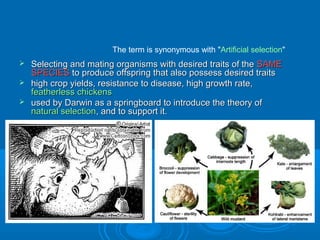
                      The term is synonymous with "Artificial selection"
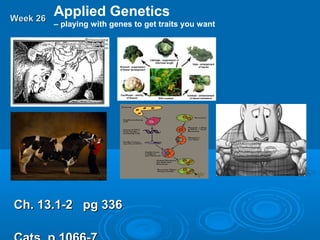
 Selecting and mating organisms with desired traits of the SAME
  SPECIES to produce offspring that also possess desired traits
 high crop yields, resistance to disease, high growth rate,
  featherless chickens
 used by Darwin as a springboard to introduce the theory of
  natural selection, and to support it.
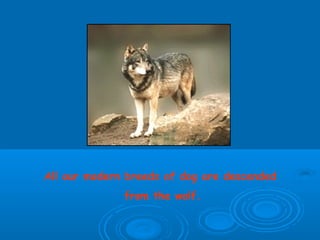
All our modern breeds of dog are descended
              from the wolf.
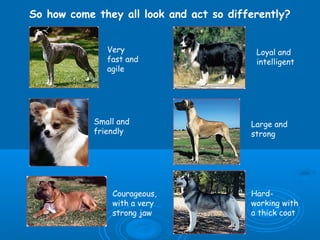
So how come they all look and act so differently?


               Very                       Loyal and
               fast and                   intelligent
               agile


            Small and                    Large and
            friendly                     strong


                Courageous,              Hard-
                with a very              working with
                strong jaw               a thick coat
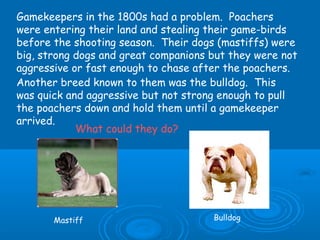
Gamekeepers in the 1800s had a problem. Poachers
were entering their land and stealing their game-birds
before the shooting season. Their dogs (mastiffs) were
big, strong dogs and great companions but they were not
aggressive or fast enough to chase after the poachers.
Another breed known to them was the bulldog. This
was quick and aggressive but not strong enough to pull
the poachers down and hold them until a gamekeeper
arrived.
            What could they do?


       Mastiff                        Bulldog
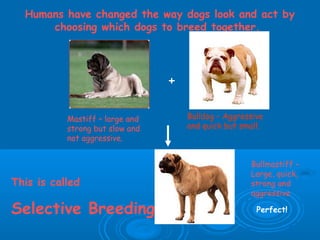
Humans have changed the way dogs look and act by
      choosing which dogs to breed together.


                                 +

           Mastiff – large and       Bulldog – Aggressive
           strong but slow and       and quick but small.
           not aggressive.


                                                     Bullmastiff –
                                                     Large, quick,
This is called                                       strong and
                                                     aggressive

Selective Breeding                                     Perfect!
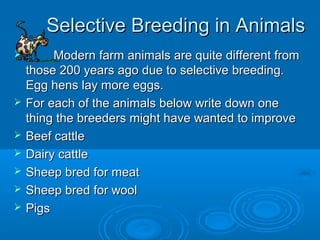
Selective Breeding in Animals
        Modern farm animals are quite different from
    those 200 years ago due to selective breeding.
    Egg hens lay more eggs.
   For each of the animals below write down one
    thing the breeders might have wanted to improve
   Beef cattle
   Dairy cattle
   Sheep bred for meat
   Sheep bred for wool
   Pigs
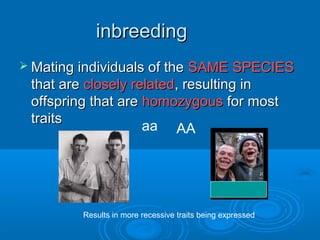
inbreeding
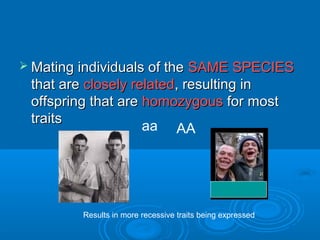
 Mating individuals of the SAME SPECIES
 that are closely related, resulting in
 offspring that are homozygous for most
 traits
                    aa AA


          Results in more recessive traits being expressed
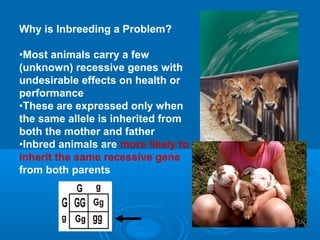
Why is Inbreeding a Problem?

•Most animals carry a few
(unknown) recessive genes with
undesirable effects on health or
performance
•These are expressed only when
the same allele is inherited from
both the mother and father
•Inbred animals are more likely to
inherit the same recessive gene
from both parents
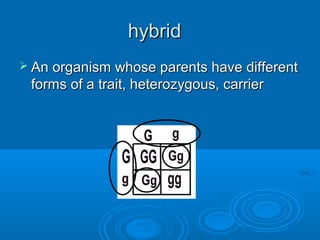
hybrid
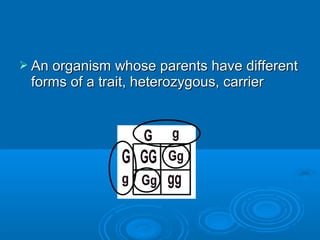
 An organism  whose parents have different
 forms of a trait, heterozygous, carrier
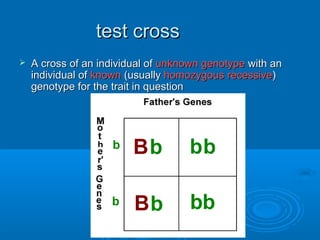
test cross
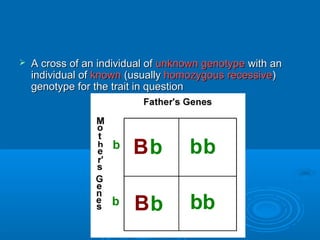
   A cross of an individual of unknown genotype with an
    individual of known (usually homozygous recessive)
    genotype for the trait in question
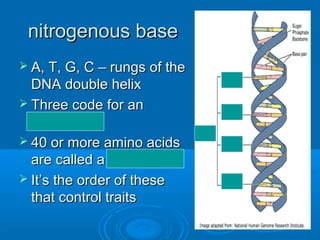
nitrogenous base
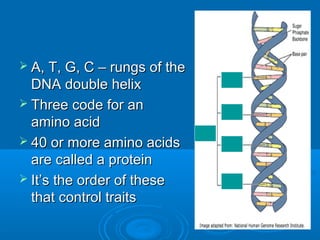
 A, T, G, C – rungs of the
  DNA double helix
 Three code for an
  amino acid
 40 or more amino acids
  are called a protein
 It’s the order of these
  that control traits
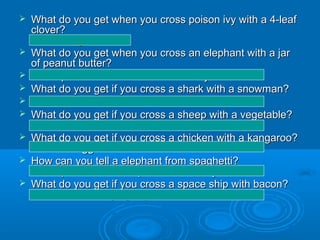
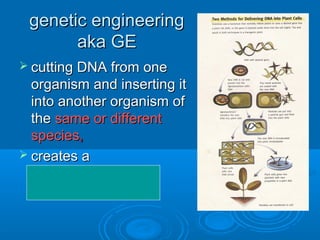
genetic engineering
       aka GE
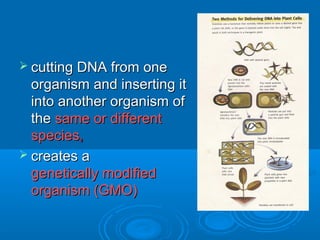
 cutting DNA from one
  organism and inserting it
  into another organism of
  the same or different
  species,
 creates a
  genetically modified
  organism (GMO)
recombinant DNA
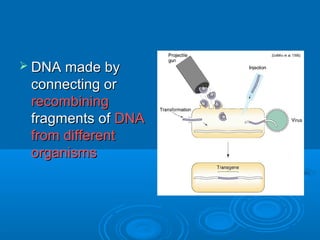
 DNA made by
 connecting or
 recombining
 fragments of DNA
 from different
 organisms
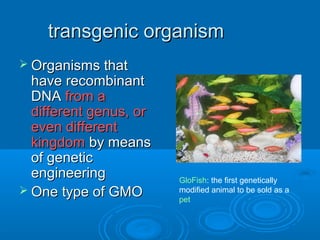
transgenic organism
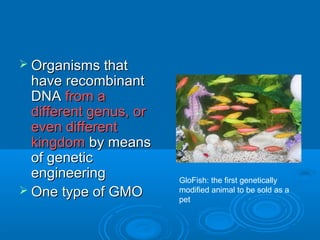
 Organisms that
  have recombinant
  DNA from a
  different genus, or
  even different
  kingdom by means
  of genetic
  engineering           GloFish: the first genetically
 One type of GMO       modified animal to be sold as a
                        pet
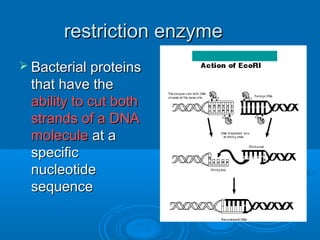
restriction enzyme
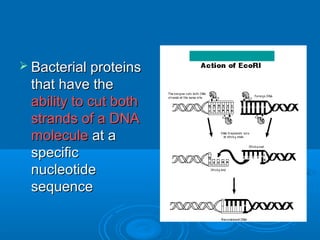
 Bacterial proteins
 that have the
 ability to cut both
 strands of a DNA
 molecule at a
 specific
 nucleotide
 sequence
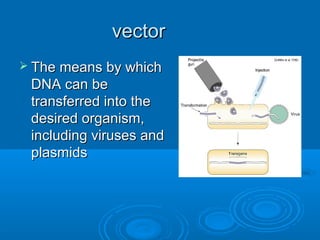
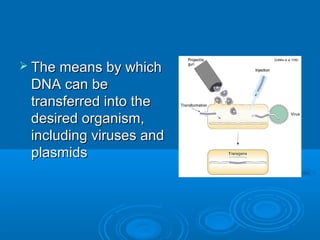
vector
 The means by which
 DNA can be
 transferred into the
 desired organism,
 including viruses and
 plasmids
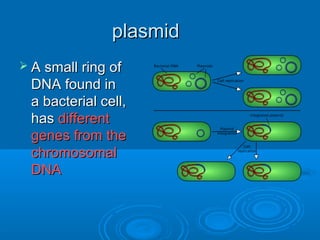
plasmid
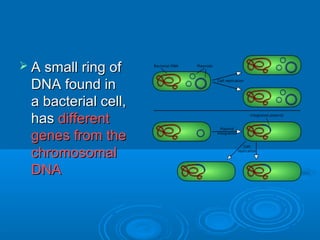
 A small ring of
 DNA found in
 a bacterial cell,
 has different
 genes from the
 chromosomal
 DNA
clone
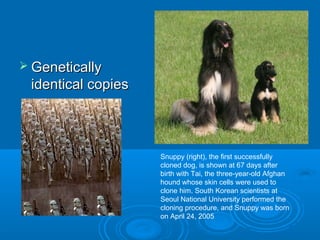
 Genetically
 identical copies


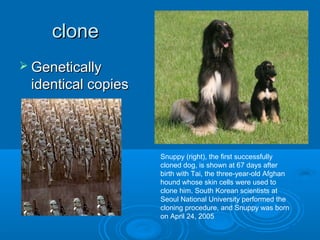
                    Snuppy (right), the first successfully
                    cloned dog, is shown at 67 days after
                    birth with Tai, the three-year-old Afghan
                    hound whose skin cells were used to
                    clone him. South Korean scientists at
                    Seoul National University performed the
                    cloning procedure, and Snuppy was born
                    on April 24, 2005
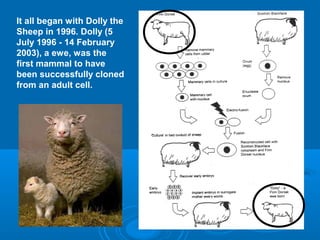
It all began with Dolly the
Sheep in 1996. Dolly (5
July 1996 - 14 February
2003), a ewe, was the
first mammal to have
been successfully cloned
from an adult cell.
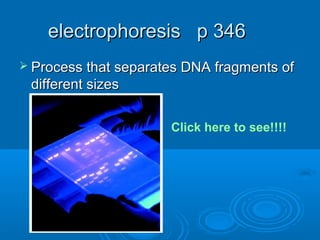
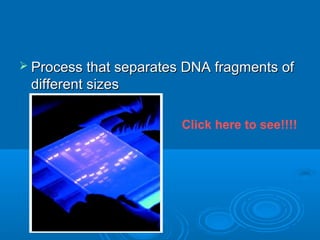
electrophoresis p 346
 Process that separates DNA fragments of
 different sizes

                      Click here to see!!!!
 And now the quiz…..
 The means by which
 DNA can be
 transferred into the
 desired organism,
 including viruses and
 plasmids
 Organisms that
  have recombinant
  DNA from a
  different genus, or
  even different
  kingdom by means
  of genetic
  engineering           GloFish: the first genetically
 One type of GMO       modified animal to be sold as a
                        pet
 Bacterial proteins
 that have the
 ability to cut both
 strands of a DNA
 molecule at a
 specific
 nucleotide
 sequence
   A cross of an individual of unknown genotype with an
    individual of known (usually homozygous recessive)
    genotype for the trait in question
 A, T, G, C – rungs of the
  DNA double helix
 Three code for an
  amino acid
 40 or more amino acids
  are called a protein
 It’s the order of these
  that control traits
 A small ring of
 DNA found in
 a bacterial cell,
 has different
 genes from the
 chromosomal
 DNA
 Genetically
 identical copies


                    Snuppy (right), the first successfully
                    cloned dog, is shown at 67 days after
                    birth with Tai, the three-year-old Afghan
                    hound whose skin cells were used to
                    clone him. South Korean scientists at
                    Seoul National University performed the
                    cloning procedure, and Snuppy was born
                    on April 24, 2005
 Process that separates DNA fragments of
 different sizes

                        Click here to see!!!!
The term is synonymous with "Artificial selection"
 Selecting and mating organisms with desired traits of the SAME
  SPECIES to produce offspring that also possess desired traits
 high crop yields, resistance to disease, high growth rate,
  featherless chickens
 used by Darwin as a springboard to introduce the theory of
  natural selection, and to support it.
 Mating individuals of the SAME SPECIES
 that are closely related, resulting in
 offspring that are homozygous for most
 traits
                    aa AA


          Results in more recessive traits being expressed
 An organism  whose parents have different
 forms of a trait, heterozygous, carrier
 cutting DNA from one
  organism and inserting it
  into another organism of
  the same or different
  species,
 creates a
  genetically modified
  organism (GMO)
 DNA made by
 connecting or
 recombining
 fragments of DNA
 from different
 organisms
 Mahalo!!!

B26 vq applied genetics

  • 1.
    Week 26 Applied Genetics – playing with genes to get traits you want Ch. 13.1-2 pg 336
  • 2.
    Q: What do you get when you cross an insomniac, an agnostic, and a dyslexic? A: Someone who stays up all night wondering if there is a Dog.”  Q: What do you get if you cross a chicken with a cement mixer? A: A brick layer!  What do you get if you cross an octopus with a cow?  An animal that can milk itself.  What do you get if you cross an elephant with a kangaroo  Big holes all over Australia..  What do you get if you cross an insect with the Easter rabbit? Bugs Bunny.  What do you get when you cross a stream and a brook? Wet feet.
  • 3.
    What do you get when you cross poison ivy with a 4-leaf clover? A rash of good luck.  What do you get when you cross an elephant with a jar of peanut butter?  An elephant that sticks to the roof of your mouth.  What do you get if you cross a shark with a snowman?  Frostbite.  What do you get if you cross a sheep with a vegetable? A colliflower.  What do you get if you cross a chicken with a kangaroo? Pouched eggs.  How can you tell a elephant from spaghetti? An elephant doesn't slip off the end of your fork.  What do you get if you cross a space ship with bacon? An unidentified frying object.
  • 4.
    selective breeding The term is synonymous with "Artificial selection"  Selecting and mating organisms with desired traits of the SAME SPECIES to produce offspring that also possess desired traits  high crop yields, resistance to disease, high growth rate, featherless chickens  used by Darwin as a springboard to introduce the theory of natural selection, and to support it.
  • 5.
    All our modernbreeds of dog are descended from the wolf.
  • 6.
    So how comethey all look and act so differently? Very Loyal and fast and intelligent agile Small and Large and friendly strong Courageous, Hard- with a very working with strong jaw a thick coat
  • 7.
    Gamekeepers in the1800s had a problem. Poachers were entering their land and stealing their game-birds before the shooting season. Their dogs (mastiffs) were big, strong dogs and great companions but they were not aggressive or fast enough to chase after the poachers. Another breed known to them was the bulldog. This was quick and aggressive but not strong enough to pull the poachers down and hold them until a gamekeeper arrived. What could they do? Mastiff Bulldog
  • 8.
    Humans have changedthe way dogs look and act by choosing which dogs to breed together. + Mastiff – large and Bulldog – Aggressive strong but slow and and quick but small. not aggressive. Bullmastiff – Large, quick, This is called strong and aggressive Selective Breeding Perfect!
  • 9.
    Selective Breeding inAnimals  Modern farm animals are quite different from those 200 years ago due to selective breeding. Egg hens lay more eggs.  For each of the animals below write down one thing the breeders might have wanted to improve  Beef cattle  Dairy cattle  Sheep bred for meat  Sheep bred for wool  Pigs
  • 10.
    inbreeding  Mating individualsof the SAME SPECIES that are closely related, resulting in offspring that are homozygous for most traits aa AA Results in more recessive traits being expressed
  • 11.
    Why is Inbreedinga Problem? •Most animals carry a few (unknown) recessive genes with undesirable effects on health or performance •These are expressed only when the same allele is inherited from both the mother and father •Inbred animals are more likely to inherit the same recessive gene from both parents
  • 12.
    hybrid  An organism whose parents have different forms of a trait, heterozygous, carrier
  • 13.
    test cross  A cross of an individual of unknown genotype with an individual of known (usually homozygous recessive) genotype for the trait in question
  • 14.
    nitrogenous base  A,T, G, C – rungs of the DNA double helix  Three code for an amino acid  40 or more amino acids are called a protein  It’s the order of these that control traits
  • 15.
    genetic engineering aka GE  cutting DNA from one organism and inserting it into another organism of the same or different species,  creates a genetically modified organism (GMO)
  • 16.
    recombinant DNA  DNAmade by connecting or recombining fragments of DNA from different organisms
  • 17.
    transgenic organism  Organismsthat have recombinant DNA from a different genus, or even different kingdom by means of genetic engineering GloFish: the first genetically  One type of GMO modified animal to be sold as a pet
  • 18.
    restriction enzyme  Bacterialproteins that have the ability to cut both strands of a DNA molecule at a specific nucleotide sequence
  • 19.
    vector  The meansby which DNA can be transferred into the desired organism, including viruses and plasmids
  • 20.
    plasmid  A smallring of DNA found in a bacterial cell, has different genes from the chromosomal DNA
  • 21.
    clone  Genetically identicalcopies Snuppy (right), the first successfully cloned dog, is shown at 67 days after birth with Tai, the three-year-old Afghan hound whose skin cells were used to clone him. South Korean scientists at Seoul National University performed the cloning procedure, and Snuppy was born on April 24, 2005
  • 22.
    It all beganwith Dolly the Sheep in 1996. Dolly (5 July 1996 - 14 February 2003), a ewe, was the first mammal to have been successfully cloned from an adult cell.
  • 23.
    electrophoresis p 346 Process that separates DNA fragments of different sizes Click here to see!!!!
  • 24.
     And nowthe quiz…..
  • 25.
     The meansby which DNA can be transferred into the desired organism, including viruses and plasmids
  • 26.
     Organisms that have recombinant DNA from a different genus, or even different kingdom by means of genetic engineering GloFish: the first genetically  One type of GMO modified animal to be sold as a pet
  • 27.
     Bacterial proteins that have the ability to cut both strands of a DNA molecule at a specific nucleotide sequence
  • 28.
    A cross of an individual of unknown genotype with an individual of known (usually homozygous recessive) genotype for the trait in question
  • 29.
     A, T,G, C – rungs of the DNA double helix  Three code for an amino acid  40 or more amino acids are called a protein  It’s the order of these that control traits
  • 30.
     A smallring of DNA found in a bacterial cell, has different genes from the chromosomal DNA
  • 31.
     Genetically identicalcopies Snuppy (right), the first successfully cloned dog, is shown at 67 days after birth with Tai, the three-year-old Afghan hound whose skin cells were used to clone him. South Korean scientists at Seoul National University performed the cloning procedure, and Snuppy was born on April 24, 2005
  • 32.
     Process thatseparates DNA fragments of different sizes Click here to see!!!!
  • 33.
    The term issynonymous with "Artificial selection"  Selecting and mating organisms with desired traits of the SAME SPECIES to produce offspring that also possess desired traits  high crop yields, resistance to disease, high growth rate, featherless chickens  used by Darwin as a springboard to introduce the theory of natural selection, and to support it.
  • 34.
     Mating individualsof the SAME SPECIES that are closely related, resulting in offspring that are homozygous for most traits aa AA Results in more recessive traits being expressed
  • 35.
     An organism whose parents have different forms of a trait, heterozygous, carrier
  • 36.
     cutting DNAfrom one organism and inserting it into another organism of the same or different species,  creates a genetically modified organism (GMO)
  • 37.
     DNA madeby connecting or recombining fragments of DNA from different organisms
  • 38.