Lab 0-B 
Microscope Training
A Brief History 
of the 
Microscope
History 
● The Greeks & Romans used “lenses” to magnify 
objects over 1000 years ago. 
● About 500 years ago, people began 
experimenting with making microscopes 
● Since many people were creating telescopes at 
that time, was the microscope created by 
accident? 
● The first microscope was 6 feet long!
History 
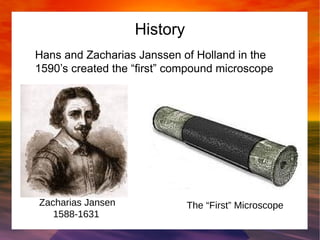
Hans and Zacharias Janssen of Holland in the 
1590’s created the “first” compound microscope 
Zacharias Jansen 
1588-1631 
The “First” Microscope
History 
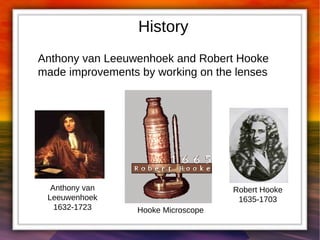
Anthony van Leeuwenhoek and Robert Hooke 
made improvements by working on the lenses 
Anthony van 
Leeuwenhoek 
1632-1723 
Robert Hooke 
1635-1703 
Hooke Microscope
History 
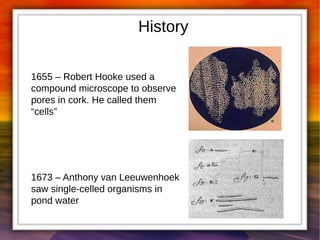
1655 – Robert Hooke used a 
compound microscope to observe 
pores in cork. He called them 
“cells” 
1673 – Anthony van Leeuwenhoek 
saw single-celled organisms in 
pond water
Types of 
Microscopes
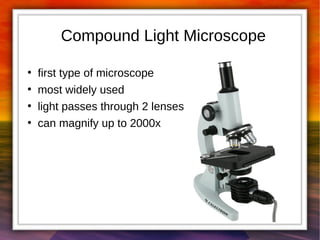
Compound Light Microscope 
● first type of microscope 
● most widely used 
● light passes through 2 lenses 
● can magnify up to 2000x
Specialized Versions 
● Dissection microscope-- image appears three dimensional. It is 
used for dissection to get a better look at the larger specimen. You 
cannot see individual cells because it has a low magnification. 
● Dark‐field microscope – useful in examining external details, such 
as outlines, edges, grain boundaries and surface defects. Contains 
a special feature that scatters light and causes it to reflect off the 
specimen at an angle. A light object is seen on a dark background. 
● Phase‐contrast microscope – has a special features that causes 
light to pass through an object at different speeds. Live organisms 
and internal cell parts such as mitochondria can be seen clearly 
● Fluorescent microscope – uses ultraviolet light which excites the 
electrons of the object and causes them to give off light in various 
shades of color. Often used with a lab procedure called the 
fluorescent‐antibody technique to help identify unknown bacteria.
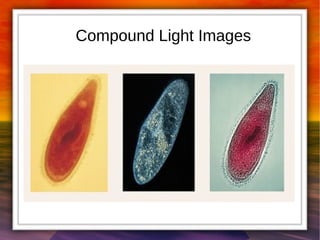
Compound Light Images
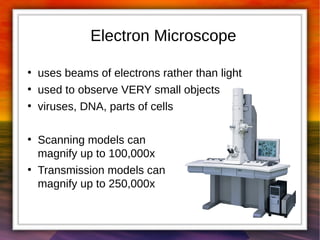
Electron Microscope 
● uses beams of electrons rather than light 
● used to observe VERY small objects 
● viruses, DNA, parts of cells 
● Scanning models can 
magnify up to 100,000x 
● Transmission models can 
magnify up to 250,000x
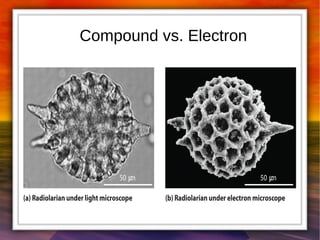
Compound vs. Electron
How does a 
Compound Microscope 
work?
How a Microscope Works 
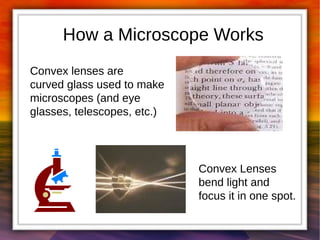
Convex lenses are 
curved glass used to make 
microscopes (and eye 
glasses, telescopes, etc.) 
Convex Lenses 
bend light and 
focus it in one spot.
How a Microscope Works 
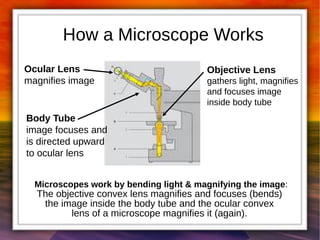
Ocular Lens 
magnifies image 
Objective Lens 
gathers light, magnifies 
and focuses image 
inside body tube 
Body Tube 
image focuses and 
is directed upward 
to ocular lens 
Microscopes work by bending light & magnifying the image: 
The objective convex lens magnifies and focuses (bends) 
the image inside the body tube and the ocular convex 
lens of a microscope magnifies it (again).
The Parts 
of a 
Microscope
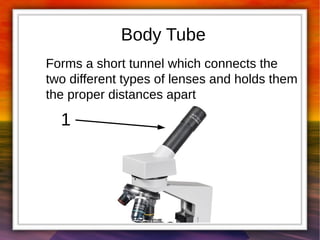
Body Tube 
Forms a short tunnel which connects the 
two different types of lenses and holds them 
the proper distances apart 
1
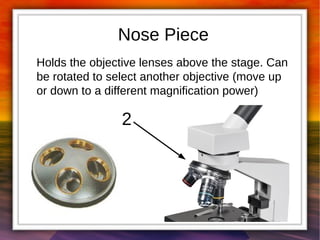
Nose Piece 
Holds the objective lenses above the stage. Can 
be rotated to select another objective (move up 
or down to a different magnification power) 
2
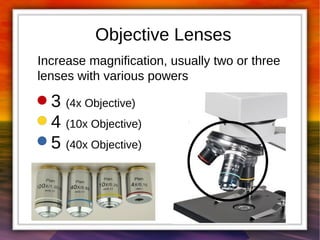
Objective Lenses 
Increase magnification, usually two or three 
lenses with various powers 
3 (4x Objective) 
4 (10x Objective) 
5 (40x Objective)
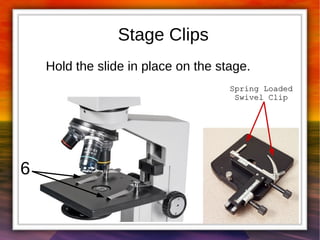
Stage Clips 
Hold the slide in place on the stage. 
6 
SSpprriinngg LLooaaddeedd 
SSwwiivveell CClliipp
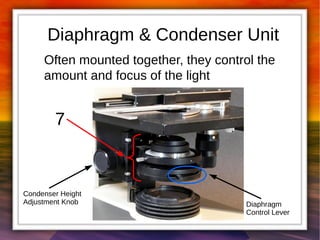
Diaphragm & Condenser Unit 
Often mounted together, they control the 
amount and focus of the light 
7 
Condenser Height 
Adjustment Knob Diaphragm 
Control Lever
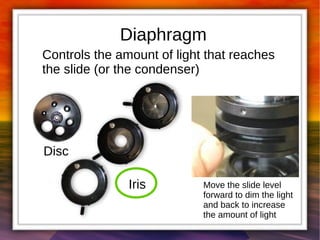
Diaphragm 
Controls the amount of light that reaches 
the slide (or the condenser) 
Iris 
Disc 
Move the slide level 
forward to dim the light 
and back to increase 
the amount of light
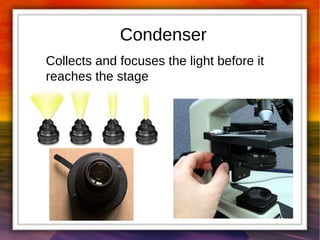
Condenser 
Collects and focuses the light before it 
reaches the stage
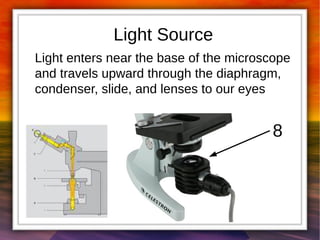
Light Source 
Light enters near the base of the microscope 
and travels upward through the diaphragm, 
condenser, slide, and lenses to our eyes 
8
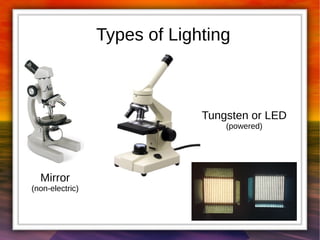
Types of Lighting 
Mirror 
(non-electric) 
Tungsten or LED 
(powered)
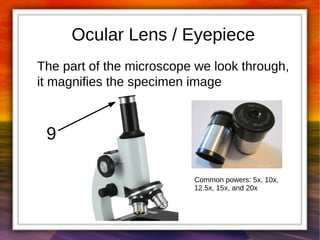
Ocular Lens / Eyepiece 
The part of the microscope we look through, 
it magnifies the specimen image 
9 
Common powers: 5x, 10x, 
12.5x, 15x, and 20x
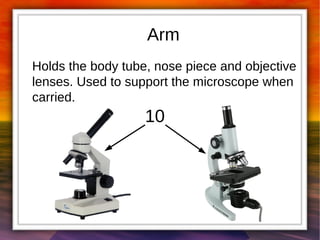
Arm 
Holds the body tube, nose piece and objective 
lenses. Used to support the microscope when 
carried. 
10
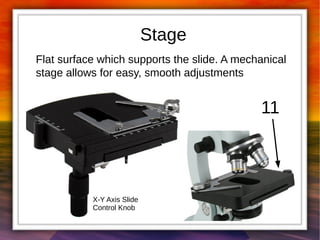
Stage 
Flat surface which supports the slide. A mechanical 
stage allows for easy, smooth adjustments 
11 
X-Y Axis Slide 
Control Knob
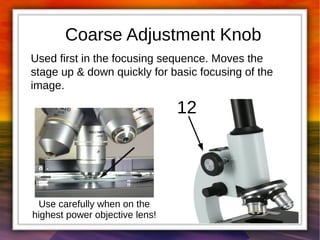
Coarse Adjustment Knob 
Used first in the focusing sequence. Moves the 
stage up & down quickly for basic focusing of the 
image. 
Use carefully when on the 
highest power objective lens! 
12
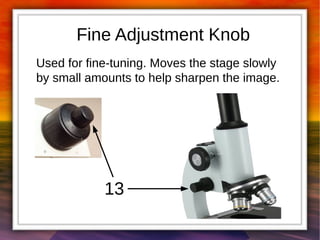
Fine Adjustment Knob 
Used for fine-tuning. Moves the stage slowly 
by small amounts to help sharpen the image. 
13
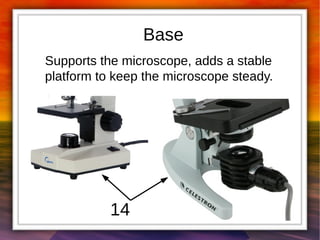
Base 
Supports the microscope, adds a stable 
platform to keep the microscope steady. 
14
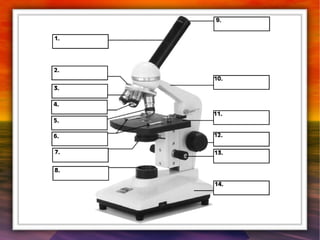
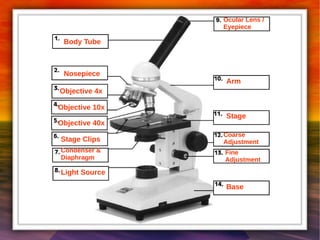
Body Tube 
Nosepiece 
Objective 4x 
Objective 10x 
Objective 40x 
Stage Clips 
Condenser & 
Diaphragm 
Light Source 
Ocular Lens / 
Eyepiece 
Arm 
Stage 
Coarse 
Adjustment 
Fine 
Adjustment 
Base
Magnification 
and 
Imaging
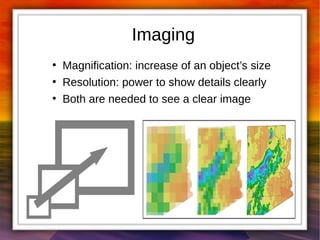
Imaging 
● Magnification: increase of an object’s size 
● Resolution: power to show details clearly 
● Both are needed to see a clear image
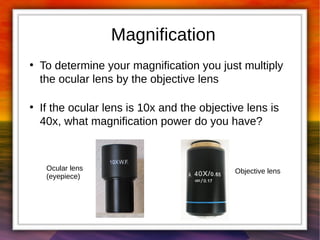
Magnification 
● To determine your magnification you just multiply 
the ocular lens by the objective lens 
● If the ocular lens is 10x and the objective lens is 
40x, what magnification power do you have? 
Ocular lens 
(eyepiece) 
Objective lens
Magnification 
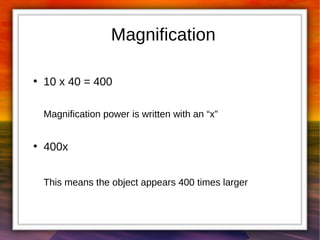
● 10 x 40 = 400 
Magnification power is written with an “x” 
● 400x 
This means the object appears 400 times larger
Caring for the 
Microscopes
Caring for a Microscope 
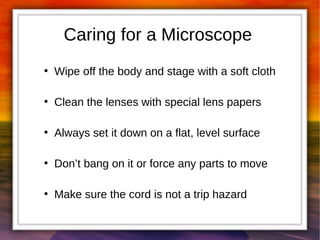
● Wipe off the body and stage with a soft cloth 
● Clean the lenses with special lens papers 
● Always set it down on a flat, level surface 
● Don’t bang on it or force any parts to move 
● Make sure the cord is not a trip hazard
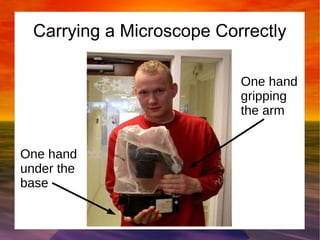
Carrying a Microscope Correctly 
One hand 
under the 
base 
One hand 
gripping 
the arm
Using 
a 
Microscope
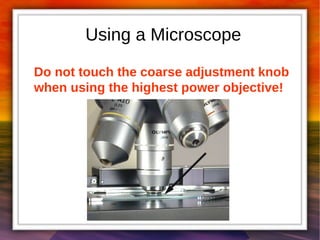
Using a Microscope 
Do not touch the coarse adjustment knob 
when using the highest power objective!
Using a Microscope 
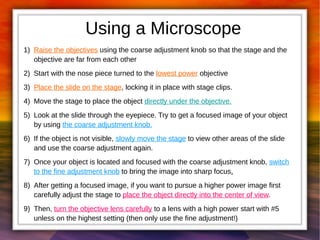
1) Raise the objectives using the coarse adjustment knob so that the stage and the 
objective are far from each other 
2) Start with the nose piece turned to the lowest power objective 
3) Place the slide on the stage, locking it in place with stage clips. 
4) Move the stage to place the object directly under the objective. 
5) Look at the slide through the eyepiece. Try to get a focused image of your object 
by using the coarse adjustment knob. 
6) If the object is not visible, slowly move the stage to view other areas of the slide 
and use the coarse adjustment again. 
7) Once your object is located and focused with the coarse adjustment knob, switch 
to the fine adjustment knob to bring the image into sharp focus. 
8) After getting a focused image, if you want to pursue a higher power image first 
carefully adjust the stage to place the object directly into the center of view. 
9) Then, turn the objective lens carefully to a lens with a high power start with #5 
unless on the highest setting (then only use the fine adjustment!)
Using a Microscope 
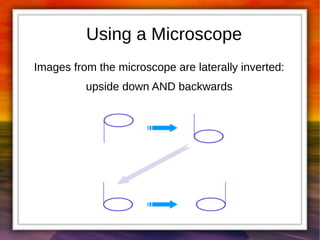
Images from the microscope are laterally inverted: 
upside down AND backwards

Lab 0-B Microscope Training

  • 1.
  • 2.
    A Brief History of the Microscope
  • 3.
    History ● TheGreeks & Romans used “lenses” to magnify objects over 1000 years ago. ● About 500 years ago, people began experimenting with making microscopes ● Since many people were creating telescopes at that time, was the microscope created by accident? ● The first microscope was 6 feet long!
  • 4.
    History Hans andZacharias Janssen of Holland in the 1590’s created the “first” compound microscope Zacharias Jansen 1588-1631 The “First” Microscope
  • 5.
    History Anthony vanLeeuwenhoek and Robert Hooke made improvements by working on the lenses Anthony van Leeuwenhoek 1632-1723 Robert Hooke 1635-1703 Hooke Microscope
  • 6.
    History 1655 –Robert Hooke used a compound microscope to observe pores in cork. He called them “cells” 1673 – Anthony van Leeuwenhoek saw single-celled organisms in pond water
  • 7.
  • 8.
    Compound Light Microscope ● first type of microscope ● most widely used ● light passes through 2 lenses ● can magnify up to 2000x
  • 9.
    Specialized Versions ●Dissection microscope-- image appears three dimensional. It is used for dissection to get a better look at the larger specimen. You cannot see individual cells because it has a low magnification. ● Dark‐field microscope – useful in examining external details, such as outlines, edges, grain boundaries and surface defects. Contains a special feature that scatters light and causes it to reflect off the specimen at an angle. A light object is seen on a dark background. ● Phase‐contrast microscope – has a special features that causes light to pass through an object at different speeds. Live organisms and internal cell parts such as mitochondria can be seen clearly ● Fluorescent microscope – uses ultraviolet light which excites the electrons of the object and causes them to give off light in various shades of color. Often used with a lab procedure called the fluorescent‐antibody technique to help identify unknown bacteria.
  • 10.
  • 11.
    Electron Microscope ●uses beams of electrons rather than light ● used to observe VERY small objects ● viruses, DNA, parts of cells ● Scanning models can magnify up to 100,000x ● Transmission models can magnify up to 250,000x
  • 12.
  • 13.
    How does a Compound Microscope work?
  • 14.
    How a MicroscopeWorks Convex lenses are curved glass used to make microscopes (and eye glasses, telescopes, etc.) Convex Lenses bend light and focus it in one spot.
  • 15.
    How a MicroscopeWorks Ocular Lens magnifies image Objective Lens gathers light, magnifies and focuses image inside body tube Body Tube image focuses and is directed upward to ocular lens Microscopes work by bending light & magnifying the image: The objective convex lens magnifies and focuses (bends) the image inside the body tube and the ocular convex lens of a microscope magnifies it (again).
  • 16.
    The Parts ofa Microscope
  • 18.
    Body Tube Formsa short tunnel which connects the two different types of lenses and holds them the proper distances apart 1
  • 19.
    Nose Piece Holdsthe objective lenses above the stage. Can be rotated to select another objective (move up or down to a different magnification power) 2
  • 20.
    Objective Lenses Increasemagnification, usually two or three lenses with various powers 3 (4x Objective) 4 (10x Objective) 5 (40x Objective)
  • 21.
    Stage Clips Holdthe slide in place on the stage. 6 SSpprriinngg LLooaaddeedd SSwwiivveell CClliipp
  • 22.
    Diaphragm & CondenserUnit Often mounted together, they control the amount and focus of the light 7 Condenser Height Adjustment Knob Diaphragm Control Lever
  • 23.
    Diaphragm Controls theamount of light that reaches the slide (or the condenser) Iris Disc Move the slide level forward to dim the light and back to increase the amount of light
  • 24.
    Condenser Collects andfocuses the light before it reaches the stage
  • 25.
    Light Source Lightenters near the base of the microscope and travels upward through the diaphragm, condenser, slide, and lenses to our eyes 8
  • 26.
    Types of Lighting Mirror (non-electric) Tungsten or LED (powered)
  • 27.
    Ocular Lens /Eyepiece The part of the microscope we look through, it magnifies the specimen image 9 Common powers: 5x, 10x, 12.5x, 15x, and 20x
  • 28.
    Arm Holds thebody tube, nose piece and objective lenses. Used to support the microscope when carried. 10
  • 29.
    Stage Flat surfacewhich supports the slide. A mechanical stage allows for easy, smooth adjustments 11 X-Y Axis Slide Control Knob
  • 30.
    Coarse Adjustment Knob Used first in the focusing sequence. Moves the stage up & down quickly for basic focusing of the image. Use carefully when on the highest power objective lens! 12
  • 31.
    Fine Adjustment Knob Used for fine-tuning. Moves the stage slowly by small amounts to help sharpen the image. 13
  • 32.
    Base Supports themicroscope, adds a stable platform to keep the microscope steady. 14
  • 33.
    Body Tube Nosepiece Objective 4x Objective 10x Objective 40x Stage Clips Condenser & Diaphragm Light Source Ocular Lens / Eyepiece Arm Stage Coarse Adjustment Fine Adjustment Base
  • 34.
  • 35.
    Imaging ● Magnification:increase of an object’s size ● Resolution: power to show details clearly ● Both are needed to see a clear image
  • 36.
    Magnification ● Todetermine your magnification you just multiply the ocular lens by the objective lens ● If the ocular lens is 10x and the objective lens is 40x, what magnification power do you have? Ocular lens (eyepiece) Objective lens
  • 37.
    Magnification ● 10x 40 = 400 Magnification power is written with an “x” ● 400x This means the object appears 400 times larger
  • 38.
    Caring for the Microscopes
  • 39.
    Caring for aMicroscope ● Wipe off the body and stage with a soft cloth ● Clean the lenses with special lens papers ● Always set it down on a flat, level surface ● Don’t bang on it or force any parts to move ● Make sure the cord is not a trip hazard
  • 40.
    Carrying a MicroscopeCorrectly One hand under the base One hand gripping the arm
  • 41.
  • 42.
    Using a Microscope Do not touch the coarse adjustment knob when using the highest power objective!
  • 43.
    Using a Microscope 1) Raise the objectives using the coarse adjustment knob so that the stage and the objective are far from each other 2) Start with the nose piece turned to the lowest power objective 3) Place the slide on the stage, locking it in place with stage clips. 4) Move the stage to place the object directly under the objective. 5) Look at the slide through the eyepiece. Try to get a focused image of your object by using the coarse adjustment knob. 6) If the object is not visible, slowly move the stage to view other areas of the slide and use the coarse adjustment again. 7) Once your object is located and focused with the coarse adjustment knob, switch to the fine adjustment knob to bring the image into sharp focus. 8) After getting a focused image, if you want to pursue a higher power image first carefully adjust the stage to place the object directly into the center of view. 9) Then, turn the objective lens carefully to a lens with a high power start with #5 unless on the highest setting (then only use the fine adjustment!)
  • 44.
    Using a Microscope Images from the microscope are laterally inverted: upside down AND backwards