ACUTE ISCHEMIC STROKE-
Arterial Spin Labelling
Dr. Yash Kumar Achantani
OSR
ASL
Arterial spin labelling (ASL) is a magnetic resonance
(MR) imaging technique used to assess cerebral blood
flow and brain perfusion at tissue level noninvasively by
magnetically labelling inflowing blood.
Clinical Applications of
ASL
• Dementia.
• Stroke.
• Vascular malformations.
• Epilepsy.
• Tumors.
• Psychiatric disorders.
Basic Concepts of ASL
• ASL is based on the principle of magnetically labelling
inflowing arterial blood protons prior to their entry
into the tissue of interest.
• As such, it can be viewed as a tracer technique with
water acting as the natural endogenous tracer to
estimate tissue perfusion.
• The label is created by applying radiofrequency
pulses to invert the bulk magnetization of the blood
water protons.
• Images are acquired after the labelling and inflow
period by using rapid acquisition techniques such as
echo-planar imaging, gradient- and spin-echo
imaging (GRASE), or three-dimensional fast spin-echo
imaging.
• A pair of images is always acquired: a labelled image,
in which the blood water magnetization is inverted,
and a control image, in which the blood water
magnetization is not inverted.
• The signal difference between labelled and control
images is proportional to the amount of
magnetization inverted and delivered to the tissue.
• If all the labelled blood has arrived at the imaging
voxel at the time of image acquisition, the signal
difference will be proportional to cerebral blood flow
(CBF).
• The current main implementations of ASL are
a. Pulsed labelling.
b. Pseudo continuous labelling.
Pulsed ASL
• In PASL, the arterial blood water is labelled by using a
short adiabatic inversion pulse.
• The labelling pulses are on the order of
approximately 10 msec and designed to invert the
blood water instantaneously in a particular region,
typically located inferior to the brain.
• After labelling, a postlabel delay period is required
(aka the inflow time for PASL), during which time the
inverted blood moves from the labelling region into
the brain, losing gradually its label through
longitudinal T1 relaxation.
• For this reason, PASL is intrinsically a lower SNR
technique than pseudocontinuous ASL (PCASL).
• The control acquisition for PASL consists of applying a
radiofrequency pulse with equivalent power to the
labelling pulse but which has a net zero effect on the
blood water magnetization in the labelling region.
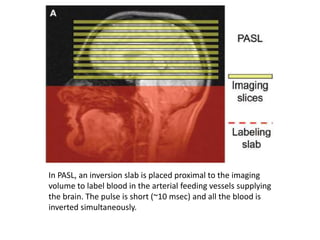
In PASL, an inversion slab is placed proximal to the imaging
volume to label blood in the arterial feeding vessels supplying
the brain. The pulse is short (~10 msec) and all the blood is
inverted simultaneously.
PCASL Technique
• In PCASL, a long labelling period (1–2 seconds) is
made up of a train of very short (1 msec) pulses.
• This train of short pulses is designed to invert the
inflowing blood magnetization in an adiabatic or
pseudo steady-state manner.
• It is useful to think of the blood being continuously
inverted as it flows through a “labelling plane” in the
inferior-superior direction.
• If the phase of every second pulse in the PCASL pulse
train is shifted by 180°, the flowing blood water is
minimally perturbed and thus enables acquisition of
nonlabelled control images.
• PCASL has recently been adopted as the labelling
method of choice for clinical imaging, due to its ease
of implementation and high SNR.
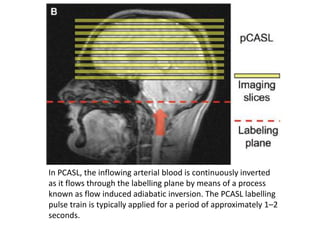
In PCASL, the inflowing arterial blood is continuously inverted
as it flows through the labelling plane by means of a process
known as flow induced adiabatic inversion. The PCASL labelling
pulse train is typically applied for a period of approximately 1–2
seconds.
• An important aspect of all ASL techniques is the
introduction of the postlabel delay (or inflow time)
between the end of the labelling pulse and the time
of image acquisition.
• If the postlabel delay is longer than the longest
transit time between the tagging plane and the
imaging volume, the ASL signal becomes insensitive
to variations in the arterial arrival time, as long as the
blood and tissue T1 values are similar (true for gray
matter but not for white matter).
Postlabel Delay Time
• This enables CBF quantification and minimizes the
appearance of intravascular signal in the ASL images.
• In addition, the choice of postlabel delay depends on
the subject’s age, with older subjects showing longer
arterial arrival times. The recommended postlabel
delay for paediatric and adult clinical populations is
1500 msec and 2000 msec, respectively.
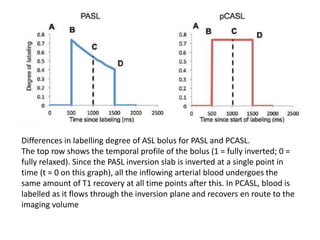
Differences in labelling degree of ASL bolus for PASL and PCASL.
The top row shows the temporal profile of the bolus (1 = fully inverted; 0 =
fully relaxed). Since the PASL inversion slab is inverted at a single point in
time (t = 0 on this graph), all the inflowing arterial blood undergoes the
same amount of T1 recovery at all time points after this. In PCASL, blood is
labelled as it flows through the inversion plane and recovers en route to the
imaging volume
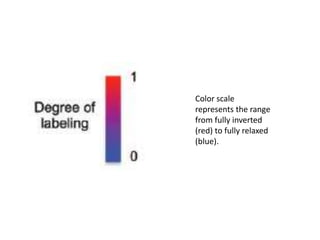
Color scale
represents the range
from fully inverted
(red) to fully relaxed
(blue).
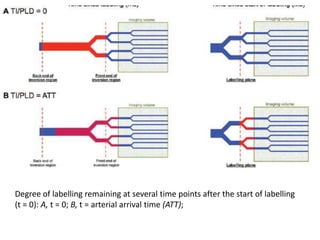
Degree of labelling remaining at several time points after the start of labelling
(t = 0): A, t = 0; B, t = arterial arrival time (ATT);
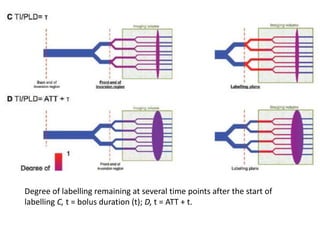
Degree of labelling remaining at several time points after the start of
labelling C, t = bolus duration (t); D, t = ATT + t.
• It can be seen that the PCASL labelling process
produces a bolus with a higher overall degree of
inversion than does the PASL, resulting in a higher
intrinsic SNR for PCASL
Alterations of Transit Time: Multi–
Inflow-Time ASL
• Most clinically available ASL sequences use only a
single delay between labelling and image acquisition,
based on original values calculated from healthy
young adults.
• In case of proximal vessel occlusion, there is a
delayed arrival of blood in the parenchyma, which
may falsely suggest a reduced relative CBF as
estimated with ASL and increased ASL signal in the
feeding arterial vessels, known as arterial transit
artefact.
• Reduced cardiac output, as seen frequently in elderly
populations, leads to similar effects, for example, in
the vascular border zone regions.
• The use of multi–inflow-time ASL sequences aims to
overcome this methodological shortcoming, but due
to the longer imaging times required, the are
currently not recommended in daily clinical practice.
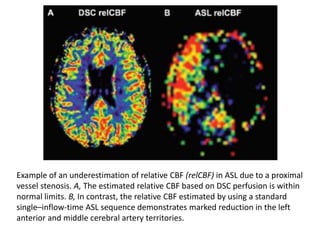
Example of an underestimation of relative CBF (relCBF) in ASL due to a proximal
vessel stenosis. A, The estimated relative CBF based on DSC perfusion is within
normal limits. B, In contrast, the relative CBF estimated by using a standard
single–inflow-time ASL sequence demonstrates marked reduction in the left
anterior and middle cerebral artery territories.
Imaging Findings in Acute Stroke
• Patients with acute ischemic stroke typically present
with a perfusion deficit (i.e., low to absent ASL CBF
signal) in the affected region.
• Depending on the precise parameters for TL and PLD,
arterial transit artifact may be visible at the
periphery of the stroke, representing labelled blood
that has not yet reached the capillary bed at the time
of imaging.
• Reperfusion of acute stroke lesions is also common,
either spontaneously or following successful
intravenous or endovascular treatment. In these
cases, increased CBF is often identified within the
affected tissue.
This phenomenon is known as “luxury perfusion.”
• It is occasionally difficult to distinguish between high
ASL signal related to delayed arrival time and that
related to parenchymal hyperperfusion.
One helpful way to tell is if you identify low ASL signal
in the territory distal to the brighter signal, it is
probably ATA; if not, it is probably hyperperfusion.
• Another artefact to be aware of is overall slow flow
to the brain, which is sometimes seen in older
patients or those with poor cardiac output.
• In this case, using standard ASL parameters, ASL
signal is only seen in the large arterial structures. This
is an extreme case of ATA, and makes interpretation
of focal CBF deficits impossible.
• In these cases ASL acquisition with longer labelling
and longer PLD can mitigate this problem and allow
better visualization of the focal perfusion deficit.
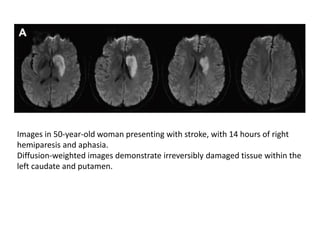
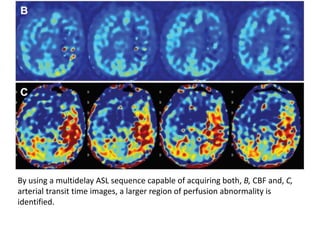
Images in 50-year-old woman presenting with stroke, with 14 hours of right
hemiparesis and aphasia.
Diffusion-weighted images demonstrate irreversibly damaged tissue within the
left caudate and putamen.
By using a multidelay ASL sequence capable of acquiring both, B, CBF and, C,
arterial transit time images, a larger region of perfusion abnormality is
identified.
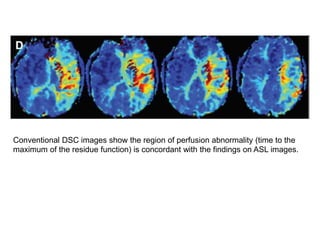
Conventional DSC images show the region of perfusion abnormality (time to the
maximum of the residue function) is concordant with the findings on ASL images.
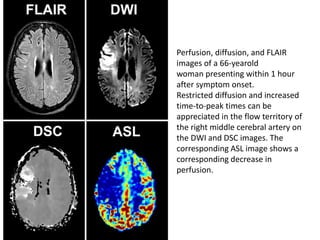
Perfusion, diffusion, and FLAIR
images of a 66-yearold
woman presenting within 1 hour
after symptom onset.
Restricted diffusion and increased
time-to-peak times can be
appreciated in the flow territory of
the right middle cerebral artery on
the DWI and DSC images. The
corresponding ASL image shows a
corresponding decrease in
perfusion.
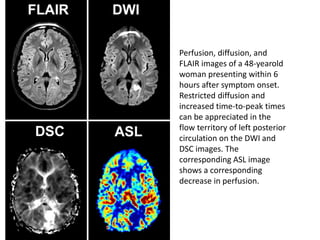
Perfusion, diffusion, and
FLAIR images of a 48-yearold
woman presenting within 6
hours after symptom onset.
Restricted diffusion and
increased time-to-peak times
can be appreciated in the
flow territory of left posterior
circulation on the DWI and
DSC images. The
corresponding ASL image
shows a corresponding
decrease in perfusion.
Limitations of ASL in Acute Stroke
• ASL is a lower SNR technique than DSC.
• Artefact that presents as overall reduced CBF to a
vascular territory that is not due to true reduced
flow, but rather to reduced labelling efficiency of the
water in a specific artery at the labelling plane in the
neck.
• Motion artefacts.
Extensions of ASL
• Super selective ASL to Map Vascular Territories (Also
Known as Selective Territory Mapping).
• Cerebrovascular Reserve Imaging.
Arterial Spin Labelling in stroke

Arterial Spin Labelling in stroke

  • 1.
    ACUTE ISCHEMIC STROKE- ArterialSpin Labelling Dr. Yash Kumar Achantani OSR
  • 2.
    ASL Arterial spin labelling(ASL) is a magnetic resonance (MR) imaging technique used to assess cerebral blood flow and brain perfusion at tissue level noninvasively by magnetically labelling inflowing blood.
  • 3.
    Clinical Applications of ASL •Dementia. • Stroke. • Vascular malformations. • Epilepsy. • Tumors. • Psychiatric disorders.
  • 4.
    Basic Concepts ofASL • ASL is based on the principle of magnetically labelling inflowing arterial blood protons prior to their entry into the tissue of interest. • As such, it can be viewed as a tracer technique with water acting as the natural endogenous tracer to estimate tissue perfusion. • The label is created by applying radiofrequency pulses to invert the bulk magnetization of the blood water protons.
  • 5.
    • Images areacquired after the labelling and inflow period by using rapid acquisition techniques such as echo-planar imaging, gradient- and spin-echo imaging (GRASE), or three-dimensional fast spin-echo imaging. • A pair of images is always acquired: a labelled image, in which the blood water magnetization is inverted, and a control image, in which the blood water magnetization is not inverted. • The signal difference between labelled and control images is proportional to the amount of magnetization inverted and delivered to the tissue.
  • 6.
    • If allthe labelled blood has arrived at the imaging voxel at the time of image acquisition, the signal difference will be proportional to cerebral blood flow (CBF). • The current main implementations of ASL are a. Pulsed labelling. b. Pseudo continuous labelling.
  • 7.
    Pulsed ASL • InPASL, the arterial blood water is labelled by using a short adiabatic inversion pulse. • The labelling pulses are on the order of approximately 10 msec and designed to invert the blood water instantaneously in a particular region, typically located inferior to the brain. • After labelling, a postlabel delay period is required (aka the inflow time for PASL), during which time the inverted blood moves from the labelling region into the brain, losing gradually its label through longitudinal T1 relaxation.
  • 8.
    • For thisreason, PASL is intrinsically a lower SNR technique than pseudocontinuous ASL (PCASL). • The control acquisition for PASL consists of applying a radiofrequency pulse with equivalent power to the labelling pulse but which has a net zero effect on the blood water magnetization in the labelling region.
  • 9.
    In PASL, aninversion slab is placed proximal to the imaging volume to label blood in the arterial feeding vessels supplying the brain. The pulse is short (~10 msec) and all the blood is inverted simultaneously.
  • 10.
    PCASL Technique • InPCASL, a long labelling period (1–2 seconds) is made up of a train of very short (1 msec) pulses. • This train of short pulses is designed to invert the inflowing blood magnetization in an adiabatic or pseudo steady-state manner. • It is useful to think of the blood being continuously inverted as it flows through a “labelling plane” in the inferior-superior direction.
  • 11.
    • If thephase of every second pulse in the PCASL pulse train is shifted by 180°, the flowing blood water is minimally perturbed and thus enables acquisition of nonlabelled control images. • PCASL has recently been adopted as the labelling method of choice for clinical imaging, due to its ease of implementation and high SNR.
  • 12.
    In PCASL, theinflowing arterial blood is continuously inverted as it flows through the labelling plane by means of a process known as flow induced adiabatic inversion. The PCASL labelling pulse train is typically applied for a period of approximately 1–2 seconds.
  • 13.
    • An importantaspect of all ASL techniques is the introduction of the postlabel delay (or inflow time) between the end of the labelling pulse and the time of image acquisition. • If the postlabel delay is longer than the longest transit time between the tagging plane and the imaging volume, the ASL signal becomes insensitive to variations in the arterial arrival time, as long as the blood and tissue T1 values are similar (true for gray matter but not for white matter). Postlabel Delay Time
  • 14.
    • This enablesCBF quantification and minimizes the appearance of intravascular signal in the ASL images. • In addition, the choice of postlabel delay depends on the subject’s age, with older subjects showing longer arterial arrival times. The recommended postlabel delay for paediatric and adult clinical populations is 1500 msec and 2000 msec, respectively.
  • 15.
    Differences in labellingdegree of ASL bolus for PASL and PCASL. The top row shows the temporal profile of the bolus (1 = fully inverted; 0 = fully relaxed). Since the PASL inversion slab is inverted at a single point in time (t = 0 on this graph), all the inflowing arterial blood undergoes the same amount of T1 recovery at all time points after this. In PCASL, blood is labelled as it flows through the inversion plane and recovers en route to the imaging volume
  • 16.
    Color scale represents therange from fully inverted (red) to fully relaxed (blue).
  • 17.
    Degree of labellingremaining at several time points after the start of labelling (t = 0): A, t = 0; B, t = arterial arrival time (ATT);
  • 18.
    Degree of labellingremaining at several time points after the start of labelling C, t = bolus duration (t); D, t = ATT + t.
  • 19.
    • It canbe seen that the PCASL labelling process produces a bolus with a higher overall degree of inversion than does the PASL, resulting in a higher intrinsic SNR for PCASL
  • 20.
    Alterations of TransitTime: Multi– Inflow-Time ASL • Most clinically available ASL sequences use only a single delay between labelling and image acquisition, based on original values calculated from healthy young adults. • In case of proximal vessel occlusion, there is a delayed arrival of blood in the parenchyma, which may falsely suggest a reduced relative CBF as estimated with ASL and increased ASL signal in the feeding arterial vessels, known as arterial transit artefact.
  • 21.
    • Reduced cardiacoutput, as seen frequently in elderly populations, leads to similar effects, for example, in the vascular border zone regions. • The use of multi–inflow-time ASL sequences aims to overcome this methodological shortcoming, but due to the longer imaging times required, the are currently not recommended in daily clinical practice.
  • 22.
    Example of anunderestimation of relative CBF (relCBF) in ASL due to a proximal vessel stenosis. A, The estimated relative CBF based on DSC perfusion is within normal limits. B, In contrast, the relative CBF estimated by using a standard single–inflow-time ASL sequence demonstrates marked reduction in the left anterior and middle cerebral artery territories.
  • 23.
    Imaging Findings inAcute Stroke • Patients with acute ischemic stroke typically present with a perfusion deficit (i.e., low to absent ASL CBF signal) in the affected region. • Depending on the precise parameters for TL and PLD, arterial transit artifact may be visible at the periphery of the stroke, representing labelled blood that has not yet reached the capillary bed at the time of imaging.
  • 24.
    • Reperfusion ofacute stroke lesions is also common, either spontaneously or following successful intravenous or endovascular treatment. In these cases, increased CBF is often identified within the affected tissue. This phenomenon is known as “luxury perfusion.” • It is occasionally difficult to distinguish between high ASL signal related to delayed arrival time and that related to parenchymal hyperperfusion. One helpful way to tell is if you identify low ASL signal in the territory distal to the brighter signal, it is probably ATA; if not, it is probably hyperperfusion.
  • 25.
    • Another artefactto be aware of is overall slow flow to the brain, which is sometimes seen in older patients or those with poor cardiac output. • In this case, using standard ASL parameters, ASL signal is only seen in the large arterial structures. This is an extreme case of ATA, and makes interpretation of focal CBF deficits impossible. • In these cases ASL acquisition with longer labelling and longer PLD can mitigate this problem and allow better visualization of the focal perfusion deficit.
  • 26.
    Images in 50-year-oldwoman presenting with stroke, with 14 hours of right hemiparesis and aphasia. Diffusion-weighted images demonstrate irreversibly damaged tissue within the left caudate and putamen.
  • 27.
    By using amultidelay ASL sequence capable of acquiring both, B, CBF and, C, arterial transit time images, a larger region of perfusion abnormality is identified.
  • 28.
    Conventional DSC imagesshow the region of perfusion abnormality (time to the maximum of the residue function) is concordant with the findings on ASL images.
  • 29.
    Perfusion, diffusion, andFLAIR images of a 66-yearold woman presenting within 1 hour after symptom onset. Restricted diffusion and increased time-to-peak times can be appreciated in the flow territory of the right middle cerebral artery on the DWI and DSC images. The corresponding ASL image shows a corresponding decrease in perfusion.
  • 30.
    Perfusion, diffusion, and FLAIRimages of a 48-yearold woman presenting within 6 hours after symptom onset. Restricted diffusion and increased time-to-peak times can be appreciated in the flow territory of left posterior circulation on the DWI and DSC images. The corresponding ASL image shows a corresponding decrease in perfusion.
  • 31.
    Limitations of ASLin Acute Stroke • ASL is a lower SNR technique than DSC. • Artefact that presents as overall reduced CBF to a vascular territory that is not due to true reduced flow, but rather to reduced labelling efficiency of the water in a specific artery at the labelling plane in the neck. • Motion artefacts.
  • 32.
    Extensions of ASL •Super selective ASL to Map Vascular Territories (Also Known as Selective Territory Mapping). • Cerebrovascular Reserve Imaging.