CT Urography
Dr. Yash Kumar Achantani
OSR
Definition
A CT urography is a CT examination of the entire urinary tract
before and after the administration of IV contrast material and
includes excretory phase images.
It gives both anatomical and functional information.
Indications
 Hematuria
 Suspected urothelial cancer (e.g., positive urine cytology)
 Follow-up urothelial cancer
 Hydronephrosis ?etiology
 Congenital anomalies
CTU is generally performed on patients more than 40 years of
age and patients with at least one of the following: a history of
transitional cell carcinoma (and who are therefore likely to have
recurrences or metachronous tumors), positive urine cytology,
previous equivocal imaging studies, and persistent symptoms
(e.g., ongoing hematuria).
Basic concept of Urinary tract imaging
Comprehensive upper tract imaging must include
(a) Unenhanced axial CT of the kidneys,
(b) Enhanced CT of the abdomen and pelvis, and
(c) excretory phase enhanced images of the urinary tract obtained with
projection urography and/or axial CT images.
Unenhanced CT scans and plain abdominal radiographs (kidney, ureter,
and bladder [KUB], scout) are primarily used for the evaluation of
• Stone disease
• Renal parenchymal calcifications,
• Precontrast attenuation measurements of renal masses,
• Exclusion of hemorrhagic changes.
Contrast material–enhanced imaging, essential for complete evaluation
of the urinary tracts.
Nephrographic phase enhanced images are useful for the evaluation of
the renal parenchyma, especially in the detection and evaluation of
renal neoplasms, parenchymal scarring, and renal inflammatory disease.
 Corticomedullary differentiation nephrographic phase CT scans
obtained 30–70 seconds after the start of intravenous contrast
material injection provide information about the renal vasculature
and perfusion, although small renal masses located in the medullary
portions of the kidneys may not be appreciated.
 Homogeneous nephrographic enhanced CT scans are typically
obtained 90– 180 seconds after initiation of intravenous contrast
material administration. Homogeneous nephrographic enhanced CT
scans are more sensitive for detection and characterization of renal
masses.
Excretory phase obtained at 8–10 minutes following intravenous
contrast material injection is essential for assessing subtle urothelial
abnormalities including Urothelial tumors,
• Papillary necrosis,
• Caliceal deformity,
• Ureteral stricture,
• Inflammatory changes of the renal collecting systems, ureters, and
bladder.
The bladder is seen best on 20- minute and postvoiding images.
Techniques
 Combined CT and EU CT urography method.
 CT scanned projection radiographic (SPR) images following
intravenous contrast material administration.
 CT-Only CT Urography.
CT-Only CT Urography
This approach relies exclusively on the acquisition of unenhanced and
enhanced CT scans of the abdomen and pelvis, including the essential
acquisition of thin-section helical CT scans of the urinary tracts during
the excretory phase of enhancement.
No bowel preparation is necessary for this type of CT urography
examination; however, the risk of aspiration of solid food from
vomiting can be lessened by withholding oral intake for several hours
prior to the examination. In some patients, metallic hip prostheses
may result in beam hardening artifacts and make assessment
of the distal ureters and bladder difficult.
Techniques
 Threephase technique.
 Splitbolustechnique.
 Supplemental use of normal saline infusion and diuretic
injection.
Three phase protocol
 Unenhanced phase
 Nephrographic phase after 90-100 secs
 Pyelographic phase after 12-15 minutes
 4 Phase protocol (5 min and 7.5 min)
Split Bolus protocol
 Unenhanced Phase
 Nephro-pyelographic phase : 30 ml of nonionic contrast
material is infused and after 10 min another 100 ml of contrast
is injected
ADV: Assess tract with low radiation exposure.
Supplemental use of normal saline
infusion and diuretic injection.
Supplemental infusion of 250 mL of physiologic saline immediately
after injecting intravenous contrast material significantly improves
opacification of the distal ureters.
Intravenous injection of low-dose diuretics (10 mg of furosemide)
before intravenous contrast material injection also permitted less
dense, homogeneous opacification of the collecting systems compared
to supplemental infusion of 300 mL of normal saline.
The 7.5-minute delayed excretory phase enhanced CT acquisition
technique resulted in the most significantly increased distention of the
intrarenal collecting system and proximal ureter, followed by the saline
infusion technique.
Assessment of source axial CT scans, displayed by using wide window
settings similar to the bone window settings, is essential for accurate
diagnosis.
Post processing techniques including multiplanar reformation and 3D
reformatted images can be generated from excretory phase enhanced
axial CT scans, displaying the urothelial anatomy and disease in a
traditional coronal display format.
Multiplanar reformatted images in orthogonal coronal or oblique (en
face) planes help define the location and extent of the lesions shown
on axial CT images.
Maximum intensity projection (MIP), average intensity projection (AIP),
and perspective volume rendered reformatted images from thin (5–20
mm) and thick (35–90 mm) slabs can be generated from the original
axial data set.
NORMAL ANATOMY
NORMAL ANATOMY
FRONTAL (ANTERIOR) VIEW OF VR IMAGES
MIP IMAGE (POSTERIOR VIEW) VR DOUBLE DENSITY IMAGE
(POSTERIOR VIEW)
NORMAL VARIANTS AND
CONGENITAL ANOMALIES
NORMAL PAPILLARY BLUSH
Backflow into terminal
collecting ducts (papillary
ducts); Produces wedge-
shaped striated area or blush
extending from a calyx;
Usually considered normal
phenomenon.
PROMINENT RENAL PAPILLA
COMPOUND CALYX
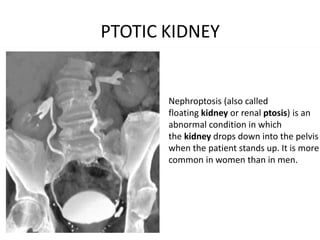
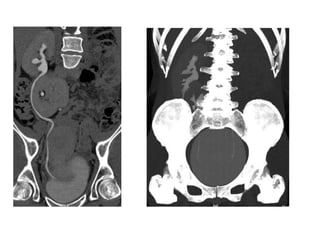
PTOTIC KIDNEY
Nephroptosis (also called
floating kidney or renal ptosis) is an
abnormal condition in which
the kidney drops down into the pelvis
when the patient stands up. It is more
common in women than in men.
ECTOPIC KIDNEY
VR IMAGE MIP IMAGE
HORSESHOE KIDNEY
DOUPLEX LEFT COLLECTING SYSTEM WITH
ECTOPIC UPPER MOIETY URETER
TheWeigert-Meyer rule states that. the
upper pole ureter is the ectopic ureter
and its orifice inserts inferomedially in the
bladder in relationship to the lower pole
normal ureter.
BENIGN TUBULAR ECTASIA
The appearance arises from congenital dilatation/ectasia of the distal tubules
of the nephrons in a medullary pyramid.
CTU shows a "paintbrush" appearance to the medullary pyramid.
The strands of the "brush" are mildly dilated tubules full of contrast
(tubules dilated to ~0.2 mm).
Unlike medullary nephrocalcinosis, renal tubular ectasia cannot be seen
on a plain radiograph or a noncontrast CT.
CROSSED FUSED ECTOPIA
Crossed fused renal ectopia essentially refers to an anomaly where the
kidneys are fused and located on the same side of the midline.
Subtypes
type a: inferior crossed fusion
type b: sigmoid kidney
type c: lump kidney
type d: disc kidney
type e: L-shaped kidney
type f: superiorly crossed fused
UROLITHIASIS
CASE (1)
NON ENHANCED CT SHOWING
BILATERAL RENAL PELVIS
CALCULI WITH MARKED
PYELITIS.
ENHANCED CT SHOWING
GOOD ENHANCEMENT.
MIP; THE STONES ARE WELL-SEEN WITHIN THE
OPACIFIED RENAL PELVIS.
CASE (2)
THICK SLAB MIP
BILATERAL RENAL
AND UB STONES
CORONAL IMAGES
SHOWING MARKED
PYELITIS OF THE
LEFT KIDNEY
MIP; THE STONES ARE WELL-SEEN WITHIN THE
OPACIFIED RENAL PELVIS. MULTIPLE UB STONES.
CASE (3)
PRE AND POST CONTRAST SCANS.
CALCULUS IN RIGHT KIDNEY
WITH MARKED STRANDING OF
THE PERINEPHRIC FAT.
CASE (4)
ACUTELY OBSTRUCTED
LEFT KIDNEY WITH
PERINEPHRIC COLLECTION
(FORNICEAL RUPTURE).
CURVED REFORMATS
SHOWING 3 LOWER
URETERIC STONES.
CASE (5)
CURVED REFORMAT
LOWER URETERIC STONE
CAUSING MILD HYDRONEPHROSIS
DOUBLE DENSITY VR IMAGE
THE STONE IS DEMONSTRATED
AGAINST THE UNDERLYINGBONE
CASE (6)
MEDULLARY NEPHROCALCINOSIS
Renal medullary nephrocalcinosis is the commonest form of nephrocalcinosis and
refers to the deposition of calcium salts in the medulla of the kidney.
Due to the concentrating effects of the loops of Henle, and the biochemical milieu of
the medulla, compared to the cortex, it is 20 times more common than cortical
nephrocalcinosis.
RENAL INFECTIONS
CASE (1)
MULTIFOCAL NEPHRONIA
Nephronia refers to an intermediate stage
between acute pyelonephritis and renal
abscess, and is a focal region of interstitial
nephritis.
It appears as a wedge of poorly perfused
renal parenchyma, without a cortical rim
sign.
CASE (2)
OBSTRUCTED INFECTED KIDNEY
ENLARGED LEFT KIDNEY WITH MARKED STRANDING OF THE
PERINEPHRIC FAT AND OBSTRUCTING PELVIC CALCULUS
DOUBLE DENSITY VR IMAGE SHOWING
THE OBSTRUCTING CALCULUS
CASE (3)
RIGHT UPPER POLAR ABSCESS
DELAYED FILLING OF THE ABSCESS
RENAL SOLs
CASE (1)
RENAL CYST
SIMPLE (BOSNIAK TYPE I) RENAL CYST
CASE (2)
PARAPELVIC CYST
MULTILOCULAR PARAPELVIC CYST
WITH STRETCHING OF THE MAJOR
CALYCES
CASE (3)
BOSNIOAK TYPE II CYST WITH THIN CALCIFIED
RIM AND INTRACYSTIC SEPTUM
CASE (4)
BOSNIAK TYPE III CYST
THICK ENHANCING INCOMPLETE
SEPTUM AND IRREGULAR OUTLINES
CASE (5)
BOSNIAK TYPE IV CYST
THICK ENHANCING MURAL NODULE
CASE (6)
RENAL MASS
SOLID UPPER POLAR MASS
CLEARLY DEMONSTRATED
IN CORONAL IMAGES
CASE (7)
MALIGNANT LOWER POLAR LEFT RENAL MASS WITH
ENHANCING MALIGNANT THROMBUS WITHIN THE IVC
AND SECONDARY VARICOSITIES OF THE LEFT TESTICULAR VEIN.
CASE (8)
MALIGNAT SUPRARENAL MASS
WITH LIVER METASTASES
DISPLACED LEFT KIDNEY WITH
DOUPLEX RIGHT COLLECTING SYSTEM
INTRARENAL COLLECTING
SYSTEM
CASE (1)
PRE AND POST CONTRAST MIP IMAGES
TUBULAR DILATATION WITH TINY
CALCULI WITHIN THE DILATED TUBULES
(MEDULLARY SPONGE KIDNEY)
CASE (2)
Renal papillary necrosis refers to ischemic necrosis of the renal papillae.
CT urography typically demonstrates multiple small collections of contrast
material in the papillary regions peripheral to the calyces. The entire papilla
may become necrotic. The papillary defects may eventually become
peripherally calcified. Sloughed papillae appear as filling defects in the
collecting system and ureters and may obstruct them and cause renal colic
ACUTE PAPILLARY NECROSIS
YOUNG FEMALE PATIENT WITH
PAINLESS HEMATURIAAND
HISTORY OF ANALGESIC ABUSE
CASE (3)
UROTHELIAL NEOPLASM
MALIGNANT UROTHELIAL NEOPLASM OF THE
UPPERE CALYX IN A MIDDLE AGED MALE WITH
PAINLESS HEMATUREA
CASE (4)
UROTHELIAL NEOPLASM
ANOTHER EXAMPLE OF MALIGNANT UROTHELIAL
NEOPLASM OF THE UPPERE CALYX
URETERS
AS A RULE;
MALIGNANT URETERIC NEOPLASMS CHARACTERISTICALLY CAUSE
DILATATION OF THE URETER BOTH PROXIMAL AND DISTAL TO THE
LESION.
CASE (1)
CASE (2)
CASE (3)
CASE (4)
CASE (5)
FIBROVASCULAR POLYP OF THE URETER
Fibroepithelial polyp is a benign
mesodermal tumor mainly seen in adults.
Radiologically, the diagnosis is very hard
to make.
Excision is advised if
hydroureteronephrosis is seen or if the
patient is symptomatic since there is an
overlap in appearance with
transitional/urothelial cell carcinoma.
URINARY BLADDER
Transitional cell carcinoma (TCC) is the most common primary neoplasm
of the urinary bladder, and bladder TCC is the most common tumour of
the entire urinary system.
Bladder transitional cell carcinomas appear as either focal regions of
thickening of the bladder wall, or as masses protruding into the bladder
lumen, or in advanced cases, extending into adjacent tissues.
The masses are of soft tissue attenuation and may be encrusted with
small calcifications.
CASE (1)
CASE (2)
EXTRAVESICAL PARARECTAL MASS
CT Urography
CT Urography

CT Urography

  • 1.
    CT Urography Dr. YashKumar Achantani OSR
  • 2.
    Definition A CT urographyis a CT examination of the entire urinary tract before and after the administration of IV contrast material and includes excretory phase images. It gives both anatomical and functional information.
  • 3.
    Indications  Hematuria  Suspectedurothelial cancer (e.g., positive urine cytology)  Follow-up urothelial cancer  Hydronephrosis ?etiology  Congenital anomalies CTU is generally performed on patients more than 40 years of age and patients with at least one of the following: a history of transitional cell carcinoma (and who are therefore likely to have recurrences or metachronous tumors), positive urine cytology, previous equivocal imaging studies, and persistent symptoms (e.g., ongoing hematuria).
  • 5.
    Basic concept ofUrinary tract imaging Comprehensive upper tract imaging must include (a) Unenhanced axial CT of the kidneys, (b) Enhanced CT of the abdomen and pelvis, and (c) excretory phase enhanced images of the urinary tract obtained with projection urography and/or axial CT images.
  • 6.
    Unenhanced CT scansand plain abdominal radiographs (kidney, ureter, and bladder [KUB], scout) are primarily used for the evaluation of • Stone disease • Renal parenchymal calcifications, • Precontrast attenuation measurements of renal masses, • Exclusion of hemorrhagic changes.
  • 7.
    Contrast material–enhanced imaging,essential for complete evaluation of the urinary tracts. Nephrographic phase enhanced images are useful for the evaluation of the renal parenchyma, especially in the detection and evaluation of renal neoplasms, parenchymal scarring, and renal inflammatory disease.  Corticomedullary differentiation nephrographic phase CT scans obtained 30–70 seconds after the start of intravenous contrast material injection provide information about the renal vasculature and perfusion, although small renal masses located in the medullary portions of the kidneys may not be appreciated.  Homogeneous nephrographic enhanced CT scans are typically obtained 90– 180 seconds after initiation of intravenous contrast material administration. Homogeneous nephrographic enhanced CT scans are more sensitive for detection and characterization of renal masses.
  • 8.
    Excretory phase obtainedat 8–10 minutes following intravenous contrast material injection is essential for assessing subtle urothelial abnormalities including Urothelial tumors, • Papillary necrosis, • Caliceal deformity, • Ureteral stricture, • Inflammatory changes of the renal collecting systems, ureters, and bladder. The bladder is seen best on 20- minute and postvoiding images.
  • 9.
    Techniques  Combined CTand EU CT urography method.  CT scanned projection radiographic (SPR) images following intravenous contrast material administration.  CT-Only CT Urography.
  • 10.
    CT-Only CT Urography Thisapproach relies exclusively on the acquisition of unenhanced and enhanced CT scans of the abdomen and pelvis, including the essential acquisition of thin-section helical CT scans of the urinary tracts during the excretory phase of enhancement. No bowel preparation is necessary for this type of CT urography examination; however, the risk of aspiration of solid food from vomiting can be lessened by withholding oral intake for several hours prior to the examination. In some patients, metallic hip prostheses may result in beam hardening artifacts and make assessment of the distal ureters and bladder difficult.
  • 11.
    Techniques  Threephase technique. Splitbolustechnique.  Supplemental use of normal saline infusion and diuretic injection.
  • 12.
    Three phase protocol Unenhanced phase  Nephrographic phase after 90-100 secs  Pyelographic phase after 12-15 minutes  4 Phase protocol (5 min and 7.5 min)
  • 13.
    Split Bolus protocol Unenhanced Phase  Nephro-pyelographic phase : 30 ml of nonionic contrast material is infused and after 10 min another 100 ml of contrast is injected ADV: Assess tract with low radiation exposure.
  • 14.
    Supplemental use ofnormal saline infusion and diuretic injection. Supplemental infusion of 250 mL of physiologic saline immediately after injecting intravenous contrast material significantly improves opacification of the distal ureters. Intravenous injection of low-dose diuretics (10 mg of furosemide) before intravenous contrast material injection also permitted less dense, homogeneous opacification of the collecting systems compared to supplemental infusion of 300 mL of normal saline.
  • 15.
    The 7.5-minute delayedexcretory phase enhanced CT acquisition technique resulted in the most significantly increased distention of the intrarenal collecting system and proximal ureter, followed by the saline infusion technique.
  • 16.
    Assessment of sourceaxial CT scans, displayed by using wide window settings similar to the bone window settings, is essential for accurate diagnosis. Post processing techniques including multiplanar reformation and 3D reformatted images can be generated from excretory phase enhanced axial CT scans, displaying the urothelial anatomy and disease in a traditional coronal display format. Multiplanar reformatted images in orthogonal coronal or oblique (en face) planes help define the location and extent of the lesions shown on axial CT images.
  • 17.
    Maximum intensity projection(MIP), average intensity projection (AIP), and perspective volume rendered reformatted images from thin (5–20 mm) and thick (35–90 mm) slabs can be generated from the original axial data set.
  • 19.
  • 20.
  • 21.
    MIP IMAGE (POSTERIORVIEW) VR DOUBLE DENSITY IMAGE (POSTERIOR VIEW)
  • 22.
  • 23.
    NORMAL PAPILLARY BLUSH Backflowinto terminal collecting ducts (papillary ducts); Produces wedge- shaped striated area or blush extending from a calyx; Usually considered normal phenomenon.
  • 24.
  • 25.
  • 26.
    PTOTIC KIDNEY Nephroptosis (alsocalled floating kidney or renal ptosis) is an abnormal condition in which the kidney drops down into the pelvis when the patient stands up. It is more common in women than in men.
  • 27.
  • 28.
  • 29.
  • 30.
    DOUPLEX LEFT COLLECTINGSYSTEM WITH ECTOPIC UPPER MOIETY URETER TheWeigert-Meyer rule states that. the upper pole ureter is the ectopic ureter and its orifice inserts inferomedially in the bladder in relationship to the lower pole normal ureter.
  • 32.
    BENIGN TUBULAR ECTASIA Theappearance arises from congenital dilatation/ectasia of the distal tubules of the nephrons in a medullary pyramid.
  • 33.
    CTU shows a"paintbrush" appearance to the medullary pyramid. The strands of the "brush" are mildly dilated tubules full of contrast (tubules dilated to ~0.2 mm). Unlike medullary nephrocalcinosis, renal tubular ectasia cannot be seen on a plain radiograph or a noncontrast CT.
  • 34.
    CROSSED FUSED ECTOPIA Crossedfused renal ectopia essentially refers to an anomaly where the kidneys are fused and located on the same side of the midline. Subtypes type a: inferior crossed fusion type b: sigmoid kidney type c: lump kidney type d: disc kidney type e: L-shaped kidney type f: superiorly crossed fused
  • 37.
  • 38.
    CASE (1) NON ENHANCEDCT SHOWING BILATERAL RENAL PELVIS CALCULI WITH MARKED PYELITIS. ENHANCED CT SHOWING GOOD ENHANCEMENT.
  • 39.
    MIP; THE STONESARE WELL-SEEN WITHIN THE OPACIFIED RENAL PELVIS.
  • 40.
    CASE (2) THICK SLABMIP BILATERAL RENAL AND UB STONES CORONAL IMAGES SHOWING MARKED PYELITIS OF THE LEFT KIDNEY
  • 41.
    MIP; THE STONESARE WELL-SEEN WITHIN THE OPACIFIED RENAL PELVIS. MULTIPLE UB STONES.
  • 42.
    CASE (3) PRE ANDPOST CONTRAST SCANS. CALCULUS IN RIGHT KIDNEY WITH MARKED STRANDING OF THE PERINEPHRIC FAT.
  • 43.
    CASE (4) ACUTELY OBSTRUCTED LEFTKIDNEY WITH PERINEPHRIC COLLECTION (FORNICEAL RUPTURE).
  • 44.
    CURVED REFORMATS SHOWING 3LOWER URETERIC STONES.
  • 45.
    CASE (5) CURVED REFORMAT LOWERURETERIC STONE CAUSING MILD HYDRONEPHROSIS DOUBLE DENSITY VR IMAGE THE STONE IS DEMONSTRATED AGAINST THE UNDERLYINGBONE
  • 46.
  • 48.
    Renal medullary nephrocalcinosisis the commonest form of nephrocalcinosis and refers to the deposition of calcium salts in the medulla of the kidney. Due to the concentrating effects of the loops of Henle, and the biochemical milieu of the medulla, compared to the cortex, it is 20 times more common than cortical nephrocalcinosis.
  • 49.
  • 50.
    CASE (1) MULTIFOCAL NEPHRONIA Nephroniarefers to an intermediate stage between acute pyelonephritis and renal abscess, and is a focal region of interstitial nephritis. It appears as a wedge of poorly perfused renal parenchyma, without a cortical rim sign.
  • 51.
    CASE (2) OBSTRUCTED INFECTEDKIDNEY ENLARGED LEFT KIDNEY WITH MARKED STRANDING OF THE PERINEPHRIC FAT AND OBSTRUCTING PELVIC CALCULUS
  • 52.
    DOUBLE DENSITY VRIMAGE SHOWING THE OBSTRUCTING CALCULUS
  • 53.
    CASE (3) RIGHT UPPERPOLAR ABSCESS
  • 54.
  • 55.
    DELAYED FILLING OFTHE ABSCESS
  • 56.
  • 57.
  • 58.
    SIMPLE (BOSNIAK TYPEI) RENAL CYST
  • 59.
  • 60.
    MULTILOCULAR PARAPELVIC CYST WITHSTRETCHING OF THE MAJOR CALYCES
  • 61.
  • 62.
    BOSNIOAK TYPE IICYST WITH THIN CALCIFIED RIM AND INTRACYSTIC SEPTUM
  • 63.
  • 64.
    BOSNIAK TYPE IIICYST THICK ENHANCING INCOMPLETE SEPTUM AND IRREGULAR OUTLINES
  • 65.
  • 66.
    BOSNIAK TYPE IVCYST THICK ENHANCING MURAL NODULE
  • 67.
  • 68.
    SOLID UPPER POLARMASS CLEARLY DEMONSTRATED IN CORONAL IMAGES
  • 69.
  • 71.
    MALIGNANT LOWER POLARLEFT RENAL MASS WITH ENHANCING MALIGNANT THROMBUS WITHIN THE IVC AND SECONDARY VARICOSITIES OF THE LEFT TESTICULAR VEIN.
  • 72.
    CASE (8) MALIGNAT SUPRARENALMASS WITH LIVER METASTASES
  • 74.
    DISPLACED LEFT KIDNEYWITH DOUPLEX RIGHT COLLECTING SYSTEM
  • 75.
  • 76.
    CASE (1) PRE ANDPOST CONTRAST MIP IMAGES TUBULAR DILATATION WITH TINY CALCULI WITHIN THE DILATED TUBULES (MEDULLARY SPONGE KIDNEY)
  • 78.
    CASE (2) Renal papillarynecrosis refers to ischemic necrosis of the renal papillae. CT urography typically demonstrates multiple small collections of contrast material in the papillary regions peripheral to the calyces. The entire papilla may become necrotic. The papillary defects may eventually become peripherally calcified. Sloughed papillae appear as filling defects in the collecting system and ureters and may obstruct them and cause renal colic
  • 79.
    ACUTE PAPILLARY NECROSIS YOUNGFEMALE PATIENT WITH PAINLESS HEMATURIAAND HISTORY OF ANALGESIC ABUSE
  • 80.
  • 81.
    MALIGNANT UROTHELIAL NEOPLASMOF THE UPPERE CALYX IN A MIDDLE AGED MALE WITH PAINLESS HEMATUREA
  • 82.
  • 83.
    ANOTHER EXAMPLE OFMALIGNANT UROTHELIAL NEOPLASM OF THE UPPERE CALYX
  • 84.
    URETERS AS A RULE; MALIGNANTURETERIC NEOPLASMS CHARACTERISTICALLY CAUSE DILATATION OF THE URETER BOTH PROXIMAL AND DISTAL TO THE LESION.
  • 85.
  • 87.
  • 89.
  • 91.
  • 93.
  • 94.
    FIBROVASCULAR POLYP OFTHE URETER Fibroepithelial polyp is a benign mesodermal tumor mainly seen in adults. Radiologically, the diagnosis is very hard to make. Excision is advised if hydroureteronephrosis is seen or if the patient is symptomatic since there is an overlap in appearance with transitional/urothelial cell carcinoma.
  • 95.
  • 96.
    Transitional cell carcinoma(TCC) is the most common primary neoplasm of the urinary bladder, and bladder TCC is the most common tumour of the entire urinary system. Bladder transitional cell carcinomas appear as either focal regions of thickening of the bladder wall, or as masses protruding into the bladder lumen, or in advanced cases, extending into adjacent tissues. The masses are of soft tissue attenuation and may be encrusted with small calcifications.
  • 97.
  • 99.