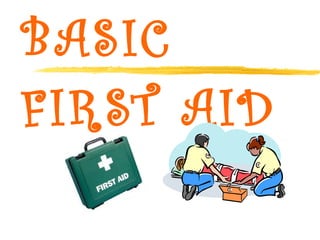
BASIC FIRST AID
First Aid?   Is the immediate assistance or treatment given to someone before the arrival of  medical staff/ ambulance
First Aid?   ~ Calm ~ Confident ~ Willing to offer assistance whenever necessary ~ Patience Qualities of a first aide:
First A   Essential to protect yourself from injury and infection Ensure surroundings are safe Protection from infection - to prevent “cross infection” ( transmitting germs to a casualty or contracting an infection yourself) - wear gloves or wash hands before doing a dressing. Protecting yourself as a first aide
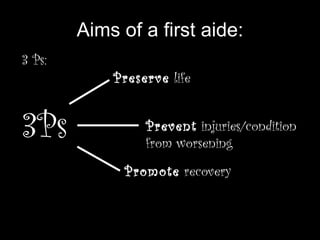
Aims of a first aide: 3 Ps: 3Ps Preserve  life Prevent  injuries/condition  from worsening Promote  recovery
Preserving life: Control bleeding Treat probable cause of shock Maintain airway in correct position Perform CPR when needed  (no breathing or pulse)
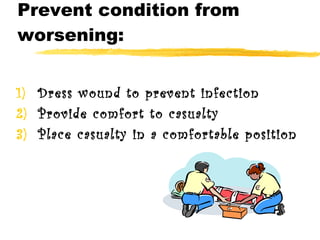
Prevent condition from worsening: 3 Ps: 3Ps 3 Ps: 3Ps 3 Ps: 3Ps Dress wound to prevent infection Provide comfort to casualty  Place casualty in a comfortable position
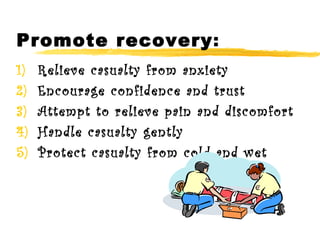
Promote recovery : Relieve casualty from anxiety Encourage confidence and trust Attempt to relieve pain and discomfort Handle casualty gently Protect casualty from cold and wet
Ambulance:  Police number:  Fire Brigade:  Emergency Hotlines 999  998  997
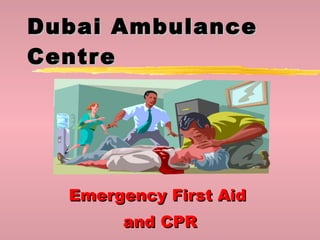
Dubai Ambulance Centre Emergency First Aid  and CPR
This presentation is not intended as a substitute for professional medical care or the Basic Life Support Training - First Aid and CPR.  All employees must meet the training requirements set forth from Dubai Ambulance Centre. NOTICE
EMERGENCY FIRST AID If you are the first on the scene of accident that results in an injury or serious illness, you may be the  only  link between a victim and emergency medical care.  Your role is to  take action , whether by providing first aid, seeking medical help or calling  999 .  Your actions may improve the victims chance of recovery. The following slides will provide specific information from The American Safety & Health Institute (ASHI) on basic first aid procedures.
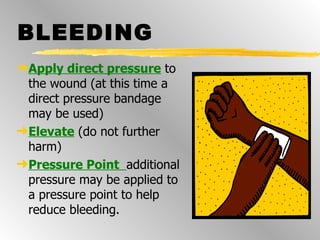
BLEEDING Apply direct pressure   to the wound   (at this time a direct pressure bandage may be used) Elevate   (do not further harm) Pressure Point  additional pressure may be applied to a pressure point to help reduce bleeding.
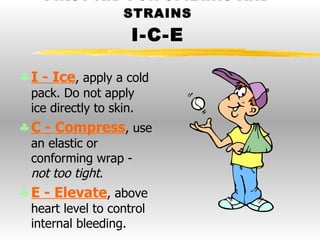
FIRST AID FOR SPRAINS AND STRAINS I-C-E I - Ice , apply a cold pack. Do not apply ice directly to skin. C - Compress , use an elastic or conforming wrap -  not too tight . E - Elevate , above heart level to control internal bleeding.
CARE FOR DISLOCATIONS AND FRACTURES I-A-C-T   I - Immobilize  area.  Use pillows, jackets, blankets, etc.  Stop any movement by supporting injured area. A - Activate  Emergency Medical Services (EMS), call 999. C - Care  for shock. See “Care for Shock” slide. T - Treat  any additional secondary injuries.
POISONING Assess the scene for clues and safety. Get victim away from poison if necessary. Provide care for any life threatening conditions. Check Material Safety Data Sheet (MSDS). Notify medical staff or on-call Doctor. Call the Poison Control Center and 999 when necessary.
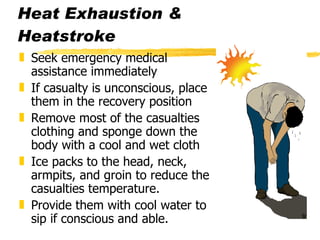
Heat Exhaustion & Heatstroke Seek emergency medical assistance immediately If casualty is unconscious, place them in the recovery position Remove most of the casualties clothing and sponge down the body with a cool and wet cloth Ice packs to the head, neck, armpits, and groin to reduce the casualties temperature. Provide them with cool water to sip if conscious and able.
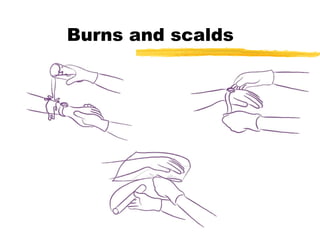
Burns  and  Scalds
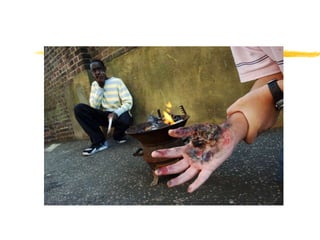
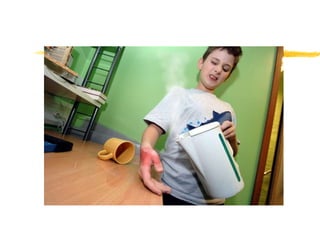
Causes: burns – dry heat - fire - hot objects - electricity Burns and scalds scalds – wet heat - hot liquids - steam
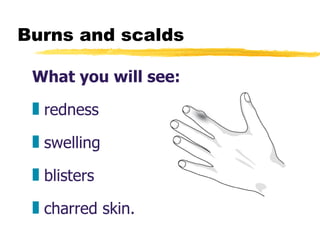
Burns and scalds What you will see: redness swelling blisters charred skin.
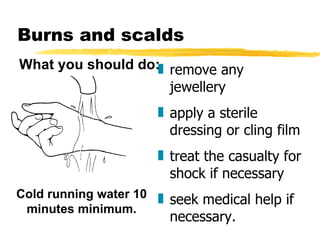
remove any jewellery apply a sterile dressing or cling film treat the casualty for shock if necessary seek medical help if necessary. Burns and scalds Cold running water 10 minutes minimum. What you should do:
Burns and scalds


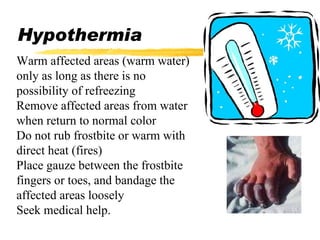
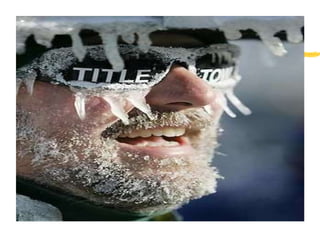
Hypothermia Warm affected areas (warm water) only as long as there is no possibility of refreezing Remove affected areas from water when return to normal color Do not rub frostbite or warm with direct heat (fires) Place gauze between the frostbite fingers or toes, and bandage the affected areas loosely Seek medical help.
 
Some of the more common symptoms or problems that one might experience due to allergies include: Runny nose Burning, watery eyes Sinus congestion Postnasal drip Sore throat Skin rash (Nutritional Programs for Allergies, E.M. Haas, M.D., www.healthy.net/templates/article.asp.) Ear infections Chest congestion Coughing Headaches Fatigue Asthma Runny nose Burning, watery eyes Sinus congestion Postnasal drip Sore throat Skin rash
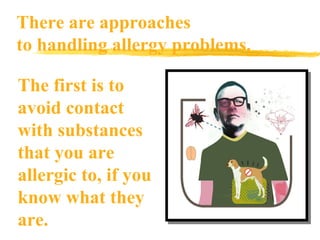
There are approaches to handling allergy problems. The first is to avoid contact with substances that you are allergic to, if you know what they are.
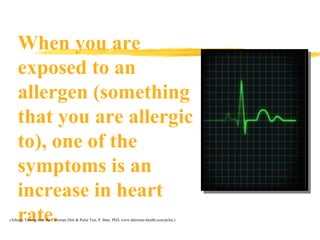
When you are exposed to an allergen (something that you are allergic to), one of the symptoms is an increase in heart rate. (Allergy Testing with the Caveman Diet & Pulse Test, P. Bate, PhD, www.alternate-health.com/pulse.)
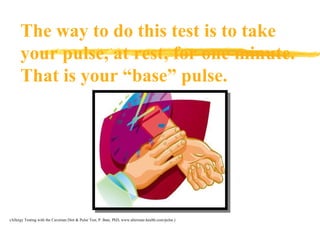
The way to do this test is to take your pulse, at rest, for one minute. That is your “base” pulse. (Allergy Testing with the Caveman Diet & Pulse Test, P. Bate, PhD, www.alternate-health.com/pulse.)
When you eat a food that is suspect or are exposed to a substance that is suspect, check your pulse again in 15, 30 and 60 minutes. If your heart rate accelerates more than 10 beats per minute over your base pulse, it indicates that you may be allergic to that particular substance. (Allergy Testing with the Caveman Diet & Pulse Test, P. Bate, PhD, www.alternate-health.com/pulse.)
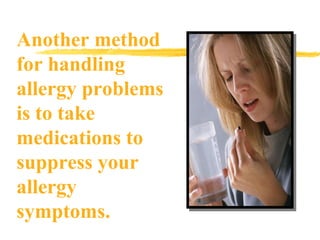
Another method for handling allergy problems is to take medications to suppress your allergy symptoms.
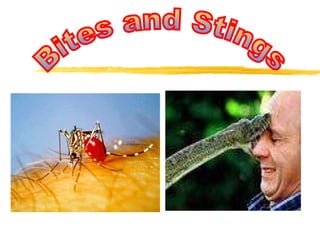
Bites and Stings
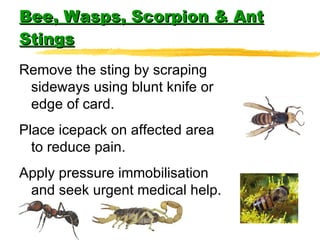
Bee, Wasps, Scorpion & Ant Stings Remove the sting by scraping sideways using blunt knife or edge of card. Place icepack on affected area to reduce pain. Apply pressure immobilisation and seek urgent medical help.
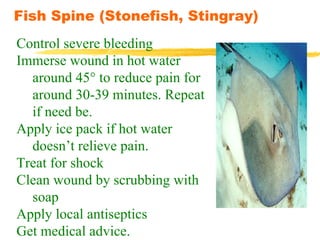
Fish Spine (Stonefish, Stingray) Control severe bleeding Immerse wound in hot water around 45° to reduce pain for around 30-39 minutes. Repeat if need be. Apply ice pack if hot water doesn’t relieve pain. Treat for shock Clean wound by scrubbing with soap Apply local antiseptics Get medical advice.
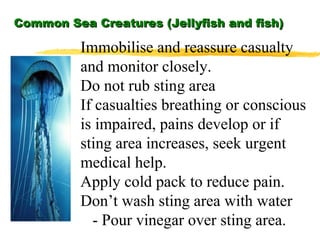
Common Sea Creatures (Jellyfish and fish) Immobilise and reassure casualty and monitor closely. Do not rub sting area If casualties breathing or conscious is impaired, pains develop or if sting area increases, seek urgent medical help. Apply cold pack to reduce pain. Don’t wash sting area with water - Pour vinegar over sting area.
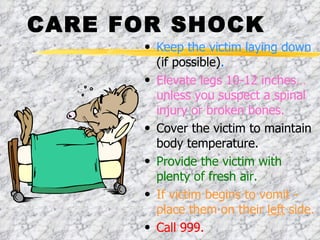
CARE FOR SHOCK Keep the victim laying down  (if possible) .   Elevate legs 10-12 inches… unless you suspect a spinal injury or broken bones. Cover the victim to maintain body temperature. Provide the victim with plenty of fresh air. If victim begins to vomit - place them on their  left  side. Call 999.
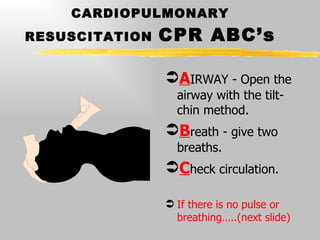
CARDIOPULMONARY RESUSCITATION   CPR ABC’s A IRWAY - Open the airway with the tilt-chin method. B reath - give two breaths. C heck circulation. If there is no pulse or breathing…..(next slide)
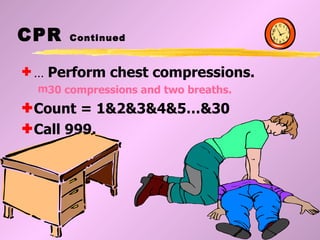
CPR  Continued …  Perform chest compressions. 30 compressions and two breaths. Count = 1&2&3&4&5…&30 Call 999.
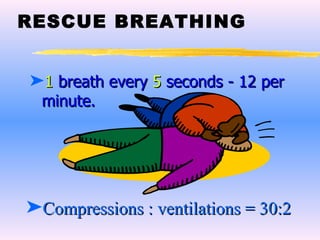
RESCUE BREATHING 1  breath every  5  seconds - 12 per minute. Compressions : ventilations = 30:2
REMEMBER!!! UNIVERSAL PRECAUTIONS: The routine use of  appropriate barrier precautions  to prevent skin and mucous membrane exposure when contact with blood or other body fluids of any individual may occur or is anticipated. Universal Precautions  apply to blood and to  all other body fluids with potential for spreading any infections.
THE END Division of Youth Corrections Office of Quality Assurance

Basic first aid & cpr

  • 1.
  • 2.
    First Aid? Is the immediate assistance or treatment given to someone before the arrival of medical staff/ ambulance
  • 3.
    First Aid? ~ Calm ~ Confident ~ Willing to offer assistance whenever necessary ~ Patience Qualities of a first aide:
  • 4.
    First A Essential to protect yourself from injury and infection Ensure surroundings are safe Protection from infection - to prevent “cross infection” ( transmitting germs to a casualty or contracting an infection yourself) - wear gloves or wash hands before doing a dressing. Protecting yourself as a first aide
  • 5.
    Aims of afirst aide: 3 Ps: 3Ps Preserve life Prevent injuries/condition from worsening Promote recovery
  • 6.
    Preserving life: Controlbleeding Treat probable cause of shock Maintain airway in correct position Perform CPR when needed (no breathing or pulse)
  • 7.
    Prevent condition fromworsening: 3 Ps: 3Ps 3 Ps: 3Ps 3 Ps: 3Ps Dress wound to prevent infection Provide comfort to casualty Place casualty in a comfortable position
  • 8.
    Promote recovery :Relieve casualty from anxiety Encourage confidence and trust Attempt to relieve pain and discomfort Handle casualty gently Protect casualty from cold and wet
  • 9.
    Ambulance: Policenumber: Fire Brigade: Emergency Hotlines 999 998 997
  • 10.
    Dubai Ambulance CentreEmergency First Aid and CPR
  • 11.
    This presentation isnot intended as a substitute for professional medical care or the Basic Life Support Training - First Aid and CPR. All employees must meet the training requirements set forth from Dubai Ambulance Centre. NOTICE
  • 12.
    EMERGENCY FIRST AIDIf you are the first on the scene of accident that results in an injury or serious illness, you may be the only link between a victim and emergency medical care. Your role is to take action , whether by providing first aid, seeking medical help or calling 999 . Your actions may improve the victims chance of recovery. The following slides will provide specific information from The American Safety & Health Institute (ASHI) on basic first aid procedures.
  • 13.
    BLEEDING Apply directpressure to the wound (at this time a direct pressure bandage may be used) Elevate (do not further harm) Pressure Point additional pressure may be applied to a pressure point to help reduce bleeding.
  • 14.
    FIRST AID FORSPRAINS AND STRAINS I-C-E I - Ice , apply a cold pack. Do not apply ice directly to skin. C - Compress , use an elastic or conforming wrap - not too tight . E - Elevate , above heart level to control internal bleeding.
  • 15.
    CARE FOR DISLOCATIONSAND FRACTURES I-A-C-T I - Immobilize area. Use pillows, jackets, blankets, etc. Stop any movement by supporting injured area. A - Activate Emergency Medical Services (EMS), call 999. C - Care for shock. See “Care for Shock” slide. T - Treat any additional secondary injuries.
  • 16.
    POISONING Assess thescene for clues and safety. Get victim away from poison if necessary. Provide care for any life threatening conditions. Check Material Safety Data Sheet (MSDS). Notify medical staff or on-call Doctor. Call the Poison Control Center and 999 when necessary.
  • 17.
    Heat Exhaustion &Heatstroke Seek emergency medical assistance immediately If casualty is unconscious, place them in the recovery position Remove most of the casualties clothing and sponge down the body with a cool and wet cloth Ice packs to the head, neck, armpits, and groin to reduce the casualties temperature. Provide them with cool water to sip if conscious and able.
  • 18.
    Burns and Scalds
  • 19.
    Causes: burns –dry heat - fire - hot objects - electricity Burns and scalds scalds – wet heat - hot liquids - steam
  • 20.
    Burns and scaldsWhat you will see: redness swelling blisters charred skin.
  • 21.
    remove any jewelleryapply a sterile dressing or cling film treat the casualty for shock if necessary seek medical help if necessary. Burns and scalds Cold running water 10 minutes minimum. What you should do:
  • 22.
  • 23.
  • 24.
  • 25.
  • 26.
    Hypothermia Warm affectedareas (warm water) only as long as there is no possibility of refreezing Remove affected areas from water when return to normal color Do not rub frostbite or warm with direct heat (fires) Place gauze between the frostbite fingers or toes, and bandage the affected areas loosely Seek medical help.
  • 27.
  • 28.
    Some of themore common symptoms or problems that one might experience due to allergies include: Runny nose Burning, watery eyes Sinus congestion Postnasal drip Sore throat Skin rash (Nutritional Programs for Allergies, E.M. Haas, M.D., www.healthy.net/templates/article.asp.) Ear infections Chest congestion Coughing Headaches Fatigue Asthma Runny nose Burning, watery eyes Sinus congestion Postnasal drip Sore throat Skin rash
  • 29.
    There are approachesto handling allergy problems. The first is to avoid contact with substances that you are allergic to, if you know what they are.
  • 30.
    When you areexposed to an allergen (something that you are allergic to), one of the symptoms is an increase in heart rate. (Allergy Testing with the Caveman Diet & Pulse Test, P. Bate, PhD, www.alternate-health.com/pulse.)
  • 31.
    The way todo this test is to take your pulse, at rest, for one minute. That is your “base” pulse. (Allergy Testing with the Caveman Diet & Pulse Test, P. Bate, PhD, www.alternate-health.com/pulse.)
  • 32.
    When you eata food that is suspect or are exposed to a substance that is suspect, check your pulse again in 15, 30 and 60 minutes. If your heart rate accelerates more than 10 beats per minute over your base pulse, it indicates that you may be allergic to that particular substance. (Allergy Testing with the Caveman Diet & Pulse Test, P. Bate, PhD, www.alternate-health.com/pulse.)
  • 33.
    Another method forhandling allergy problems is to take medications to suppress your allergy symptoms.
  • 34.
  • 35.
    Bee, Wasps, Scorpion& Ant Stings Remove the sting by scraping sideways using blunt knife or edge of card. Place icepack on affected area to reduce pain. Apply pressure immobilisation and seek urgent medical help.
  • 36.
    Fish Spine (Stonefish,Stingray) Control severe bleeding Immerse wound in hot water around 45° to reduce pain for around 30-39 minutes. Repeat if need be. Apply ice pack if hot water doesn’t relieve pain. Treat for shock Clean wound by scrubbing with soap Apply local antiseptics Get medical advice.
  • 37.
    Common Sea Creatures(Jellyfish and fish) Immobilise and reassure casualty and monitor closely. Do not rub sting area If casualties breathing or conscious is impaired, pains develop or if sting area increases, seek urgent medical help. Apply cold pack to reduce pain. Don’t wash sting area with water - Pour vinegar over sting area.
  • 38.
    CARE FOR SHOCKKeep the victim laying down (if possible) . Elevate legs 10-12 inches… unless you suspect a spinal injury or broken bones. Cover the victim to maintain body temperature. Provide the victim with plenty of fresh air. If victim begins to vomit - place them on their left side. Call 999.
  • 39.
    CARDIOPULMONARY RESUSCITATION CPR ABC’s A IRWAY - Open the airway with the tilt-chin method. B reath - give two breaths. C heck circulation. If there is no pulse or breathing…..(next slide)
  • 40.
    CPR Continued… Perform chest compressions. 30 compressions and two breaths. Count = 1&2&3&4&5…&30 Call 999.
  • 41.
    RESCUE BREATHING 1 breath every 5 seconds - 12 per minute. Compressions : ventilations = 30:2
  • 42.
    REMEMBER!!! UNIVERSAL PRECAUTIONS:The routine use of appropriate barrier precautions to prevent skin and mucous membrane exposure when contact with blood or other body fluids of any individual may occur or is anticipated. Universal Precautions apply to blood and to all other body fluids with potential for spreading any infections.
  • 43.
    THE END Divisionof Youth Corrections Office of Quality Assurance