WHAT IS FIRST AID?
 First aid is the temporary help given to an
injured or a sick person before professional
medical treatment can be provided.
 Any layperson can be trained to administer first
aid.
 Basic training in first aid skills should be taught
in school, in work places and, in general, be
learnt by all.
INTRODUCTION
WHY FIRST AID TRAINING IS SO IMPORTANT?
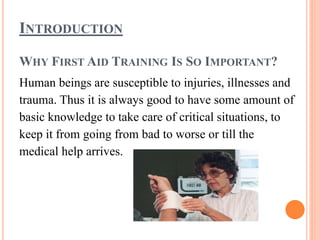
Human beings are susceptible to injuries, illnesses and
trauma. Thus it is always good to have some amount of
basic knowledge to take care of critical situations, to
keep it from going from bad to worse or till the
medical help arrives.
PURPOSE OF FIRST AID TRAINING
 Increases safety: The basis of first aid training is
"prevention". It is always better to be safe than to be sorry.
 Helps save lives: If a person who is trained to give first
aid administration happens to see any casualty in his
vicinity, immediate action can be taken and lives be saved.
 Helps relieve pain: Some injuries require a very simple
solution like applying ice pack or a quick rub. In such
cases, calling a person trained in first aid courses is more
reliable.
 Makes people more secure: Knowing that you can save
your own life when required, or that of the people you
know or those in trauma during some emergency helps
you relax more and be more secure.
 Prevents the situation from becoming worse: A trained
person would know how to keep the situation from
becoming bad to worse.
PRINCIPLES OF FIRST AID
 To prevent further injury to the casualty and to avoid
injury to yourself .
 To assess and treat the casualty in the correct order of
priority.
 To place casualties in a comfortable position.
 To immobilize injured limbs.
 To relieve pain and anxiety if possible.
 To arrange evacuation if necessary in the correct priority.
PEOPLE AFFECTED BY ROAD ACCIDENTS
drivers
passengers
pedestrianscyclists
motorcyclists
ROAD ACCIDENT FATALITIES IN INDIA
 India suffers from the highest number of deaths - around
1,05,000 in absolute terms annually- due to road
accidents in the world owing to poor infrastructure and
dangerous driving habits.
 “Road traffic crashes take the lives of nearly 1.3 million
every year, and injure 20-50 million more" in the world,
India along with China are listed among countries with
the highest number of deaths.
 Poor road infrastructure, failure to comply with speed
limits, growing drinking and driving habits are among
the main factors contributing to deaths from road
crashes.
13 INDIANS DIE EVERY HOUR DUE TO
ACCIDENTS
With at least 13 people dying every hour on Indian roads,
India has topped the global list of deaths in road accidents,
leaving behind the world's most populated country - China.
This was revealed in the first ever Global Status Report on
Road Safety by the World Health Organization (WHO) and
latest report of the National Crime Records Bureau
(NCRB).
LACK OF FIRST AID ON TIME
 Up to 150,000 people a year could be given a chance to
live if more people knew first aid, says charity St John
Ambulance, as it launches a hard-hitting campaign to
encourage more people to learn this vital skill.
 Thousands of people are dying each year in situations
where first aid could have made the difference. This
includes nearly 900 people who choke to death, 2,500
who asphyxiate from a blocked airway and 29,000 who
die from heart attacks.
 First aid could make a dramatic difference in these
situations, either through direct intervention, in the case
of choking, or by recognising life-threatening signs, such
as a heart attack, and caring for someone until medical
help arrives.
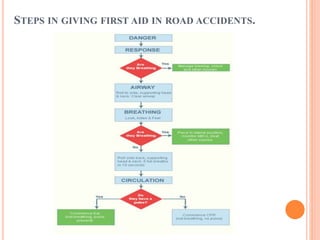
STEPS IN GIVING FIRST AID IN ROAD ACCIDENTS.
PREVENTION
STEPS TO BE TAKEN FOR PREVENTING ROAD
ACCIDENTS
 Most important method to bring down accidents is strict
enforcement of speed limits.
 90 % of accidents can be avoided by strict enforcement
of speed limits.
 Existing speed limits should be brought down further.
 Diving tests for issue of Driving license is to be made
more stringent and foolproof.
 Raising of lower age limit for two wheeler and Heavy
Vehicle license to 21.
 Helmet should be made compulsory by law in all states,
OR impose a lower speed limit for those who do not use
helmet.
 Helmet should be made compulsory for back seat riders
also.
 Strict enforcement of existing traffic rules.
 Law should be modified such that the person who made
the accident has to bear (say) 0 to 10 % of the insurance
claims.
 All those who do not maintain the safe distance for the
speed should be punished.
ROAD SAFETY (FIRST AID)

ROAD SAFETY (FIRST AID)

  • 2.
    WHAT IS FIRSTAID?  First aid is the temporary help given to an injured or a sick person before professional medical treatment can be provided.  Any layperson can be trained to administer first aid.  Basic training in first aid skills should be taught in school, in work places and, in general, be learnt by all.
  • 3.
    INTRODUCTION WHY FIRST AIDTRAINING IS SO IMPORTANT? Human beings are susceptible to injuries, illnesses and trauma. Thus it is always good to have some amount of basic knowledge to take care of critical situations, to keep it from going from bad to worse or till the medical help arrives.
  • 4.
    PURPOSE OF FIRSTAID TRAINING  Increases safety: The basis of first aid training is "prevention". It is always better to be safe than to be sorry.  Helps save lives: If a person who is trained to give first aid administration happens to see any casualty in his vicinity, immediate action can be taken and lives be saved.
  • 5.
     Helps relievepain: Some injuries require a very simple solution like applying ice pack or a quick rub. In such cases, calling a person trained in first aid courses is more reliable.  Makes people more secure: Knowing that you can save your own life when required, or that of the people you know or those in trauma during some emergency helps you relax more and be more secure.  Prevents the situation from becoming worse: A trained person would know how to keep the situation from becoming bad to worse.
  • 6.
    PRINCIPLES OF FIRSTAID  To prevent further injury to the casualty and to avoid injury to yourself .  To assess and treat the casualty in the correct order of priority.  To place casualties in a comfortable position.  To immobilize injured limbs.  To relieve pain and anxiety if possible.  To arrange evacuation if necessary in the correct priority.
  • 7.
    PEOPLE AFFECTED BYROAD ACCIDENTS drivers passengers pedestrianscyclists motorcyclists
  • 8.
    ROAD ACCIDENT FATALITIESIN INDIA  India suffers from the highest number of deaths - around 1,05,000 in absolute terms annually- due to road accidents in the world owing to poor infrastructure and dangerous driving habits.  “Road traffic crashes take the lives of nearly 1.3 million every year, and injure 20-50 million more" in the world, India along with China are listed among countries with the highest number of deaths.  Poor road infrastructure, failure to comply with speed limits, growing drinking and driving habits are among the main factors contributing to deaths from road crashes.
  • 9.
    13 INDIANS DIEEVERY HOUR DUE TO ACCIDENTS With at least 13 people dying every hour on Indian roads, India has topped the global list of deaths in road accidents, leaving behind the world's most populated country - China. This was revealed in the first ever Global Status Report on Road Safety by the World Health Organization (WHO) and latest report of the National Crime Records Bureau (NCRB).
  • 10.
    LACK OF FIRSTAID ON TIME  Up to 150,000 people a year could be given a chance to live if more people knew first aid, says charity St John Ambulance, as it launches a hard-hitting campaign to encourage more people to learn this vital skill.  Thousands of people are dying each year in situations where first aid could have made the difference. This includes nearly 900 people who choke to death, 2,500 who asphyxiate from a blocked airway and 29,000 who die from heart attacks.  First aid could make a dramatic difference in these situations, either through direct intervention, in the case of choking, or by recognising life-threatening signs, such as a heart attack, and caring for someone until medical help arrives.
  • 11.
    STEPS IN GIVINGFIRST AID IN ROAD ACCIDENTS.
  • 12.
    PREVENTION STEPS TO BETAKEN FOR PREVENTING ROAD ACCIDENTS  Most important method to bring down accidents is strict enforcement of speed limits.  90 % of accidents can be avoided by strict enforcement of speed limits.  Existing speed limits should be brought down further.
  • 13.
     Diving testsfor issue of Driving license is to be made more stringent and foolproof.  Raising of lower age limit for two wheeler and Heavy Vehicle license to 21.  Helmet should be made compulsory by law in all states, OR impose a lower speed limit for those who do not use helmet.  Helmet should be made compulsory for back seat riders also.  Strict enforcement of existing traffic rules.  Law should be modified such that the person who made the accident has to bear (say) 0 to 10 % of the insurance claims.  All those who do not maintain the safe distance for the speed should be punished.