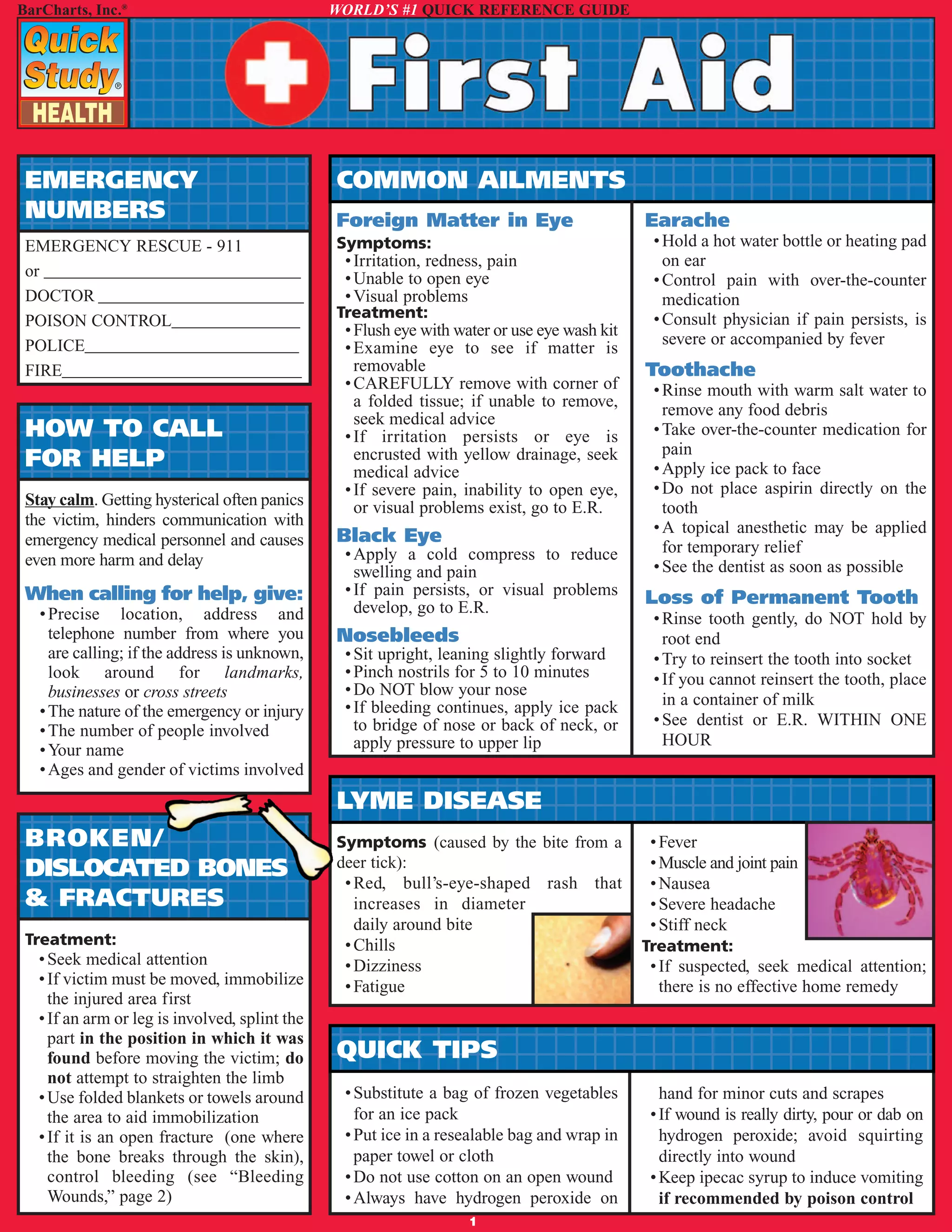
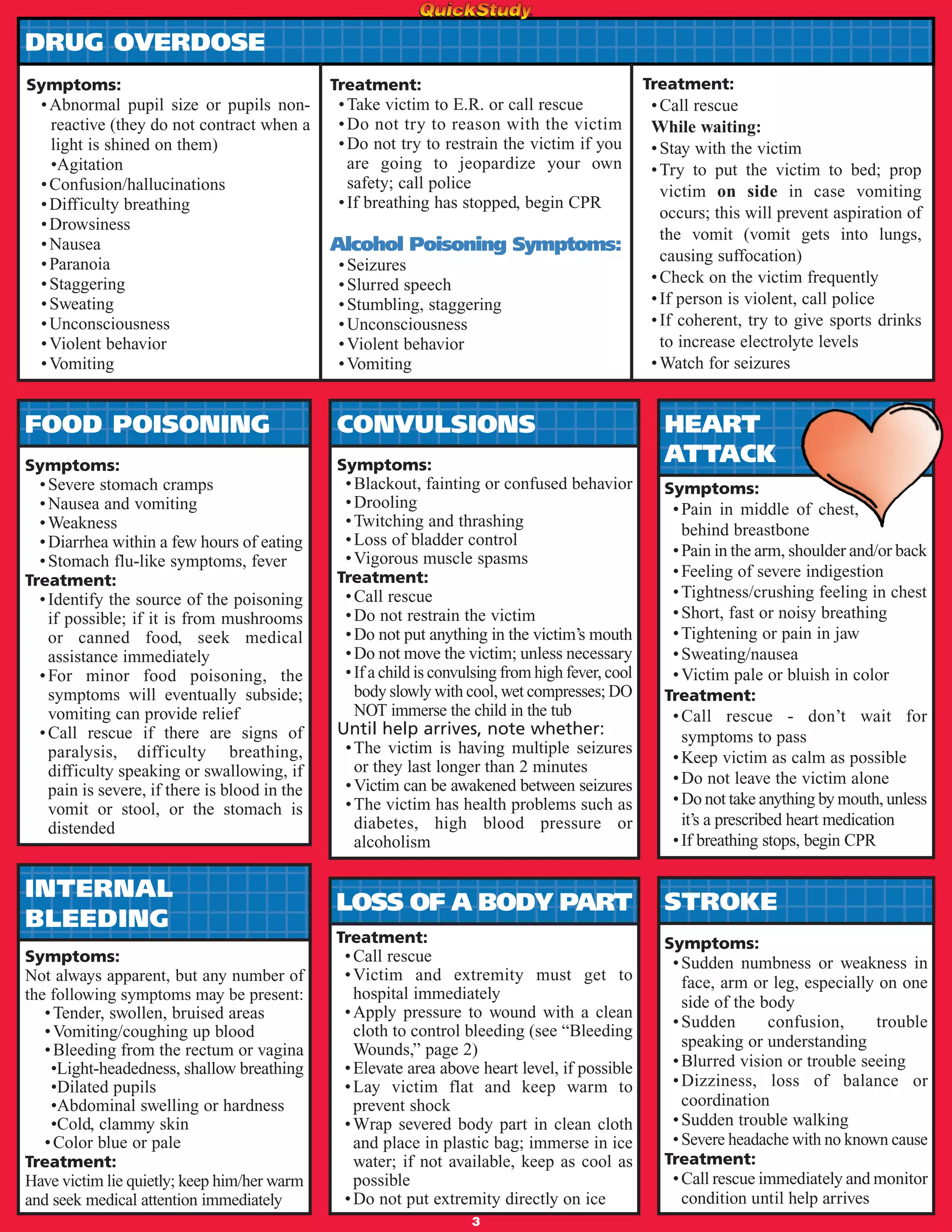
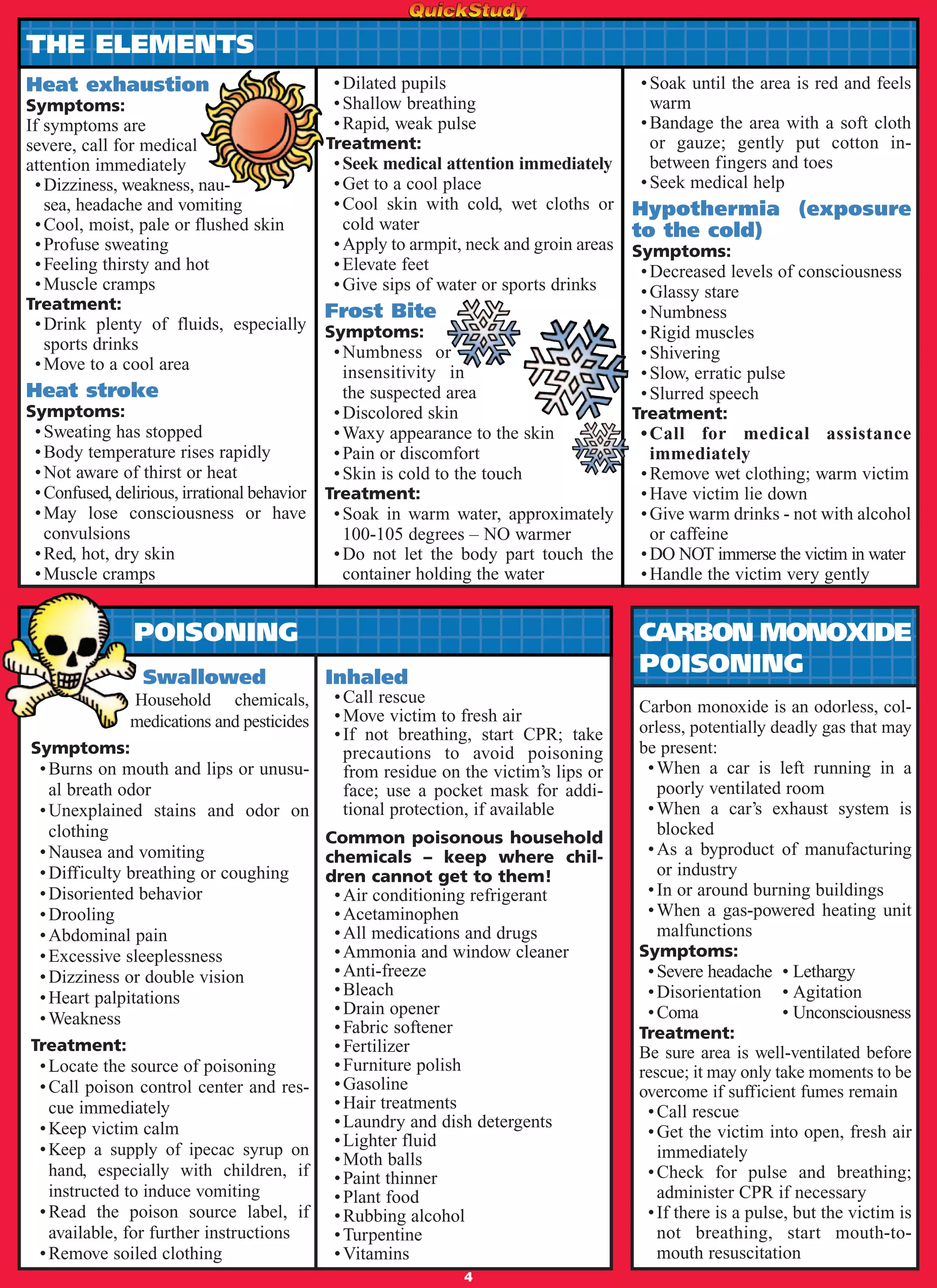
BarCharts, Inc.®
WORLD’S #1 QUICK REFERENCE GUIDE
HOW TO CALL
FOR HELP
Stay calm. Getting hysterical often panics
the victim, hinders communication with
emergency medical personnel and causes
even more harm and delay
When calling for help, give:
•Precise location, address and
telephone number from where you
are calling; if the address is unknown,
look around for landmarks,
businesses or cross streets
•The nature of the emergency or injury
•The number of people involved
•Your name
•Ages and gender of victims involved
Earache
•Hold a hot water bottle or heating pad
on ear
•Control pain with over-the-counter
medication
•Consult physician if pain persists, is
severe or accompanied by fever
Toothache
•Rinse mouth with warm salt water to
remove any food debris
•Take over-the-counter medication for
pain
•Apply ice pack to face
•Do not place aspirin directly on the
tooth
•A topical anesthetic may be applied
for temporary relief
•See the dentist as soon as possible
Loss of Permanent Tooth
•Rinse tooth gently, do NOT hold by
root end
•Try to reinsert the tooth into socket
•If you cannot reinsert the tooth, place
in a container of milk
•See dentist or E.R. WITHIN ONE
HOUR
COMMON AILMENTS
•Substitute a bag of frozen vegetables
for an ice pack
•Put ice in a resealable bag and wrap in
paper towel or cloth
•Do not use cotton on an open wound
•Always have hydrogen peroxide on
hand for minor cuts and scrapes
•If wound is really dirty, pour or dab on
hydrogen peroxide; avoid squirting
directly into wound
•Keep ipecac syrup to induce vomiting
if recommended by poison control
QUICK TIPS
Symptoms (caused by the bite from a
deer tick):
•Red, bull’s-eye-shaped rash that
increases in diameter
daily around bite
•Chills
•Dizziness
•Fatigue
•Fever
•Muscle and joint pain
•Nausea
•Severe headache
•Stiff neck
Treatment:
•If suspected, seek medical attention;
there is no effective home remedy
LYME DISEASE
BROKEN/
DISLOCATED BONES
& FRACTURES
Treatment:
•Seek medical attention
•If victim must be moved, immobilize
the injured area first
•If an arm or leg is involved, splint the
part in the position in which it was
found before moving the victim; do
not attempt to straighten the limb
•Use folded blankets or towels around
the area to aid immobilization
•If it is an open fracture (one where
the bone breaks through the skin),
control bleeding (see “Bleeding
Wounds,” page 2)
EMERGENCY
NUMBERS
EMERGENCY RESCUE - 911
or ______________________________
DOCTOR ________________________
POISON CONTROL_______________
POLICE_________________________
FIRE____________________________
Foreign Matter in Eye
Symptoms:
•Irritation, redness, pain
•Unable to open eye
•Visual problems
Treatment:
•Flush eye with water or use eye wash kit
•Examine eye to see if matter is
removable
•CAREFULLY remove with corner of
a folded tissue; if unable to remove,
seek medical advice
•If irritation persists or eye is
encrusted with yellow drainage, seek
medical advice
•If severe pain, inability to open eye,
or visual problems exist, go to E.R.
Black Eye
•Apply a cold compress to reduce
swelling and pain
•If pain persists, or visual problems
develop, go to E.R.
Nosebleeds
•Sit upright, leaning slightly forward
•Pinch nostrils for 5 to 10 minutes
•Do NOT blow your nose
•If bleeding continues, apply ice pack
to bridge of nose or back of neck, or
apply pressure to upper lip
1
If unavailable, apply pressure with
hand
•Maintain pressure for 10 minutes, do
NOT remove original bandage; if it
becomes blood-soaked, apply another
bandage over it
•If bleeding cannot be controlled, apply
pressure to a point above the wound
•If internal organs are exposed, apply
wet, clean cloth with gentle pressure
•Attempt to control bleeding with
pressure until medical personnel
arrive
•A tourniquet is not recommended
Penetrating Objects
•Call rescue
•Do NOT remove any penetrating or
foreign objects
•Apply sufficient bandages to
immobilize the object and support its
position in the wound
SPRAINS & STRAINS
Symptoms:
•Severe pain
•Bruising, swelling and heat
•Unable to move injured part
Treatment:
•Rest affected limb
•Ice on and off for 48 hrs.
•Compress with elastic bandage
•Elevate affected limb
Note: Any burn to the face, hands, feet,
mouth or groin needs immediate
medical attention.
First-degree burn: A minor
burn, affecting only the top layers of skin
Symptoms:
•Redness and pain
Treatment:
•Run under cold water or apply a cold,
wet cloth off and on for 24 hrs.
•Do not rub or apply butter or
petroleum-based products
•Keep clean to prevent infection
Second-degree burn: Affects
the underlying layers of skin as well as
outer layers
Symptoms:
•Redness, pain, swelling and blisters
Treatment:
•Immediately immerse affected area in
cold water or apply cold, wet compresses
•Cover the area loosely with clean gauze
or cloth
•Do not apply butter or petroleum-based
products or sprays
•Do NOT break blisters; if blisters open,
keep dressing on area
•If a large area is affected, or if burn
starts draining, seek medical attention
Third-degree burn: Destroys all
the layers of skin and nerves
Symptoms:
•Skin may be white or black in appearance
•Can be extremely painful, or completely
painless if there is nerve damage
•Underlying tissue and/or muscle may
be exposed
Treatment:
•Call rescue
•Lightly cover area with a sheet or
sterile gauze (do not secure with tape)
•If breathing has stopped, begin CPR
Fire
If clothing is on fire, smother flames with
a blanket, coat, etc; do not remove
clothing stuck to skin
Sunburn
•Take cool baths or apply wet, cool
compresses
•Apply aloe or lotion to sooth skin
•Take over-the-counter pain
medication for fever, chills or pain
•Do NOT use butter or petroleum-
based products
•Do NOT break blisters
•For severe sunburn, with severe pain,
swelling or large blistered area, go to E.R.
BURNS & SCALDS
SHOCK
Shock due to Injury
Symptoms:
•Weakness and cold, clammy skin
with pale or bluish tinge
•Rapid, shallow breathing
•Faint and/or rapid pulse
•Restlessness, confusion or agitation
•Nausea and sweating
Treatment:
•Call for medical assistance
•Lay victim down, tilt head to one side
•Loosen clothing; keep victim warm
•Control any bleeding
•Keep victim calm and quiet
•Do not administer liquid; moisten
lips if necessary
•Elevate legs if there are no suspected
hip, leg, head, neck or back injuries
Allergic Reaction &
Anaphylactic Shock
Symptoms:
•Sudden appearance of hives that are
widespread and itching
•Swelling of the lips, tongue and
mouth (may feel itchy)
•Wheezing or difficulty breathing
•Nausea, vomiting or cramps
•Lightheadedness
Treatment:
•Call rescue to determine severity
of reaction
•If available, take recommended dose
of oral antihistamine
•If food-related, brush teeth to prevent
ingesting more allergen
WOUNDS
Cut, Puncture,
Scrape, Abrasion
Treatment:
•Stop bleeding by applying pressure
•Clean area thoroughly with antiseptic
or warm, soapy water
•Apply antibiotic ointment and
bandage
•With a puncture wound, or wound
inflicted by a rusty/dirty item, seek
medical care within 24 hrs., as anti-
biotics/tetanus shot may be required
•If the cut is on an extremity, hold
above heart level to stop bleeding
•If there are signs of infection,
redness, swelling, yellow discharge,
increased pain or fever, see your
physician
•If wound is deep, long, or gapes open,
see your physician or go to E.R.
Bleeding Wounds
When dealing with a severely bleeding
wound or amputation, if you have to
leave the victim to seek help, first get the
bleeding under control
•Call rescue - if blood is bright red,
there may be an artery involved; be
sure to tell the operator
•Have victim lie down, preferably with
head slightly lowered to prevent fainting
•If wound is on an extremity, raise
above heart level
• Cut away clothing and apply
pressure with a clean,
absorbent cloth
2
STROKE
Symptoms:
•Sudden numbness or weakness in
face, arm or leg, especially on one
side of the body
•Sudden confusion, trouble
speaking or understanding
•Blurred vision or trouble seeing
•Dizziness, loss of balance or
coordination
•Sudden trouble walking
•Severe headache with no known cause
Treatment:
•Call rescue immediately and monitor
condition until help arrives
CONVULSIONS
Symptoms:
•Blackout, fainting or confused behavior
•Drooling
•Twitching and thrashing
•Loss of bladder control
•Vigorous muscle spasms
Treatment:
•Call rescue
•Do not restrain the victim
•Do not put anything in the victim’s mouth
•Do not move the victim; unless necessary
•If a child is convulsing from high fever, cool
body slowly with cool, wet compresses; DO
NOT immerse the child in the tub
Until help arrives, note whether:
•The victim is having multiple seizures
or they last longer than 2 minutes
•Victim can be awakened between seizures
•The victim has health problems such as
diabetes, high blood pressure or
alcoholism
Symptoms:
•Abnormal pupil size or pupils non-
reactive (they do not contract when a
light is shined on them)
•Agitation
•Confusion/hallucinations
•Difficulty breathing
•Drowsiness
•Nausea
•Paranoia
•Staggering
•Sweating
•Unconsciousness
•Violent behavior
•Vomiting
Treatment:
•Take victim to E.R. or call rescue
•Do not try to reason with the victim
•Do not try to restrain the victim if you
are going to jeopardize your own
safety; call police
•If breathing has stopped, begin CPR
Alcohol Poisoning Symptoms:
•Seizures
•Slurred speech
•Stumbling, staggering
•Unconsciousness
•Violent behavior
•Vomiting
DRUG OVERDOSE
INTERNAL
BLEEDING
Symptoms:
Not always apparent, but any number of
the following symptoms may be present:
•Tender, swollen, bruised areas
•Vomiting/coughing up blood
•Bleeding from the rectum or vagina
•Light-headedness, shallow breathing
•Dilated pupils
•Abdominal swelling or hardness
•Cold, clammy skin
•Color blue or pale
Treatment:
Have victim lie quietly; keep him/her warm
and seek medical attention immediately
HEART
ATTACK
Symptoms:
•Pain in middle of chest,
behind breastbone
•Pain in the arm, shoulder and/or back
•Feeling of severe indigestion
•Tightness/crushing feeling in chest
•Short, fast or noisy breathing
•Tightening or pain in jaw
•Sweating/nausea
•Victim pale or bluish in color
Treatment:
•Call rescue - don’t wait for
symptoms to pass
•Keep victim as calm as possible
•Do not leave the victim alone
•Do not take anything by mouth, unless
it’s a prescribed heart medication
•If breathing stops, begin CPR
FOOD POISONING
Symptoms:
•Severe stomach cramps
•Nausea and vomiting
•Weakness
•Diarrhea within a few hours of eating
•Stomach flu-like symptoms, fever
Treatment:
•Identify the source of the poisoning
if possible; if it is from mushrooms
or canned food, seek medical
assistance immediately
•For minor food poisoning, the
symptoms will eventually subside;
vomiting can provide relief
•Call rescue if there are signs of
paralysis, difficulty breathing,
difficulty speaking or swallowing, if
pain is severe, if there is blood in the
vomit or stool, or the stomach is
distended
LOSS OF A BODY PART
Treatment:
•Call rescue
•Victim and extremity must get to
hospital immediately
•Apply pressure to wound with a clean
cloth to control bleeding (see “Bleeding
Wounds,” page 2)
•Elevate area above heart level, if possible
•Lay victim flat and keep warm to
prevent shock
•Wrap severed body part in clean cloth
and place in plastic bag; immerse in ice
water; if not available, keep as cool as
possible
•Do not put extremity directly on ice
Treatment:
•Call rescue
While waiting:
•Stay with the victim
•Try to put the victim to bed; prop
victim on side in case vomiting
occurs; this will prevent aspiration of
the vomit (vomit gets into lungs,
causing suffocation)
•Check on the victim frequently
•If person is violent, call police
•If coherent, try to give sports drinks
to increase electrolyte levels
•Watch for seizures
3
Heat exhaustion
Symptoms:
If symptoms are
severe, call for medical
attention immediately
•Dizziness, weakness, nau-
sea, headache and vomiting
•Cool, moist, pale or flushed skin
•Profuse sweating
•Feeling thirsty and hot
•Muscle cramps
Treatment:
•Drink plenty of fluids, especially
sports drinks
•Move to a cool area
Heat stroke
Symptoms:
•Sweating has stopped
•Body temperature rises rapidly
•Not aware of thirst or heat
•Confused, delirious, irrational behavior
•May lose consciousness or have
convulsions
•Red, hot, dry skin
•Muscle cramps
•Dilated pupils
•Shallow breathing
•Rapid, weak pulse
Treatment:
•Seek medical attention immediately
•Get to a cool place
•Cool skin with cold, wet cloths or
cold water
•Apply to armpit, neck and groin areas
•Elevate feet
•Give sips of water or sports drinks
Frost Bite
Symptoms:
•Numbness or
insensitivity in
the suspected area
•Discolored skin
•Waxy appearance to the skin
•Pain or discomfort
•Skin is cold to the touch
Treatment:
•Soak in warm water, approximately
100-105 degrees – NO warmer
•Do not let the body part touch the
container holding the water
Swallowed
Household chemicals,
medications and pesticides
Symptoms:
•Burns on mouth and lips or unusu-
al breath odor
•Unexplained stains and odor on
clothing
•Nausea and vomiting
•Difficulty breathing or coughing
•Disoriented behavior
•Drooling
•Abdominal pain
•Excessive sleeplessness
•Dizziness or double vision
•Heart palpitations
•Weakness
Treatment:
•Locate the source of poisoning
•Call poison control center and res-
cue immediately
•Keep victim calm
•Keep a supply of ipecac syrup on
hand, especially with children, if
instructed to induce vomiting
•Read the poison source label, if
available, for further instructions
•Remove soiled clothing
Inhaled
•Call rescue
•Move victim to fresh air
•If not breathing, start CPR; take
precautions to avoid poisoning
from residue on the victim’s lips or
face; use a pocket mask for addi-
tional protection, if available
Common poisonous household
chemicals – keep where chil-
dren cannot get to them!
•Air conditioning refrigerant
•Acetaminophen
•All medications and drugs
•Ammonia and window cleaner
•Anti-freeze
•Bleach
•Drain opener
•Fabric softener
•Fertilizer
•Furniture polish
•Gasoline
•Hair treatments
•Laundry and dish detergents
•Lighter fluid
•Moth balls
•Paint thinner
•Plant food
•Rubbing alcohol
•Turpentine
•Vitamins
POISONING CARBON MONOXIDE
POISONING
Carbon monoxide is an odorless, col-
orless, potentially deadly gas that may
be present:
•When a car is left running in a
poorly ventilated room
•When a car’s exhaust system is
blocked
•As a byproduct of manufacturing
or industry
•In or around burning buildings
•When a gas-powered heating unit
malfunctions
Symptoms:
•Severe headache • Lethargy
•Disorientation • Agitation
•Coma • Unconsciousness
Treatment:
Be sure area is well-ventilated before
rescue; it may only take moments to be
overcome if sufficient fumes remain
•Call rescue
•Get the victim into open, fresh air
immediately
•Check for pulse and breathing;
administer CPR if necessary
•If there is a pulse, but the victim is
not breathing, start mouth-to-
mouth resuscitation
THE ELEMENTS
•Soak until the area is red and feels
warm
•Bandage the area with a soft cloth
or gauze; gently put cotton in-
between fingers and toes
•Seek medical help
Hypothermia (exposure
to the cold)
Symptoms:
•Decreased levels of consciousness
•Glassy stare
•Numbness
•Rigid muscles
•Shivering
•Slow, erratic pulse
•Slurred speech
Treatment:
•Call for medical assistance
immediately
•Remove wet clothing; warm victim
•Have victim lie down
•Give warm drinks - not with alcohol
or caffeine
•DO NOT immerse the victim in water
•Handle the victim very gently
4
Treatment:
•Gently pick off any tentacles, using
gloves or edge of credit card
•Rinse the area with salt or fresh
water or soak with vinegar
•1% hydrocortisone cream may be
used on affected area
•If rash or pain persists, seek med-
ical advice
Animal Bite
•Wash carefully with soap and water
•Apply an antiseptic, such as hydro-
gen peroxide
•Apply antibiotic cream and bandage
•Rabies is always a concern with any
animal bite; be sure to notify animal
control so the animal may be cap-
tured (if necessary), tested for
rabies, and quarantined
•Seek medical attention immediately
•If bite is severe, try to stop the
bleeding (see “Bleeding Wounds,”
page 2) and call rescue
Fire Ants (only in south-
ern states):
Symptoms:
•Itchy, stinging rash
•Blisters
Treatment:
•Apply ice pack to bites to relieve
pain and swelling
•1% hydrocortisone cream can be
applied to relieve itching
•If an allergic reaction occurs, or if
large areas are bitten, seek medical
attention
Symptoms:
•Redness of skin and extreme itching
•Rash in the pattern of streaks or patches
•Pimples or blisters
Treatment:
•Wash exposed skin immediately
with soap and water
•Clean under fingernails to prevent
spreading
•Remove and wash clothes and clean
shoes of victim to prevent spreading
•Apply cool compresses
•Apply anti-itch medication (calamine
lotion/1% hydrocortisone cream)
•Consult physician if rash persists,
itching can’t be controlled, rash is
on face, eyes or genitals, and/or
rash has pus or odor
•Seek medical help if there is
swelling or difficulty breathing
Poison Ivy Poison Oak Poison Sumac
PLANTS - POISON IVY, OAK & SUMAC
Bee & Wasp
Stings
Difficulty breathing,
headache or coughing,
could be signs of allergic
reaction; seek medical attention
immediately (see “Anaphylactic
Shock,” page 2)
Symptoms:
•Red, swollen, painful area with a
small point of entry in the center
Treatment:
•Remove the stinger by scraping
skin with a credit card or cardboard
edge; do not use tweezers; they can
inject more venom into the skin
•Wash area with soap and water
•Apply ice pack
•Apply calamine lotion or use a paste
of baking soda and water, or over-the-
counter 1% hydrocortisone cream
Snake Bites
Take a good look at the snake, if pos-
sible - you may need to provide a
description
Symptoms:
•Sharp pain
•Swelling
•Weakness
•Shortness of breath
• Vomiting
• Dizziness
• Blurred vision
Treatment:
•Call rescue
•Have the victim lie quietly, keeping
the bitten area below heart level to
slow the blood flow to the heart
•Clean the area - wipe AWAY from
the bite to prevent more venom
from entering the wound
•Do NOT cut the bite or try to suck
out the venom
•Do not apply ice
Spider Bites
•Spiders are found in dark areas, such
as under furniture, woodpiles, in
shoes, barns, basements, etc.
•If possible, bring the spider or the
remains of the spider with you to the
physician for identification
Both the black widow and brown recluse
spider bites need to be attended to imme-
diately by a medical professional
Black Widow
Symptoms:
•A b d o m i n a l
pain
•Pain in muscles
•Pain in soles of feet
•Swollen eyelids
•Excessive sweating
•Bite looks like a small pin prick
•Dull, numbing pain
•Headache
•Shortness of breath
•Tightness in chest
Brown Recluse Spider
Symptoms:
•Bite appears as an ulcer circled by a
red ring
•Stinging sensation
•Weakness
•Fever
•Joint Pain
•Nausea
•Shock
Treatment:
•Wash area with soap and water
•Apply a cold compress
Man-o-war
(Jellyfish) Sting
Symptoms:
•Sudden severe stinging
sensation when swimming
in ocean water
•Tentacles stuck to the skin
INSECTS, SNAKES, SPIDERS & SEA CREATURES
Scarlet King Snake
5
If injury is suspected, DO NOT move
victim unless absolutely necessary
Symptoms:
•Head, neck or back are in an odd
position
•Paralysis
•Unable to move fingers and/or toes
•Numbness in any part of the body
Treatment:
•Call rescue
•If there is head injury, assume there is
neck injury
•Keep victim as still as possible
HEAD, NECK & BACK INJURY
•NEVER touch a victim of electric
shock until the source of
electricity has been separated from
victim, turned off, or proper
precautions have been taken
•Shut off fuse box or unplug
the source of electricity
Treatment:
•Call rescue
Disclaimer: This QuickStudy®
guide is intended as a reference only. It is not a substitute for professional
medical care. BarCharts®
, its writers, editors or designers are not in any way responsible nor liable for the use
or misuse of the information contained in this chart.
•If victim is not breathing,
administer CPR until medical help
arrives
•With lightening strikes, begin CPR
immediately, if necessary (electricity
has already passed through the body)
•When breathing has started, elevate
victim’s feet and keep him/her warm
to avoid shock
ELECTROCUTION ISBN-13: 978-142320726-9
ISBN-10: 142320726-2
All rights reserved. No part of this publication may be reproduced or transmitted in any
form, or by any means, electronic or mechanical, including photocopy, recording, or any
information storage and retrieval system, without written permission from the publisher.
©2002, 2003 BarCharts, Inc. 0508
This guide was compiled, written and edited by a consortium consisting of 2
EMT's, a nurse practitioner and a certified first aid instructor.
HYPERVENTILATION
Symptoms:
•Deep, rapid, irregular breathing
•The feeling of loss of control of
breathing
Treatment:
•Calm the person; ask him/her to
concentrate on taking slow, deep breaths
•If this is not effective, call rescue
FAINTING
Symptoms that fainting is about to
occur:
•Sensation of dizziness, weakness,
cold sweats, rapid pulse
To prevent onset:
•Have victim sit down and place head
between knees or lie down
If victim faints:
•Raise feet 12 to 15 inches
•Apply wet, cool, cloth to forehead
•If consciousness does not return
within 8 minutes, call rescue
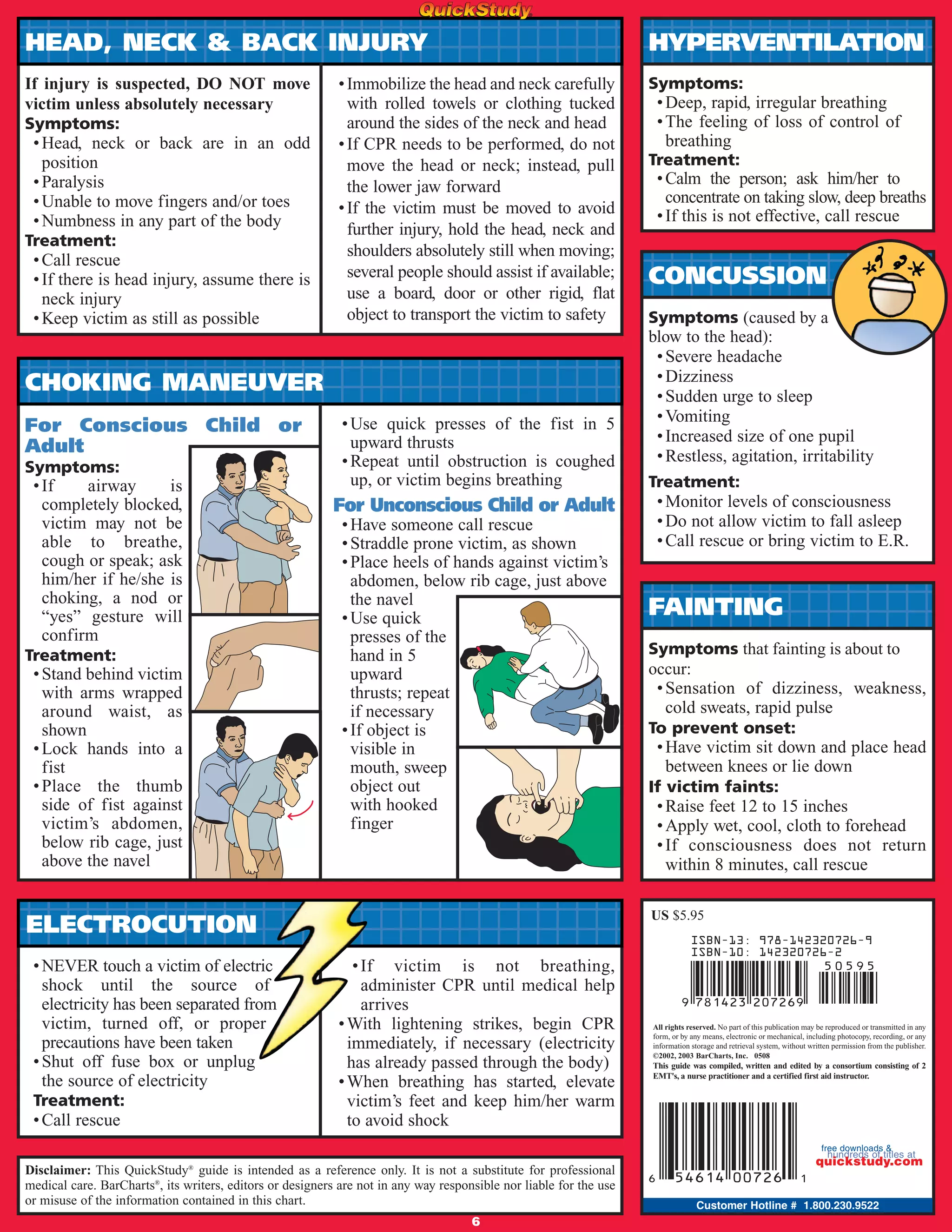
For Conscious Child or
Adult
Symptoms:
•If airway is
completely blocked,
victim may not be
able to breathe,
cough or speak; ask
him/her if he/she is
choking, a nod or
“yes” gesture will
confirm
Treatment:
•Stand behind victim
with arms wrapped
around waist, as
shown
•Lock hands into a
fist
•Place the thumb
side of fist against
victim’s abdomen,
below rib cage, just
above the navel
•Use quick presses of the fist in 5
upward thrusts
•Repeat until obstruction is coughed
up, or victim begins breathing
For Unconscious Child or Adult
•Have someone call rescue
•Straddle prone victim, as shown
•Place heels of hands against victim’s
abdomen, below rib cage, just above
the navel
•Use quick
presses of the
hand in 5
upward
thrusts; repeat
if necessary
•If object is
visible in
mouth, sweep
object out
with hooked
finger
CHOKING MANEUVER
6
•Immobilize the head and neck carefully
with rolled towels or clothing tucked
around the sides of the neck and head
•If CPR needs to be performed, do not
move the head or neck; instead, pull
the lower jaw forward
•If the victim must be moved to avoid
further injury, hold the head, neck and
shoulders absolutely still when moving;
several people should assist if available;
use a board, door or other rigid, flat
object to transport the victim to safety
CONCUSSION
Symptoms (caused by a
blow to the head):
•Severe headache
•Dizziness
•Sudden urge to sleep
•Vomiting
•Increased size of one pupil
•Restless, agitation, irritability
Treatment:
•Monitor levels of consciousness
•Do not allow victim to fall asleep
•Call rescue or bring victim to E.R.
Customer Hotline # 1.800.230.9522
US $5.95
free downloads &
hundreds of titles at
quickstudy.com

Bar charts quickstudy first aid

  • 1.
    BarCharts, Inc.® WORLD’S #1QUICK REFERENCE GUIDE HOW TO CALL FOR HELP Stay calm. Getting hysterical often panics the victim, hinders communication with emergency medical personnel and causes even more harm and delay When calling for help, give: •Precise location, address and telephone number from where you are calling; if the address is unknown, look around for landmarks, businesses or cross streets •The nature of the emergency or injury •The number of people involved •Your name •Ages and gender of victims involved Earache •Hold a hot water bottle or heating pad on ear •Control pain with over-the-counter medication •Consult physician if pain persists, is severe or accompanied by fever Toothache •Rinse mouth with warm salt water to remove any food debris •Take over-the-counter medication for pain •Apply ice pack to face •Do not place aspirin directly on the tooth •A topical anesthetic may be applied for temporary relief •See the dentist as soon as possible Loss of Permanent Tooth •Rinse tooth gently, do NOT hold by root end •Try to reinsert the tooth into socket •If you cannot reinsert the tooth, place in a container of milk •See dentist or E.R. WITHIN ONE HOUR COMMON AILMENTS •Substitute a bag of frozen vegetables for an ice pack •Put ice in a resealable bag and wrap in paper towel or cloth •Do not use cotton on an open wound •Always have hydrogen peroxide on hand for minor cuts and scrapes •If wound is really dirty, pour or dab on hydrogen peroxide; avoid squirting directly into wound •Keep ipecac syrup to induce vomiting if recommended by poison control QUICK TIPS Symptoms (caused by the bite from a deer tick): •Red, bull’s-eye-shaped rash that increases in diameter daily around bite •Chills •Dizziness •Fatigue •Fever •Muscle and joint pain •Nausea •Severe headache •Stiff neck Treatment: •If suspected, seek medical attention; there is no effective home remedy LYME DISEASE BROKEN/ DISLOCATED BONES & FRACTURES Treatment: •Seek medical attention •If victim must be moved, immobilize the injured area first •If an arm or leg is involved, splint the part in the position in which it was found before moving the victim; do not attempt to straighten the limb •Use folded blankets or towels around the area to aid immobilization •If it is an open fracture (one where the bone breaks through the skin), control bleeding (see “Bleeding Wounds,” page 2) EMERGENCY NUMBERS EMERGENCY RESCUE - 911 or ______________________________ DOCTOR ________________________ POISON CONTROL_______________ POLICE_________________________ FIRE____________________________ Foreign Matter in Eye Symptoms: •Irritation, redness, pain •Unable to open eye •Visual problems Treatment: •Flush eye with water or use eye wash kit •Examine eye to see if matter is removable •CAREFULLY remove with corner of a folded tissue; if unable to remove, seek medical advice •If irritation persists or eye is encrusted with yellow drainage, seek medical advice •If severe pain, inability to open eye, or visual problems exist, go to E.R. Black Eye •Apply a cold compress to reduce swelling and pain •If pain persists, or visual problems develop, go to E.R. Nosebleeds •Sit upright, leaning slightly forward •Pinch nostrils for 5 to 10 minutes •Do NOT blow your nose •If bleeding continues, apply ice pack to bridge of nose or back of neck, or apply pressure to upper lip 1
  • 2.
    If unavailable, applypressure with hand •Maintain pressure for 10 minutes, do NOT remove original bandage; if it becomes blood-soaked, apply another bandage over it •If bleeding cannot be controlled, apply pressure to a point above the wound •If internal organs are exposed, apply wet, clean cloth with gentle pressure •Attempt to control bleeding with pressure until medical personnel arrive •A tourniquet is not recommended Penetrating Objects •Call rescue •Do NOT remove any penetrating or foreign objects •Apply sufficient bandages to immobilize the object and support its position in the wound SPRAINS & STRAINS Symptoms: •Severe pain •Bruising, swelling and heat •Unable to move injured part Treatment: •Rest affected limb •Ice on and off for 48 hrs. •Compress with elastic bandage •Elevate affected limb Note: Any burn to the face, hands, feet, mouth or groin needs immediate medical attention. First-degree burn: A minor burn, affecting only the top layers of skin Symptoms: •Redness and pain Treatment: •Run under cold water or apply a cold, wet cloth off and on for 24 hrs. •Do not rub or apply butter or petroleum-based products •Keep clean to prevent infection Second-degree burn: Affects the underlying layers of skin as well as outer layers Symptoms: •Redness, pain, swelling and blisters Treatment: •Immediately immerse affected area in cold water or apply cold, wet compresses •Cover the area loosely with clean gauze or cloth •Do not apply butter or petroleum-based products or sprays •Do NOT break blisters; if blisters open, keep dressing on area •If a large area is affected, or if burn starts draining, seek medical attention Third-degree burn: Destroys all the layers of skin and nerves Symptoms: •Skin may be white or black in appearance •Can be extremely painful, or completely painless if there is nerve damage •Underlying tissue and/or muscle may be exposed Treatment: •Call rescue •Lightly cover area with a sheet or sterile gauze (do not secure with tape) •If breathing has stopped, begin CPR Fire If clothing is on fire, smother flames with a blanket, coat, etc; do not remove clothing stuck to skin Sunburn •Take cool baths or apply wet, cool compresses •Apply aloe or lotion to sooth skin •Take over-the-counter pain medication for fever, chills or pain •Do NOT use butter or petroleum- based products •Do NOT break blisters •For severe sunburn, with severe pain, swelling or large blistered area, go to E.R. BURNS & SCALDS SHOCK Shock due to Injury Symptoms: •Weakness and cold, clammy skin with pale or bluish tinge •Rapid, shallow breathing •Faint and/or rapid pulse •Restlessness, confusion or agitation •Nausea and sweating Treatment: •Call for medical assistance •Lay victim down, tilt head to one side •Loosen clothing; keep victim warm •Control any bleeding •Keep victim calm and quiet •Do not administer liquid; moisten lips if necessary •Elevate legs if there are no suspected hip, leg, head, neck or back injuries Allergic Reaction & Anaphylactic Shock Symptoms: •Sudden appearance of hives that are widespread and itching •Swelling of the lips, tongue and mouth (may feel itchy) •Wheezing or difficulty breathing •Nausea, vomiting or cramps •Lightheadedness Treatment: •Call rescue to determine severity of reaction •If available, take recommended dose of oral antihistamine •If food-related, brush teeth to prevent ingesting more allergen WOUNDS Cut, Puncture, Scrape, Abrasion Treatment: •Stop bleeding by applying pressure •Clean area thoroughly with antiseptic or warm, soapy water •Apply antibiotic ointment and bandage •With a puncture wound, or wound inflicted by a rusty/dirty item, seek medical care within 24 hrs., as anti- biotics/tetanus shot may be required •If the cut is on an extremity, hold above heart level to stop bleeding •If there are signs of infection, redness, swelling, yellow discharge, increased pain or fever, see your physician •If wound is deep, long, or gapes open, see your physician or go to E.R. Bleeding Wounds When dealing with a severely bleeding wound or amputation, if you have to leave the victim to seek help, first get the bleeding under control •Call rescue - if blood is bright red, there may be an artery involved; be sure to tell the operator •Have victim lie down, preferably with head slightly lowered to prevent fainting •If wound is on an extremity, raise above heart level • Cut away clothing and apply pressure with a clean, absorbent cloth 2
  • 3.
    STROKE Symptoms: •Sudden numbness orweakness in face, arm or leg, especially on one side of the body •Sudden confusion, trouble speaking or understanding •Blurred vision or trouble seeing •Dizziness, loss of balance or coordination •Sudden trouble walking •Severe headache with no known cause Treatment: •Call rescue immediately and monitor condition until help arrives CONVULSIONS Symptoms: •Blackout, fainting or confused behavior •Drooling •Twitching and thrashing •Loss of bladder control •Vigorous muscle spasms Treatment: •Call rescue •Do not restrain the victim •Do not put anything in the victim’s mouth •Do not move the victim; unless necessary •If a child is convulsing from high fever, cool body slowly with cool, wet compresses; DO NOT immerse the child in the tub Until help arrives, note whether: •The victim is having multiple seizures or they last longer than 2 minutes •Victim can be awakened between seizures •The victim has health problems such as diabetes, high blood pressure or alcoholism Symptoms: •Abnormal pupil size or pupils non- reactive (they do not contract when a light is shined on them) •Agitation •Confusion/hallucinations •Difficulty breathing •Drowsiness •Nausea •Paranoia •Staggering •Sweating •Unconsciousness •Violent behavior •Vomiting Treatment: •Take victim to E.R. or call rescue •Do not try to reason with the victim •Do not try to restrain the victim if you are going to jeopardize your own safety; call police •If breathing has stopped, begin CPR Alcohol Poisoning Symptoms: •Seizures •Slurred speech •Stumbling, staggering •Unconsciousness •Violent behavior •Vomiting DRUG OVERDOSE INTERNAL BLEEDING Symptoms: Not always apparent, but any number of the following symptoms may be present: •Tender, swollen, bruised areas •Vomiting/coughing up blood •Bleeding from the rectum or vagina •Light-headedness, shallow breathing •Dilated pupils •Abdominal swelling or hardness •Cold, clammy skin •Color blue or pale Treatment: Have victim lie quietly; keep him/her warm and seek medical attention immediately HEART ATTACK Symptoms: •Pain in middle of chest, behind breastbone •Pain in the arm, shoulder and/or back •Feeling of severe indigestion •Tightness/crushing feeling in chest •Short, fast or noisy breathing •Tightening or pain in jaw •Sweating/nausea •Victim pale or bluish in color Treatment: •Call rescue - don’t wait for symptoms to pass •Keep victim as calm as possible •Do not leave the victim alone •Do not take anything by mouth, unless it’s a prescribed heart medication •If breathing stops, begin CPR FOOD POISONING Symptoms: •Severe stomach cramps •Nausea and vomiting •Weakness •Diarrhea within a few hours of eating •Stomach flu-like symptoms, fever Treatment: •Identify the source of the poisoning if possible; if it is from mushrooms or canned food, seek medical assistance immediately •For minor food poisoning, the symptoms will eventually subside; vomiting can provide relief •Call rescue if there are signs of paralysis, difficulty breathing, difficulty speaking or swallowing, if pain is severe, if there is blood in the vomit or stool, or the stomach is distended LOSS OF A BODY PART Treatment: •Call rescue •Victim and extremity must get to hospital immediately •Apply pressure to wound with a clean cloth to control bleeding (see “Bleeding Wounds,” page 2) •Elevate area above heart level, if possible •Lay victim flat and keep warm to prevent shock •Wrap severed body part in clean cloth and place in plastic bag; immerse in ice water; if not available, keep as cool as possible •Do not put extremity directly on ice Treatment: •Call rescue While waiting: •Stay with the victim •Try to put the victim to bed; prop victim on side in case vomiting occurs; this will prevent aspiration of the vomit (vomit gets into lungs, causing suffocation) •Check on the victim frequently •If person is violent, call police •If coherent, try to give sports drinks to increase electrolyte levels •Watch for seizures 3
  • 4.
    Heat exhaustion Symptoms: If symptomsare severe, call for medical attention immediately •Dizziness, weakness, nau- sea, headache and vomiting •Cool, moist, pale or flushed skin •Profuse sweating •Feeling thirsty and hot •Muscle cramps Treatment: •Drink plenty of fluids, especially sports drinks •Move to a cool area Heat stroke Symptoms: •Sweating has stopped •Body temperature rises rapidly •Not aware of thirst or heat •Confused, delirious, irrational behavior •May lose consciousness or have convulsions •Red, hot, dry skin •Muscle cramps •Dilated pupils •Shallow breathing •Rapid, weak pulse Treatment: •Seek medical attention immediately •Get to a cool place •Cool skin with cold, wet cloths or cold water •Apply to armpit, neck and groin areas •Elevate feet •Give sips of water or sports drinks Frost Bite Symptoms: •Numbness or insensitivity in the suspected area •Discolored skin •Waxy appearance to the skin •Pain or discomfort •Skin is cold to the touch Treatment: •Soak in warm water, approximately 100-105 degrees – NO warmer •Do not let the body part touch the container holding the water Swallowed Household chemicals, medications and pesticides Symptoms: •Burns on mouth and lips or unusu- al breath odor •Unexplained stains and odor on clothing •Nausea and vomiting •Difficulty breathing or coughing •Disoriented behavior •Drooling •Abdominal pain •Excessive sleeplessness •Dizziness or double vision •Heart palpitations •Weakness Treatment: •Locate the source of poisoning •Call poison control center and res- cue immediately •Keep victim calm •Keep a supply of ipecac syrup on hand, especially with children, if instructed to induce vomiting •Read the poison source label, if available, for further instructions •Remove soiled clothing Inhaled •Call rescue •Move victim to fresh air •If not breathing, start CPR; take precautions to avoid poisoning from residue on the victim’s lips or face; use a pocket mask for addi- tional protection, if available Common poisonous household chemicals – keep where chil- dren cannot get to them! •Air conditioning refrigerant •Acetaminophen •All medications and drugs •Ammonia and window cleaner •Anti-freeze •Bleach •Drain opener •Fabric softener •Fertilizer •Furniture polish •Gasoline •Hair treatments •Laundry and dish detergents •Lighter fluid •Moth balls •Paint thinner •Plant food •Rubbing alcohol •Turpentine •Vitamins POISONING CARBON MONOXIDE POISONING Carbon monoxide is an odorless, col- orless, potentially deadly gas that may be present: •When a car is left running in a poorly ventilated room •When a car’s exhaust system is blocked •As a byproduct of manufacturing or industry •In or around burning buildings •When a gas-powered heating unit malfunctions Symptoms: •Severe headache • Lethargy •Disorientation • Agitation •Coma • Unconsciousness Treatment: Be sure area is well-ventilated before rescue; it may only take moments to be overcome if sufficient fumes remain •Call rescue •Get the victim into open, fresh air immediately •Check for pulse and breathing; administer CPR if necessary •If there is a pulse, but the victim is not breathing, start mouth-to- mouth resuscitation THE ELEMENTS •Soak until the area is red and feels warm •Bandage the area with a soft cloth or gauze; gently put cotton in- between fingers and toes •Seek medical help Hypothermia (exposure to the cold) Symptoms: •Decreased levels of consciousness •Glassy stare •Numbness •Rigid muscles •Shivering •Slow, erratic pulse •Slurred speech Treatment: •Call for medical assistance immediately •Remove wet clothing; warm victim •Have victim lie down •Give warm drinks - not with alcohol or caffeine •DO NOT immerse the victim in water •Handle the victim very gently 4
  • 5.
    Treatment: •Gently pick offany tentacles, using gloves or edge of credit card •Rinse the area with salt or fresh water or soak with vinegar •1% hydrocortisone cream may be used on affected area •If rash or pain persists, seek med- ical advice Animal Bite •Wash carefully with soap and water •Apply an antiseptic, such as hydro- gen peroxide •Apply antibiotic cream and bandage •Rabies is always a concern with any animal bite; be sure to notify animal control so the animal may be cap- tured (if necessary), tested for rabies, and quarantined •Seek medical attention immediately •If bite is severe, try to stop the bleeding (see “Bleeding Wounds,” page 2) and call rescue Fire Ants (only in south- ern states): Symptoms: •Itchy, stinging rash •Blisters Treatment: •Apply ice pack to bites to relieve pain and swelling •1% hydrocortisone cream can be applied to relieve itching •If an allergic reaction occurs, or if large areas are bitten, seek medical attention Symptoms: •Redness of skin and extreme itching •Rash in the pattern of streaks or patches •Pimples or blisters Treatment: •Wash exposed skin immediately with soap and water •Clean under fingernails to prevent spreading •Remove and wash clothes and clean shoes of victim to prevent spreading •Apply cool compresses •Apply anti-itch medication (calamine lotion/1% hydrocortisone cream) •Consult physician if rash persists, itching can’t be controlled, rash is on face, eyes or genitals, and/or rash has pus or odor •Seek medical help if there is swelling or difficulty breathing Poison Ivy Poison Oak Poison Sumac PLANTS - POISON IVY, OAK & SUMAC Bee & Wasp Stings Difficulty breathing, headache or coughing, could be signs of allergic reaction; seek medical attention immediately (see “Anaphylactic Shock,” page 2) Symptoms: •Red, swollen, painful area with a small point of entry in the center Treatment: •Remove the stinger by scraping skin with a credit card or cardboard edge; do not use tweezers; they can inject more venom into the skin •Wash area with soap and water •Apply ice pack •Apply calamine lotion or use a paste of baking soda and water, or over-the- counter 1% hydrocortisone cream Snake Bites Take a good look at the snake, if pos- sible - you may need to provide a description Symptoms: •Sharp pain •Swelling •Weakness •Shortness of breath • Vomiting • Dizziness • Blurred vision Treatment: •Call rescue •Have the victim lie quietly, keeping the bitten area below heart level to slow the blood flow to the heart •Clean the area - wipe AWAY from the bite to prevent more venom from entering the wound •Do NOT cut the bite or try to suck out the venom •Do not apply ice Spider Bites •Spiders are found in dark areas, such as under furniture, woodpiles, in shoes, barns, basements, etc. •If possible, bring the spider or the remains of the spider with you to the physician for identification Both the black widow and brown recluse spider bites need to be attended to imme- diately by a medical professional Black Widow Symptoms: •A b d o m i n a l pain •Pain in muscles •Pain in soles of feet •Swollen eyelids •Excessive sweating •Bite looks like a small pin prick •Dull, numbing pain •Headache •Shortness of breath •Tightness in chest Brown Recluse Spider Symptoms: •Bite appears as an ulcer circled by a red ring •Stinging sensation •Weakness •Fever •Joint Pain •Nausea •Shock Treatment: •Wash area with soap and water •Apply a cold compress Man-o-war (Jellyfish) Sting Symptoms: •Sudden severe stinging sensation when swimming in ocean water •Tentacles stuck to the skin INSECTS, SNAKES, SPIDERS & SEA CREATURES Scarlet King Snake 5
  • 6.
    If injury issuspected, DO NOT move victim unless absolutely necessary Symptoms: •Head, neck or back are in an odd position •Paralysis •Unable to move fingers and/or toes •Numbness in any part of the body Treatment: •Call rescue •If there is head injury, assume there is neck injury •Keep victim as still as possible HEAD, NECK & BACK INJURY •NEVER touch a victim of electric shock until the source of electricity has been separated from victim, turned off, or proper precautions have been taken •Shut off fuse box or unplug the source of electricity Treatment: •Call rescue Disclaimer: This QuickStudy® guide is intended as a reference only. It is not a substitute for professional medical care. BarCharts® , its writers, editors or designers are not in any way responsible nor liable for the use or misuse of the information contained in this chart. •If victim is not breathing, administer CPR until medical help arrives •With lightening strikes, begin CPR immediately, if necessary (electricity has already passed through the body) •When breathing has started, elevate victim’s feet and keep him/her warm to avoid shock ELECTROCUTION ISBN-13: 978-142320726-9 ISBN-10: 142320726-2 All rights reserved. No part of this publication may be reproduced or transmitted in any form, or by any means, electronic or mechanical, including photocopy, recording, or any information storage and retrieval system, without written permission from the publisher. ©2002, 2003 BarCharts, Inc. 0508 This guide was compiled, written and edited by a consortium consisting of 2 EMT's, a nurse practitioner and a certified first aid instructor. HYPERVENTILATION Symptoms: •Deep, rapid, irregular breathing •The feeling of loss of control of breathing Treatment: •Calm the person; ask him/her to concentrate on taking slow, deep breaths •If this is not effective, call rescue FAINTING Symptoms that fainting is about to occur: •Sensation of dizziness, weakness, cold sweats, rapid pulse To prevent onset: •Have victim sit down and place head between knees or lie down If victim faints: •Raise feet 12 to 15 inches •Apply wet, cool, cloth to forehead •If consciousness does not return within 8 minutes, call rescue For Conscious Child or Adult Symptoms: •If airway is completely blocked, victim may not be able to breathe, cough or speak; ask him/her if he/she is choking, a nod or “yes” gesture will confirm Treatment: •Stand behind victim with arms wrapped around waist, as shown •Lock hands into a fist •Place the thumb side of fist against victim’s abdomen, below rib cage, just above the navel •Use quick presses of the fist in 5 upward thrusts •Repeat until obstruction is coughed up, or victim begins breathing For Unconscious Child or Adult •Have someone call rescue •Straddle prone victim, as shown •Place heels of hands against victim’s abdomen, below rib cage, just above the navel •Use quick presses of the hand in 5 upward thrusts; repeat if necessary •If object is visible in mouth, sweep object out with hooked finger CHOKING MANEUVER 6 •Immobilize the head and neck carefully with rolled towels or clothing tucked around the sides of the neck and head •If CPR needs to be performed, do not move the head or neck; instead, pull the lower jaw forward •If the victim must be moved to avoid further injury, hold the head, neck and shoulders absolutely still when moving; several people should assist if available; use a board, door or other rigid, flat object to transport the victim to safety CONCUSSION Symptoms (caused by a blow to the head): •Severe headache •Dizziness •Sudden urge to sleep •Vomiting •Increased size of one pupil •Restless, agitation, irritability Treatment: •Monitor levels of consciousness •Do not allow victim to fall asleep •Call rescue or bring victim to E.R. Customer Hotline # 1.800.230.9522 US $5.95 free downloads & hundreds of titles at quickstudy.com