FIRST AID
by,
Dr. DHEEN KUMAR,M.PHARM,Ph.D.,
Principal, GP PHARMACY COLLEGE
TIRUPATTUR, TAMILNADU- 635851
FIRST AID IS THE PROVISION OF INITIAL
CARE FOR AN ILLNESS OR INJURY.
IT IS USUALLY PERFORMED BY NON-
EXPERT, BUT TRAINED PERSONNEL
LIFE SAVING TECHNIQUES.
AIM
PRESERVE LIFE
PREVENT FURTHER HARM
PROMOTE RECOVERY
Accidental Trauma
Burns/Wounds
Poisoning
Electric Shock
Heart Attack
Animal Bites
ACCIDENTAL TRAUMA
Head trauma is an injury that affects the brain or
skull Injuries range from minor to serious.
Treatment : For mild injury-
Apply ice to injured area to minimize swelling
The size of the bump is not related to the severity
of injury
Observe the patient carefully for signs of bleeding
For moderate to severe injury
· Check the patient's breathing pattern
· If necessary do Cardio Pulmonary Resuscitation
(CPR) · In case of bleeding, press area with a clean
cloth
· If the cloth soaks, place a fresh cloth over the first
one
· Do not remove debris from the wound
· If person is vomiting turn on the side and lower the
head
· To minimize spine injury- hold head, neck and body
in one line
· If unconscious, treat it like a spinal injury
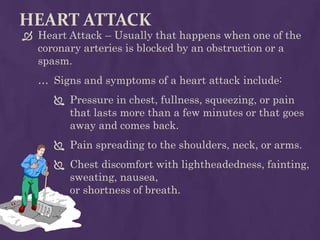
HEART ATTACK
 Heart Attack – Usually that happens when one of the
coronary arteries is blocked by an obstruction or a
spasm.
… Signs and symptoms of a heart attack include:
 Pressure in chest, fullness, squeezing, or pain
that lasts more than a few minutes or that goes
away and comes back.
 Pain spreading to the shoulders, neck, or arms.
 Chest discomfort with lightheadedness, fainting,
sweating, nausea,
or shortness of breath.
HEART ATTACK
 What to Do:
… Call 108 or get to the nearest hospital emergency
department with 24-emergency cardiac care.
… Monitor victim’s condition.
… Help the victim to the least painful position, usually
sitting with legs up and bent at the knees.
 Loosen clothing around the neck and midriff.
… Determine if the victim is known to have coronary
heart disease and is using nitroglycerin.
… If the victim is unresponsive, check ABCs and start
CPR, if needed.
ELECTRIC SHOCK
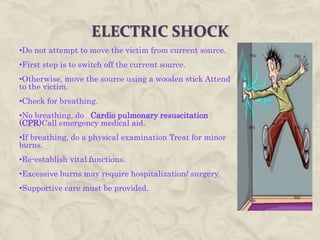
•Do not attempt to move the victim from current source.
•First step is to switch off the current source.
•Otherwise, move the source using a wooden stick Attend
to the victim.
•Check for breathing.
•No breathing, do Cardio pulmonary resuscitation
(CPR)Call emergency medical aid.
•If breathing, do a physical examination Treat for minor
burns.
•Re-establish vital functions.
•Excessive burns may require hospitalization/ surgery.
•Supportive care must be provided.
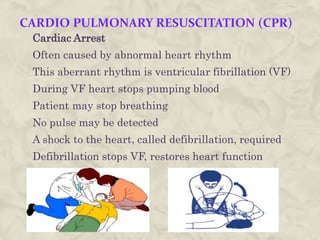
CARDIO PULMONARY RESUSCITATION (CPR)
Cardiac Arrest
Often caused by abnormal heart rhythm
This aberrant rhythm is ventricular fibrillation (VF)
During VF heart stops pumping blood
Patient may stop breathing
No pulse may be detected
A shock to the heart, called defibrillation, required
Defibrillation stops VF, restores heart function
WHAT IS CPR?
EMERGENCY LIFE-SAVING MEASURE
COMBINATION OF RESCUE BREATHING & CHEST
COMPRESSIONS
DONE ON UNCONSCIOUS/ NON-BREATHING PATIENT
CPR CONDUCTS DEFIBRILLATION
SUPPORTS HEART PUMPING FOR SHORT DURATION
ALLOWS OXYGEN TO REACH BRAIN
MORE EFFECTIVE WHEN DONE AS EARLY AS POSSIBLE
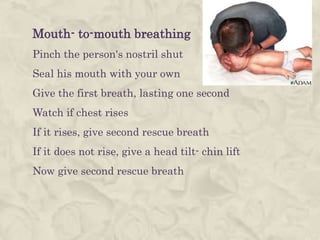
Mouth- to-mouth breathing
Pinch the person's nostril shut
Seal his mouth with your own
Give the first breath, lasting one second
Watch if chest rises
If it rises, give second rescue breath
If it does not rise, give a head tilt- chin lift
Now give second rescue breath
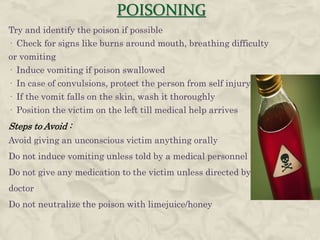
POISONING
Try and identify the poison if possible
· Check for signs like burns around mouth, breathing difficulty
or vomiting
· Induce vomiting if poison swallowed
· In case of convulsions, protect the person from self injury
· If the vomit falls on the skin, wash it thoroughly
· Position the victim on the left till medical help arrives
Steps to Avoid :
Avoid giving an unconscious victim anything orally
Do not induce vomiting unless told by a medical personnel
Do not give any medication to the victim unless directed by a
doctor
Do not neutralize the poison with limejuice/honey
ANIMAL BITES
o Calm the affected person.
o Wash hands before attending to wound.
o Wash wound with soap & running water.
o Apply antibiotic ointment Dress using sterile bandage.
o After first aid, medical treatment must be sought quickly.
o Suturing may be required.
o Tetanus booster / antibiotics required.
o Treatment depends on type / location of wound.
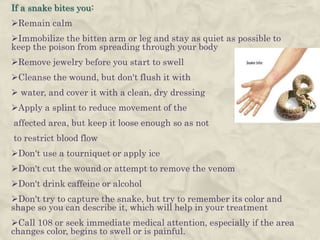
If a snake bites you:
Remain calm
Immobilize the bitten arm or leg and stay as quiet as possible to
keep the poison from spreading through your body
Remove jewelry before you start to swell
Cleanse the wound, but don't flush it with
 water, and cover it with a clean, dry dressing
Apply a splint to reduce movement of the
affected area, but keep it loose enough so as not
to restrict blood flow
Don't use a tourniquet or apply ice
Don't cut the wound or attempt to remove the venom
Don't drink caffeine or alcohol
Don't try to capture the snake, but try to remember its color and
shape so you can describe it, which will help in your treatment
Call 108 or seek immediate medical attention, especially if the area
changes color, begins to swell or is painful.
SHOCK
 Shock refers to circulatory system failure that
happens when insufficient amounts of oxygenated
blood is provided for every body part. This can be as
the result of:
… Loss of blood due to uncontrolled bleeding or
other circulatory system problem.
… Loss of fluid due to dehydration or excessive
sweating.
… Trauma (injury)
… Occurrence of an extreme emotional event.
SHOCK CONT.
 What to Do
… After first treating life-threatening injuries such as
breathing or bleeding, the following procedures shall
be performed:
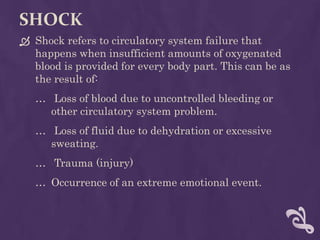
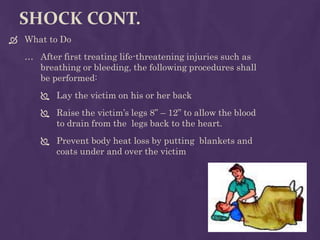
 Lay the victim on his or her back
 Raise the victim’s legs 8” – 12” to allow the blood
to drain from the legs back to the heart.
 Prevent body heat loss by putting blankets and
coats under and over the victim
Facilities Planning & Management
UW-Eau Claire
BURNS
 Burns have been described as:
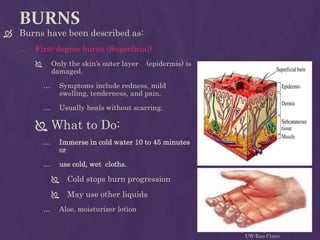
… First-degree burns (Superficial)
 Only the skin’s outer layer (epidermis) is
damaged.
… Symptoms include redness, mild
swelling, tenderness, and pain.
… Usually heals without scarring.
 What to Do:
… Immerse in cold water 10 to 45 minutes
or
… use cold, wet cloths.
 Cold stops burn progression
 May use other liquids
… Aloe, moisturizer lotion
BURNS CONT.
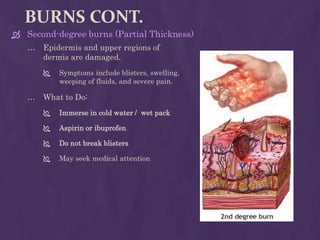
 Second-degree burns (Partial Thickness)
… Epidermis and upper regions of
dermis are damaged.
 Symptoms include blisters, swelling,
weeping of fluids, and severe pain.
… What to Do:
 Immerse in cold water / wet pack
 Aspirin or ibuprofen
 Do not break blisters
 May seek medical attention
BURNS CONT.
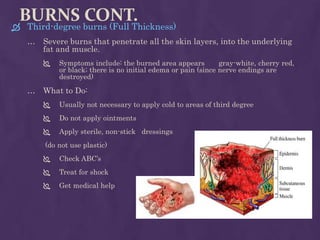
 Third-degree burns (Full Thickness)
… Severe burns that penetrate all the skin layers, into the underlying
fat and muscle.
 Symptoms include: the burned area appears gray-white, cherry red,
or black; there is no initial edema or pain (since nerve endings are
destroyed)
… What to Do:
 Usually not necessary to apply cold to areas of third degree
 Do not apply ointments
 Apply sterile, non-stick dressings
(do not use plastic)
 Check ABC’s
 Treat for shock
 Get medical help
BURNS CONT.
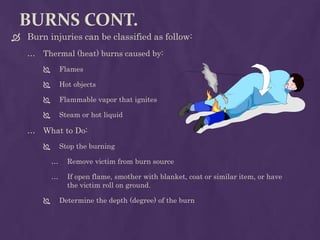
 Burn injuries can be classified as follow:
… Thermal (heat) burns caused by:
 Flames
 Hot objects
 Flammable vapor that ignites
 Steam or hot liquid
… What to Do:
 Stop the burning
… Remove victim from burn source
… If open flame, smother with blanket, coat or similar item, or have
the victim roll on ground.
 Determine the depth (degree) of the burn
CHEMICAL BURNS
 What to Do:
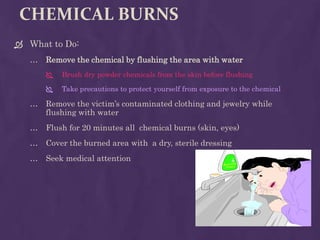
… Remove the chemical by flushing the area with water
 Brush dry powder chemicals from the skin before flushing
 Take precautions to protect yourself from exposure to the chemical
… Remove the victim’s contaminated clothing and jewelry while
flushing with water
… Flush for 20 minutes all chemical burns (skin, eyes)
… Cover the burned area with a dry, sterile dressing
… Seek medical attention
First aid
First aid

First aid

  • 2.
    FIRST AID by, Dr. DHEENKUMAR,M.PHARM,Ph.D., Principal, GP PHARMACY COLLEGE TIRUPATTUR, TAMILNADU- 635851
  • 3.
    FIRST AID ISTHE PROVISION OF INITIAL CARE FOR AN ILLNESS OR INJURY. IT IS USUALLY PERFORMED BY NON- EXPERT, BUT TRAINED PERSONNEL LIFE SAVING TECHNIQUES.
  • 4.
    AIM PRESERVE LIFE PREVENT FURTHERHARM PROMOTE RECOVERY
  • 5.
  • 6.
    ACCIDENTAL TRAUMA Head traumais an injury that affects the brain or skull Injuries range from minor to serious. Treatment : For mild injury- Apply ice to injured area to minimize swelling The size of the bump is not related to the severity of injury Observe the patient carefully for signs of bleeding
  • 7.
    For moderate tosevere injury · Check the patient's breathing pattern · If necessary do Cardio Pulmonary Resuscitation (CPR) · In case of bleeding, press area with a clean cloth · If the cloth soaks, place a fresh cloth over the first one · Do not remove debris from the wound · If person is vomiting turn on the side and lower the head · To minimize spine injury- hold head, neck and body in one line · If unconscious, treat it like a spinal injury
  • 8.
    HEART ATTACK  HeartAttack – Usually that happens when one of the coronary arteries is blocked by an obstruction or a spasm. … Signs and symptoms of a heart attack include:  Pressure in chest, fullness, squeezing, or pain that lasts more than a few minutes or that goes away and comes back.  Pain spreading to the shoulders, neck, or arms.  Chest discomfort with lightheadedness, fainting, sweating, nausea, or shortness of breath.
  • 9.
    HEART ATTACK  Whatto Do: … Call 108 or get to the nearest hospital emergency department with 24-emergency cardiac care. … Monitor victim’s condition. … Help the victim to the least painful position, usually sitting with legs up and bent at the knees.  Loosen clothing around the neck and midriff. … Determine if the victim is known to have coronary heart disease and is using nitroglycerin. … If the victim is unresponsive, check ABCs and start CPR, if needed.
  • 10.
    ELECTRIC SHOCK •Do notattempt to move the victim from current source. •First step is to switch off the current source. •Otherwise, move the source using a wooden stick Attend to the victim. •Check for breathing. •No breathing, do Cardio pulmonary resuscitation (CPR)Call emergency medical aid. •If breathing, do a physical examination Treat for minor burns. •Re-establish vital functions. •Excessive burns may require hospitalization/ surgery. •Supportive care must be provided.
  • 11.
    CARDIO PULMONARY RESUSCITATION(CPR) Cardiac Arrest Often caused by abnormal heart rhythm This aberrant rhythm is ventricular fibrillation (VF) During VF heart stops pumping blood Patient may stop breathing No pulse may be detected A shock to the heart, called defibrillation, required Defibrillation stops VF, restores heart function
  • 12.
    WHAT IS CPR? EMERGENCYLIFE-SAVING MEASURE COMBINATION OF RESCUE BREATHING & CHEST COMPRESSIONS DONE ON UNCONSCIOUS/ NON-BREATHING PATIENT CPR CONDUCTS DEFIBRILLATION SUPPORTS HEART PUMPING FOR SHORT DURATION ALLOWS OXYGEN TO REACH BRAIN MORE EFFECTIVE WHEN DONE AS EARLY AS POSSIBLE
  • 13.
    Mouth- to-mouth breathing Pinchthe person's nostril shut Seal his mouth with your own Give the first breath, lasting one second Watch if chest rises If it rises, give second rescue breath If it does not rise, give a head tilt- chin lift Now give second rescue breath
  • 14.
    POISONING Try and identifythe poison if possible · Check for signs like burns around mouth, breathing difficulty or vomiting · Induce vomiting if poison swallowed · In case of convulsions, protect the person from self injury · If the vomit falls on the skin, wash it thoroughly · Position the victim on the left till medical help arrives Steps to Avoid : Avoid giving an unconscious victim anything orally Do not induce vomiting unless told by a medical personnel Do not give any medication to the victim unless directed by a doctor Do not neutralize the poison with limejuice/honey
  • 15.
    ANIMAL BITES o Calmthe affected person. o Wash hands before attending to wound. o Wash wound with soap & running water. o Apply antibiotic ointment Dress using sterile bandage. o After first aid, medical treatment must be sought quickly. o Suturing may be required. o Tetanus booster / antibiotics required. o Treatment depends on type / location of wound.
  • 16.
    If a snakebites you: Remain calm Immobilize the bitten arm or leg and stay as quiet as possible to keep the poison from spreading through your body Remove jewelry before you start to swell Cleanse the wound, but don't flush it with  water, and cover it with a clean, dry dressing Apply a splint to reduce movement of the affected area, but keep it loose enough so as not to restrict blood flow Don't use a tourniquet or apply ice Don't cut the wound or attempt to remove the venom Don't drink caffeine or alcohol Don't try to capture the snake, but try to remember its color and shape so you can describe it, which will help in your treatment Call 108 or seek immediate medical attention, especially if the area changes color, begins to swell or is painful.
  • 17.
    SHOCK  Shock refersto circulatory system failure that happens when insufficient amounts of oxygenated blood is provided for every body part. This can be as the result of: … Loss of blood due to uncontrolled bleeding or other circulatory system problem. … Loss of fluid due to dehydration or excessive sweating. … Trauma (injury) … Occurrence of an extreme emotional event.
  • 18.
    SHOCK CONT.  Whatto Do … After first treating life-threatening injuries such as breathing or bleeding, the following procedures shall be performed:  Lay the victim on his or her back  Raise the victim’s legs 8” – 12” to allow the blood to drain from the legs back to the heart.  Prevent body heat loss by putting blankets and coats under and over the victim
  • 19.
    Facilities Planning &Management UW-Eau Claire BURNS  Burns have been described as: … First-degree burns (Superficial)  Only the skin’s outer layer (epidermis) is damaged. … Symptoms include redness, mild swelling, tenderness, and pain. … Usually heals without scarring.  What to Do: … Immerse in cold water 10 to 45 minutes or … use cold, wet cloths.  Cold stops burn progression  May use other liquids … Aloe, moisturizer lotion
  • 20.
    BURNS CONT.  Second-degreeburns (Partial Thickness) … Epidermis and upper regions of dermis are damaged.  Symptoms include blisters, swelling, weeping of fluids, and severe pain. … What to Do:  Immerse in cold water / wet pack  Aspirin or ibuprofen  Do not break blisters  May seek medical attention
  • 21.
    BURNS CONT.  Third-degreeburns (Full Thickness) … Severe burns that penetrate all the skin layers, into the underlying fat and muscle.  Symptoms include: the burned area appears gray-white, cherry red, or black; there is no initial edema or pain (since nerve endings are destroyed) … What to Do:  Usually not necessary to apply cold to areas of third degree  Do not apply ointments  Apply sterile, non-stick dressings (do not use plastic)  Check ABC’s  Treat for shock  Get medical help
  • 22.
    BURNS CONT.  Burninjuries can be classified as follow: … Thermal (heat) burns caused by:  Flames  Hot objects  Flammable vapor that ignites  Steam or hot liquid … What to Do:  Stop the burning … Remove victim from burn source … If open flame, smother with blanket, coat or similar item, or have the victim roll on ground.  Determine the depth (degree) of the burn
  • 23.
    CHEMICAL BURNS  Whatto Do: … Remove the chemical by flushing the area with water  Brush dry powder chemicals from the skin before flushing  Take precautions to protect yourself from exposure to the chemical … Remove the victim’s contaminated clothing and jewelry while flushing with water … Flush for 20 minutes all chemical burns (skin, eyes) … Cover the burned area with a dry, sterile dressing … Seek medical attention