FIRST AID
Dr. Abdirizak yusuf olow
MBBS-Somali international university
Senior clerkship at the university of Nairobi(UoN)
Clinical internship at MBALE RR HOSPITAL-uganda
The Basics of First Aid
Defining “First Aid”
• FIRST - coming before all others in time
or order; earliest;
• 1st. AID -help or support (someone or
something) in the achievement of
something.
• DEFINITION: “First Aid is defined as any
and all emergency care given to an injured
or sick person prior to the intervention of
any professional medical treatment”.
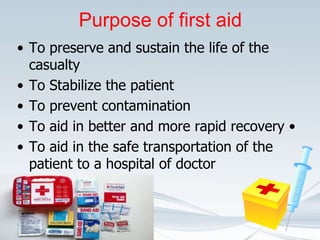
Purpose of first aid
• To preserve and sustain the life of the
casualty
• To Stabilize the patient
• To prevent contamination
• To aid in better and more rapid recovery •
• To aid in the safe transportation of the
patient to a hospital of doctor
Points to be clear on
• You are NOT A DOCTOR.
• Role of the first aider is to help keep the patient
alive, as comfortable as possible till medical help
arrive.
• NEVER give up on a patient.
• Only a doctor should declare a patient dead and
stop life-saving procedures.
• Your efforts may save a life.
• Being aware of safety issues
• You cannot help someone else if you become a
victim yourself!
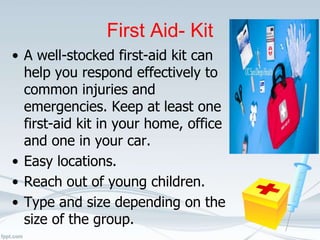
First Aid- Kit
• A well-stocked first-aid kit can
help you respond effectively to
common injuries and
emergencies. Keep at least one
first-aid kit in your home, office
and one in your car.
• Easy locations.
• Reach out of young children.
• Type and size depending on the
size of the group.
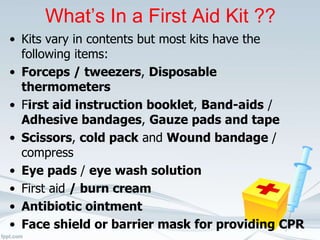
What’s In a First Aid Kit ??
• Kits vary in contents but most kits have the
following items:
• Forceps / tweezers, Disposable
thermometers
• First aid instruction booklet, Band-aids /
Adhesive bandages, Gauze pads and tape
• Scissors, cold pack and Wound bandage /
compress
• Eye pads / eye wash solution
• First aid / burn cream
• Antibiotic ointment
• Face shield or barrier mask for providing CPR
Dressings and Bandages
The purpose of a dressing
is to:
• Control bleeding
• Prevent infection and
contamination
• Absorb blood and
fluid drainage
• Protect the wound
from further injury
What to Do:
• Always wear gloves (if
possible)
• Use a dressing large
enough to extend
beyond the wound’s
edges.
• Cover the dressing
with bandages.
Dressings and Bandages cont…
• Bandage can be used to:
i. Hold a dressing in place over an open wound
ii. Apply direct pressure over a dressing to control
bleeding
iii.Prevent or reduce swelling
iv.Provide support and stability for an extremity or
joint
v. Bandage should be clean but need not be
sterile.
Spinal Injuries
• Spinal Injuries:
• Head injuries may indicate that there are possible spinal
injuries
i. It may have been moved suddenly in one or more directions,
damaging the spine.
• What to Look For :
• General signs & symptoms:
i. Painful movement of the arms or legs
ii. Numbness, tingling, weakness, or burning sensation in the
arms or legs
iii.Loss of bowel or bladder control
iv.Paralysis of the arms or legs
v. Deformity (odd-looking angle of the victim’s head & neck
Spinal Injuries Cont.
• What to Do:
• Stabilize the victim against
any movement.
• Check ABCs. (Airway
Breathing Circulation)
• Unresponsive Victim:
• Look for cuts, bruise, and
deformities.
• Test response by pinching
the victim’s hand, and bare
foot.
• If no reaction, assume the
victim may have spinal
damage
• Responsive Victim
• Upper Extremity Checks:
• Victim wiggles fingers.
• Victim feels rescuer
squeeze fingers.
• Victim squeeze rescuer’s
hand.
• Lower Extremity
Checks:
• Victim wiggles toes.
• Victim feels rescuer
squeezes toes.
• Victim pushes foot against
rescuer’s hand.
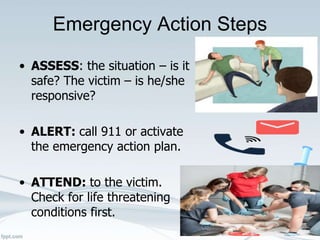
Emergency Action Steps
• ASSESS: the situation – is it
safe? The victim – is he/she
responsive?
• ALERT: call 911 or activate
the emergency action plan.
• ATTEND: to the victim.
Check for life threatening
conditions first.
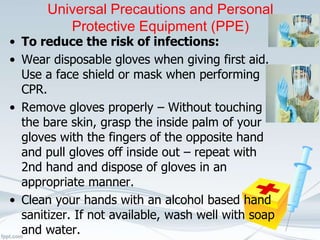
Universal Precautions and Personal
Protective Equipment (PPE)
• To reduce the risk of infections:
• Wear disposable gloves when giving first aid.
Use a face shield or mask when performing
CPR.
• Remove gloves properly – Without touching
the bare skin, grasp the inside palm of your
gloves with the fingers of the opposite hand
and pull gloves off inside out – repeat with
2nd hand and dispose of gloves in an
appropriate manner.
• Clean your hands with an alcohol based hand
sanitizer. If not available, wash well with soap
and water.
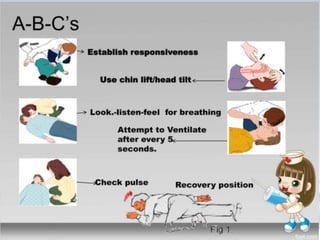
The ABCs of First Aid
• The ABCs stands for…
1.Airway
2.Breathing
3.Circulation
• Additional things to pay attention to:
i. Notice the color of the persons’ skin. Blue, grey
or purple colors usually indicate illness.
ii. Try to smell for alcohol on the breath
iii.Listen for groaning noises or rasping in the
breathing.
iv.Listen for coughing or spluttering
Adult / Child Choking : Severe Airway
Blockage
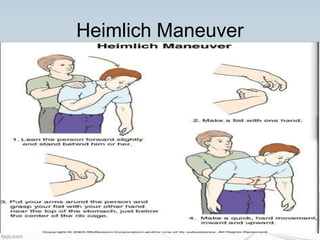
• Victim is responsive:
i. Quickly ask, “are you choking?”
ii. If the victim nods yes, or is unable to talk, speak, or
cough – act quickly.
iii.Stand behind the victim.
iv.Make a fist and place the thumb side of that hand
against the victim’s abdomen, just above the navel
and below the ribs. Grasp fist with the other hand.
v. Quickly thrust inward and upward into the abdomen.
vi.Repeat thrusts until object is expelled or victim
becomes unresponsive.
Adult / Child Choking : Severe Airway
Blockage
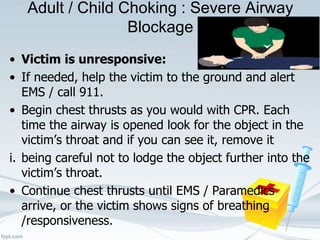
• Victim is unresponsive:
• If needed, help the victim to the ground and alert
EMS / call 911.
• Begin chest thrusts as you would with CPR. Each
time the airway is opened look for the object in the
victim’s throat and if you can see it, remove it
i. being careful not to lodge the object further into the
victim’s throat.
• Continue chest thrusts until EMS / Paramedics
arrive, or the victim shows signs of breathing
/responsiveness.
Heimlich Maneuver
Basic First Aid Instructions Minor
Wounds
Minor wounds include abrasions, lacerations, punctures
and incisions. The most significant issues to consider with
any open wound are control of bleeding and infection.
• Signs and Symptoms:
• Break, cut or opening in the
skin
• Bleeding – may be minor,
moderate or severe
• Bruising and pain
• Infection
• Progressing shock
• First Aid:
• If bleeding, apply direct
pressure with a clean cloth
or absorbent pad.
• Wash area with antibacterial
soap and clean until there
appears to be no foreign
matter in the wound.
• Cover area with an adhesive
bandage or gauze wrap
Minor Wounds, continued
• Bruising: Caused by broken
blood vessels leaking blood under
the skin. Bruising can be minimal
or large and severe.
• Signs and Symptoms:
• Pain and swelling
• Discoloration: new bruising will be
dark purple / older bruising will
fade to greenish yellow
• First Aid:
• Apply ice to injury to reduce pain,
bleeding and swelling.
• To prevent frost bite to the
injured area, place a thin towel or
cloth between the skin and ice.
Limit ice application to 20 minutes
on, 20 off.
Crush Injury: Occurs when a
body part is subjected to a high
degree of force or pressure .
Example: smashed fingers in
door.
Signs and Symptoms:
• Pain and swelling
• Discoloration and sometimes
deformity
• First Aid:
• Apply ice just as you would
with a bruising injury.
• If pain is severe and does not
lessen with ice or there is
decreased sensation,
weakness, or paleness of the
skin in the affected area,
seek emergency care.
Burns
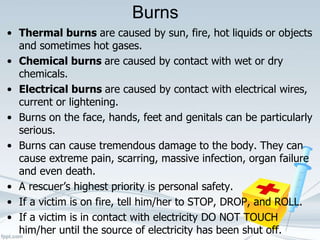
• Thermal burns are caused by sun, fire, hot liquids or objects
and sometimes hot gases.
• Chemical burns are caused by contact with wet or dry
chemicals.
• Electrical burns are caused by contact with electrical wires,
current or lightening.
• Burns on the face, hands, feet and genitals can be particularly
serious.
• Burns can cause tremendous damage to the body. They can
cause extreme pain, scarring, massive infection, organ failure
and even death.
• A rescuer’s highest priority is personal safety.
• If a victim is on fire, tell him/her to STOP, DROP, and ROLL.
• If a victim is in contact with electricity DO NOT TOUCH
him/her until the source of electricity has been shut off.
Burns: Minor/Major and First Aid Care
Minor Burns:
• Signs and Symptoms:
• Pain, Redness • Swelling,
Blisters First Aid:
• Expose the burn.
• Cool burns with cold water
and continue until pain
lessens.
• After cooling, cover with a
dry, sterile bandage or clean
dressing.
• Protect from friction /pressure
• DO NOT pop blisters or apply
any ointment or other
substance.
Major Burns:
• Signs and Symptoms:
• Dry/leathery, white or
blackened, charred skin
First Aid:
• Assess/Alert/Attend to
any life threatening
problems.
• Call 911and Activate EMS.
• If caused by a liquid
chemical, flush with large
amounts of water right
away if you are fully
trained in First Aid.
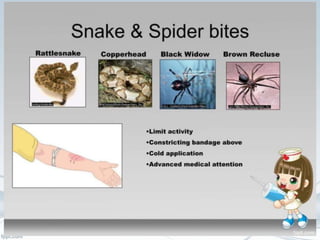
Bites and Stings
• Bites and stings that could require first aid care can
occur from a wide variety of sources.
• Most cause only minor discomfort and can easily be
treated by a first aid provider. However bites and stings
from venomous snakes, insects or animals can cause
intense pain and swelling.
• Bites from humans and animals such as dogs, cats, bats,
etc., can cause severe injury and infection, including
tetanus and rabies.
• Some people have severe allergic reactions to bites or
stings that can be life threatening.
• In these cases, the most important first aid measure is
rapid access to advanced emergency medical care
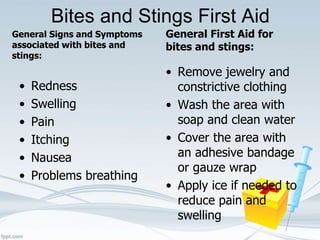
Bites and Stings First Aid
General Signs and Symptoms
associated with bites and
stings:
• Redness
• Swelling
• Pain
• Itching
• Nausea
• Problems breathing
General First Aid for
bites and stings:
• Remove jewelry and
constrictive clothing
• Wash the area with
soap and clean water
• Cover the area with
an adhesive bandage
or gauze wrap
• Apply ice if needed to
reduce pain and
swelling
Nosebleeds and First Aid
• Most nosebleeds are not serious and can be handled
by a first aid responder.
• Most will stop on their own or with simple first aid
actions.
• In some cases nosebleeds can indicate a more
serious condition which may require ongoing medical
attention.
• If the nose bleed is related to an injury, the victim
should be assisted in finding medical assistance
urgently.
• Some people may be taking medications that make
them more prone to bleeding. These people should
also seek care urgently.
Diabetes and Diabetic Emergencies
• Diabetes is a chronic condition that causes
an imbalance of blood sugar and insulin.
Emergencies can occur if someone’s blood
sugar becomes very high or very low.
• Several factors can contribute to
hypoglycemia in people with diabetes,
including taking too much insulin or other
diabetes medications, skipping a meal, or
exercising more or at a higher intensity
than usual.
Hypoglycemia (Low Blood Sugar)
Signs and Symptoms
• Shakiness
• Dizziness
• Sweating
• Hunger
• Irritability or moodiness
• Anxiety or nervousness
• Headache, vision
problems
• Drowsiness
• Seizures
First Aid Interventions:
• Five to six pieces of hard candy
• Four ounces of fruit juice or
regular not diet soda
• One tablespoon of sugar, jelly
or honey
• Three glucose tablets (available
without a prescription at most
pharmacies)
• Use the above interventions
only if victim is alert – if not
alert or appears confused, call
911.
Heat Exhaustion & Heat Stroke
• Causes of heat exhaustion include exposure to high
temperatures, particularly when combined with high
humidity, and strenuous physical activity. Without
prompt treatment, heat exhaustion can lead to
heatstroke, a life-threatening condition. Fortunately,
heat exhaustion is preventable.
• Heatstroke occurs if your body temperature
continues to rise. At this point, emergency treatment
is needed. In a period of hours, untreated heatstroke
can cause damage to your brain, heart, kidneys and
muscles. These injuries get worse the longer
treatment is delayed, increasing your risk of very
serious complications.
Fractures
• Definition: A fracture is a break or splinter in a bone.
It can be caused by violent impact or by any number of
diseases that cause bone decay.
• classifications of fractures:
1)Greenstick fracture – which is a simple crack in the
bone. They can be determined by a doctor using an x-ray
machine.
2)Closed or “simple” fracture – in which the broken
bone has not pierced through the skin.
3)Open or “compound” fracture – in which the broken
bone has pierced or torn the skin resulting in an open
wound.
4)Comminuted or “multiple” fracture – in which the
bone is broken in more than one place.
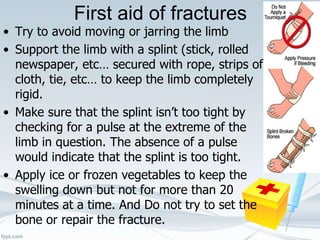
First aid of fractures
• Try to avoid moving or jarring the limb
• Support the limb with a splint (stick, rolled
newspaper, etc… secured with rope, strips of
cloth, tie, etc… to keep the limb completely
rigid.
• Make sure that the splint isn’t too tight by
checking for a pulse at the extreme of the
limb in question. The absence of a pulse
would indicate that the splint is too tight.
• Apply ice or frozen vegetables to keep the
swelling down but not for more than 20
minutes at a time. And Do not try to set the
bone or repair the fracture.
Asthma
• Asthma is a chronic disease that causes
the airways to constrict, become inflamed
or accumulates excessive amounts of
mucus. These attacks may be triggered by
a number of different factors including
cigarette smoke, pollen, cold air, warm air,
pet dander and any number of other
airborne particulates. Additionally the
triggers may be brought on because of
emotions or excursions. Asthma can be
severe and, in extreme cases, the attacks
can be fatal.
First – Aid - asthma
• Help the sufferer sit upright as it is easier for them to breathe
in this position than if they are laying down.
• Try to calm them. Talk with a soothing voice. Do not panic and
add to the emotional stress that the sufferer is already
experiencing. Any additional stress will just make matters
worse.
• Get them to take their medication. Help them if they can’t take
it for themselves. Shake the inhaler and give them one good
puff. Have them hold the breath in for 4 seconds or so followed
by 4-5 normal breaths. Repeat this procedure up to four times.
If, after 4 minutes there is no improvement you should repeat
the procedure.
• If there is still no improvement in the sufferers condition, call
911 and stay with them until help arrive
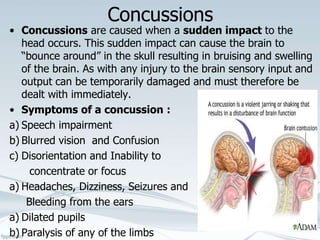
Concussions
• Concussions are caused when a sudden impact to the
head occurs. This sudden impact can cause the brain to
“bounce around” in the skull resulting in bruising and swelling
of the brain. As with any injury to the brain sensory input and
output can be temporarily damaged and must therefore be
dealt with immediately.
• Symptoms of a concussion :
a) Speech impairment
b) Blurred vision and Confusion
c) Disorientation and Inability to
concentrate or focus
a) Headaches, Dizziness, Seizures and
Bleeding from the ears
a) Dilated pupils
b) Paralysis of any of the limbs
First – Aid - concussion
• Lay the patient down on his or her back with legs elevated
over the head and loosen all clothing.
• Apply a damp cloth to face and neck
• DO NOT GIVE THEM ANYTHING TO DRINK, even if they ask for it.
• Although most concussions do not require any additional
medical treatment except rest, it is important to note two very
important facts related to concussions:
• Immediate symptoms and the injury seemed to be a minor
one. This means that it is better to be safe and to have a
patient checked out by a professional if there is the least
doubt.
• Damage from concussions can be cumulative. It is therefore
essential to keep the head protected by using hard hats, bump
caps and helmets. It is also essential to use seatbelts while
driving.
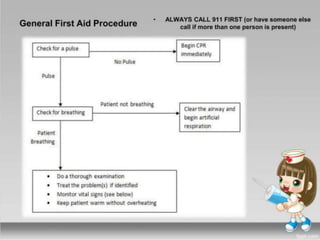
Performing CPR
• If the patient is not breathing, tilt their head back and
cover their mouth with yours. Blow until you see their
chest rise. Breathe this way twice for two seconds
each.
• If the patient still shows no signs of life (sputtering,
coughing, etc…) begin chest compressions directly
between the nipples. Most people do not compress
hard enough. Push hard, using the heel of your hand
with the other hand over it. Pump at the rate of 100
compressions per minute. Again, most people do not
pump fast enough.
• Breaths to pumps should ideally be 2 breaths to 15
pumps.
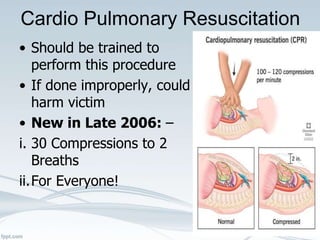
Cardio Pulmonary Resuscitation
• Should be trained to
perform this procedure
• If done improperly, could
harm victim
• New in Late 2006: –
i. 30 Compressions to 2
Breaths
ii.For Everyone!
CHAPTER 4 First Aid.ppt

CHAPTER 4 First Aid.ppt

  • 1.
    FIRST AID Dr. Abdirizakyusuf olow MBBS-Somali international university Senior clerkship at the university of Nairobi(UoN) Clinical internship at MBALE RR HOSPITAL-uganda
  • 2.
    The Basics ofFirst Aid Defining “First Aid” • FIRST - coming before all others in time or order; earliest; • 1st. AID -help or support (someone or something) in the achievement of something. • DEFINITION: “First Aid is defined as any and all emergency care given to an injured or sick person prior to the intervention of any professional medical treatment”.
  • 3.
    Purpose of firstaid • To preserve and sustain the life of the casualty • To Stabilize the patient • To prevent contamination • To aid in better and more rapid recovery • • To aid in the safe transportation of the patient to a hospital of doctor
  • 4.
    Points to beclear on • You are NOT A DOCTOR. • Role of the first aider is to help keep the patient alive, as comfortable as possible till medical help arrive. • NEVER give up on a patient. • Only a doctor should declare a patient dead and stop life-saving procedures. • Your efforts may save a life. • Being aware of safety issues • You cannot help someone else if you become a victim yourself!
  • 5.
    First Aid- Kit •A well-stocked first-aid kit can help you respond effectively to common injuries and emergencies. Keep at least one first-aid kit in your home, office and one in your car. • Easy locations. • Reach out of young children. • Type and size depending on the size of the group.
  • 6.
    What’s In aFirst Aid Kit ?? • Kits vary in contents but most kits have the following items: • Forceps / tweezers, Disposable thermometers • First aid instruction booklet, Band-aids / Adhesive bandages, Gauze pads and tape • Scissors, cold pack and Wound bandage / compress • Eye pads / eye wash solution • First aid / burn cream • Antibiotic ointment • Face shield or barrier mask for providing CPR
  • 7.
    Dressings and Bandages Thepurpose of a dressing is to: • Control bleeding • Prevent infection and contamination • Absorb blood and fluid drainage • Protect the wound from further injury What to Do: • Always wear gloves (if possible) • Use a dressing large enough to extend beyond the wound’s edges. • Cover the dressing with bandages.
  • 8.
    Dressings and Bandagescont… • Bandage can be used to: i. Hold a dressing in place over an open wound ii. Apply direct pressure over a dressing to control bleeding iii.Prevent or reduce swelling iv.Provide support and stability for an extremity or joint v. Bandage should be clean but need not be sterile.
  • 9.
    Spinal Injuries • SpinalInjuries: • Head injuries may indicate that there are possible spinal injuries i. It may have been moved suddenly in one or more directions, damaging the spine. • What to Look For : • General signs & symptoms: i. Painful movement of the arms or legs ii. Numbness, tingling, weakness, or burning sensation in the arms or legs iii.Loss of bowel or bladder control iv.Paralysis of the arms or legs v. Deformity (odd-looking angle of the victim’s head & neck
  • 10.
    Spinal Injuries Cont. •What to Do: • Stabilize the victim against any movement. • Check ABCs. (Airway Breathing Circulation) • Unresponsive Victim: • Look for cuts, bruise, and deformities. • Test response by pinching the victim’s hand, and bare foot. • If no reaction, assume the victim may have spinal damage • Responsive Victim • Upper Extremity Checks: • Victim wiggles fingers. • Victim feels rescuer squeeze fingers. • Victim squeeze rescuer’s hand. • Lower Extremity Checks: • Victim wiggles toes. • Victim feels rescuer squeezes toes. • Victim pushes foot against rescuer’s hand.
  • 11.
    Emergency Action Steps •ASSESS: the situation – is it safe? The victim – is he/she responsive? • ALERT: call 911 or activate the emergency action plan. • ATTEND: to the victim. Check for life threatening conditions first.
  • 12.
    Universal Precautions andPersonal Protective Equipment (PPE) • To reduce the risk of infections: • Wear disposable gloves when giving first aid. Use a face shield or mask when performing CPR. • Remove gloves properly – Without touching the bare skin, grasp the inside palm of your gloves with the fingers of the opposite hand and pull gloves off inside out – repeat with 2nd hand and dispose of gloves in an appropriate manner. • Clean your hands with an alcohol based hand sanitizer. If not available, wash well with soap and water.
  • 13.
    The ABCs ofFirst Aid • The ABCs stands for… 1.Airway 2.Breathing 3.Circulation • Additional things to pay attention to: i. Notice the color of the persons’ skin. Blue, grey or purple colors usually indicate illness. ii. Try to smell for alcohol on the breath iii.Listen for groaning noises or rasping in the breathing. iv.Listen for coughing or spluttering
  • 16.
    Adult / ChildChoking : Severe Airway Blockage • Victim is responsive: i. Quickly ask, “are you choking?” ii. If the victim nods yes, or is unable to talk, speak, or cough – act quickly. iii.Stand behind the victim. iv.Make a fist and place the thumb side of that hand against the victim’s abdomen, just above the navel and below the ribs. Grasp fist with the other hand. v. Quickly thrust inward and upward into the abdomen. vi.Repeat thrusts until object is expelled or victim becomes unresponsive.
  • 17.
    Adult / ChildChoking : Severe Airway Blockage • Victim is unresponsive: • If needed, help the victim to the ground and alert EMS / call 911. • Begin chest thrusts as you would with CPR. Each time the airway is opened look for the object in the victim’s throat and if you can see it, remove it i. being careful not to lodge the object further into the victim’s throat. • Continue chest thrusts until EMS / Paramedics arrive, or the victim shows signs of breathing /responsiveness.
  • 18.
  • 19.
    Basic First AidInstructions Minor Wounds Minor wounds include abrasions, lacerations, punctures and incisions. The most significant issues to consider with any open wound are control of bleeding and infection. • Signs and Symptoms: • Break, cut or opening in the skin • Bleeding – may be minor, moderate or severe • Bruising and pain • Infection • Progressing shock • First Aid: • If bleeding, apply direct pressure with a clean cloth or absorbent pad. • Wash area with antibacterial soap and clean until there appears to be no foreign matter in the wound. • Cover area with an adhesive bandage or gauze wrap
  • 20.
    Minor Wounds, continued •Bruising: Caused by broken blood vessels leaking blood under the skin. Bruising can be minimal or large and severe. • Signs and Symptoms: • Pain and swelling • Discoloration: new bruising will be dark purple / older bruising will fade to greenish yellow • First Aid: • Apply ice to injury to reduce pain, bleeding and swelling. • To prevent frost bite to the injured area, place a thin towel or cloth between the skin and ice. Limit ice application to 20 minutes on, 20 off. Crush Injury: Occurs when a body part is subjected to a high degree of force or pressure . Example: smashed fingers in door. Signs and Symptoms: • Pain and swelling • Discoloration and sometimes deformity • First Aid: • Apply ice just as you would with a bruising injury. • If pain is severe and does not lessen with ice or there is decreased sensation, weakness, or paleness of the skin in the affected area, seek emergency care.
  • 22.
    Burns • Thermal burnsare caused by sun, fire, hot liquids or objects and sometimes hot gases. • Chemical burns are caused by contact with wet or dry chemicals. • Electrical burns are caused by contact with electrical wires, current or lightening. • Burns on the face, hands, feet and genitals can be particularly serious. • Burns can cause tremendous damage to the body. They can cause extreme pain, scarring, massive infection, organ failure and even death. • A rescuer’s highest priority is personal safety. • If a victim is on fire, tell him/her to STOP, DROP, and ROLL. • If a victim is in contact with electricity DO NOT TOUCH him/her until the source of electricity has been shut off.
  • 23.
    Burns: Minor/Major andFirst Aid Care Minor Burns: • Signs and Symptoms: • Pain, Redness • Swelling, Blisters First Aid: • Expose the burn. • Cool burns with cold water and continue until pain lessens. • After cooling, cover with a dry, sterile bandage or clean dressing. • Protect from friction /pressure • DO NOT pop blisters or apply any ointment or other substance. Major Burns: • Signs and Symptoms: • Dry/leathery, white or blackened, charred skin First Aid: • Assess/Alert/Attend to any life threatening problems. • Call 911and Activate EMS. • If caused by a liquid chemical, flush with large amounts of water right away if you are fully trained in First Aid.
  • 24.
    Bites and Stings •Bites and stings that could require first aid care can occur from a wide variety of sources. • Most cause only minor discomfort and can easily be treated by a first aid provider. However bites and stings from venomous snakes, insects or animals can cause intense pain and swelling. • Bites from humans and animals such as dogs, cats, bats, etc., can cause severe injury and infection, including tetanus and rabies. • Some people have severe allergic reactions to bites or stings that can be life threatening. • In these cases, the most important first aid measure is rapid access to advanced emergency medical care
  • 25.
    Bites and StingsFirst Aid General Signs and Symptoms associated with bites and stings: • Redness • Swelling • Pain • Itching • Nausea • Problems breathing General First Aid for bites and stings: • Remove jewelry and constrictive clothing • Wash the area with soap and clean water • Cover the area with an adhesive bandage or gauze wrap • Apply ice if needed to reduce pain and swelling
  • 27.
    Nosebleeds and FirstAid • Most nosebleeds are not serious and can be handled by a first aid responder. • Most will stop on their own or with simple first aid actions. • In some cases nosebleeds can indicate a more serious condition which may require ongoing medical attention. • If the nose bleed is related to an injury, the victim should be assisted in finding medical assistance urgently. • Some people may be taking medications that make them more prone to bleeding. These people should also seek care urgently.
  • 28.
    Diabetes and DiabeticEmergencies • Diabetes is a chronic condition that causes an imbalance of blood sugar and insulin. Emergencies can occur if someone’s blood sugar becomes very high or very low. • Several factors can contribute to hypoglycemia in people with diabetes, including taking too much insulin or other diabetes medications, skipping a meal, or exercising more or at a higher intensity than usual.
  • 29.
    Hypoglycemia (Low BloodSugar) Signs and Symptoms • Shakiness • Dizziness • Sweating • Hunger • Irritability or moodiness • Anxiety or nervousness • Headache, vision problems • Drowsiness • Seizures First Aid Interventions: • Five to six pieces of hard candy • Four ounces of fruit juice or regular not diet soda • One tablespoon of sugar, jelly or honey • Three glucose tablets (available without a prescription at most pharmacies) • Use the above interventions only if victim is alert – if not alert or appears confused, call 911.
  • 30.
    Heat Exhaustion &Heat Stroke • Causes of heat exhaustion include exposure to high temperatures, particularly when combined with high humidity, and strenuous physical activity. Without prompt treatment, heat exhaustion can lead to heatstroke, a life-threatening condition. Fortunately, heat exhaustion is preventable. • Heatstroke occurs if your body temperature continues to rise. At this point, emergency treatment is needed. In a period of hours, untreated heatstroke can cause damage to your brain, heart, kidneys and muscles. These injuries get worse the longer treatment is delayed, increasing your risk of very serious complications.
  • 31.
    Fractures • Definition: Afracture is a break or splinter in a bone. It can be caused by violent impact or by any number of diseases that cause bone decay. • classifications of fractures: 1)Greenstick fracture – which is a simple crack in the bone. They can be determined by a doctor using an x-ray machine. 2)Closed or “simple” fracture – in which the broken bone has not pierced through the skin. 3)Open or “compound” fracture – in which the broken bone has pierced or torn the skin resulting in an open wound. 4)Comminuted or “multiple” fracture – in which the bone is broken in more than one place.
  • 32.
    First aid offractures • Try to avoid moving or jarring the limb • Support the limb with a splint (stick, rolled newspaper, etc… secured with rope, strips of cloth, tie, etc… to keep the limb completely rigid. • Make sure that the splint isn’t too tight by checking for a pulse at the extreme of the limb in question. The absence of a pulse would indicate that the splint is too tight. • Apply ice or frozen vegetables to keep the swelling down but not for more than 20 minutes at a time. And Do not try to set the bone or repair the fracture.
  • 33.
    Asthma • Asthma isa chronic disease that causes the airways to constrict, become inflamed or accumulates excessive amounts of mucus. These attacks may be triggered by a number of different factors including cigarette smoke, pollen, cold air, warm air, pet dander and any number of other airborne particulates. Additionally the triggers may be brought on because of emotions or excursions. Asthma can be severe and, in extreme cases, the attacks can be fatal.
  • 34.
    First – Aid- asthma • Help the sufferer sit upright as it is easier for them to breathe in this position than if they are laying down. • Try to calm them. Talk with a soothing voice. Do not panic and add to the emotional stress that the sufferer is already experiencing. Any additional stress will just make matters worse. • Get them to take their medication. Help them if they can’t take it for themselves. Shake the inhaler and give them one good puff. Have them hold the breath in for 4 seconds or so followed by 4-5 normal breaths. Repeat this procedure up to four times. If, after 4 minutes there is no improvement you should repeat the procedure. • If there is still no improvement in the sufferers condition, call 911 and stay with them until help arrive
  • 35.
    Concussions • Concussions arecaused when a sudden impact to the head occurs. This sudden impact can cause the brain to “bounce around” in the skull resulting in bruising and swelling of the brain. As with any injury to the brain sensory input and output can be temporarily damaged and must therefore be dealt with immediately. • Symptoms of a concussion : a) Speech impairment b) Blurred vision and Confusion c) Disorientation and Inability to concentrate or focus a) Headaches, Dizziness, Seizures and Bleeding from the ears a) Dilated pupils b) Paralysis of any of the limbs
  • 36.
    First – Aid- concussion • Lay the patient down on his or her back with legs elevated over the head and loosen all clothing. • Apply a damp cloth to face and neck • DO NOT GIVE THEM ANYTHING TO DRINK, even if they ask for it. • Although most concussions do not require any additional medical treatment except rest, it is important to note two very important facts related to concussions: • Immediate symptoms and the injury seemed to be a minor one. This means that it is better to be safe and to have a patient checked out by a professional if there is the least doubt. • Damage from concussions can be cumulative. It is therefore essential to keep the head protected by using hard hats, bump caps and helmets. It is also essential to use seatbelts while driving.
  • 37.
    Performing CPR • Ifthe patient is not breathing, tilt their head back and cover their mouth with yours. Blow until you see their chest rise. Breathe this way twice for two seconds each. • If the patient still shows no signs of life (sputtering, coughing, etc…) begin chest compressions directly between the nipples. Most people do not compress hard enough. Push hard, using the heel of your hand with the other hand over it. Pump at the rate of 100 compressions per minute. Again, most people do not pump fast enough. • Breaths to pumps should ideally be 2 breaths to 15 pumps.
  • 39.
    Cardio Pulmonary Resuscitation •Should be trained to perform this procedure • If done improperly, could harm victim • New in Late 2006: – i. 30 Compressions to 2 Breaths ii.For Everyone!