1
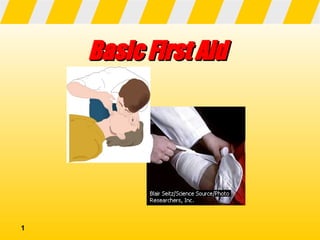
Basic First Aid
Basic First Aid
2
Securing the scene
Securing the scene
• 1. Electrical hazards
• 2. Chemical hazards
• 3. Noxious & Toxic gases
• 4. Ground hazards
• 5. Fire
• 6. Unstable equipment
Before performing any First Aid,
Check for:
Check for:
3
Chain of Survival
Early
Access”911”
Early CPR
or First Aid
You
Early
Defibrillation
EMS on
scene
Early
Advanced
Care
Hospital
In order for a person to survive:
Pay attention to:
HISTORY; what happened; from the casualty or bystanders
SYMPTOMS; what only the casualty can tell you
SIGNS; what you can see for yourself
4
Universal Precautions for Airborne
& Bloodborn Pathogens
HIV & Hepatitis
Tuberculosis
Gloves & Respiratory
Barrier devise are a must to
prevent transmission of
diseases
5
DURING TREATMENT
DURING TREATMENT
avoid coughing, breathing, or speaking over the
avoid coughing, breathing, or speaking over the
wound
wound
avoid contact with body fluids
avoid contact with body fluids
use a face shield or mask with one-way-valve
use a face shield or mask with one-way-valve
when doing active resuscitation
use only clean bandages and dressings
use only clean bandages and dressings
avoid treating more than one casualty without
avoid treating more than one casualty without
washing hands and changing gloves
AFTER TREATMENT
AFTER TREATMENT
clean up both casualty and yourself
clean up both casualty and yourself
clean up the immediate vicinity
clean up the immediate vicinity
dispose of dressings, bandages, gloves and
dispose of dressings, bandages, gloves and
soiled clothing correctly
wash hands with soap and water
wash hands with soap and water
6
Fundamentals of First Aid
Activate EMS System
Activate EMS System
“911”
• 1. ABC (airway-breathing-circulation)
• 2. Control bleeding
• 3. Treat for Shock(medical emergencies)
• 4. Open wounds & Burns
• 5. Fractures & Dislocations
• 6. Transportation
7
ABC’s
ABC’s
• Causes of Respiratory/Cardiac Arrest
Electrical
Drowning
Toxic -
Noxious
gases
Suffocation
Heart Attack Trauma
Drugs Allergic reactions
8
Reaction Time
Reaction Time
• If CPR/Artificial respiration is administered
• Chance of brain damage
0 to 4 minutes -
4 to 6 minutes -
6 to 10 minutes-
10 minutes + -
Recovery rate of
Recovery rate of
victim if has
victim if has
artificial
artificial
respiration done
respiration done
immediately
immediately
Oxygenated
blood flow
must get to
brain
9
A-B-C’s
A-B-C’s
• Use chin lift/head tilt
Look.-listen-feel for breathing
Attempt to Ventilate
Ventilate Every 5 seconds
• Establish responsiveness
Check pulse Recovery position
10
Cardio Pulmonary Resuscitation
• Should be trained to perform this procedure
• If done improperly, could harm victim
• Courses available everywhere
• New in Late 2006
– 30 Compressions to 2 Breaths
– For Everyone!
11
Airway Obstructions
Airway Obstructions
open
closed
obstructed
Tongue
12
Heimlich Maneuver
Heimlich Maneuver
for
for
Conscious Airway Obstruction
13
Types of Bleeding
Types of Bleeding
•Veins
•Capillary
Spurting
Steady flow
Oozing
Artery
Internal Injuries
14
Types of Wounds
Types of Wounds
15
Control of Bleeding
Control of Bleeding
Direct Pressure
Elevation
Cold Applications
Pressure bandage
16
Pressure Points
Pressure Points
Where the artery
passes over a bone
close to the skin
Temporal
Facial
Carotid
Sub-clavian
Brachial
Radial
Ulnar
Femoral
Popliteal
Pedal
17
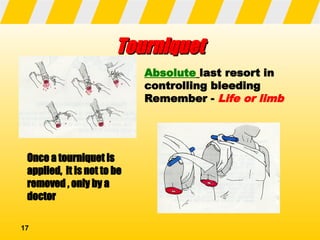
Tourniquet
Tourniquet
Absolute last resort in
controlling bleeding
Remember - Life or limb
Once a tourniquet is
applied, it is not to be
removed , only by a
doctor
18
Shock
Shock
Shock affects all major
functions of the body
loss of blood flow to the
tissues and organs
Shock must be treated in
all accident cases
19
Treatment for Shock
Treatment for Shock
•Lie victim down if possible
Lie victim down if possible
•Face is pale-raise the tail
Face is pale-raise the tail
•Face is red-raise the head
Face is red-raise the head
•Loosen tight clothing
Loosen tight clothing
•Keep victim warm and dry
Keep victim warm and dry
•Do not give anything by mouth
Do not give anything by mouth
•No stimulants
No stimulants
There are three types of
heat emergencies you may
be required to treat.
1.Heat Exhaustion
2.Heat Stroke
3.Heat Cramps
Heat exhaustion is less
dangerous than heat stroke.
It is caused by fluid loss which
in turn causes blood flow to
decrease in vital organs,
resulting in a form of shock.
Signs and Symptoms
Cool, Pale, and Moist Skin
Heavy Sweating
Dilated Pupils
Headache
Nausea
Vomiting
Body temperature will be near
Get the victim out of the heat and into a
cool place.
Place in the shock position, lying on the
back with feet raised.
Remove or loosen clothing.
Cool by fanning or applying cold packs or
wet towels or sheets. If conscious, give
water to drink every 15 minutes.
WHILE HEAT EXHAUSTION IS
NOT A LIFE- THREATENING
EMERGENCY LIKE HEAT
STROKE, IT CAN PROGRESS
TO HEAT STROKE IF LEFT
UNTREATED!
Heat cramps are muscular pain
and spasms due to heavy
exertion. They usually involve the
abdominal muscles or legs. It is
generally thought this condition
is caused by loss of water and
salt through sweating.
Get victim to a cool place.
If they can tolerate it, give one-half
glass of water every 15 minutes.
Heat cramps can usually be
avoided by increasing fluid intake
when active in hot weather.
Heat Stroke is the most serious type
of heat emergency.
It is LIFE-THREATENING and
requires
IMMEDIATE and
AGGRESSIVE treatment!
Heat stroke occurs when the body's heat
regulating mechanism fails. The body
temperature rises so high that brain damage --
and death-- may result unless the body is
cooled quickly.
Signs and Symptoms
The victim's skin is HOT, RED
and usually DRY.
Pupils are very small.
The body temperature is VERY
HIGH,
sometimes as high as 105
degrees.
Remember, Heat Stroke is a life-
threatening emergency and
requires prompt action!
Summon professional help.
Get the victim into a cool place.
Do not give victim anything by mouth. Treat
for shock.
COOL THE VICTIM AS QUICKLY AS
POSSIBLE IN ANY MANNER POSSIBLE!
Place the victim into a bathtub of cool water, wrap in
wet sheets, place in an air conditioned room.
32
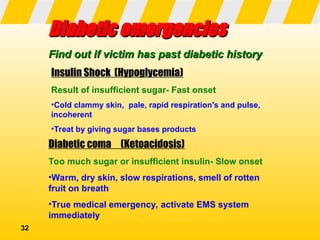
Diabetic emergencies
Insulin Shock (Hypoglycemia)
Result of insufficient sugar- Fast onset
•Cold clammy skin, pale, rapid respiration's and pulse,
incoherent
•Treat by giving sugar bases products
Diabetic coma (Ketoacidosis)
Too much sugar or insufficient insulin- Slow onset
•Warm, dry skin, slow respirations, smell of rotten
fruit on breath
•True medical emergency, activate EMS system
immediately
Find out if victim has past diabetic history
33
Snake & Spider bites
Rattlesnake Copperhead Black Widow Brown Recluse
Limit activity
Constricting bandage above
Cold application
Advanced medical attention
34
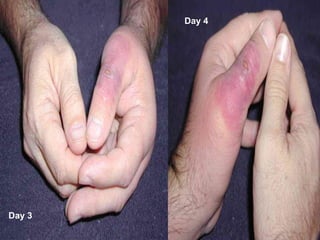
Brown
Brown
Recluse
Recluse
35
Day 3
Day 4
36
Day 5
Day 6
37
Day 9
Day 10
38
Burns
Burns
Cool applicationDon’t break
blisters
Dry sterile dressing, treat for
shock
RAPID TRANSPORT!!!
39
Severe Burns and Scalds
Treatment:
Cool the burn area with water for 10 to 20 minutes.
Lay the casualty down and make him as comfortable as possible,
protecting burn area from ground contact.
Gently remove any rings, watches, belts or constricting clothing
from the injured area before it begins to swell.
Cover the injured area loosely with sterile unmedicated dressing or
similar non fluffy material and bandage.
Don't remove anything that is sticking to the burn.
Don't apply lotions, ointments, butter or fat to the injury.
Don't break blisters or otherwise interfere with the injured area.
Don't over-cool the patient and cause shivering.
If breathing and heartbeat stop, begin resuscitation immediately,
If casualty is unconscious but breathing normally, place in the
recovery position.
Treat for shock.
Send for medical attention and prep for transport.
40
Minor Burns and Scalds
Treatment:
Place the injured part under slowly running water,
or soak in cold water for 10 minutes or as long as
pain persists.
Gently remove any rings, watches, belts, and
shoes from the injured area before it starts to
swell.
Dress with clean, sterile, non fluffy material.
Don't use adhesive dressings.
Don't apply lotions, ointments or fat to burn/
scald.
Don't break blisters or otherwise interfere.
If in doubt, seek medical aid.
41
Chemical Burns
Chemical Burns
Treatment:
Flood the area with slowly running water for
Flood the area with slowly running water for
at least ten minutes. (or proper neutralizing
agent)
agent)
Gently remove contaminated clothing while
Gently remove contaminated clothing while
flooding injured area, taking care not to
contaminate yourself.
Continue treatment for SEVERE BURNS
Continue treatment for SEVERE BURNS
Remove to hospital.
Remove to hospital.
42
Fractures & Dislocations
Must treat for bleeding first
Do not push
bones back
into place
Don’t straighten break
Treat the way you found it
43
IF A DISLOCATION IS SUSPECTED...
1. Apply a splint to the joint to keep it from moving.
2. Try to keep joint elevated to slow bloodflow to the area
3. A doctor should be contacted to have the bone set back
into its socket.
into its socket.
The most common dislocations occur in the shoulder, elbow,
finger, or thumb.
finger, or thumb.
Dislocations
Dislocations
LOOK FOR THESE SIGNS:
1. swelling
1. swelling
2. deformed look
2. deformed look
3. pain and tenderness
4. possible discoloration of the affected area
44
Splints
Splints
Must be a straight line break Can be formed to shape of
deformity
Be careful of temperature
change
45
PROPER CARE:
PROPER CARE:
1. While waiting on help to arrive, keep the victim lying down in the recovery
position
position
2. Control any bleeding, and be sure that he is breathing properly.
3. Do not give the victim any liquids to drink.
4. If the victim becomes unconscious for any amount of time, keep track of
this information so that you can report it when medical help arrives.
Head
Head Injuries
Injuries
A sharp blow to the head could result in a concussion, a jostling of the
brain inside its protective, bony covering. A more serious head injury
may result in contusions, or bruises to the brain.
OTHER SYMPTOMS TO LOOK FOR IF YOU SUSPECT A VICTIM MAY HAVE
A BRAIN INJURY:
A BRAIN INJURY:
1. clear or reddish fluid draining from the ears, nose, or mouth
2. difficulty in speaking
3. headache
3. headache
4. unequal size of pupils
5. pale skin
5. pale skin
6. paralysis of an arm or leg (opposite side of the injury) or face (same
side of the injury)
side of the injury)
46
Neck & Spinal Injuries
CARE AND TREATMENT
CARE AND TREATMENT
ABC
ABC
extreme care in initial
extreme care in initial
examination — minimal
movement
movement
urgent ambulance transport
urgent ambulance transport
apply cervical collar
apply cervical collar
treat for shock
treat for shock
treat any other injuries
treat any other injuries
maintain body heat
maintain body heat
if movement required, 'log roll'
if movement required, 'log roll'
and use assistants
and use assistants
always maintain casualty's head
always maintain casualty's head
in line with the shoulders
47
48
These are symptoms of what?
• Uncomfortable pressure ,
squeezing, fullness or dull pain in
the chest or upper abdomen
• Shortness of breath
• Pain in shoulders, arms, neck or
jaws
49
These are possible symptoms of what?
• Pain
• Swelling
• Bruising
• Distortion of limb
50
What type of burn is this?
1st
Degree
51
What should you never do for a
any degree burn?
Gunk it up.
52
The first way to control bleeding
is:
Direct pressure.
53
If you find an unconscious victim, you
should first:
• A. Try 2 rescue breaths
• B. Open the airway
• C. Call 911
• D. Treat major bleeding
54
If a choking victim becomes
unconscious, you should:
• A. Beat them on the back
• B. Check the mouth for
obstructions
• C. Try 2 rescue breaths
• D. Use abdominal thrusts
55
If you get something stuck in your eye,
you should:
• A. Use a tissue or gauze to pull it
out.
• B. Flush it with water
• C. Cover the eyes and get to a
doctor
• D. Rub it, and blink repeatedly
56
Rescue breathing should not be done:
• A. On supervisors
• B. If the person has a pulse
• C. On drowning victims
• D. If the person is breathing
57
Fall victims should be treated:
• A. The same as burn victims
• B. The same as choking victims
• C. As if they had a broken neck or
spine
• D. As soon as they wake up
58
What type of burn is this?
2nd
Degree
59
Victims of electrical shock can:
• A. Have serious burns
• B. Be disoriented
• C. Have no pulse
• D. All of the above
60
The best place to check for a pulse is:
• A. The back
• B. The neck
• C. The foot
• D. Inside the left armpit
61
The biggest killer of burn victims is:
• A. Shock
• B. Infection
• C. Contamination of blood
• D. First aiders
62
When calling 911, you should tell them:
• A. Your location
• B. The number of victims
• C. The type of injury, if known
• D. All of the above
63
Heart attack victims usually:
• A. Refuse to believe they are having one
• B. Like to jog a bit
• C. Have back pain
• D. Show all the symptoms
64
For second degree burns you should:
• A. Make sure you pop all blisters as they
appear
• B. Wrap in dry, sterile dressing
• C. Coat with burn cream
• D. None of the above
65
For sprains, you should:
• A. Apply pressure bandages
• B. Soak in hot water
• C. Apply cold packs
• D. Give two rescue breaths
66
What kind of burns are these?
67
If bitten by a snake, you should:
• A. Use a snakebite kit to open the
wound
• B. Use a tourniquet
• C. Apply cold packs and call 911
• D. Drink plenty of alcohol
68
Moving a victim with broken bones can
result in:
• A. Damage to internal tissues and organs
• B. Paralysis
• C. Death
• D. All of the above
69
You are most likely to perform first aid
at:
• A. Home
• B. Work
• C. Sporting events
• D. On the highway
70
You cannot be successfully sued as a
first aider because of:
• A. Lawyers aren’t like that
• B. People don’t sue those
who try to help them
• C. The Good Samaritan Law
• D. The Bill of Rights

Basic FIRST AID PRINCIPLES AND APPROPRIATE MEASURES

  • 1.
  • 2.
    2 Securing the scene Securingthe scene • 1. Electrical hazards • 2. Chemical hazards • 3. Noxious & Toxic gases • 4. Ground hazards • 5. Fire • 6. Unstable equipment Before performing any First Aid, Before performing any First Aid, Check for: Check for:
  • 3.
    3 Chain of Survival Early Access”911” EarlyCPR or First Aid You Early Defibrillation EMS on scene Early Advanced Care Hospital In order for a person to survive: Pay attention to: HISTORY; what happened; from the casualty or bystanders SYMPTOMS; what only the casualty can tell you SIGNS; what you can see for yourself
  • 4.
    4 Universal Precautions forAirborne & Bloodborn Pathogens HIV & Hepatitis Tuberculosis Gloves & Respiratory Barrier devise are a must to prevent transmission of diseases
  • 5.
    5 DURING TREATMENT DURING TREATMENT avoidcoughing, breathing, or speaking over the avoid coughing, breathing, or speaking over the wound wound avoid contact with body fluids avoid contact with body fluids use a face shield or mask with one-way-valve use a face shield or mask with one-way-valve when doing active resuscitation when doing active resuscitation use only clean bandages and dressings use only clean bandages and dressings avoid treating more than one casualty without avoid treating more than one casualty without washing hands and changing gloves washing hands and changing gloves AFTER TREATMENT AFTER TREATMENT clean up both casualty and yourself clean up both casualty and yourself clean up the immediate vicinity clean up the immediate vicinity dispose of dressings, bandages, gloves and dispose of dressings, bandages, gloves and soiled clothing correctly soiled clothing correctly wash hands with soap and water wash hands with soap and water
  • 6.
    6 Fundamentals of FirstAid Fundamentals of First Aid Activate EMS System Activate EMS System “911” • 1. ABC (airway-breathing-circulation) • 2. Control bleeding • 3. Treat for Shock(medical emergencies) • 4. Open wounds & Burns • 5. Fractures & Dislocations • 6. Transportation
  • 7.
    7 ABC’s ABC’s • Causes ofRespiratory/Cardiac Arrest Electrical Drowning Toxic - Noxious gases Suffocation Heart Attack Trauma Drugs Allergic reactions
  • 8.
    8 Reaction Time Reaction Time •If CPR/Artificial respiration is administered • Chance of brain damage 0 to 4 minutes - 4 to 6 minutes - 6 to 10 minutes- 10 minutes + - Recovery rate of Recovery rate of victim if has victim if has artificial artificial respiration done respiration done immediately immediately Oxygenated blood flow must get to brain
  • 9.
    9 A-B-C’s A-B-C’s • Use chinlift/head tilt Look.-listen-feel for breathing Attempt to Ventilate Ventilate Every 5 seconds • Establish responsiveness Check pulse Recovery position
  • 10.
    10 Cardio Pulmonary Resuscitation CardioPulmonary Resuscitation • Should be trained to perform this procedure • If done improperly, could harm victim • Courses available everywhere • New in Late 2006 – 30 Compressions to 2 Breaths – For Everyone!
  • 11.
  • 12.
    12 Heimlich Maneuver Heimlich Maneuver for for ConsciousAirway Obstruction Conscious Airway Obstruction
  • 13.
    13 Types of Bleeding Typesof Bleeding •Veins •Capillary Spurting Steady flow Oozing Artery Internal Injuries
  • 14.
  • 15.
    15 Control of Bleeding Controlof Bleeding Direct Pressure Elevation Cold Applications Pressure bandage
  • 16.
    16 Pressure Points Pressure Points Wherethe artery passes over a bone close to the skin Temporal Facial Carotid Sub-clavian Brachial Radial Ulnar Femoral Popliteal Pedal
  • 17.
    17 Tourniquet Tourniquet Absolute last resortin controlling bleeding Remember - Life or limb Once a tourniquet is applied, it is not to be removed , only by a doctor
  • 18.
    18 Shock Shock Shock affects allmajor functions of the body loss of blood flow to the tissues and organs Shock must be treated in all accident cases
  • 19.
    19 Treatment for Shock Treatmentfor Shock •Lie victim down if possible Lie victim down if possible •Face is pale-raise the tail Face is pale-raise the tail •Face is red-raise the head Face is red-raise the head •Loosen tight clothing Loosen tight clothing •Keep victim warm and dry Keep victim warm and dry •Do not give anything by mouth Do not give anything by mouth •No stimulants No stimulants
  • 21.
    There are threetypes of heat emergencies you may be required to treat. 1.Heat Exhaustion 2.Heat Stroke 3.Heat Cramps
  • 22.
    Heat exhaustion isless dangerous than heat stroke. It is caused by fluid loss which in turn causes blood flow to decrease in vital organs, resulting in a form of shock.
  • 23.
    Signs and Symptoms Cool,Pale, and Moist Skin Heavy Sweating Dilated Pupils Headache Nausea Vomiting Body temperature will be near
  • 24.
    Get the victimout of the heat and into a cool place. Place in the shock position, lying on the back with feet raised. Remove or loosen clothing. Cool by fanning or applying cold packs or wet towels or sheets. If conscious, give water to drink every 15 minutes.
  • 25.
    WHILE HEAT EXHAUSTIONIS NOT A LIFE- THREATENING EMERGENCY LIKE HEAT STROKE, IT CAN PROGRESS TO HEAT STROKE IF LEFT UNTREATED!
  • 26.
    Heat cramps aremuscular pain and spasms due to heavy exertion. They usually involve the abdominal muscles or legs. It is generally thought this condition is caused by loss of water and salt through sweating.
  • 27.
    Get victim toa cool place. If they can tolerate it, give one-half glass of water every 15 minutes. Heat cramps can usually be avoided by increasing fluid intake when active in hot weather.
  • 28.
    Heat Stroke isthe most serious type of heat emergency. It is LIFE-THREATENING and requires IMMEDIATE and AGGRESSIVE treatment! Heat stroke occurs when the body's heat regulating mechanism fails. The body temperature rises so high that brain damage -- and death-- may result unless the body is cooled quickly.
  • 29.
    Signs and Symptoms Thevictim's skin is HOT, RED and usually DRY. Pupils are very small. The body temperature is VERY HIGH, sometimes as high as 105 degrees.
  • 30.
    Remember, Heat Strokeis a life- threatening emergency and requires prompt action! Summon professional help. Get the victim into a cool place. Do not give victim anything by mouth. Treat for shock.
  • 31.
    COOL THE VICTIMAS QUICKLY AS POSSIBLE IN ANY MANNER POSSIBLE! Place the victim into a bathtub of cool water, wrap in wet sheets, place in an air conditioned room.
  • 32.
    32 Diabetic emergencies Diabetic emergencies InsulinShock (Hypoglycemia) Result of insufficient sugar- Fast onset •Cold clammy skin, pale, rapid respiration's and pulse, incoherent •Treat by giving sugar bases products Diabetic coma (Ketoacidosis) Too much sugar or insufficient insulin- Slow onset •Warm, dry skin, slow respirations, smell of rotten fruit on breath •True medical emergency, activate EMS system immediately Find out if victim has past diabetic history Find out if victim has past diabetic history
  • 33.
    33 Snake & Spiderbites Snake & Spider bites Rattlesnake Copperhead Black Widow Brown Recluse Limit activity Constricting bandage above Cold application Advanced medical attention
  • 34.
  • 35.
  • 36.
  • 37.
  • 38.
    38 Burns Burns Cool applicationDon’t break blisters Drysterile dressing, treat for shock RAPID TRANSPORT!!!
  • 39.
    39 Severe Burns andScalds Treatment: Cool the burn area with water for 10 to 20 minutes. Lay the casualty down and make him as comfortable as possible, protecting burn area from ground contact. Gently remove any rings, watches, belts or constricting clothing from the injured area before it begins to swell. Cover the injured area loosely with sterile unmedicated dressing or similar non fluffy material and bandage. Don't remove anything that is sticking to the burn. Don't apply lotions, ointments, butter or fat to the injury. Don't break blisters or otherwise interfere with the injured area. Don't over-cool the patient and cause shivering. If breathing and heartbeat stop, begin resuscitation immediately, If casualty is unconscious but breathing normally, place in the recovery position. Treat for shock. Send for medical attention and prep for transport.
  • 40.
    40 Minor Burns andScalds Treatment: Place the injured part under slowly running water, or soak in cold water for 10 minutes or as long as pain persists. Gently remove any rings, watches, belts, and shoes from the injured area before it starts to swell. Dress with clean, sterile, non fluffy material. Don't use adhesive dressings. Don't apply lotions, ointments or fat to burn/ scald. Don't break blisters or otherwise interfere. If in doubt, seek medical aid.
  • 41.
    41 Chemical Burns Chemical Burns Treatment: Floodthe area with slowly running water for Flood the area with slowly running water for at least ten minutes. (or proper neutralizing at least ten minutes. (or proper neutralizing agent) agent) Gently remove contaminated clothing while Gently remove contaminated clothing while flooding injured area, taking care not to flooding injured area, taking care not to contaminate yourself. contaminate yourself. Continue treatment for SEVERE BURNS Continue treatment for SEVERE BURNS Remove to hospital. Remove to hospital.
  • 42.
    42 Fractures & Dislocations Fractures& Dislocations Must treat for bleeding first Do not push bones back into place Don’t straighten break Treat the way you found it
  • 43.
    43 IF A DISLOCATIONIS SUSPECTED... IF A DISLOCATION IS SUSPECTED... 1. Apply a splint to the joint to keep it from moving. 1. Apply a splint to the joint to keep it from moving. 2. Try to keep joint elevated to slow bloodflow to the area 2. Try to keep joint elevated to slow bloodflow to the area 3. A doctor should be contacted to have the bone set back 3. A doctor should be contacted to have the bone set back into its socket. into its socket. The most common dislocations occur in the shoulder, elbow, The most common dislocations occur in the shoulder, elbow, finger, or thumb. finger, or thumb. Dislocations Dislocations LOOK FOR THESE SIGNS: LOOK FOR THESE SIGNS: 1. swelling 1. swelling 2. deformed look 2. deformed look 3. pain and tenderness 3. pain and tenderness 4. possible discoloration of the affected area 4. possible discoloration of the affected area
  • 44.
    44 Splints Splints Must be astraight line break Can be formed to shape of deformity Be careful of temperature change
  • 45.
    45 PROPER CARE: PROPER CARE: 1.While waiting on help to arrive, keep the victim lying down in the recovery 1. While waiting on help to arrive, keep the victim lying down in the recovery position position 2. Control any bleeding, and be sure that he is breathing properly. 2. Control any bleeding, and be sure that he is breathing properly. 3. Do not give the victim any liquids to drink. 3. Do not give the victim any liquids to drink. 4. If the victim becomes unconscious for any amount of time, keep track of 4. If the victim becomes unconscious for any amount of time, keep track of this information so that you can report it when medical help arrives. this information so that you can report it when medical help arrives. Head Head Injuries Injuries A sharp blow to the head could result in a concussion, a jostling of the A sharp blow to the head could result in a concussion, a jostling of the brain inside its protective, bony covering. A more serious head injury brain inside its protective, bony covering. A more serious head injury may result in contusions, or bruises to the brain. may result in contusions, or bruises to the brain. OTHER SYMPTOMS TO LOOK FOR IF YOU SUSPECT A VICTIM MAY HAVE OTHER SYMPTOMS TO LOOK FOR IF YOU SUSPECT A VICTIM MAY HAVE A BRAIN INJURY: A BRAIN INJURY: 1. clear or reddish fluid draining from the ears, nose, or mouth 1. clear or reddish fluid draining from the ears, nose, or mouth 2. difficulty in speaking 2. difficulty in speaking 3. headache 3. headache 4. unequal size of pupils 4. unequal size of pupils 5. pale skin 5. pale skin 6. paralysis of an arm or leg (opposite side of the injury) or face (same 6. paralysis of an arm or leg (opposite side of the injury) or face (same side of the injury) side of the injury)
  • 46.
    46 Neck & SpinalInjuries Neck & Spinal Injuries CARE AND TREATMENT CARE AND TREATMENT ABC ABC extreme care in initial extreme care in initial examination — minimal examination — minimal movement movement urgent ambulance transport urgent ambulance transport apply cervical collar apply cervical collar treat for shock treat for shock treat any other injuries treat any other injuries maintain body heat maintain body heat if movement required, 'log roll' if movement required, 'log roll' and use assistants and use assistants always maintain casualty's head always maintain casualty's head in line with the shoulders in line with the shoulders
  • 47.
  • 48.
    48 These are symptomsof what? • Uncomfortable pressure , squeezing, fullness or dull pain in the chest or upper abdomen • Shortness of breath • Pain in shoulders, arms, neck or jaws
  • 49.
    49 These are possiblesymptoms of what? • Pain • Swelling • Bruising • Distortion of limb
  • 50.
    50 What type ofburn is this? 1st Degree
  • 51.
    51 What should younever do for a any degree burn? Gunk it up.
  • 52.
    52 The first wayto control bleeding is: Direct pressure.
  • 53.
    53 If you findan unconscious victim, you should first: • A. Try 2 rescue breaths • B. Open the airway • C. Call 911 • D. Treat major bleeding
  • 54.
    54 If a chokingvictim becomes unconscious, you should: • A. Beat them on the back • B. Check the mouth for obstructions • C. Try 2 rescue breaths • D. Use abdominal thrusts
  • 55.
    55 If you getsomething stuck in your eye, you should: • A. Use a tissue or gauze to pull it out. • B. Flush it with water • C. Cover the eyes and get to a doctor • D. Rub it, and blink repeatedly
  • 56.
    56 Rescue breathing shouldnot be done: • A. On supervisors • B. If the person has a pulse • C. On drowning victims • D. If the person is breathing
  • 57.
    57 Fall victims shouldbe treated: • A. The same as burn victims • B. The same as choking victims • C. As if they had a broken neck or spine • D. As soon as they wake up
  • 58.
    58 What type ofburn is this? 2nd Degree
  • 59.
    59 Victims of electricalshock can: • A. Have serious burns • B. Be disoriented • C. Have no pulse • D. All of the above
  • 60.
    60 The best placeto check for a pulse is: • A. The back • B. The neck • C. The foot • D. Inside the left armpit
  • 61.
    61 The biggest killerof burn victims is: • A. Shock • B. Infection • C. Contamination of blood • D. First aiders
  • 62.
    62 When calling 911,you should tell them: • A. Your location • B. The number of victims • C. The type of injury, if known • D. All of the above
  • 63.
    63 Heart attack victimsusually: • A. Refuse to believe they are having one • B. Like to jog a bit • C. Have back pain • D. Show all the symptoms
  • 64.
    64 For second degreeburns you should: • A. Make sure you pop all blisters as they appear • B. Wrap in dry, sterile dressing • C. Coat with burn cream • D. None of the above
  • 65.
    65 For sprains, youshould: • A. Apply pressure bandages • B. Soak in hot water • C. Apply cold packs • D. Give two rescue breaths
  • 66.
    66 What kind ofburns are these?
  • 67.
    67 If bitten bya snake, you should: • A. Use a snakebite kit to open the wound • B. Use a tourniquet • C. Apply cold packs and call 911 • D. Drink plenty of alcohol
  • 68.
    68 Moving a victimwith broken bones can result in: • A. Damage to internal tissues and organs • B. Paralysis • C. Death • D. All of the above
  • 69.
    69 You are mostlikely to perform first aid at: • A. Home • B. Work • C. Sporting events • D. On the highway
  • 70.
    70 You cannot besuccessfully sued as a first aider because of: • A. Lawyers aren’t like that • B. People don’t sue those who try to help them • C. The Good Samaritan Law • D. The Bill of Rights