FIRST AID
What is First Aid ?
Definition:
 First aid is the immediate assistance given to a casualty
or victim of sudden illness or injuries before being taken to
a health unit for further management.
AIMS OF GIVING FIRST AID
 To save life.
 To relieve pain.
 To promote quick recovery
 To prevent further Injuries and Infection
 To control bleeding
 To be able transport casualties
Purpose of First Aid
To Sustain the life
To Prevent suffering
To Prevent secondary complications
To Promote speedy recovery
Call for Help
Calmly Take Charge
Principles of First Aid (4 C’s)
Check the scene & the casualty
Carefully apply FIRSTAID
DR ABC
 Danger
 Response
 Airway
 Breathing
 Circulation
Danger
To yourself
To others
To casualty
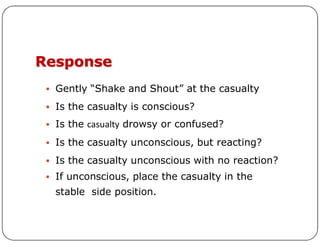
Response
 Gently “Shake and Shout” at the casualty
 Is the casualty is conscious?
 Is the casualty drowsy or confused?
 Is the casualty unconscious, but reacting?
 Is the casualty unconscious with no reaction?
 If unconscious, place the casualty in the
stable side position.
Airway
 Is the airway is open and clear?
 Is there noisy in breathing?
 Are there Potential obstruction such as
blood etc?
 If so, open and clear the airway!
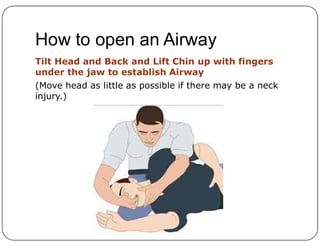
How to open an Airway
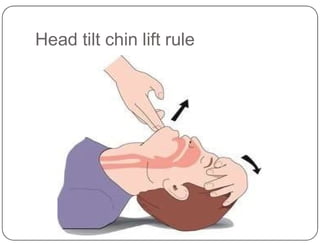
Tilt Head and Back and Lift Chin up with fingers
under the jaw to establish Airway
(Move head as little as possible if there may be a neck
injury.)
Breathing
 Look for chest movements
Listen for sounds for breathing
 Listen for sounds for breathing
 Feel for breathes on your cheek
 If not breathing give Artificial Respiration
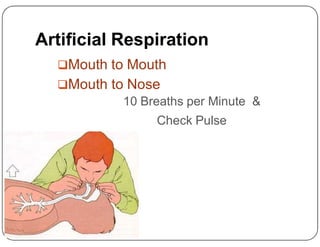
Artificial Respiration
Mouth to Mouth
Mouth to Nose
10 Breaths per Minute &
Check Pulse
Check Pulse
Circulation
Is there a carotid pulse?
Is it strong?
Is it regular”
Is it regular”
Is there a major blood loss?
If no pulse, then start CPR
(Cardio Pulmonary Resuscitation)
CPR (Cardio Pulmonary Resuscitation)
 See person consciousness
 Send someone for help
 Check for breathing
 Compressions
 Compressions
 Head tilt chin lift rule
Head tilt chin lift rule
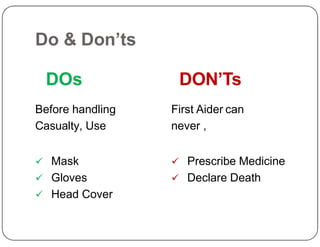
Do & Don’ts
DOs
Before handling
Casualty, Use
DON’Ts
First Aider can
never ,
Casualty, Use
 Mask
 Gloves
 Head Cover
never ,
 Prescribe Medicine
 Declare Death
Action Plan
 Assess the Situation
 Safety of yourself and the casualty
 Assess the casualty
 Treat the casualty
 Arrange the removal of the casualty to
hospital or safe area
 Write a report / Communicate the status
Bleeding
Maintain Pressure on Wound
15 Minutes
Apply more layers if needed
Elevate extremity if no fractures (Lie down)
Direct Pressure
Steady firm pressure
Clean cloth or bandage – Avoid contact
Wounds
 Abrasion – The top layer of the skin removed
 Laceration – A cut skin with jagged, irregular
edges and caused by a forceful tearing away of
skin tissue.
 Incisions – Smooth edges and resembles a
surgical or paper cut.
 Punctures – Deep, narrow wounds such as a
stab wound from a nail or a knife in the skin and
underlying organs.
 Avulsion – Flap of skin is torn loose and is
either hanging from the body or completely
removed.
 Amputation – Cutting or tearing off of a body
part such as finger, toe, hand, foot, arm, leg etc.
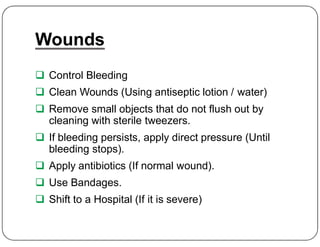
Wounds
 Control Bleeding
 Clean Wounds (Using antiseptic lotion / water)
 Remove small objects that do not flush out by
cleaning with sterile tweezers.
 If bleeding persists, apply direct pressure (Until
bleeding stops).
 Apply antibiotics (If normal wound).
 Use Bandages.
 Shift to a Hospital (If it is severe)
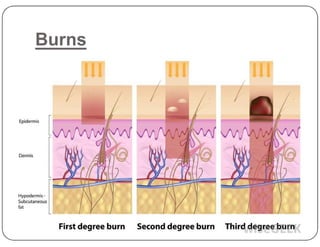
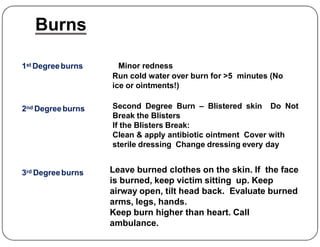
Burns
Burns
1st Degreeburns Minor redness
Run cold water over burn for >5 minutes (No
ice or ointments!)
2nd Degreeburns Second Degree Burn – Blistered skin Do Not
Break the Blisters
If the Blisters Break:
3rd Degreeburns Leave burned clothes on the skin. If the face
is burned, keep victim sitting up. Keep
airway open, tilt head back. Evaluate burned
arms, legs, hands.
Keep burn higher than heart. Call
ambulance.
If the Blisters Break:
Clean & apply antibiotic ointment Cover with
sterile dressing Change dressing every day
Burns
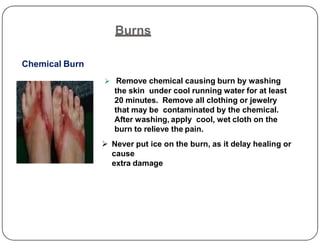
Chemical Burn
 Remove chemical causing burn by washing
the skin under cool running water for at least
20 minutes. Remove all clothing or jewelry
that may be contaminated by the chemical.
After washing, apply cool, wet cloth on the
burn to relieve the pain.
 Never put ice on the burn, as it delay healing or
cause
extra damage
Burns
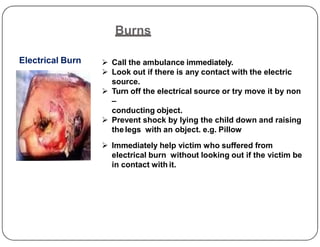
Electrical Burn  Call the ambulance immediately.
 Look out if there is any contact with the electric
source.
 Turn off the electrical source or try move it by non
–
conducting object.
 Prevent shock by lying the child down and raising
thelegs with an object. e.g. Pillow
 Immediately help victim who suffered from
electrical burn without looking out if the victim be
in contact with it.
DIRECT INJURY
INDIRECT INJURY
MUSCULAR CONTRACTION OR
EXPANSION
Pain
Swelling
Tenderness
Loss of Power
Loss of Power
Deformity
Unnatural Movement
Irregularity
Crapitus
Make The Patient Comfortable
Check Bleeding
Give Support
Give Support
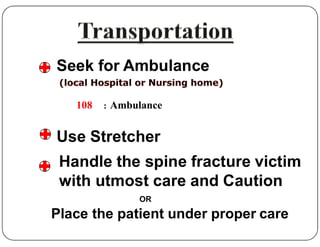
Transportation.
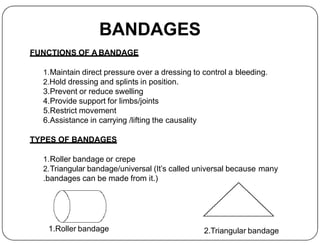
BANDAGES
FUNCTIONS OF A BANDAGE
1.Maintain direct pressure over a dressing to control a bleeding.
2.Hold dressing and splints in position.
3.Prevent or reduce swelling
4.Provide support for limbs/joints
5.Restrict movement
6.Assistance in carrying /lifting the causality
TYPES OF BANDAGES
1.Roller bandage or crepe
2.Triangular bandage/universal (It’s called universal because many
.bandages can be made from it.)
1.Roller bandage 2.Triangular bandage
Seek for Ambulance
108 : Ambulance
Use Stretcher
Handle the spine fracture victim
with utmost care and Caution
OR
Place the patient under proper care
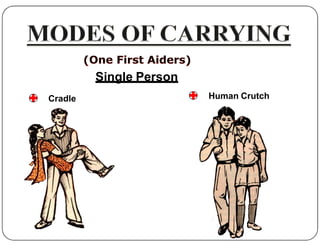
Single Person
Cradle Human Crutch
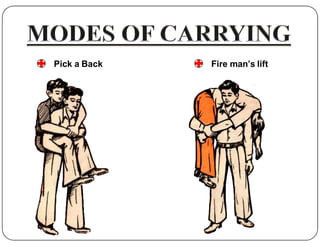
Pick a Back Fire man’s lift
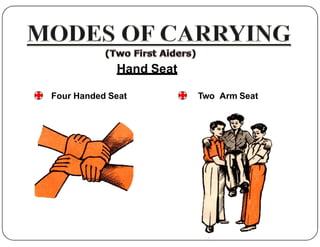
Hand Seat
Four Handed Seat Two Arm Seat
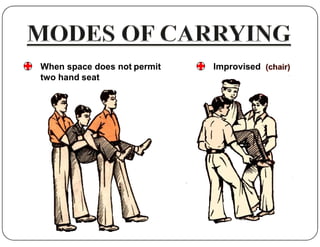
When space does not permit
two hand seat
Improvised
FIRST-AID TRAINING PPT.pdf