
FIRST AID TRAINING
Dr.ABHISHEK KUMAR
MBBS,MDEMS,AFIH,CCDM,D.DIABETOLOGY
WHAT DO YOU MEAN BY FIRST AID ?
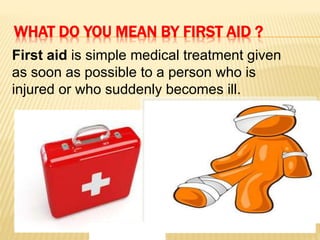
First aid is simple medical treatment given
as soon as possible to a person who is
injured or who suddenly becomes ill.
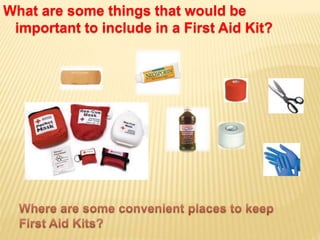
What are some things that would be
important to include in a First Aid Kit?
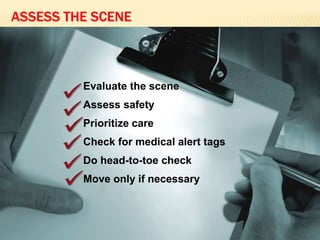
ASSESS THE SCENE
Evaluate the scene
Assess safety
Prioritize care
Check for medical alert tags
Do head-to-toe check
Move only if necessary
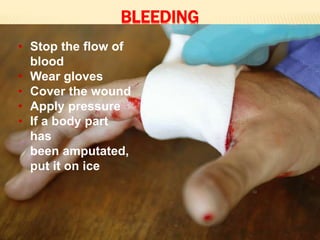
BLEEDING
• Stop the flow of
blood
• Wear gloves
• Cover the wound
• Apply pressure
• If a body part
has
been amputated,
put it on ice
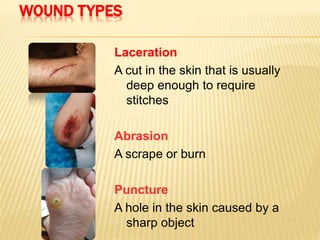
WOUND TYPES
Laceration
A cut in the skin that is usually
deep enough to require
stitches
Abrasion
A scrape or burn
Puncture
A hole in the skin caused by a
sharp object
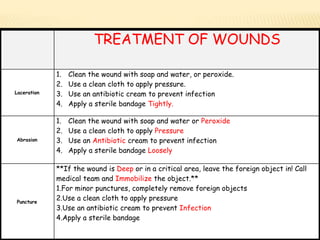
TREATMENT OF WOUNDS
Laceration
1. Clean the wound with soap and water, or peroxide.
2. Use a clean cloth to apply pressure.
3. Use an antibiotic cream to prevent infection
4. Apply a sterile bandage Tightly.
Abrasion
1. Clean the wound with soap and water or Peroxide
2. Use a clean cloth to apply Pressure
3. Use an Antibiotic cream to prevent infection
4. Apply a sterile bandage Loosely
Puncture
**If the wound is Deep or in a critical area, leave the foreign object in! Call
medical team and Immobilize the object.**
1.For minor punctures, completely remove foreign objects
2.Use a clean cloth to apply pressure
3.Use an antibiotic cream to prevent Infection
4.Apply a sterile bandage
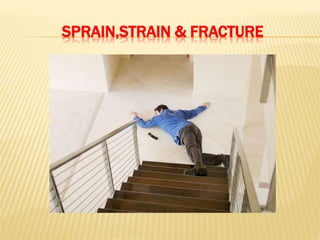
SPRAIN,STRAIN & FRACTURE
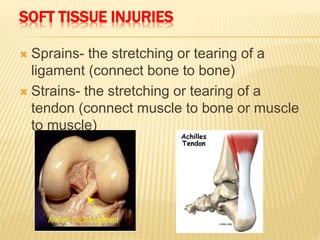
SOFT TISSUE INJURIES
 Sprains- the stretching or tearing of a
ligament (connect bone to bone)
 Strains- the stretching or tearing of a
tendon (connect muscle to bone or muscle
to muscle)
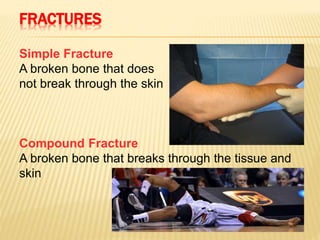
FRACTURES
Simple Fracture
A broken bone that does
not break through the skin
Compound Fracture
A broken bone that breaks through the tissue and
skin
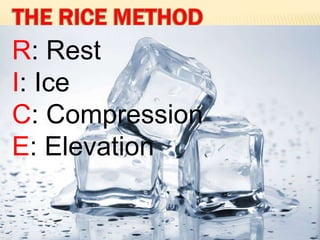
R: Rest
I: Ice
C: Compression
E: Elevation
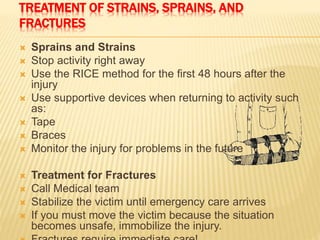
TREATMENT OF STRAINS, SPRAINS, AND
FRACTURES
 Sprains and Strains
 Stop activity right away
 Use the RICE method for the first 48 hours after the
injury
 Use supportive devices when returning to activity such
as:
 Tape
 Braces
 Monitor the injury for problems in the future
 Treatment for Fractures
 Call Medical team
 Stabilize the victim until emergency care arrives
 If you must move the victim because the situation
becomes unsafe, immobilize the injury.
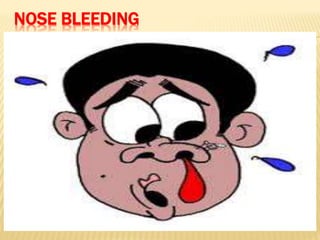
NOSE BLEEDING
Treatment
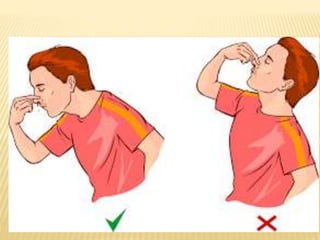
1.Sit down
2.Tilt your head slightly Forward. (Leaning Back may cause blood to flow
down the back of the throat, which tastes bad and may cause gagging,
coughing or vomiting.
3.Gently Pinch your nose. Use your thumb and Index finger and breathe
through your Mouth. Continue for about 5-10 minutes.
To prevent further bleeding: Do not Bend Over or Blow Your Nose for
several hours after bleeding stops.
Nosebleeds
EYE INJURIES
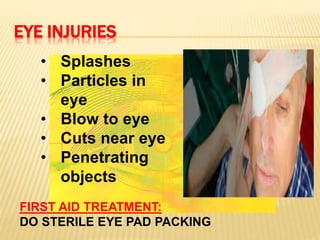
EYE INJURIES
• Splashes
• Particles in
eye
• Blow to eye
• Cuts near eye
• Penetrating
objects
FIRST AID TREATMENT:
DO STERILE EYE PAD PACKING
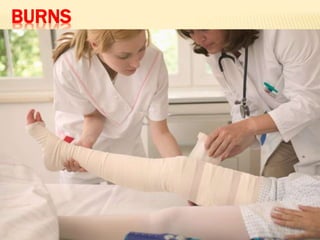
BURNS
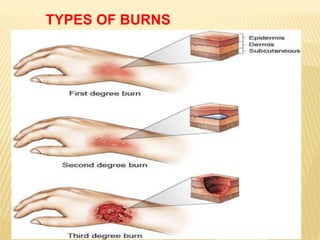
TYPES OF BURNS
TYPES OF BURNS
1st Degree:
 Only the Epidermis, or outer layer of skin, is
burned. The skin usually Red and swells with
pain.
2nd Degree:
 The Outer layer of skin is burned through and
the 2nd layer, called the Dermis, becomes
red and blotchy (blistering)
3rd Degree:
 A major burn that involves all layers of the
skin, tissue, muscle and sometimes even
bone. Areas may be charred black or appear
dry and white.
TREATMENT OF BURNS
Treatment for Minor Burns
 Cool the burn. Immediately hold the burn under Cool Water until
the pain subsides. Do not put Ice directly on the burn.
 Cover the burn by wrapping it Loosely with Sterile Bandages.
 Take OTC (Over The Counter) pain reliever.
Treatment for Major Burns
 Call Medical team
 Provide care by removing any smoldering or hot materials from
the victim.
 Do not immerse Major burns in Water.
 Check for response and Begin CPR if necessary.
 Wrap the burn with cool, moist, sterile bandages or moist towels.
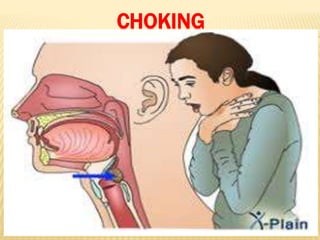
CHOKING
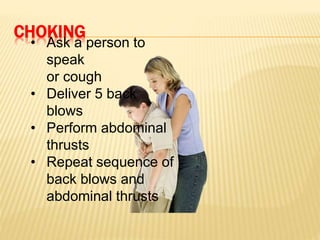
CHOKING
• Ask a person to
speak
or cough
• Deliver 5 back
blows
• Perform abdominal
thrusts
• Repeat sequence of
back blows and
abdominal thrusts
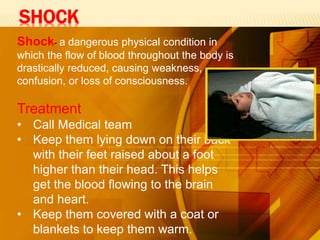
SHOCK
Shock- a dangerous physical condition in
which the flow of blood throughout the body is
drastically reduced, causing weakness,
confusion, or loss of consciousness.
Treatment
• Call Medical team
• Keep them lying down on their back
with their feet raised about a foot
higher than their head. This helps
get the blood flowing to the brain
and heart.
• Keep them covered with a coat or
blankets to keep them warm.
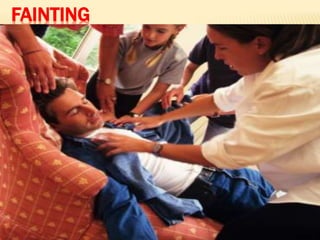
FAINTING
FAINTING
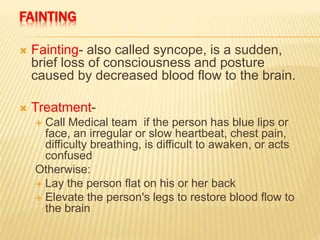
 Fainting- also called syncope, is a sudden,
brief loss of consciousness and posture
caused by decreased blood flow to the brain.
 Treatment-
 Call Medical team if the person has blue lips or
face, an irregular or slow heartbeat, chest pain,
difficulty breathing, is difficult to awaken, or acts
confused
Otherwise:
 Lay the person flat on his or her back
 Elevate the person's legs to restore blood flow to
the brain
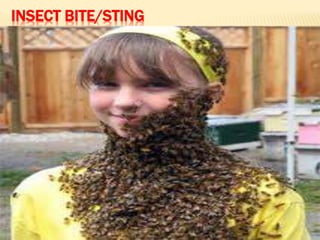
INSECT BITE/STING
STINGS AND BITES
1. Remove the Stinger: Scrape the
area with a fingernail to remove it.
Don't pinch the stinger (that can
inject more venom)
2. Control Swelling: Ice the area.
3. Treat Symptoms: For pain, take an over-the-
counter painkiller like ibuprofen. For itchiness, take
an antihistamine.
4. Follow-Up: It might take 2-5 days for the area to
heal. Keep it clean to prevent infection.
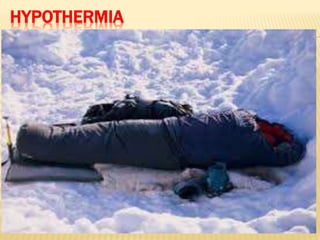
HYPOTHERMIA
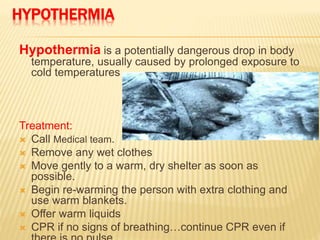
HYPOTHERMIA
Hypothermia is a potentially dangerous drop in body
temperature, usually caused by prolonged exposure to
cold temperatures
Treatment:
 Call Medical team.
 Remove any wet clothes
 Move gently to a warm, dry shelter as soon as
possible.
 Begin re-warming the person with extra clothing and
use warm blankets.
 Offer warm liquids
 CPR if no signs of breathing…continue CPR even if
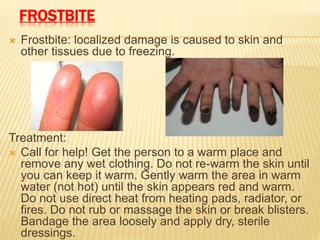
FROSTBITE
 Frostbite: localized damage is caused to skin and
other tissues due to freezing.
Treatment:
 Call for help! Get the person to a warm place and
remove any wet clothing. Do not re-warm the skin until
you can keep it warm. Gently warm the area in warm
water (not hot) until the skin appears red and warm.
Do not use direct heat from heating pads, radiator, or
fires. Do not rub or massage the skin or break blisters.
Bandage the area loosely and apply dry, sterile
dressings.
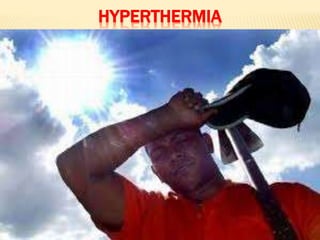
HYPERTHERMIA
HYPERTHERMIA
 Hyperthermia is a result of the body being overheated
due to increased air temperature, solar or reflected
radiation, poorly ventilated clothing, a low fitness level
or excess bulk.
 Symptoms include:
1. Heat stress & exhaustion is a mild form of
hyperthermia and includes symptoms such as
scanty dark yellow coloured urine , headache,
dizziness, fainting, clammy skin, blurred vision,
nausea and vomiting.
2. Heat cramps may occur and should be treated by
moving the victim to a shady area and supplying water
and salt tablets.
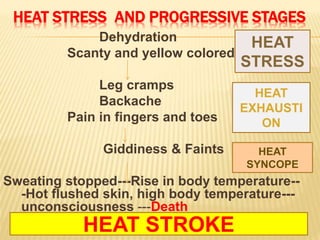
HEAT STRESS AND PROGRESSIVE STAGES
Dehydration
Scanty and yellow colored urine.
Leg cramps
Backache
Pain in fingers and toes
Giddiness & Faints
Sweating stopped---Rise in body temperature--
-Hot flushed skin, high body temperature---
unconsciousness ---Death
HEAT
STRESS
HEAT
EXHAUSTI
ON
HEAT
SYNCOPE
HEAT STROKE
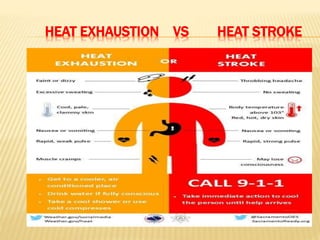
HEAT EXHAUSTION VS HEAT STROKE
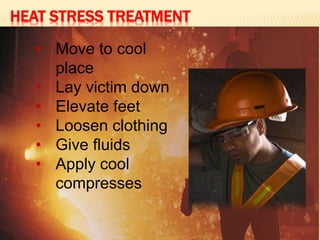
HEAT STRESS TREATMENT
• Move to cool
place
• Lay victim down
• Elevate feet
• Loosen clothing
• Give fluids
• Apply cool
compresses
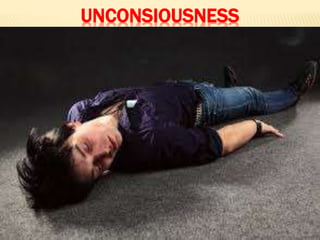
UNCONSIOUSNESS
YOUR RESPONSIBILITIES AS A RESPONDER
• Check the Scene- make
sure it is safe
• Call Emergency
Responders- the most
important step!
• Provide Care
• The 3 C’s of Responding
• Check
• Call
• Care
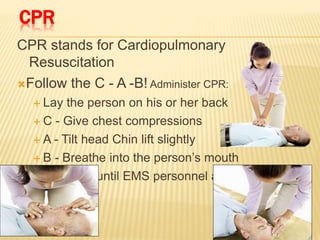
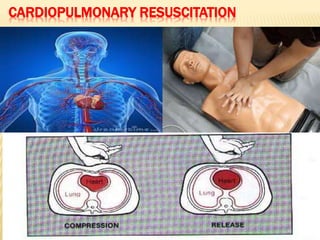
CPR
CPR stands for Cardiopulmonary
Resuscitation
Follow the C - A -B! Administer CPR:
 Lay the person on his or her back
 C - Give chest compressions
 A - Tilt head Chin lift slightly
 B - Breathe into the person’s mouth
 Continue until EMS personnel arrive
CARDIOPULMONARY RESUSCITATION
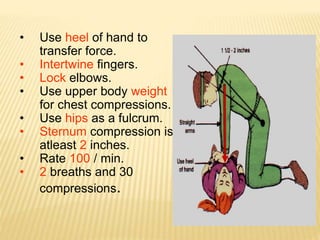
• Use heel of hand to
transfer force.
• Intertwine fingers.
• Lock elbows.
• Use upper body weight
for chest compressions.
• Use hips as a fulcrum.
• Sternum compression is
atleast 2 inches.
• Rate 100 / min.
• 2 breaths and 30
compressions.
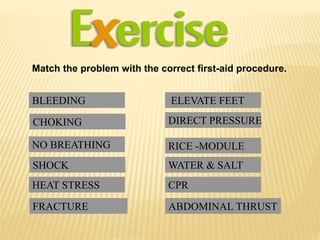
Match the problem with the correct first-aid procedure.
BLEEDING
CHOKING
NO BREATHING
SHOCK
HEAT STRESS
FRACTURE
ELEVATE FEET
DIRECT PRESSURE
RICE -MODULE
CPR
ABDOMINAL THRUST
WATER & SALT
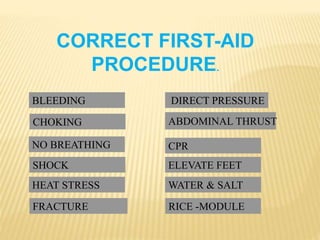
CORRECT FIRST-AID
PROCEDURE.
BLEEDING
CHOKING
NO BREATHING
SHOCK
HEAT STRESS
FRACTURE
DIRECT PRESSURE
ABDOMINAL THRUST
CPR
WATER & SALT
RICE -MODULE
ELEVATE FEET
First Aid Training

First Aid Training

  • 1.
    FIRST AID TRAINING Dr.ABHISHEKKUMAR MBBS,MDEMS,AFIH,CCDM,D.DIABETOLOGY
  • 2.
    WHAT DO YOUMEAN BY FIRST AID ?
  • 3.
    WHAT DO YOUMEAN BY FIRST AID ? First aid is simple medical treatment given as soon as possible to a person who is injured or who suddenly becomes ill.
  • 4.
    What are somethings that would be important to include in a First Aid Kit?
  • 5.
    ASSESS THE SCENE Evaluatethe scene Assess safety Prioritize care Check for medical alert tags Do head-to-toe check Move only if necessary
  • 6.
    BLEEDING • Stop theflow of blood • Wear gloves • Cover the wound • Apply pressure • If a body part has been amputated, put it on ice
  • 7.
    WOUND TYPES Laceration A cutin the skin that is usually deep enough to require stitches Abrasion A scrape or burn Puncture A hole in the skin caused by a sharp object
  • 8.
    TREATMENT OF WOUNDS Laceration 1.Clean the wound with soap and water, or peroxide. 2. Use a clean cloth to apply pressure. 3. Use an antibiotic cream to prevent infection 4. Apply a sterile bandage Tightly. Abrasion 1. Clean the wound with soap and water or Peroxide 2. Use a clean cloth to apply Pressure 3. Use an Antibiotic cream to prevent infection 4. Apply a sterile bandage Loosely Puncture **If the wound is Deep or in a critical area, leave the foreign object in! Call medical team and Immobilize the object.** 1.For minor punctures, completely remove foreign objects 2.Use a clean cloth to apply pressure 3.Use an antibiotic cream to prevent Infection 4.Apply a sterile bandage
  • 9.
  • 10.
    SOFT TISSUE INJURIES Sprains- the stretching or tearing of a ligament (connect bone to bone)  Strains- the stretching or tearing of a tendon (connect muscle to bone or muscle to muscle)
  • 11.
    FRACTURES Simple Fracture A brokenbone that does not break through the skin Compound Fracture A broken bone that breaks through the tissue and skin
  • 12.
    R: Rest I: Ice C:Compression E: Elevation
  • 13.
    TREATMENT OF STRAINS,SPRAINS, AND FRACTURES  Sprains and Strains  Stop activity right away  Use the RICE method for the first 48 hours after the injury  Use supportive devices when returning to activity such as:  Tape  Braces  Monitor the injury for problems in the future  Treatment for Fractures  Call Medical team  Stabilize the victim until emergency care arrives  If you must move the victim because the situation becomes unsafe, immobilize the injury.
  • 14.
  • 15.
    Treatment 1.Sit down 2.Tilt yourhead slightly Forward. (Leaning Back may cause blood to flow down the back of the throat, which tastes bad and may cause gagging, coughing or vomiting. 3.Gently Pinch your nose. Use your thumb and Index finger and breathe through your Mouth. Continue for about 5-10 minutes. To prevent further bleeding: Do not Bend Over or Blow Your Nose for several hours after bleeding stops. Nosebleeds
  • 17.
  • 18.
    EYE INJURIES • Splashes •Particles in eye • Blow to eye • Cuts near eye • Penetrating objects FIRST AID TREATMENT: DO STERILE EYE PAD PACKING
  • 19.
  • 20.
  • 21.
    TYPES OF BURNS 1stDegree:  Only the Epidermis, or outer layer of skin, is burned. The skin usually Red and swells with pain. 2nd Degree:  The Outer layer of skin is burned through and the 2nd layer, called the Dermis, becomes red and blotchy (blistering) 3rd Degree:  A major burn that involves all layers of the skin, tissue, muscle and sometimes even bone. Areas may be charred black or appear dry and white.
  • 22.
    TREATMENT OF BURNS Treatmentfor Minor Burns  Cool the burn. Immediately hold the burn under Cool Water until the pain subsides. Do not put Ice directly on the burn.  Cover the burn by wrapping it Loosely with Sterile Bandages.  Take OTC (Over The Counter) pain reliever. Treatment for Major Burns  Call Medical team  Provide care by removing any smoldering or hot materials from the victim.  Do not immerse Major burns in Water.  Check for response and Begin CPR if necessary.  Wrap the burn with cool, moist, sterile bandages or moist towels.
  • 23.
  • 24.
    CHOKING • Ask aperson to speak or cough • Deliver 5 back blows • Perform abdominal thrusts • Repeat sequence of back blows and abdominal thrusts
  • 25.
    SHOCK Shock- a dangerousphysical condition in which the flow of blood throughout the body is drastically reduced, causing weakness, confusion, or loss of consciousness. Treatment • Call Medical team • Keep them lying down on their back with their feet raised about a foot higher than their head. This helps get the blood flowing to the brain and heart. • Keep them covered with a coat or blankets to keep them warm.
  • 26.
  • 27.
    FAINTING  Fainting- alsocalled syncope, is a sudden, brief loss of consciousness and posture caused by decreased blood flow to the brain.  Treatment-  Call Medical team if the person has blue lips or face, an irregular or slow heartbeat, chest pain, difficulty breathing, is difficult to awaken, or acts confused Otherwise:  Lay the person flat on his or her back  Elevate the person's legs to restore blood flow to the brain
  • 28.
  • 29.
    STINGS AND BITES 1.Remove the Stinger: Scrape the area with a fingernail to remove it. Don't pinch the stinger (that can inject more venom) 2. Control Swelling: Ice the area. 3. Treat Symptoms: For pain, take an over-the- counter painkiller like ibuprofen. For itchiness, take an antihistamine. 4. Follow-Up: It might take 2-5 days for the area to heal. Keep it clean to prevent infection.
  • 30.
  • 31.
    HYPOTHERMIA Hypothermia is apotentially dangerous drop in body temperature, usually caused by prolonged exposure to cold temperatures Treatment:  Call Medical team.  Remove any wet clothes  Move gently to a warm, dry shelter as soon as possible.  Begin re-warming the person with extra clothing and use warm blankets.  Offer warm liquids  CPR if no signs of breathing…continue CPR even if
  • 32.
    FROSTBITE  Frostbite: localizeddamage is caused to skin and other tissues due to freezing. Treatment:  Call for help! Get the person to a warm place and remove any wet clothing. Do not re-warm the skin until you can keep it warm. Gently warm the area in warm water (not hot) until the skin appears red and warm. Do not use direct heat from heating pads, radiator, or fires. Do not rub or massage the skin or break blisters. Bandage the area loosely and apply dry, sterile dressings.
  • 33.
  • 34.
    HYPERTHERMIA  Hyperthermia isa result of the body being overheated due to increased air temperature, solar or reflected radiation, poorly ventilated clothing, a low fitness level or excess bulk.  Symptoms include: 1. Heat stress & exhaustion is a mild form of hyperthermia and includes symptoms such as scanty dark yellow coloured urine , headache, dizziness, fainting, clammy skin, blurred vision, nausea and vomiting. 2. Heat cramps may occur and should be treated by moving the victim to a shady area and supplying water and salt tablets.
  • 35.
    HEAT STRESS ANDPROGRESSIVE STAGES Dehydration Scanty and yellow colored urine. Leg cramps Backache Pain in fingers and toes Giddiness & Faints Sweating stopped---Rise in body temperature-- -Hot flushed skin, high body temperature--- unconsciousness ---Death HEAT STRESS HEAT EXHAUSTI ON HEAT SYNCOPE HEAT STROKE
  • 36.
    HEAT EXHAUSTION VSHEAT STROKE
  • 37.
    HEAT STRESS TREATMENT •Move to cool place • Lay victim down • Elevate feet • Loosen clothing • Give fluids • Apply cool compresses
  • 38.
  • 39.
    YOUR RESPONSIBILITIES ASA RESPONDER • Check the Scene- make sure it is safe • Call Emergency Responders- the most important step! • Provide Care • The 3 C’s of Responding • Check • Call • Care
  • 40.
    CPR CPR stands forCardiopulmonary Resuscitation Follow the C - A -B! Administer CPR:  Lay the person on his or her back  C - Give chest compressions  A - Tilt head Chin lift slightly  B - Breathe into the person’s mouth  Continue until EMS personnel arrive
  • 41.
  • 42.
    • Use heelof hand to transfer force. • Intertwine fingers. • Lock elbows. • Use upper body weight for chest compressions. • Use hips as a fulcrum. • Sternum compression is atleast 2 inches. • Rate 100 / min. • 2 breaths and 30 compressions.
  • 43.
    Match the problemwith the correct first-aid procedure. BLEEDING CHOKING NO BREATHING SHOCK HEAT STRESS FRACTURE ELEVATE FEET DIRECT PRESSURE RICE -MODULE CPR ABDOMINAL THRUST WATER & SALT
  • 44.
    CORRECT FIRST-AID PROCEDURE. BLEEDING CHOKING NO BREATHING SHOCK HEATSTRESS FRACTURE DIRECT PRESSURE ABDOMINAL THRUST CPR WATER & SALT RICE -MODULE ELEVATE FEET