Basic First Aid
First Aid Awareness
What is First Aid:
First Aid is the assistance or treatment given to a casualty for any injury or
sudden illness before the arrival of an ambulance or qualified medical expert.
It may involve improvising with facilities and materials available at the time.
Aim of First Aid
First Aid treatment is given to a casualty in order:
• To preserve life
• To prevent the condition from worsening
• To promote recovery
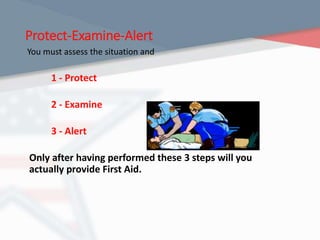
Protect-Examine-Alert
You must assess the situation and
1 - Protect
2 - Examine
3 - Alert
Only after having performed these 3 steps will you
actually provide First Aid.
1 - Protect
Protect yourself and the injured person
Avoid another accident by eliminating the cause:
• Turn-off the electricity to equipment
• Have someone control traffic
• Keep bystanders away from the scene of the accident
• Extinguish fire if possible without putting yourself in danger
• Protect yourself against blood borne pathogens (AIDS, Hepatitis)
Break the circuit
2 - Examine the victim
A- Look for severe external bleeding
B- Check for responsiveness and unconsciousness
C- Check for breathing
D- Check for circulation
2 - Examine
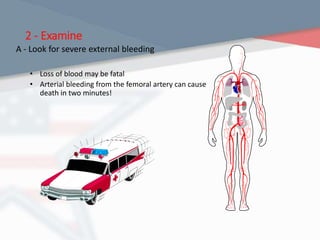
A - Look for severe external bleeding
• Loss of blood may be fatal
• Arterial bleeding from the femoral artery can cause
death in two minutes!
2- Examine
B - Check For Responsiveness/ Unconsciousness
Ask simple questions
“Can you hear me?”
Give simple orders
“Press my hand.”
If there is no reply and no response, the victim is unconscious.
2 - Examine
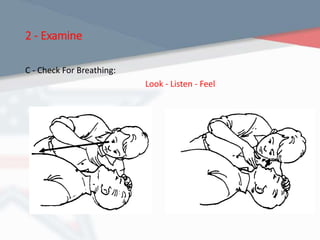
C - Check For Breathing:
Look - Listen - Feel
2 - Examine
D - Check Circulation/Pulse
Until recently, the rule was to check for the carotid pulse.
THIS IS NO LONGER THE RULE - This has now been abandonned in the revised First
Aid international recommendations due to the fact that many first aiders were
not able to find a pulse when faced with an emergency situation.
One must consider that there is no pulse if the victim:
1 – is unconscious and
2 – is not breathing and
3 – has no reaction (coughing or body movements).
3 - Alert
Call for assistance or have someone alert the emergency medical service
rapidly. Always provide:
 Exact location or address of the accident or incident
 Telephone number where you can be called
 How many people are involved
 Nature of injuries (fractures, burns, etc.)
 Indication of the seriousness of the injuries (breathing or not, etc.)
 What first aid has been given
Do not hang up until you are sure that the person at the other end has all the info and have
them repeat the address to send assistance.
Treat the victim
1- Control Blood Loss
2- Open the Airway
3- Give Artificial Ventilation
4- Give External Chest Compressions (ECC)
5- Place in the Recovery Position
6- Keep under Observation
CPR
1-Treating: Control Blood Loss
A- For important but non-complicated external bleeding:
Apply direct pressure on the wound.
Avoid direct contact with blood (gloves, gauze, handkerchief, etc.)
1 - Treating: Control Blood Loss
B- For important and complicated external bleeding (associated with a
fracture or foreign body):
use indirect pressure.
This requires applying pressure
to the appropriate pressure point.
Brachial pressure point = Inner part of the upper arm
(Used to stop bleeding in hand, forearm and arm)
Femoral pressure point = Groin
(Used to stop bleeding in thigh, leg, foot)
Brachial
Femoral
1 - Treating: Control Blood Loss
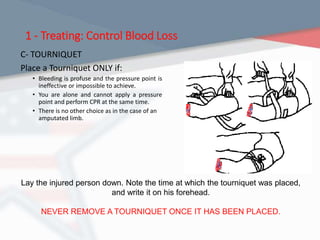
C- TOURNIQUET
Place a Tourniquet ONLY if:
• Bleeding is profuse and the pressure point is
ineffective or impossible to achieve.
• You are alone and cannot apply a pressure
point and perform CPR at the same time.
• There is no other choice as in the case of an
amputated limb.
Lay the injured person down. Note the time at which the tourniquet was placed,
and write it on his forehead.
NEVER REMOVE A TOURNIQUET ONCE IT HAS BEEN PLACED.
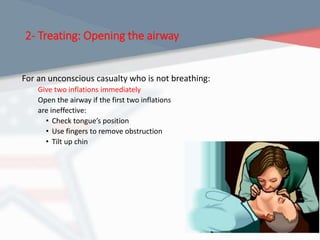
2- Treating: Opening the airway
For an unconscious casualty who is not breathing:
Give two inflations immediately
Open the airway if the first two inflations
are ineffective:
• Check tongue’s position
• Use fingers to remove obstruction
• Tilt up chin
2 - Treating: Opening the airway
If casualty is unconscious
Free the airway by using the head-tilt, chin-lift maneuver. This places the
tongue so as to open the airway.
BEFORE (airway closed) AFTER (airway open)
Airway
Tongue
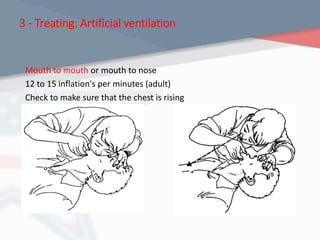
3 - Treating: Artificial ventilation
Mouth to mouth or mouth to nose
12 to 15 inflation's per minutes (adult)
Check to make sure that the chest is rising
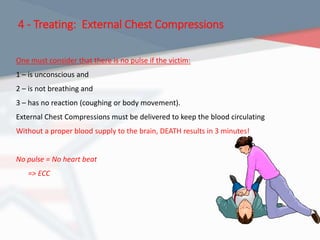
4 - Treating: External Chest Compressions
One must consider that there is no pulse if the victim:
1 – is unconscious and
2 – is not breathing and
3 – has no reaction (coughing or body movement).
External Chest Compressions must be delivered to keep the blood circulating
Without a proper blood supply to the brain, DEATH results in 3 minutes!
No pulse = No heart beat
=> ECC
4 - Treating: External Chest Compressions
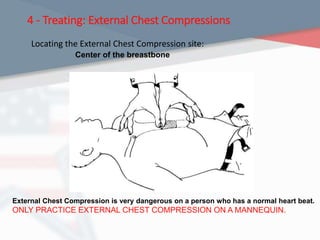
Locating the External Chest Compression site:
Center of the breastbone
External Chest Compression is very dangerous on a person who has a normal heart beat.
ONLY PRACTICE EXTERNAL CHEST COMPRESSION ON A MANNEQUIN.
4 - Treating: External Chest Compressions
Use the heel of
the hand for ECC
Deliver
compressions
straight down
Lungs
Heart
4 - Treating: External Chest Compressions
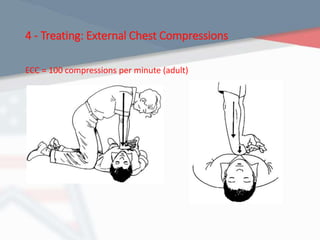
ECC = 100 compressions per minute (adult)
Treating: CPR
Artificial Ventilation + External Chest Compression =
Cardiopulmonary Resuscitation or CPR
• CPR is required when there is: No breathing + No consciousness + No reactivity
• Once started, CPR must be continued until emergency medical services arrive or
until the victim starts breathing, coughing or reacting.
• If spontaneous breathing has restarted = keep under observation
• If spontaneous breathing has NOT restarted = continue Artificial Ventilation
Treating: CPR
CPR (External Chest Compressions + Artificial Ventilation) can be done
by one or two first aiders:
If two first aiders: 15 ECC for 2 Artificial ventilations
If one first aider: 15 ECC for 2 Artificial ventilations
In a small child: 5 ECC for 1 Artificial ventilation
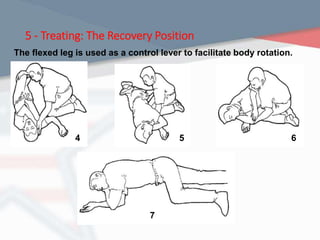
5 - Treating: The Recovery Position
For the unconscious casualty who is breathing and is reactive. Prevents
obstruction of the airway by saliva or the tongue.
1 2 3
5 - Treating: The Recovery Position
The flexed leg is used as a control lever to facilitate body rotation.
4 5 6
7
6 - Treating: Keep under observation
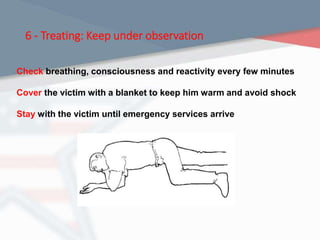
Check breathing, consciousness and reactivity every few minutes
Cover the victim with a blanket to keep him warm and avoid shock
Stay with the victim until emergency services arrive
Other Basic Things To Know
Other Injuries
• Choking
• Burns
• Fractures
• Bites
Moving the Casualty
• When?
• How?
Other Injuries = Choking
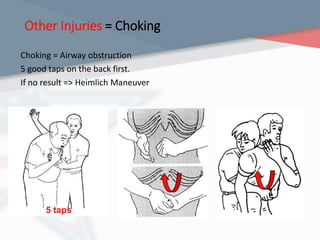
Choking = Airway obstruction
5 good taps on the back first.
If no result => Heimlich Maneuver
5 taps
Other Injuries = Burns
Thermal & Chemical Burns
• Carefully remove clothing, especially when chemicals are involved.
• Cool the burnt area with cold water or other non-inflammable liquid (milk,
etc.) for at least 10 minutes.
Other Injuries = Fractures
• Immobilize the fractured limb
• Immobilize the head if a fracture of the neck is suspected
Whenever possible, never move an injured person before immobilization of fractured bone.
Other Injuries = Bites
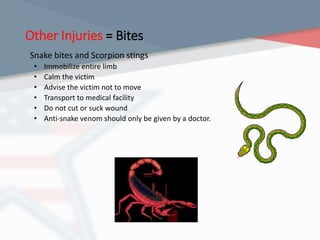
Snake bites and Scorpion stings
• Immobilize entire limb
• Calm the victim
• Advise the victim not to move
• Transport to medical facility
• Do not cut or suck wound
• Anti-snake venom should only be given by a doctor.
Moving a casualty urgently - When ?
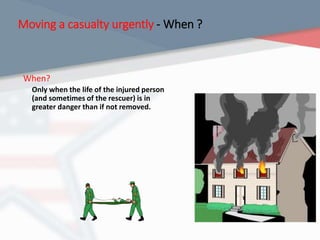
When?
Only when the life of the injured person
(and sometimes of the rescuer) is in
greater danger than if not removed.
Moving a casualty - How ?
1- If you are alone and there is a flat surface =
The foot drag
Moving a casualty - How ?
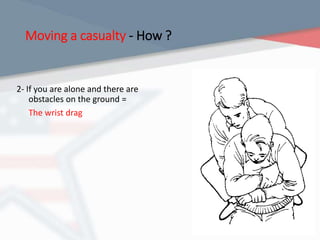
2- If you are alone and there are
obstacles on the ground =
The wrist drag
3- If you are alone and need to
get the victim out of a vehicle.
Switch off ignition.
Look at the car damage. It will indicate how severely the person is injured.
Moving a casualty - How ?
4- If more than one first aider = Move as a block
Always ask yourself if it is really necessary to move the injured person ?
FIRST
AID