1. A management information system (MIS) is a system that collects, processes, stores, and disseminates data to support management decision-making and functions in an organization.
2. An education management information system (EMIS) is a type of MIS used by educational institutions and governments to collect and analyze student, teacher, and school performance data to inform education planning and policy decisions.
3. An EMIS typically includes components like student records, teacher information, curriculum management, financial records, and examination results to provide administrators with comprehensive education data.
• A managementinformation system (MIS) is
a systematized collection of people,
procedures, software, databases, and
devices that provides routine information
to managers and decision makers.
• A management information system (MIS)
produces information that supports the
management functions of an organization
and facilitates the decision-making
process.
• The MIS is thus an organized approach of
collecting, processing, storing and
disseminating data to carry out
management functions
• To transform data into information,
processing is needed and it must be done
while considering the context of a
decision
What is
Management
Information
System?
2
3.
It provides
information to
successfully
managean
organization
such as
1.Extract and
summarize
data from
TPSs
2.Allow
managers to
monitor &
direct the
organization
3.Provide
accurate
feedback
4.Provide
pre-specified
reports on a
scheduled
basis
3
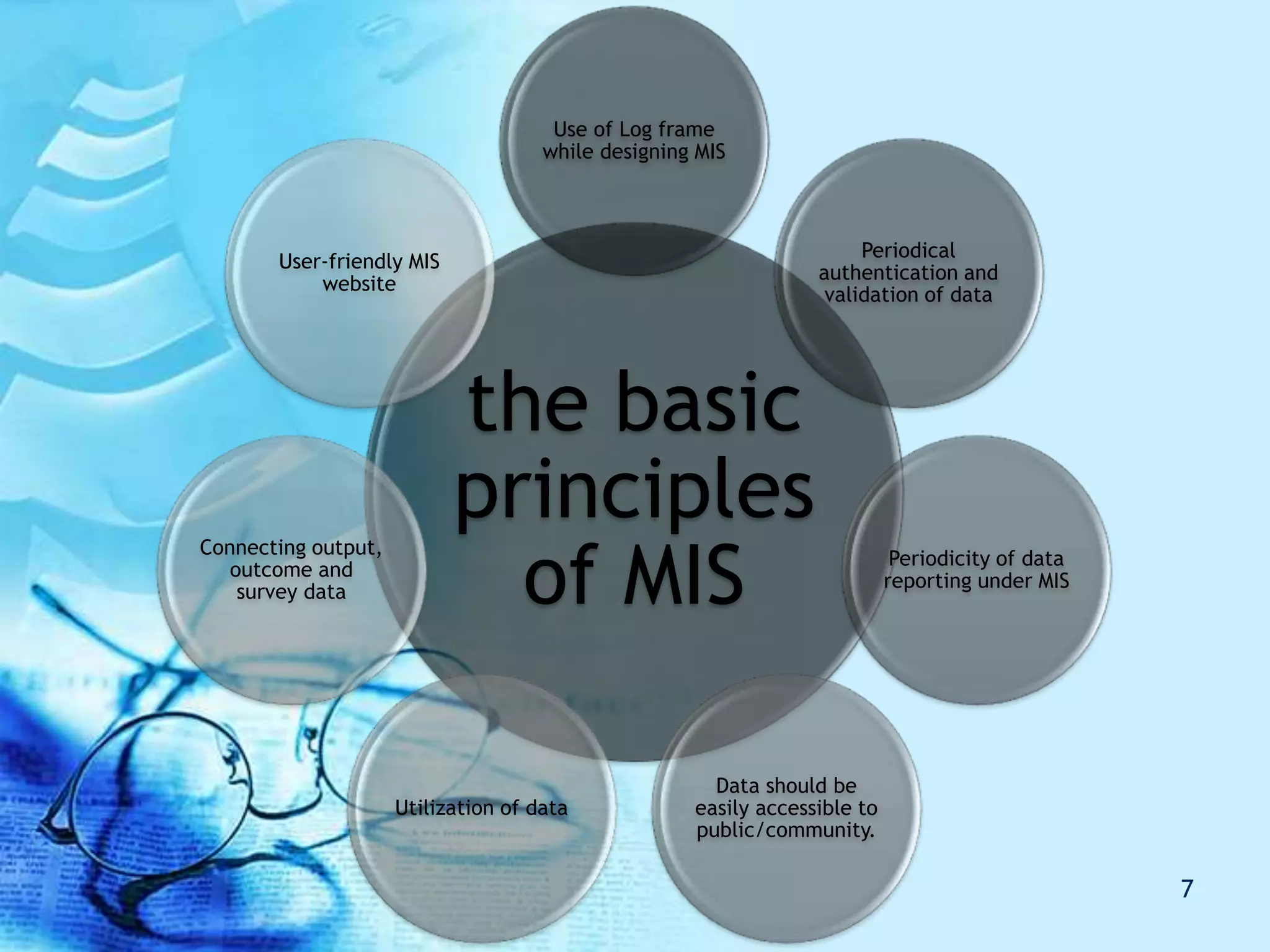
the basic
principles
of MIS
Useof Log frame
while designing MIS
Periodical
authentication and
validation of data
Periodicity of data
reporting under MIS
Data should be
easily accessible to
public/community.
Utilization of data
Connecting output,
outcome and
survey data
User-friendly MIS
website
7
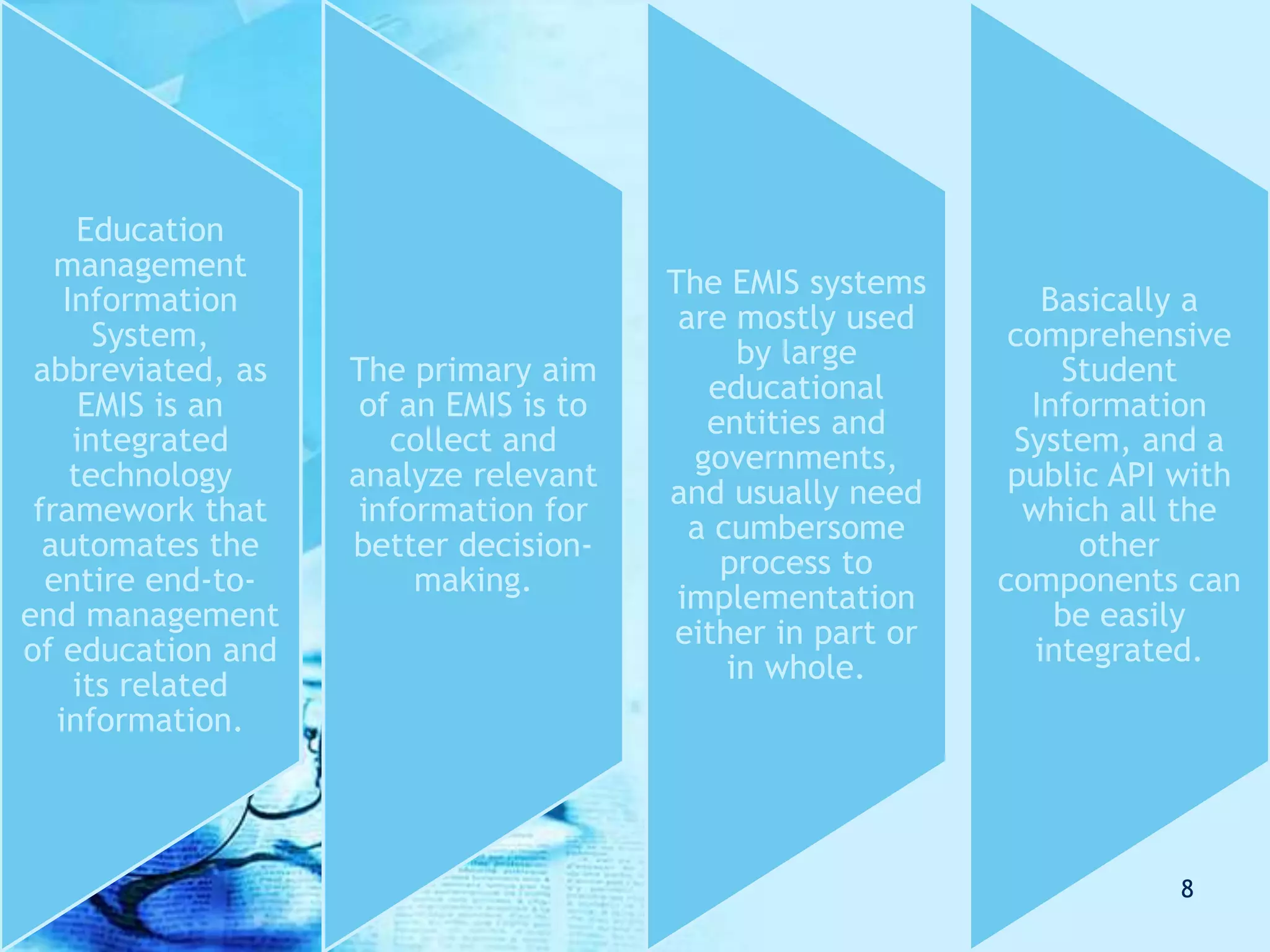
8.
Education
management
Information
System,
abbreviated, as
EMIS isan
integrated
technology
framework that
automates the
entire end-to-
end management
of education and
its related
information.
The primary aim
of an EMIS is to
collect and
analyze relevant
information for
better decision-
making.
The EMIS systems
are mostly used
by large
educational
entities and
governments,
and usually need
a cumbersome
process to
implementation
either in part or
in whole.
Basically a
comprehensive
Student
Information
System, and a
public API with
which all the
other
components can
be easily
integrated.
8
9.
Certain countries haveprovided publicly available data on education relating
to student attendance, student examination performance, teacher performance,
improvement survey results, School Infrastructure and others.
These information, when analyzed, can give immediate guidance for corrective
measures.
All the necessary information automatically recorded that can be analyzed by
Institutions for data driven improvement strategies.
Also will be working towards creating data models that will work on these raw
facts to arrive at meaningful interpretations.
These data models will then be represented in an easily digestible data
visualization format.
A comprehensive EMIS that will help the future generations with a better
education delivery.
9
10.
The overall
concept of
anEMIS has
given to
the
following
objectives:
To improve capacities in data processing, storage, analysis
and supply of educational management information so
that education planners and administrators can avail
themselves of reliable and timely data
To co-ordinate and further improve dispersed efforts in
the acquisition, processing, storage, transmission,
analysis, repackaging, dissemination and use of
educational management information
To facilitate and promote the use of relevant information
by various agencies and individuals at all levels for more
effective educational planning implementation and
management
To streamline the flow of information for decision-making
by reducing and eliminating duplications as well as filling
information gaps
To provide information for policy dialogue and scenarios
for development of the education system
10
11.
Student Records and
Information
StudentAcademic
Record keeping
Teacher related
information
including
performance test
records.
Integrated
Curriculum
Management
Integrated Learning
Management.
Communication
system
Financial Records
Planning and
Scheduling
Examination and
result recording.
11
Primary Components of an EMIS
12.
The components
of thesystem
you can
physically touch
are called
hardware.
the system
unit (tower,
desktop,
laptop),
internal
devices
peripheral
devices
(keyboards
and
monitors) -
12
13.
Hardware are theparts of the computer that are
tangible and can be touched.
Specifics of peripheral devices are provided in
many other ways,
think of them as hardware that surrounds the
system unit.
Hint: Your peripheral vision is what lets you see
out of the sides, or corners, of your eyes.
These peripheral devices may be connected by
wired or wireless technology to the system unit.
Peripherals communicate with the interior
components of the system unit via installed
software.
Software itself is intangible and can't be touched
physically. 13
14.
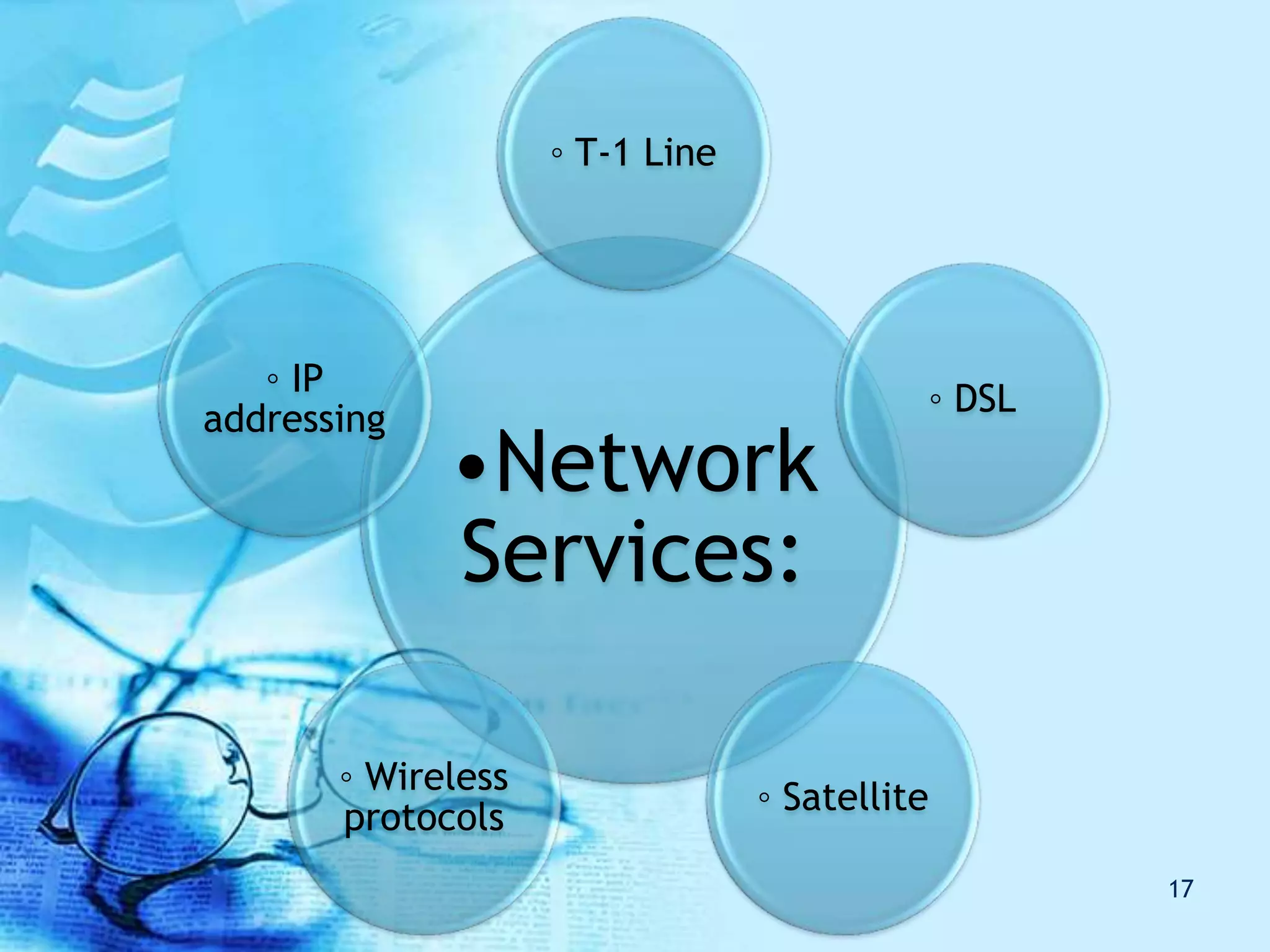
Network infrastructure
is typicallypart of the
IT infrastructure found
in most enterprise IT
environments.
The entire network
infrastructure is
interconnected,
can be used for internal
communications,
external
communications or
both.
14
#4 A transaction process system (TPS) is an information processing system for business transactions involving the collection, modification and retrieval of all transaction data. Characteristics of a TPS include performance, reliability and consistency.
TPS is also known as transaction processing or real-time processing.








![Employee State Insurance Act, [ESI] 1948](https://cdn.slidesharecdn.com/ss_thumbnails/businesslawprospero-171005164330-thumbnail.jpg?width=640&height=640&fit=bounds)


