1
MIS : A DEFINITION
A Management Information System provides
information that organizations require to manage
themselves efficiently and effectively.
This term is commonly used to refer to the study of
how individuals , groups , and organizations evaluate ,
design , implement , manage and utilize systems to
generate information to improve efficiency.
A Management Information system gives the business
managers the information that they need to make
decisions.
2
History Of MIS
Before the concept of management information systems was
created , computer scientist was just programmer creating
application for science and math calculation to computer usage
evolved in field of business and data management ,software
application were needed to process non scientific data.Five
phases in development of computing techonology.
i. Mainframe and Minicomputers computing
ii. Personal Computers
iii. Client Server network
iv. Enterprise Computing
v. Cloud Computing
s 3
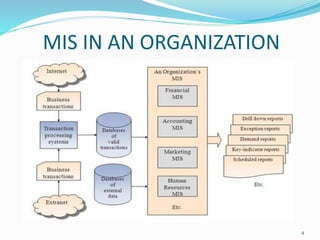
MIS IN AN ORGANIZATION
4
Importance of MIS
Decision making (rational)– managerial function
Reliable, timely info – essential
MIS – a logical, well-structured method of info
collection, processing, and disseminating to decision-
makers
Era of liberalization and globalization
Era of computers and IT
MIS – nerve center
5
ROLE OF MIS
• System ensures that an appropriate data is collected
from the various sources, processed, and sent further
to all the needy destination.
MIS helps in Strategic Planning, Management Control,
Operational Control and Transaction Processing.
MIS plays the role of information generation,
communication, problem identification and helps in
the process of decision making
6
Objectives
List and describe the classic functions of managers –
planning, organizing, staffing, directing, and
controlling
Describe the purpose and components of a
management information system (MIS)
Explain how computer networking and related
software have flattened the classic management
pyramid
7
Objectives
Describe how many companies use employees in task-
oriented teams
Describe the purpose and function of sophisticated
software for top managers
Explain the problems and solutions related to
managing personal computers
Explain the concept of total cost of personal computer
ownership
8
Advantages Of MIS
Globalisation : It has not only brought the world closer
together ,but it has allowed the worlds economy to become
a single interdependent sysem. This means that we can
bring down barriers of linguistic and geographic
boundaries.
Communication :With the help of this , communication
has become cheaper , quicker and more efficient.
Cost effectiveness:It has helped to computerize business
processes thus streamlining businesses to make them
extremely cost effective money making machines.
9
Disadvantages of MIS
Lack of Job Security: Industry experts believe that the
internet has made job security a big issue as
technology keeps on changing with each day.
Dominant Culture: While information techonology
may have made the world a global village , it has also
contributsed to one culture dominating another
weaker one.
Privacy: Though IT may have made communication
quicker, easier and more convenient , it has also
brought along privacy issues.
10
MIS As A Career
MIS professionals are leaders who initiate ,design and
apply technology to transform business functions and
produce innovative products and services.
MIS professionals have following career options:
 Analyst
 Consultant
 Application Developer
 Data Analyst
 Project Leader
11
Roles Of MIS Professionals
MIS as a SYSTEM ANALYST study business problems and
implement systems to solve them.
MIS as a CONSULTANT analyze problems and change
business processes.
MIS as a APPLICATION DEVELOPER develop software to
gather and store data
MIS as a DATA ANALYST extracts and analyzes
organizational data.
MIS as a PROJECT LEADER organizes a team of analysts
,programmers and others to create an innovative solution.
12
PEOPLE PURSUING MIS DEGREES
People pursuing MIS degrees must possess
following traits:
Good problem solving skills
Excellent communication skills
Ability to effectively manage time and resources
Ability to think strategically about techonolgy.
13
New perspective of Information
MIS = MI + S
MIS must provide MI to managers for decision-making
MI-quality info
Timeliness
Accuracy
Completeness
Adequacy
MI-a subset of the entire available info
14
MIS FUNCTIONS
Data capturing
Processing of data
Storage
Retrieval
Dissemination of MI – finished product of MIS
15
COMPONENTS OF MIS
Input: Data to be arranged
- Sales in units by each salesman for a period.
- Estimated sales in units of competitors.
- Economic condition and trends
Processor: Classify , Sort , Summarize , calculate
- Conversion of input into outputs
Output: Arranged Data
- Sale by Product
- Sales by Salesman
16
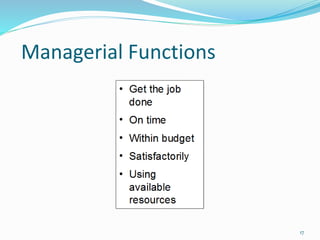
Managerial Functions
17
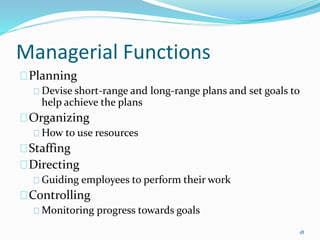
Managerial Functions
Planning
Devise short-range and long-range plans and set goals to
help achieve the plans
Organizing
How to use resources
Staffing
Directing
Guiding employees to perform their work
Controlling
Monitoring progress towards goals
18
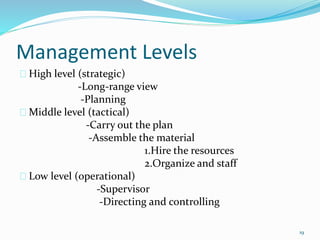
Management Levels
High level (strategic)
-Long-range view
-Planning
Middle level (tactical)
-Carry out the plan
-Assemble the material
1.Hire the resources
2.Organize and staff
Low level (operational)
-Supervisor
-Directing and controlling
19
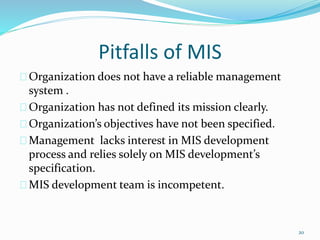
Pitfalls of MIS
Organization does not have a reliable management
system .
Organization has not defined its mission clearly.
Organization’s objectives have not been specified.
Management lacks interest in MIS development
process and relies solely on MIS development’s
specification.
MIS development team is incompetent.
20
Bibliography
Textbook Source
-M.Awadh
Internet Sources
-wikipedia
-www.mu.ac.in/mis.pdf
21

Our presentation on Management Information System

  • 1.
  • 2.
    MIS : ADEFINITION A Management Information System provides information that organizations require to manage themselves efficiently and effectively. This term is commonly used to refer to the study of how individuals , groups , and organizations evaluate , design , implement , manage and utilize systems to generate information to improve efficiency. A Management Information system gives the business managers the information that they need to make decisions. 2
  • 3.
    History Of MIS Beforethe concept of management information systems was created , computer scientist was just programmer creating application for science and math calculation to computer usage evolved in field of business and data management ,software application were needed to process non scientific data.Five phases in development of computing techonology. i. Mainframe and Minicomputers computing ii. Personal Computers iii. Client Server network iv. Enterprise Computing v. Cloud Computing s 3
  • 4.
    MIS IN ANORGANIZATION 4
  • 5.
    Importance of MIS Decisionmaking (rational)– managerial function Reliable, timely info – essential MIS – a logical, well-structured method of info collection, processing, and disseminating to decision- makers Era of liberalization and globalization Era of computers and IT MIS – nerve center 5
  • 6.
    ROLE OF MIS •System ensures that an appropriate data is collected from the various sources, processed, and sent further to all the needy destination. MIS helps in Strategic Planning, Management Control, Operational Control and Transaction Processing. MIS plays the role of information generation, communication, problem identification and helps in the process of decision making 6
  • 7.
    Objectives List and describethe classic functions of managers – planning, organizing, staffing, directing, and controlling Describe the purpose and components of a management information system (MIS) Explain how computer networking and related software have flattened the classic management pyramid 7
  • 8.
    Objectives Describe how manycompanies use employees in task- oriented teams Describe the purpose and function of sophisticated software for top managers Explain the problems and solutions related to managing personal computers Explain the concept of total cost of personal computer ownership 8
  • 9.
    Advantages Of MIS Globalisation: It has not only brought the world closer together ,but it has allowed the worlds economy to become a single interdependent sysem. This means that we can bring down barriers of linguistic and geographic boundaries. Communication :With the help of this , communication has become cheaper , quicker and more efficient. Cost effectiveness:It has helped to computerize business processes thus streamlining businesses to make them extremely cost effective money making machines. 9
  • 10.
    Disadvantages of MIS Lackof Job Security: Industry experts believe that the internet has made job security a big issue as technology keeps on changing with each day. Dominant Culture: While information techonology may have made the world a global village , it has also contributsed to one culture dominating another weaker one. Privacy: Though IT may have made communication quicker, easier and more convenient , it has also brought along privacy issues. 10
  • 11.
    MIS As ACareer MIS professionals are leaders who initiate ,design and apply technology to transform business functions and produce innovative products and services. MIS professionals have following career options:  Analyst  Consultant  Application Developer  Data Analyst  Project Leader 11
  • 12.
    Roles Of MISProfessionals MIS as a SYSTEM ANALYST study business problems and implement systems to solve them. MIS as a CONSULTANT analyze problems and change business processes. MIS as a APPLICATION DEVELOPER develop software to gather and store data MIS as a DATA ANALYST extracts and analyzes organizational data. MIS as a PROJECT LEADER organizes a team of analysts ,programmers and others to create an innovative solution. 12
  • 13.
    PEOPLE PURSUING MISDEGREES People pursuing MIS degrees must possess following traits: Good problem solving skills Excellent communication skills Ability to effectively manage time and resources Ability to think strategically about techonolgy. 13
  • 14.
    New perspective ofInformation MIS = MI + S MIS must provide MI to managers for decision-making MI-quality info Timeliness Accuracy Completeness Adequacy MI-a subset of the entire available info 14
  • 15.
    MIS FUNCTIONS Data capturing Processingof data Storage Retrieval Dissemination of MI – finished product of MIS 15
  • 16.
    COMPONENTS OF MIS Input:Data to be arranged - Sales in units by each salesman for a period. - Estimated sales in units of competitors. - Economic condition and trends Processor: Classify , Sort , Summarize , calculate - Conversion of input into outputs Output: Arranged Data - Sale by Product - Sales by Salesman 16
  • 17.
  • 18.
    Managerial Functions Planning Devise short-rangeand long-range plans and set goals to help achieve the plans Organizing How to use resources Staffing Directing Guiding employees to perform their work Controlling Monitoring progress towards goals 18
  • 19.
    Management Levels High level(strategic) -Long-range view -Planning Middle level (tactical) -Carry out the plan -Assemble the material 1.Hire the resources 2.Organize and staff Low level (operational) -Supervisor -Directing and controlling 19
  • 20.
    Pitfalls of MIS Organizationdoes not have a reliable management system . Organization has not defined its mission clearly. Organization’s objectives have not been specified. Management lacks interest in MIS development process and relies solely on MIS development’s specification. MIS development team is incompetent. 20
  • 21.