Principles of
Democratic of
Education
Prepared and presented by:
ANN SHEENA MARGARET C.
TAMPUS
Democratic philosophy of
education
Democratic education infuses the learning process.
It is an educational ideal in which democracy is both
a goal and a method of instruction.
It brings democratic values to education and can
include self-determination within a community of
equals.
The purpose of education in a democratic society
is to instill the values of cooperation, respect, fairness
and justice into the hearts of our students.
Freedom
Freedom for All
The concepts of choice and control are at
the heart of democratic education. Choice,
the ability to have autonomy in the direction
of one's own educational path, and control,
the ability to decide how to approach
major educational needs, are the two main
principles of democratic education.
Student-centered
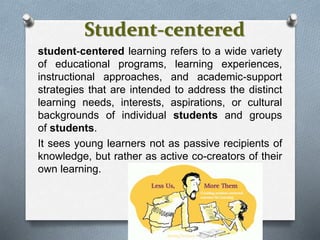
student-centered learning refers to a wide variety
of educational programs, learning experiences,
instructional approaches, and academic-support
strategies that are intended to address the distinct
learning needs, interests, aspirations, or cultural
backgrounds of individual students and groups
of students.
It sees young learners not as passive recipients of
knowledge, but rather as active co-creators of their
own learning.
The administration must be
flexible, adaptable and stable
An institution must be able to adjust with changing
situations by fulfilling the developing needs and by
improving its day-to-day dealings with persons or
agencies involved. This characteristic of an
institution is called adaptability.
GOAL: to change, to develop and to improve
In the process of achieving its educational
objectives, it has to deal differently with different
human beings like teachers, parents and the public
at large, who are affected in one way or other by
the process or its products. This tendency is called
flexibility.
Flexible education systems enable learners to
move within and across education, training and
employment. Flexibility means that young people
can adapt their learning pathway as they go along,
to suit their interests and abilities.
The educational institution however must be
able to achieve adaptability without creating any
dislocation or disruption in its process and
achievements. This property is named as stability.
Promote educational stability for children in foster
care so they can continue their education without
disruption, maintain important relationships, and
have the opportunity to achieve college and career
readiness.
An institution must have these characteristics in
order to be able to achieve its objectives adequately
and to give due regard to all persons concerned in
some way or other, especially in learning and
educational process.
THANK YOU for listening


Educ 605: DEMOCRATIC SCHOOL ADMINISTRATION

  • 1.
    Principles of Democratic of Education Preparedand presented by: ANN SHEENA MARGARET C. TAMPUS
  • 2.
    Democratic philosophy of education Democraticeducation infuses the learning process. It is an educational ideal in which democracy is both a goal and a method of instruction. It brings democratic values to education and can include self-determination within a community of equals. The purpose of education in a democratic society is to instill the values of cooperation, respect, fairness and justice into the hearts of our students.
  • 3.
    Freedom Freedom for All Theconcepts of choice and control are at the heart of democratic education. Choice, the ability to have autonomy in the direction of one's own educational path, and control, the ability to decide how to approach major educational needs, are the two main principles of democratic education.
  • 4.
    Student-centered student-centered learning refersto a wide variety of educational programs, learning experiences, instructional approaches, and academic-support strategies that are intended to address the distinct learning needs, interests, aspirations, or cultural backgrounds of individual students and groups of students. It sees young learners not as passive recipients of knowledge, but rather as active co-creators of their own learning.
  • 5.
    The administration mustbe flexible, adaptable and stable An institution must be able to adjust with changing situations by fulfilling the developing needs and by improving its day-to-day dealings with persons or agencies involved. This characteristic of an institution is called adaptability. GOAL: to change, to develop and to improve In the process of achieving its educational objectives, it has to deal differently with different human beings like teachers, parents and the public at large, who are affected in one way or other by the process or its products. This tendency is called flexibility.
  • 6.
    Flexible education systemsenable learners to move within and across education, training and employment. Flexibility means that young people can adapt their learning pathway as they go along, to suit their interests and abilities. The educational institution however must be able to achieve adaptability without creating any dislocation or disruption in its process and achievements. This property is named as stability. Promote educational stability for children in foster care so they can continue their education without disruption, maintain important relationships, and have the opportunity to achieve college and career readiness.
  • 7.
    An institution musthave these characteristics in order to be able to achieve its objectives adequately and to give due regard to all persons concerned in some way or other, especially in learning and educational process. THANK YOU for listening 