Pictures and Concepts are not mine, credits to the owner | See the Reference
APPROACHES TO
EDUCATIONAL PLANNING
Presented By:
DEXTER H. VARQUEZ
Pictures and Concepts are not mine, credits to the owner | See the Reference
What is Educational Planning?
 The process of setting out in advance the strategies, policies, procedures,
programmes and standards through which an educational objective (or set of
objectives) can be acheived.
 It is a detailed and systematic process; it just does not happen by chance.
 It is goal-oriented: it is directed at achieving a set of educational objectives.
 Educational planning strives to research, develop, implement and advance
policies, programs and reforms within educational institutions.
Pictures and Concepts are not mine, credits to the owner | See the Reference
Important Facts About Educational
Planning
 Educational planners might work at the local, national or international level to
advance or improve education.
 While educational planning might center on pre-school and K-12 education, you
could also work in postsecondary education as well. As an educational planner,
you could work within educational institutions, government agencies, and private or
not-for-profit organizations.
 Educational planners typically hold graduate degrees. You might also consider
becoming a licensed teacher or earning additional degrees in education.
Administrators within schools or districts are commonly involved in educational
planning.
Pictures and Concepts are not mine, credits to the owner | See the Reference
APPROACHES TO EDUCATIONAL
PLANNING (Prof.S.G.Isave, Tilak College of Education in India)
Intra-educational extrapolation model.
Demographic projection model.
School mapping.
Manpower or human resource development
approach or model.
Social demand approach or model.
Rate of return approach or model.
Social justice approach or model
 All approaches are related with each other.
Pictures and Concepts are not mine, credits to the owner | See the Reference
INTRA-EDUCATIONAL
EXTRAPOLATION MODEL
 Planning based on data available.
 Concentration on one aspect / program.
 Size of target, time, money.
 Govt. schemes, organization of workshop
 One of the option in the Educational Planning for Primary
Education (Sidney Leite, Blogger)
 It analyzes the time and funding required in light of the needs
for the specific program, and promotes workshops to
involve members of the institution in decision-making
activities.
DEMOGRAPHIC PROJECTION MODEL
 Demographic development has become a source of planning.
 Estimating the population that future educational system is to
serve.
 Useful to take decision on new school/college permission.
Pictures and Concepts are not mine, credits to the owner | See the Reference
SCHOOL MAPPING.
 Micro planning.
 Geographical location of school is considered.
 From national frame to regional and local conditions and constraints
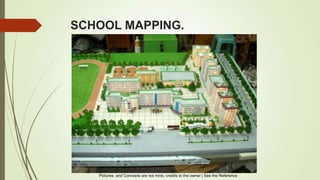
 School mapping is a set of techniques and procedures used to estimate
future education requirements at local level and work out what needs to be
done to meet them.
 Do not confuse school mapping with a simple “atlas” merely showing the
location of schools.
 Unlike an ordinary map that by its very nature is static, school mapping
gives a dynamic and prospective vision of how the education service
should look in the future, showing its buildings, teachers, and facilities, to
enable the implementation of education policies.
Pictures and Concepts are not mine, credits to the owner | See the Reference
SCHOOL MAPPING.
Pictures and Concepts are not mine, credits to the owner | See the Reference
MANPOWER OR HUMAN RESOURCE
DEVELOPMENT APPROACH OR
MODEL
Planning should consider of human resource in all
fields required for country.
Education planning should be skill based, expected
man power.
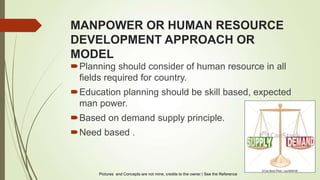
Based on demand supply principle.
Need based .
Pictures and Concepts are not mine, credits to the owner | See the Reference
SOCIAL DEMAND APPROACH OR
MODEL.
Educational planning should be given according to
the demand from society.
It should be able to fulfill to need of all level
education .
 It focuses on quantitative planning
Pictures and Concepts are not mine, credits to the owner | See the Reference
RATE OF RETURN APPROACH OR
MODEL
Economics approach
Capitalist approach.
Cost – effectiveness/ cost-benefits
More benefits – more investment.
Education as an investment.
Measurement is difficult.
Ignoring personal satisfaction,
social development.
Pictures and Concepts are not mine, credits to the owner | See the Reference
SOCIAL JUSTICE APPROACH OR
MODEL
Planning for social development.
Constitutional goals.
Education for Deprived groups of society like dalits,
women, minority.
Equal opportunity
Pictures and Concepts are not mine, credits to the owner | See the Reference
MORE APPROACHES
Pattern oriented approaches.– Following the
successful pattern of education implemented
elsewhere.
Need based (Educationists) approaches.
International , national , social , personal needs.
Resource based approach (Economists) Correlation
of human and financial resources.
Pictures and Concepts are not mine, credits to the owner | See the Reference
DURATION BASED APPROACHES
Short term planning
Long term planning
Pictures and Concepts are not mine, credits to the owner | See the Reference
REFERENCES
 https://educatinginternationally.wordpress.com/2015/08/30/educational-planning-
in-primary-education/
 https://learningportal.iiep.unesco.org/en/glossary/school-mapping
Pictures and Concepts are not mine, credits to the owner | See the Reference
FIVE MAIN STAGES OF EDUCATIONAL
PLANNING (Article shared by Deepti Verma)
 (1) Collection and Analysis of Statistical Information:
 (2) Evolving Policy Proposals:
 (3) Projections, Programming and Project Analysis:
 (4) Costing Educational Plans:
 (5) Decision, Implementation and Evaluation:
Pictures and Concepts are not mine, credits to the owner | See the Reference
(1) Collection and Analysis of Statistical
Information:
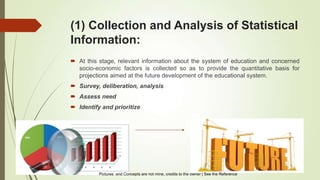
 At this stage, relevant information about the system of education and concerned
socio-economic factors is collected so as to provide the quantitative basis for
projections aimed at the future development of the educational system.
 Survey, deliberation, analysis
 Assess need
 Identify and prioritize
Pictures and Concepts are not mine, credits to the owner | See the Reference
(2) Evolving Policy Proposals:
 The statistical information collected helps in identifying the gaps, weaknesses and
shortcoming and provides the planners with a clear idea of the existing conditions.
This helps the planners in formulating policy proposals aimed at accomplishing
pre-determined objectives.
 Definition of goals and objectives
 Set goals and objectives
Pictures and Concepts are not mine, credits to the owner | See the Reference
(2) Evolving Policy Proposals:
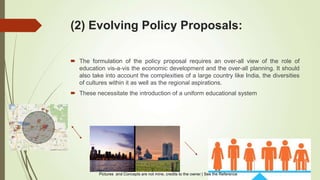
 The formulation of the policy proposal requires an over-all view of the role of
education vis-a-vis the economic development and the over-all planning. It should
also take into account the complexities of a large country like India, the diversities
of cultures within it as well as the regional aspirations.
 These necessitate the introduction of a uniform educational system
Pictures and Concepts are not mine, credits to the owner | See the Reference
(3) Projections, Programming and
Project Analysis:
 An effective plan necessitates projections of all the inputs of the educational
system – students, teachers, administrators, school buildings and classrooms,
equipment and financial requirements.
 Projections have to be made of the future nature and size of the demographic
composition of population for a period of fifteen to twenty years. Since student is
the focus of the educational process, projection should begin with the school and
the college age-groups drawn on a yearly basis in terms of enrolments.
 Program design and specification
 Develop strategy
Pictures and Concepts are not mine, credits to the owner | See the Reference
(4) Costing Educational Plans:
 Education is an activity wherein the institution and the society bear part of the cost
and the learner bears part of the cost. In order to improve the formulation and
implementation of educational plans, it is necessary to understand the methods of
costing education and the problems associated with it.
 The unit costs of different types of educational facilities need to be computed.
These costs are to be studied in terms of the availability of present and future
financial resources. It should be ensured at this stage that the real cost of
education is not too high so as to be inconsistent with the attainment of the overall
plan objectives.
 Program provision
 The cost of education refers to the cost incurred by the state government or private
sector for providing education to the citizens.
Pictures and Concepts are not mine, credits to the owner | See the Reference
(5) Decision, Implementation and
Evaluation:
 A five year plan needs to be broken up into annual plans. Each annual plan is
scrutinized, discussed and criticized in relation to a review of previous year’s
strengths, weaknesses and achievements. At this stage, the necessary conditions
for effective implementation of the programme need to be created. Thereafter, the
actual operations take place.
 Implementation and control
 Plan evaluation
Pictures and Concepts are not mine, credits to the owner | See the Reference
Educational Planning Process
Shafiqur Rehman
, Lecturer
Pictures and Concepts are not mine, credits to the owner | See the Reference
FOUR BASIC STAGES
(Prof. Namita S. Sahare, S.P. Mandali’s Tilak College of Education,Pune-30)
 Analysis
 Planning
 Implementation
 Evaluation
Pictures and Concepts are not mine, credits to the owner | See the Reference
REFERENCES
 http://www.shareyouressays.com/knowledge/5-main-stages-of-educational-
planning/100978
 https://learn.org/articles/What_is_Educational_Planning.html
 https://rems.ed.gov/docs/Volume5Issue3.pdf
 https://www.slideshare.net/shafiqurrehman526/educational-planning-56831868
Pictures and Concepts are not mine, credits to the owner | See the Reference
SALAMAT!
Pictures and Concepts are not mine, credits to the owner | See the Reference