DEEPTI K K
MSW
LOYOLA COLLEGE
Introduction
Resource mobilization is all the means that an
organization should acquire to implement its action plan.
It goes beyond fund raising. It entails obtaining various
resources from a multitude of partners, by different means.
Thus resource mobilization could be seen as a
combination between:
Resources: elements necessary for the running of an
organization.
Mechanisms: means which make it possible to obtain
resources directly.
Partners: persons and/or institutions providing resources.
Definition
Resource Mobilization is a process, which will identify the
resources essential for the development, implementation and
continuation of works for achieving the organization's mission.
In real terms, Resource Mobilization means expansion of
relations with the Resource Providers, the skills, knowledge
and capacity for proper use of resources.
Resource Mobilization does not only
mean use of money but it extensiveness denotes the process
that achieves the mission of the Organization through the
mobilization of knowledge in human, use of skills, equipment,
services etc. It also means seeking new sources of resource
mobilization and right and maximum use of the available
resources.
Moral Aspects
Every organization can develop a code of conduct on
Resource Mobilization, which should specify what are the
resource providers that one would like to expand relations
with, and what types of resources should be mobilized.
Such a code of conduct looks essential in the context of
Nepali NGOs because NGOs are rarely found carrying out
analysis of the type of resource providers and their
expectations. For example, a company developing arms
can provide financial sources to a human rights
organization. Such trends are found in plenty.
Importance
 To diversify and expand resources.
 Resource Mobilization helps to formulate an
independent budget. To break the tradition of
running the specific programs of any donor agencies
only.
 To spend in the program of the Organization's
liking.
 To decrease dependency on others.
 To save oneself the chance of becoming contractors
of foreign donor agencies.
 For sustainability of the Organization and program.
 For maximum use of domestic capital and skills.
Importance
 To expand deep relations with the stakeholder and
community.
 To clean the image of the Organization and expand
relations.
 To fulfill responsibilities towards the community.
 To run programs based on the genuine needs of the
community.
 To disseminate the good practices of the Organization.
 To develop new thinking and challenge the old traditions.
 To enhance the dignity of one's Organization.
Features
 Resource identification
 Identification of Resource Provider
 Identification of mechanism to receive resource
 Expansion of relations with the Resource Provider
 Right use of resource
 Knowledge and skills to Resource Mobilization
 Human skills, service, information, equipment
 Seeking out new resource
 Thought of institutional sustainability
 Lower financial risk
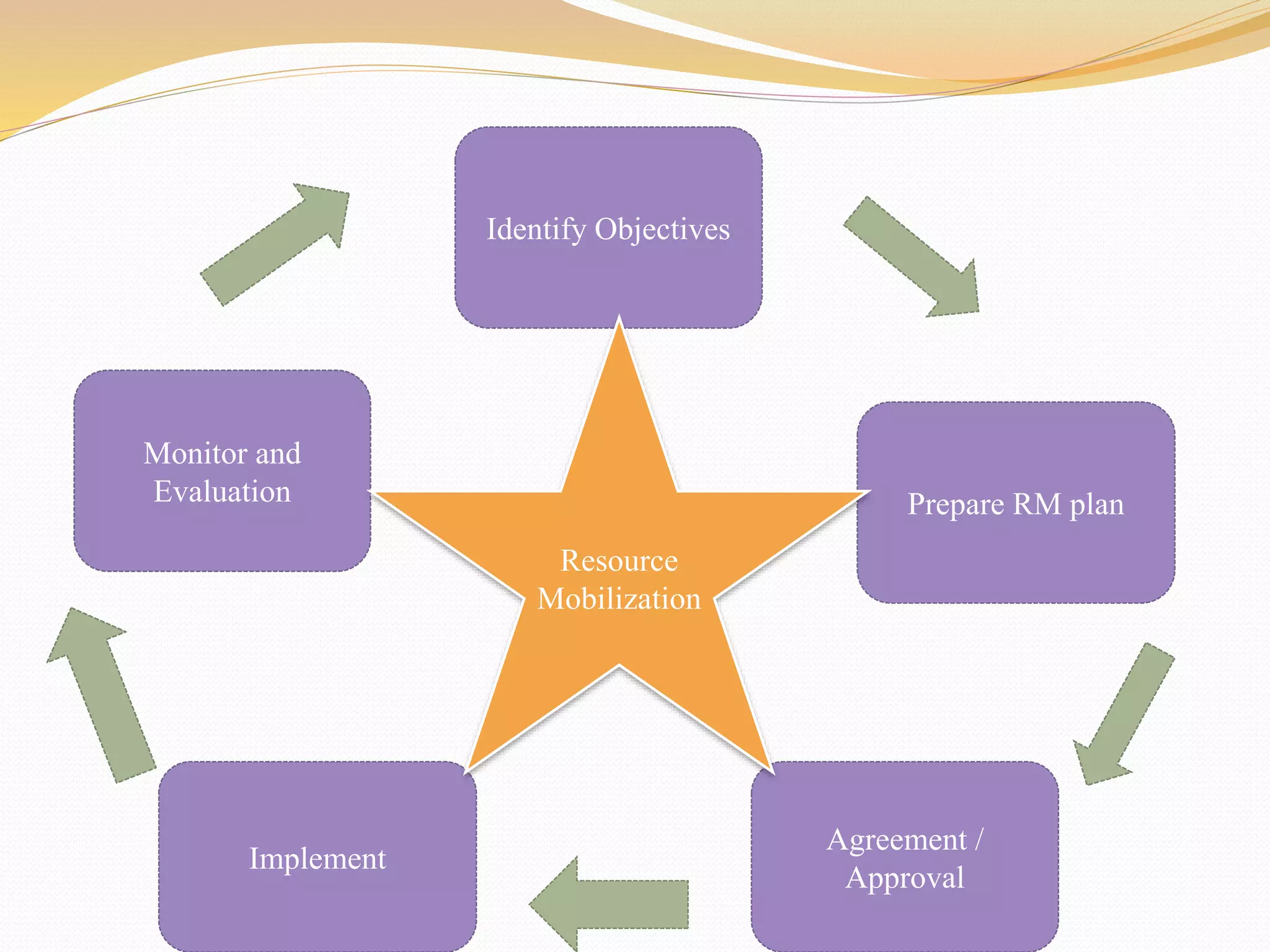
Identify Objectives
Prepare RM plan
Agreement /
Approval
Monitor and
Evaluation
Implement
Resource
Mobilization
Reasons for the requirement
 In order to continue with its work and achieve the works
and targets.
 In order to begin or plan for new work.
 In order to enhance or maintain relationship with the
community, individuals,
 Government Organizations, Private organizations or donor
agencies.
 For the development of the various conditions of the
Organization.
Types of Resources
In general terms, Resource is understood as materials,
goods or services that help fulfill the organization's needs.
Materials, money, human (man and woman), means and
time are Resources that are used by Group, organization
and individuals to fulfill their objectives. Resource is
required by every kind of organization to fulfill its
objectives. It is essential to know the type of resource, its
normal availability and the estimated cost to attain the
require resources in order to carry our works as per the
objectives of the Organization. On the basis of this
information, the primary plans of resource mobilization
should be established, checked and if needed repeated.
Types of Resources
Money/Cash:
Wealth/Cash is essential in order to run the existing programs, pay
cost of goods and salary and to carry out new works. Wealth/Cash
can be increased through various means like membership fees, grant
received as per or without request, local fund, donations and various
other sources such as NGO, INGO or external funding.
Technical Assistance/Cooperation:
Every Organization will not have people essential for carrying out
various types of activities, project and programs. Apart from that,
every organization may not have the necessary fund to appoint
essential efficient employees. Technical cooperation can be made by
any Organization by providing the amount essential for appointing
such efficient employees for a special project or the efficient
employee helping for a fixed timeframe. Some organizations provide
technical cooperation through trainings.
Types of Resources
Human Resources:
Every type of Organization will require people/personnel to ensure that the
Organizational role and works are fulfilled. For essential human resources,
the Organization will make different provisions. The Organization can
appoint some permanent employees while the remaining appointments are
made as per requirement. The permanent employees are taken as internal
resources of the Organization while employees appointed for a specific time
period are regarded as external resources. Many NGOs utilize dedicated and
regular volunteer groups in order to fulfill the need of human resource.
Physical Goods:
They are physical goods resources. For example, the Organization's activities
or availability of the project are taken ahead together by the tools. It is
essential for the Organization to spend on such goods in order to train on
main activities of the project/organization. Examples of resources like office
tools, furniture, training tools and raw goods, vehicles and other machines
have been classified under the Physical Goods.
Types of Resources
Free Service and Facilities:
A non-profit-making Organization gives many physical goods,
service and facilities only in minimum cost. As a result, provisions
for free services in the Project/Organization should be made through
community support. Apart from this, other Organizations provide the
non-profit-making Organizations to use these facilities (Eg.
Computer, Telephone, Photocopy Machine and Internet). Which is a
form of free facility. The kinds of resources could differ and change
as per the various phases of the project. For example, in the
preliminary phases, active participation from all the organizations is
essential for leadership and management of the organization.
Maintenance service and resources to make it sustainable is essential.
This condition or need has a big impact on the kind of human
resource and accordingly on assisting tools and equipments.
Resource Providers
Resource Providers refers the different
individuals/organizations that provide resources to any
organization. There are many organizations, groups and
individuals that provide resources to the NGOs. The groups
have been classified as follows:
 Organizations/Institutions
 International Non-Government
Organizations/Institutions
 National Governments
 Businessmen/Organizations/Private sector
 Individual
 Other Groups
Factors motivate
1. Politics: Receiving votes, spreading the ideology, making
decisions for one's interest,
asking to keep the name of the party, asking to construct
statue of leaders, enforce the party's program, publicizing
the party, bringing divisions.
2. Social: To have one's name, protect image, for
employment, for future of son/daughter, or family, to expand
relations with various personalities, enhance pride, for
genuine development, to support, to affect on education,
utilize the unused resources.
3. Financial: To earn money, make profit, for job,
employment, use illegal property, to evade tax, to get tax
concessions, to receive interest .
Factors motivate
4. Business: To evade tax, to get concessions, to make profit, to
sell one's products, to earn interest, as a good citizen of the
country, realizing one's duty, because there is not many profit.
5. Religious: To publicize the religion, to increase followers, to
built temples/monasteries etc.
6. Development: Because of common thought on development,
pity, love, to share experiences, utilize free time, to gain
knowledge skills, with pure heart/ spirit, to bring equality.
7. Cultural: To increase influence of one's culture, to influence
on the food, style of working, to preserve good culture, to wipe
out superstition etc.
Conclusion
A resource mobilization plan becomes effective
when the organization analyzes the existing resources at its
disposal and run programs on the basis of a plan on the type
and quantity of resources essential to achieve the strategic
objectives (mission).
In this manner, strategic plan, state of
resources, analysis of mechanism/instruments to receive
resources and skills etc. are essential for resource
mobilization. So, the meaning of Resource Mobilization is
to collect resources from more and more resource
providers, which will in turn brings down the financial risks
and give sustainability to the organization.
Reference
 Kairala,Deepak.(2002) Resource mobilization; definition
and outline of resource mobilization, USAID, America.
 WHO.(2016) Resource mobilization Orientation; planning
for resource mobilization,Tailand.
Thank you…

Resource mobilization

  • 1.
  • 2.
    Introduction Resource mobilization isall the means that an organization should acquire to implement its action plan. It goes beyond fund raising. It entails obtaining various resources from a multitude of partners, by different means. Thus resource mobilization could be seen as a combination between: Resources: elements necessary for the running of an organization. Mechanisms: means which make it possible to obtain resources directly. Partners: persons and/or institutions providing resources.
  • 3.
    Definition Resource Mobilization isa process, which will identify the resources essential for the development, implementation and continuation of works for achieving the organization's mission. In real terms, Resource Mobilization means expansion of relations with the Resource Providers, the skills, knowledge and capacity for proper use of resources. Resource Mobilization does not only mean use of money but it extensiveness denotes the process that achieves the mission of the Organization through the mobilization of knowledge in human, use of skills, equipment, services etc. It also means seeking new sources of resource mobilization and right and maximum use of the available resources.
  • 4.
    Moral Aspects Every organizationcan develop a code of conduct on Resource Mobilization, which should specify what are the resource providers that one would like to expand relations with, and what types of resources should be mobilized. Such a code of conduct looks essential in the context of Nepali NGOs because NGOs are rarely found carrying out analysis of the type of resource providers and their expectations. For example, a company developing arms can provide financial sources to a human rights organization. Such trends are found in plenty.
  • 5.
    Importance  To diversifyand expand resources.  Resource Mobilization helps to formulate an independent budget. To break the tradition of running the specific programs of any donor agencies only.  To spend in the program of the Organization's liking.  To decrease dependency on others.  To save oneself the chance of becoming contractors of foreign donor agencies.  For sustainability of the Organization and program.  For maximum use of domestic capital and skills.
  • 6.
    Importance  To expanddeep relations with the stakeholder and community.  To clean the image of the Organization and expand relations.  To fulfill responsibilities towards the community.  To run programs based on the genuine needs of the community.  To disseminate the good practices of the Organization.  To develop new thinking and challenge the old traditions.  To enhance the dignity of one's Organization.
  • 7.
    Features  Resource identification Identification of Resource Provider  Identification of mechanism to receive resource  Expansion of relations with the Resource Provider  Right use of resource  Knowledge and skills to Resource Mobilization  Human skills, service, information, equipment  Seeking out new resource  Thought of institutional sustainability  Lower financial risk
  • 8.
    Identify Objectives Prepare RMplan Agreement / Approval Monitor and Evaluation Implement Resource Mobilization
  • 9.
    Reasons for therequirement  In order to continue with its work and achieve the works and targets.  In order to begin or plan for new work.  In order to enhance or maintain relationship with the community, individuals,  Government Organizations, Private organizations or donor agencies.  For the development of the various conditions of the Organization.
  • 10.
    Types of Resources Ingeneral terms, Resource is understood as materials, goods or services that help fulfill the organization's needs. Materials, money, human (man and woman), means and time are Resources that are used by Group, organization and individuals to fulfill their objectives. Resource is required by every kind of organization to fulfill its objectives. It is essential to know the type of resource, its normal availability and the estimated cost to attain the require resources in order to carry our works as per the objectives of the Organization. On the basis of this information, the primary plans of resource mobilization should be established, checked and if needed repeated.
  • 11.
    Types of Resources Money/Cash: Wealth/Cashis essential in order to run the existing programs, pay cost of goods and salary and to carry out new works. Wealth/Cash can be increased through various means like membership fees, grant received as per or without request, local fund, donations and various other sources such as NGO, INGO or external funding. Technical Assistance/Cooperation: Every Organization will not have people essential for carrying out various types of activities, project and programs. Apart from that, every organization may not have the necessary fund to appoint essential efficient employees. Technical cooperation can be made by any Organization by providing the amount essential for appointing such efficient employees for a special project or the efficient employee helping for a fixed timeframe. Some organizations provide technical cooperation through trainings.
  • 12.
    Types of Resources HumanResources: Every type of Organization will require people/personnel to ensure that the Organizational role and works are fulfilled. For essential human resources, the Organization will make different provisions. The Organization can appoint some permanent employees while the remaining appointments are made as per requirement. The permanent employees are taken as internal resources of the Organization while employees appointed for a specific time period are regarded as external resources. Many NGOs utilize dedicated and regular volunteer groups in order to fulfill the need of human resource. Physical Goods: They are physical goods resources. For example, the Organization's activities or availability of the project are taken ahead together by the tools. It is essential for the Organization to spend on such goods in order to train on main activities of the project/organization. Examples of resources like office tools, furniture, training tools and raw goods, vehicles and other machines have been classified under the Physical Goods.
  • 13.
    Types of Resources FreeService and Facilities: A non-profit-making Organization gives many physical goods, service and facilities only in minimum cost. As a result, provisions for free services in the Project/Organization should be made through community support. Apart from this, other Organizations provide the non-profit-making Organizations to use these facilities (Eg. Computer, Telephone, Photocopy Machine and Internet). Which is a form of free facility. The kinds of resources could differ and change as per the various phases of the project. For example, in the preliminary phases, active participation from all the organizations is essential for leadership and management of the organization. Maintenance service and resources to make it sustainable is essential. This condition or need has a big impact on the kind of human resource and accordingly on assisting tools and equipments.
  • 14.
    Resource Providers Resource Providersrefers the different individuals/organizations that provide resources to any organization. There are many organizations, groups and individuals that provide resources to the NGOs. The groups have been classified as follows:  Organizations/Institutions  International Non-Government Organizations/Institutions  National Governments  Businessmen/Organizations/Private sector  Individual  Other Groups
  • 15.
    Factors motivate 1. Politics:Receiving votes, spreading the ideology, making decisions for one's interest, asking to keep the name of the party, asking to construct statue of leaders, enforce the party's program, publicizing the party, bringing divisions. 2. Social: To have one's name, protect image, for employment, for future of son/daughter, or family, to expand relations with various personalities, enhance pride, for genuine development, to support, to affect on education, utilize the unused resources. 3. Financial: To earn money, make profit, for job, employment, use illegal property, to evade tax, to get tax concessions, to receive interest .
  • 16.
    Factors motivate 4. Business:To evade tax, to get concessions, to make profit, to sell one's products, to earn interest, as a good citizen of the country, realizing one's duty, because there is not many profit. 5. Religious: To publicize the religion, to increase followers, to built temples/monasteries etc. 6. Development: Because of common thought on development, pity, love, to share experiences, utilize free time, to gain knowledge skills, with pure heart/ spirit, to bring equality. 7. Cultural: To increase influence of one's culture, to influence on the food, style of working, to preserve good culture, to wipe out superstition etc.
  • 17.
    Conclusion A resource mobilizationplan becomes effective when the organization analyzes the existing resources at its disposal and run programs on the basis of a plan on the type and quantity of resources essential to achieve the strategic objectives (mission). In this manner, strategic plan, state of resources, analysis of mechanism/instruments to receive resources and skills etc. are essential for resource mobilization. So, the meaning of Resource Mobilization is to collect resources from more and more resource providers, which will in turn brings down the financial risks and give sustainability to the organization.
  • 18.
    Reference  Kairala,Deepak.(2002) Resourcemobilization; definition and outline of resource mobilization, USAID, America.  WHO.(2016) Resource mobilization Orientation; planning for resource mobilization,Tailand.
  • 19.