
Education Institute Management System
(EIMS)
Submitted By :
Chetan Heireholi : 2BV10CS037
Kavya K Puranik : 2BV10CS042
Mugdha S Bhat : 2BV10CS050
Praneeth Shetty : 2BV10CS063
Rahul Kumar : 2BV10CS071
Under the Guidance of :
Manjunath Hiremath
eKlakshya
Prof.Padmashri Desai
BVBCET
Problem Definition
To develop a generic platform for
managing an entire education institute
that can also to cater their need of
achieving quality outcome via meticulous
tracking of student activities.
Scope and Objective
1. Hosted Solution for the Training
Management and Content Delivery Management.
On Campus Training (Full-time) Program – Infrastructure
2. Program Management
3. Course Management, Module, Sub-Module, Concepts,
Activities Management
4. Student Management
5. Faculty Management
6. Batch Management
7. Assessment System for All courses, Modules, activities, Labs
8. Content Management — PDFs, PPTs, Videos. etc
9. Online Test/Quiz Management per Course, Modules,
assignments, activities.
10.Lab Experiments Reviews — Complete Review System
Common Infrastructure
11 Assessment Reports — Different Level of reports (per
activity.Experiments, course, students, batch level)
12 Security Management — Administrator, Faculty,
Students, etc
13 Bulk Import and Export for Students, Assessment,
Course, etc.
Advantage of Proposed
System
 Easily adapted
 Integration of personal details with academic details.
 efficiently track the progress of the student.
 Dynamic generation of reports.
 Transparent assessment of activities.
 Reduce the strain on the faculty by providing templates
for evaluation that are available system wide.
 Support offline evaluation of student assessment.
 Robust online test module.
 System generates automatic ID codes
 Role based access.
Software Requirement
Specification
1.Functional Requirement
2.Non Functional Requirement
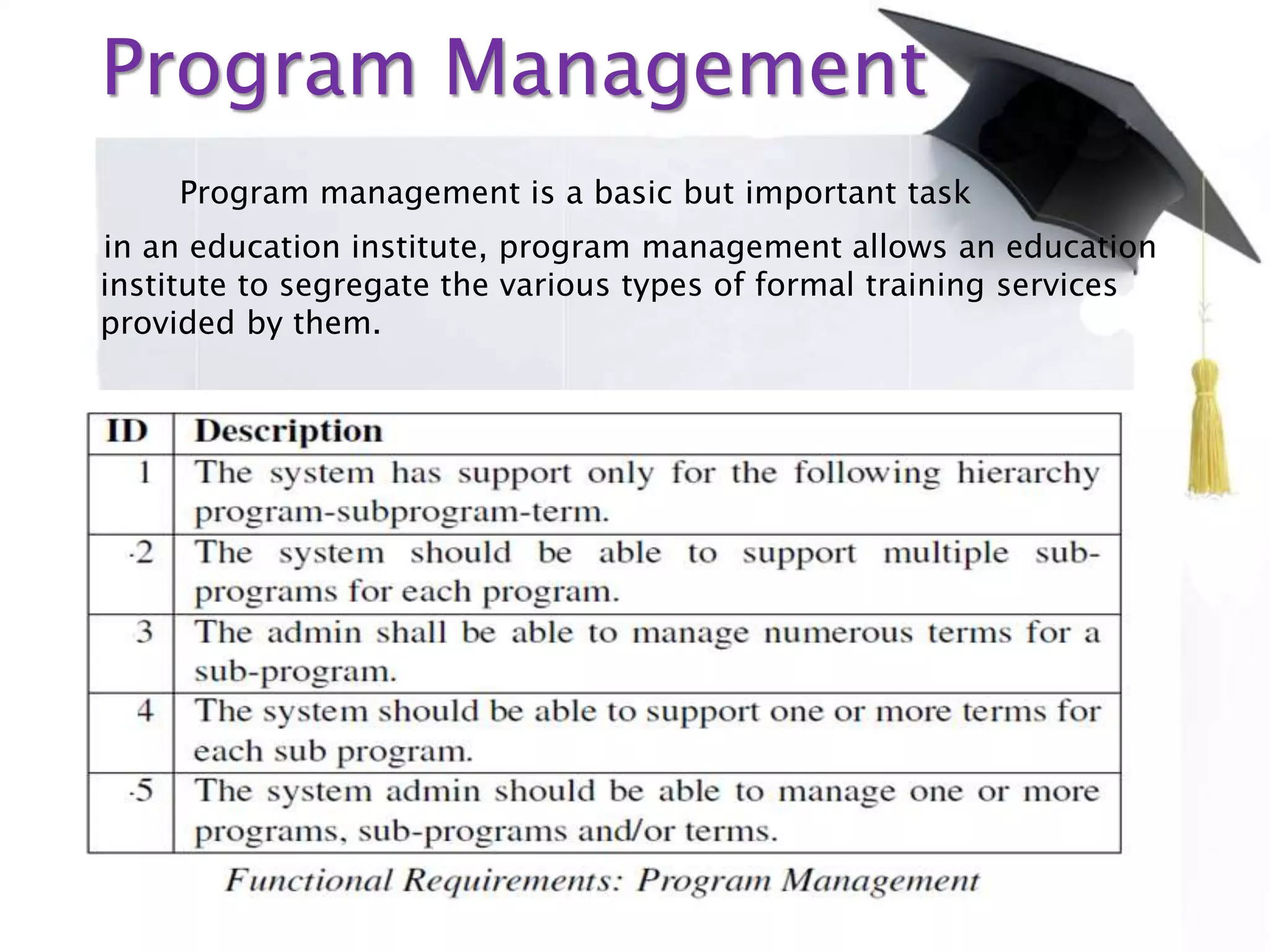
Program Management
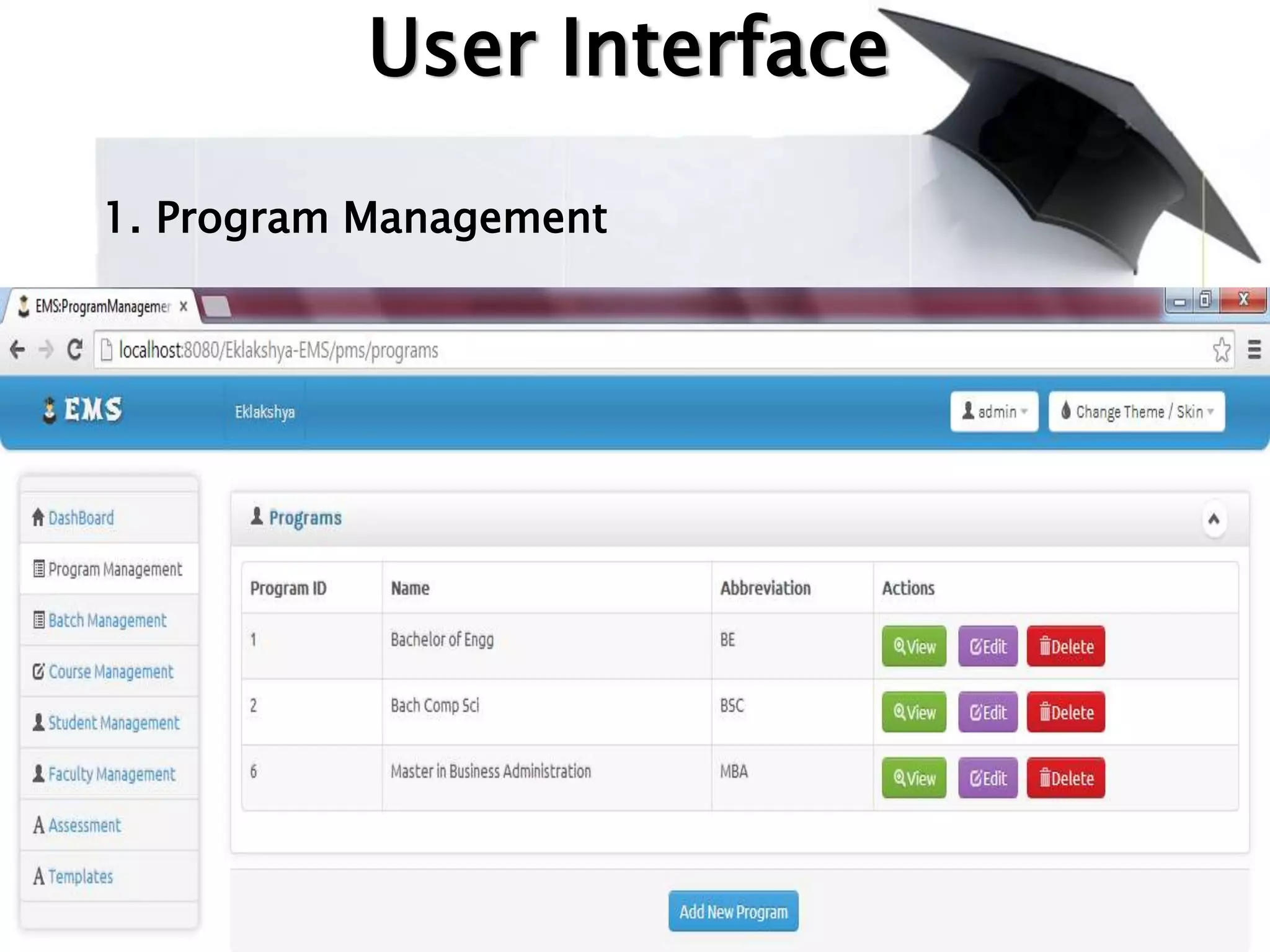
Program management is a basic but important task
in an education institute, program management allows an education
institute to segregate the various types of formal training services
provided by them.
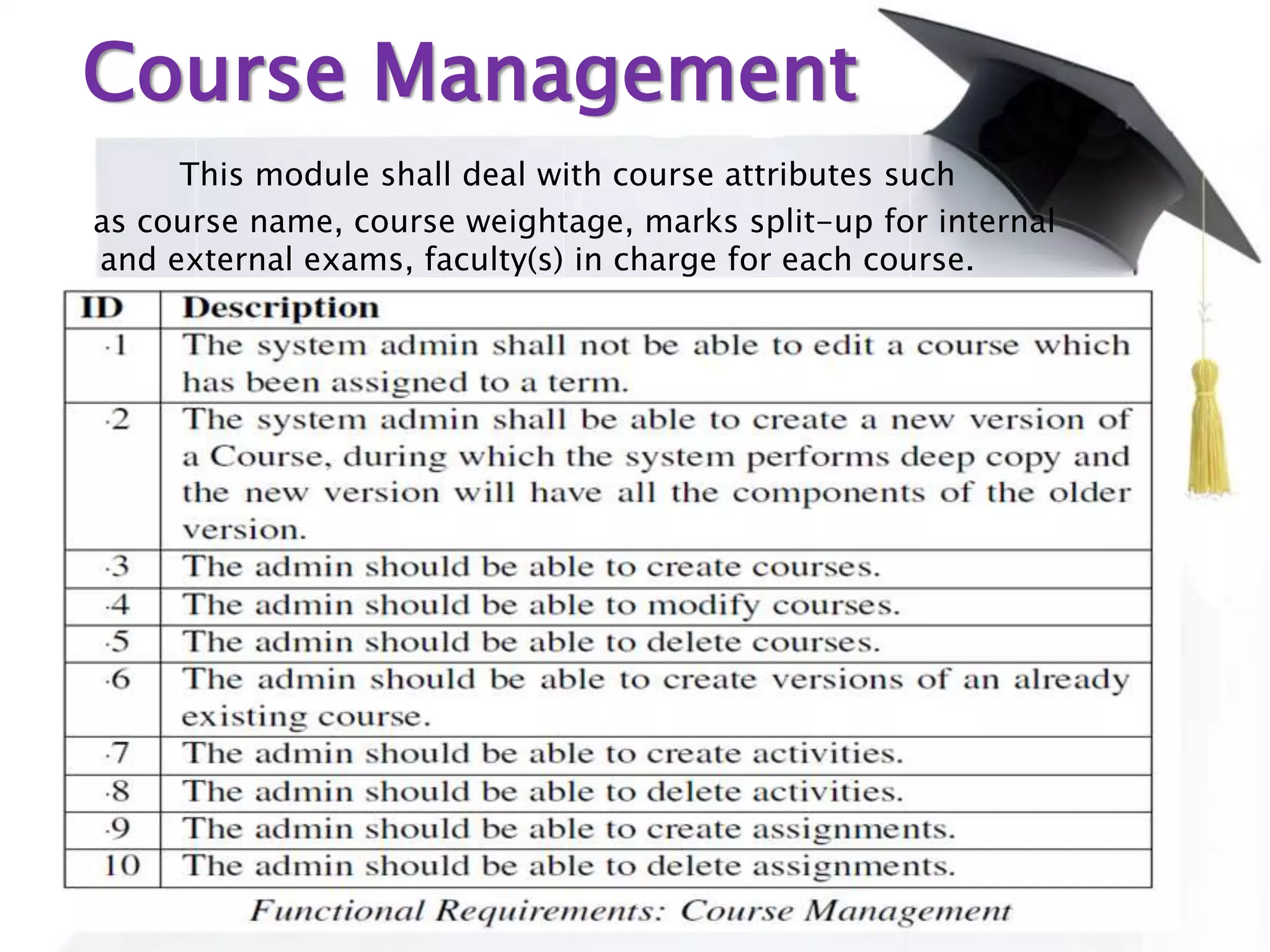
Course Management
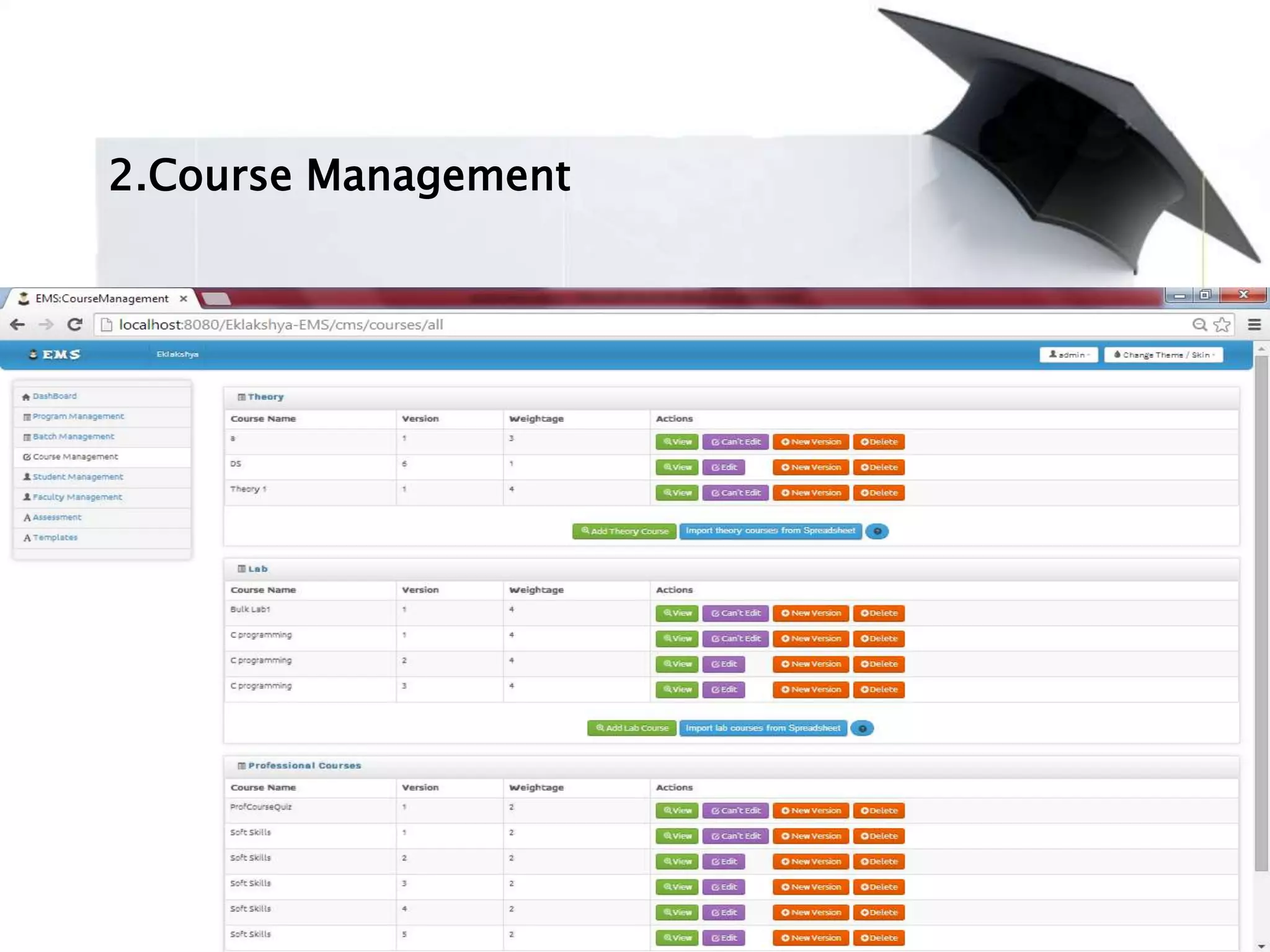
This module shall deal with course attributes such
as course name, course weightage, marks split-up for internal
and external exams, faculty(s) in charge for each course.
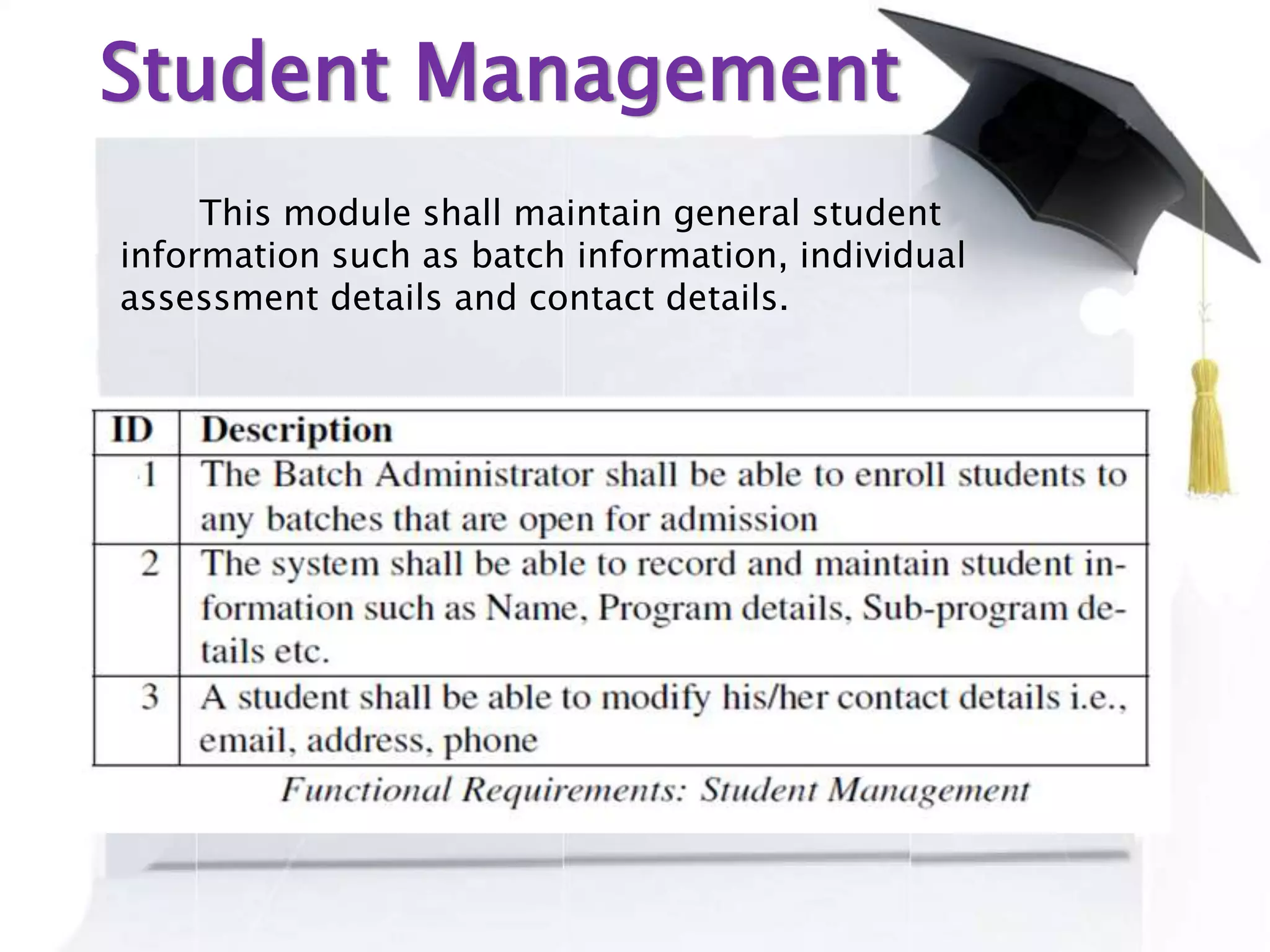
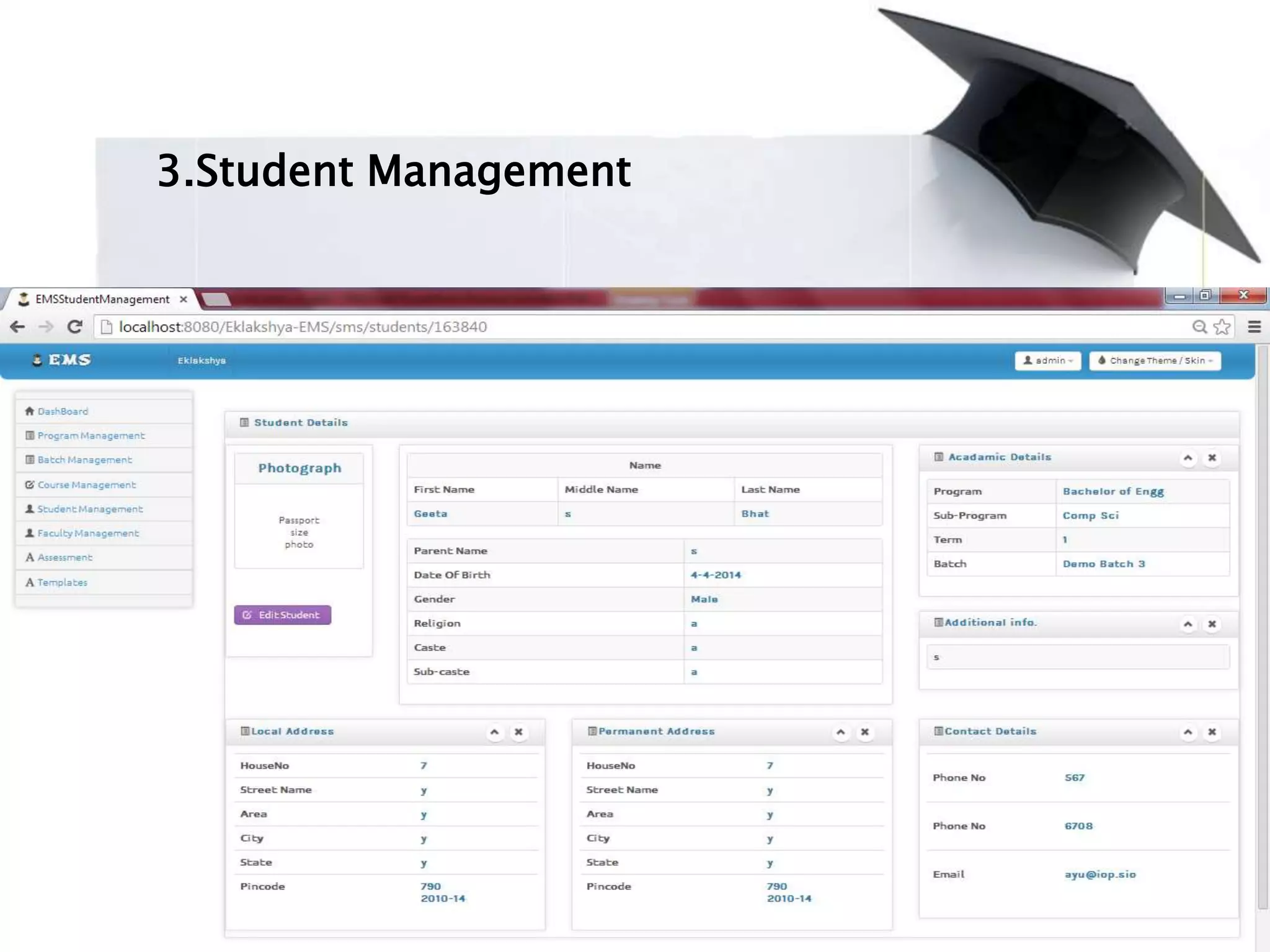
Student Management
This module shall maintain general student
information such as batch information, individual
assessment details and contact details.
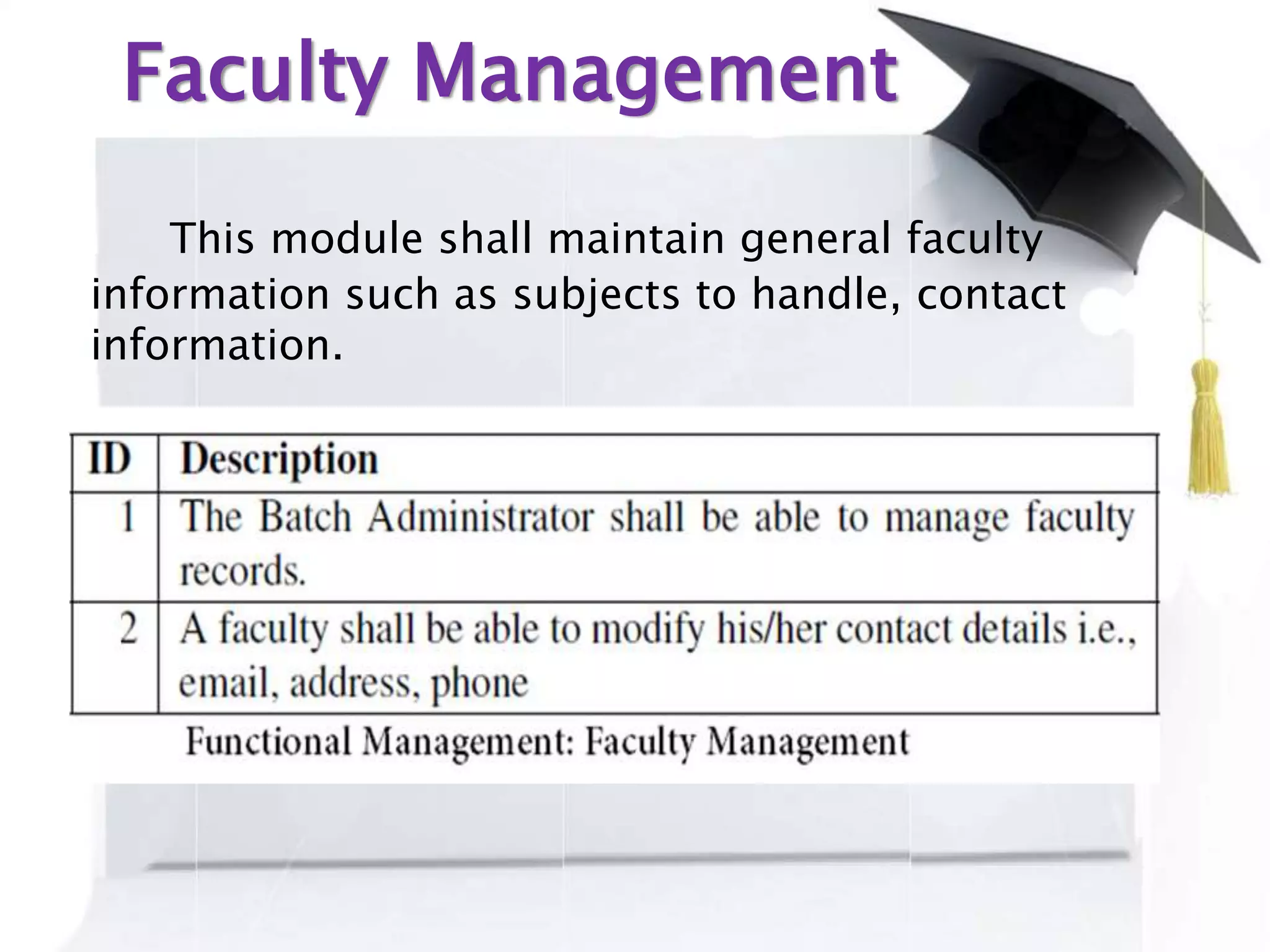
Faculty Management
This module shall maintain general faculty
information such as subjects to handle, contact
information.
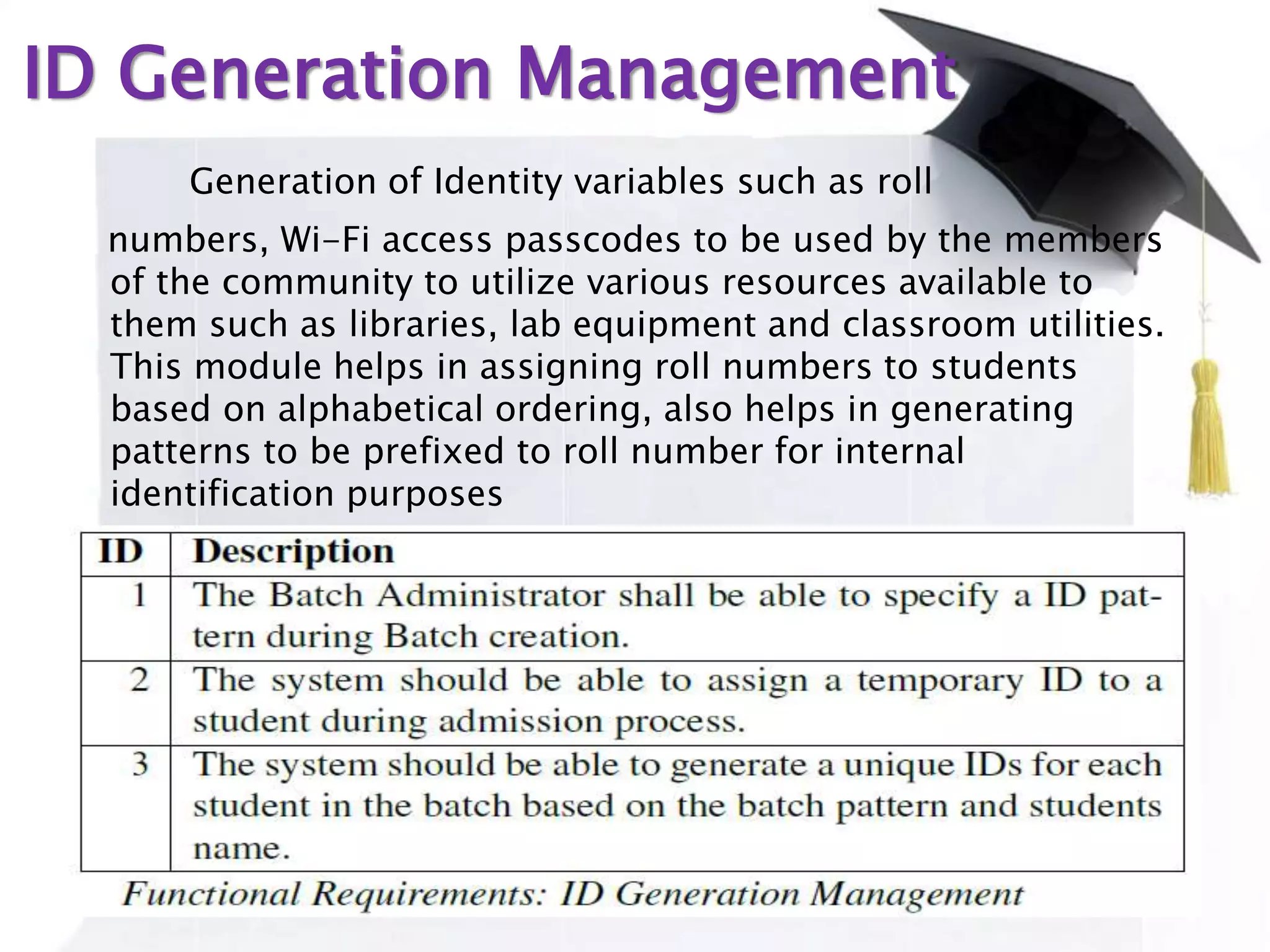
ID Generation Management
Generation of Identity variables such as roll
numbers, Wi-Fi access passcodes to be used by the members
of the community to utilize various resources available to
them such as libraries, lab equipment and classroom utilities.
This module helps in assigning roll numbers to students
based on alphabetical ordering, also helps in generating
patterns to be prefixed to roll number for internal
identification purposes
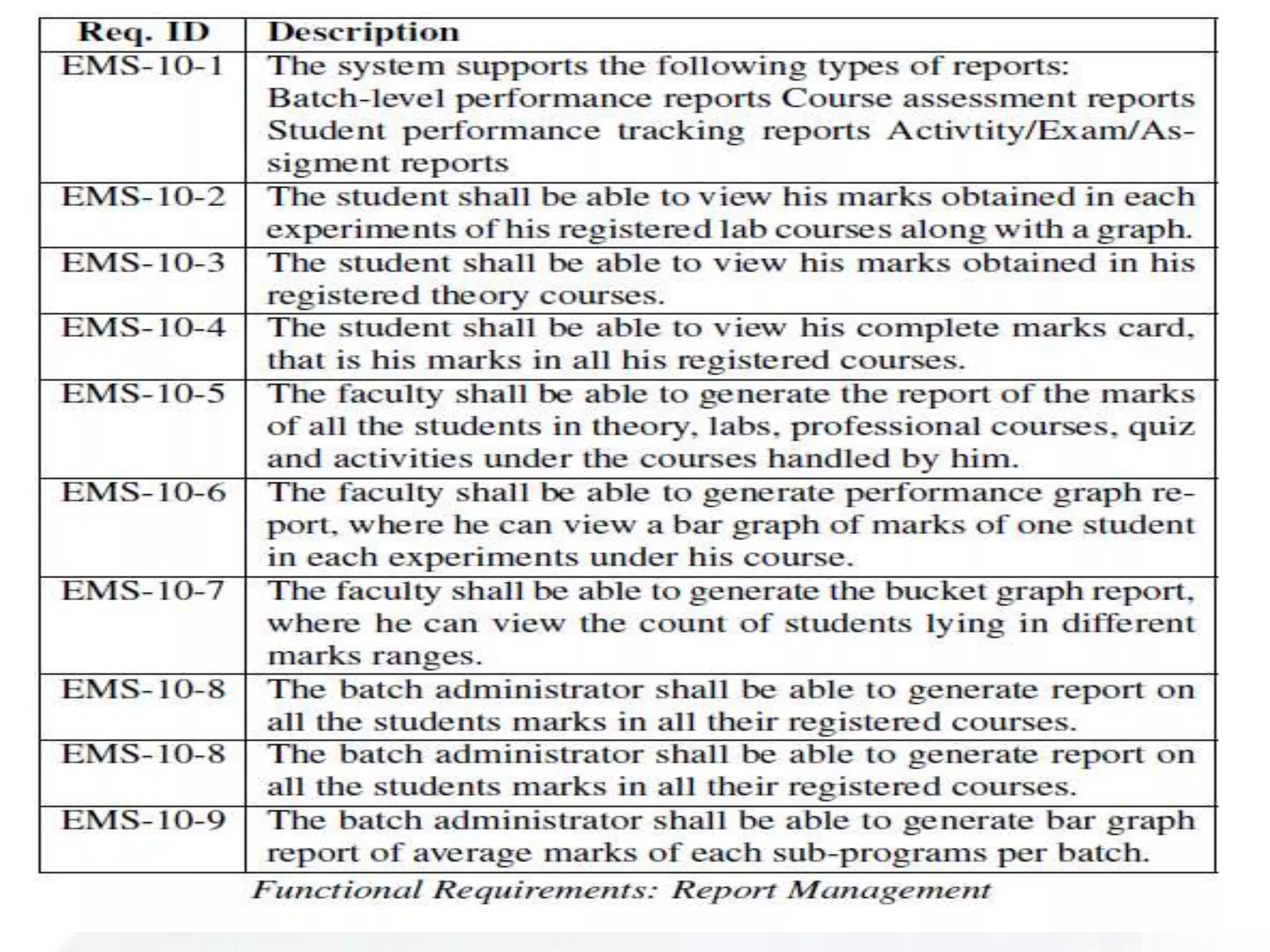
Report Management
The purpose of this module is to
provide visual aids such as bar graphs, pie
charts to represent data in an aggregated
way to audiences such as HODs, Principal,
faculties and various academic welfare
committees.
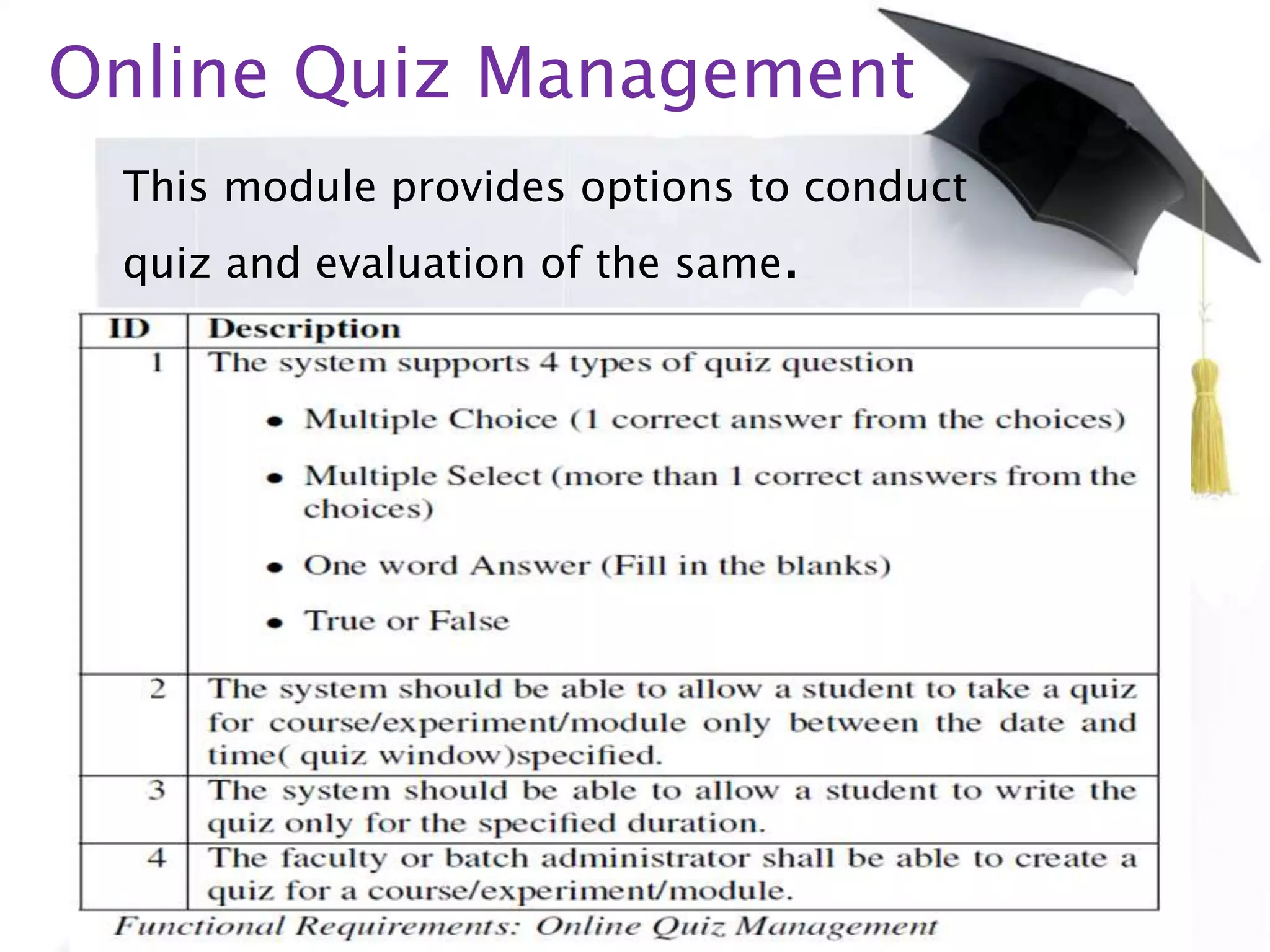
Online Quiz Management
This module provides options to conduct
quiz and evaluation of the same.
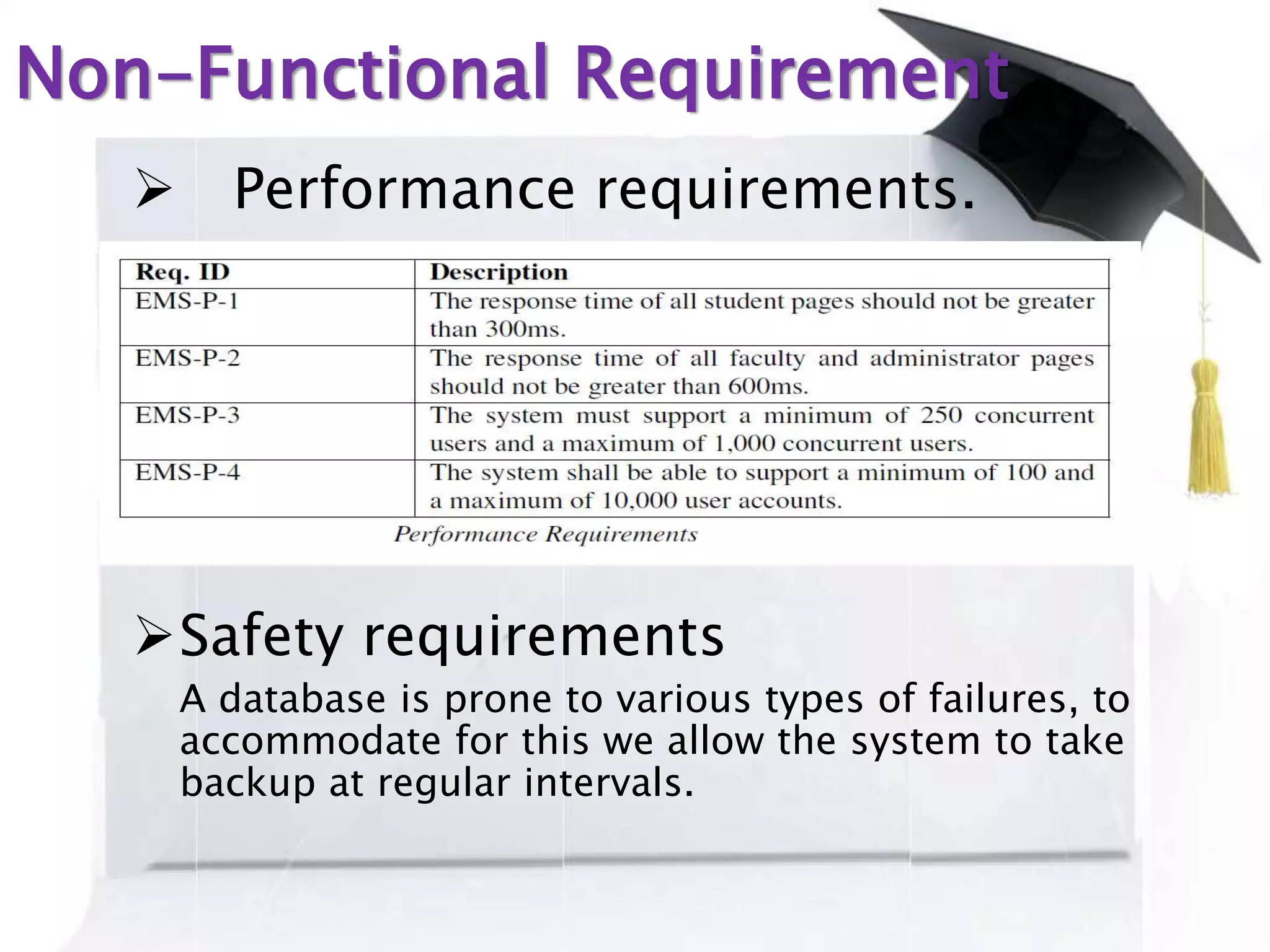
Non-Functional Requirement
 Performance requirements.
Safety requirements
A database is prone to various types of failures, to
accommodate for this we allow the system to take
backup at regular intervals.
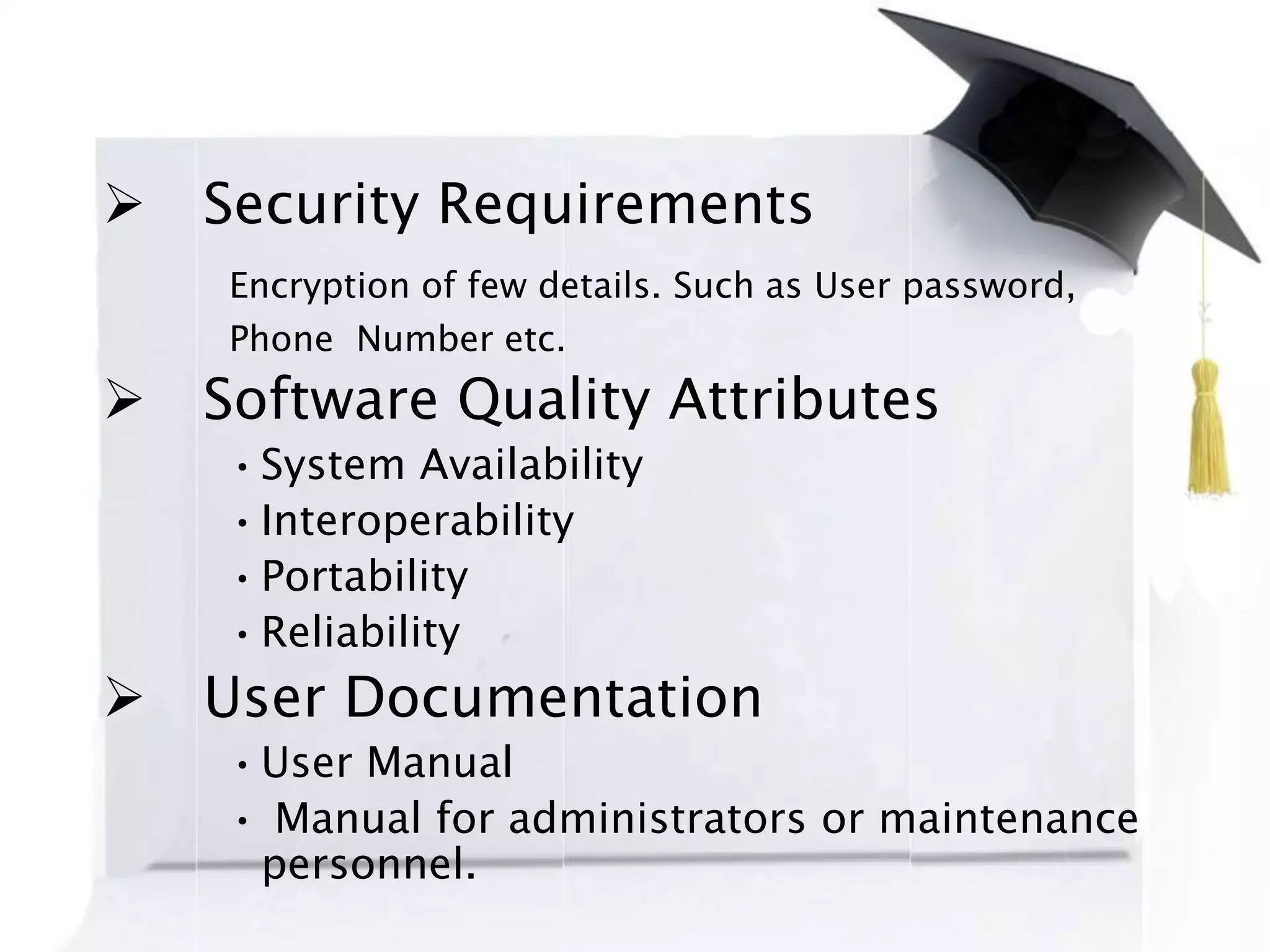
 Security Requirements
Encryption of few details. Such as User password,
Phone Number etc.
 Software Quality Attributes
•System Availability
•Interoperability
•Portability
•Reliability
 User Documentation
•User Manual
• Manual for administrators or maintenance
personnel.
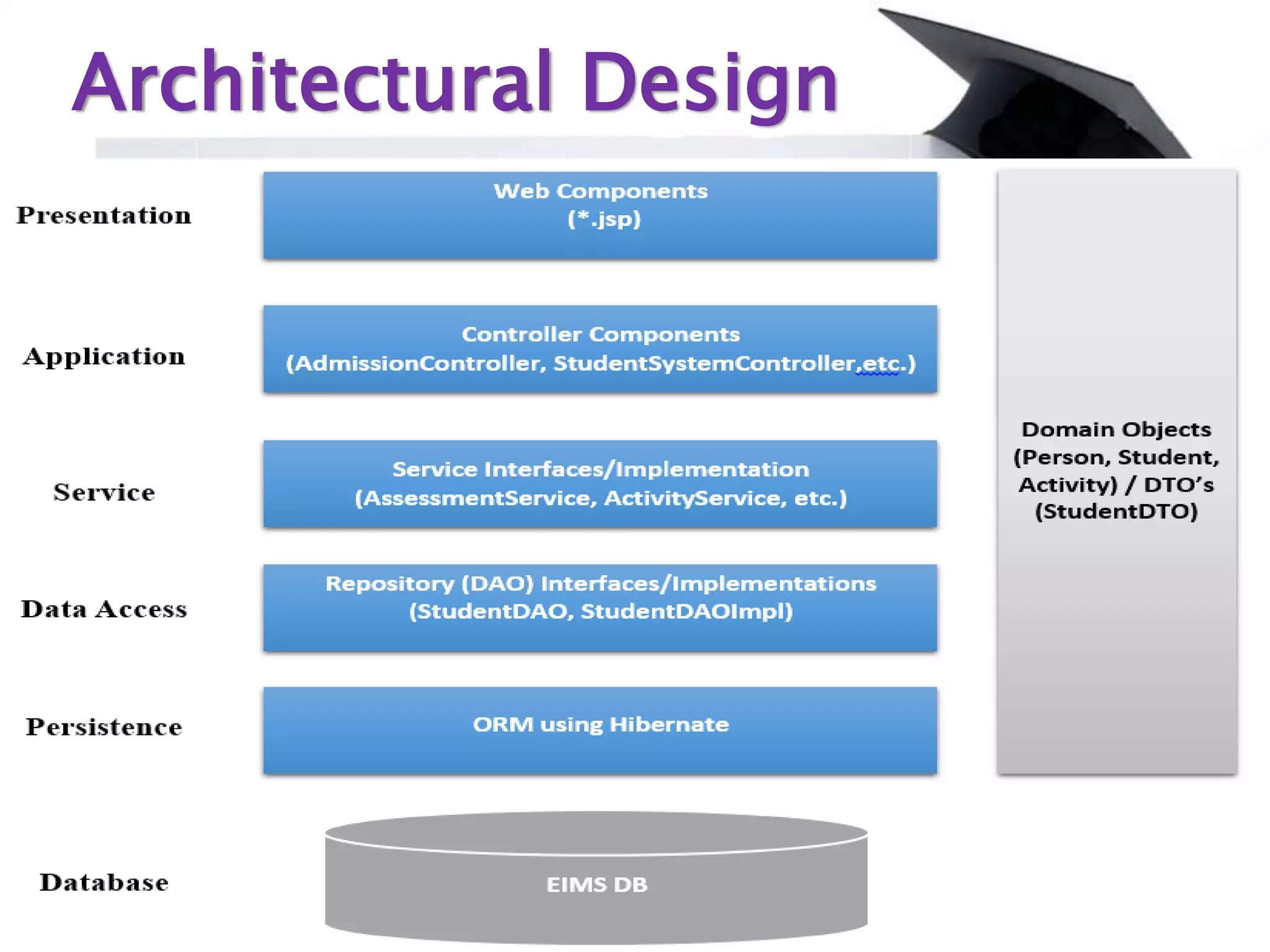
Architectural Design
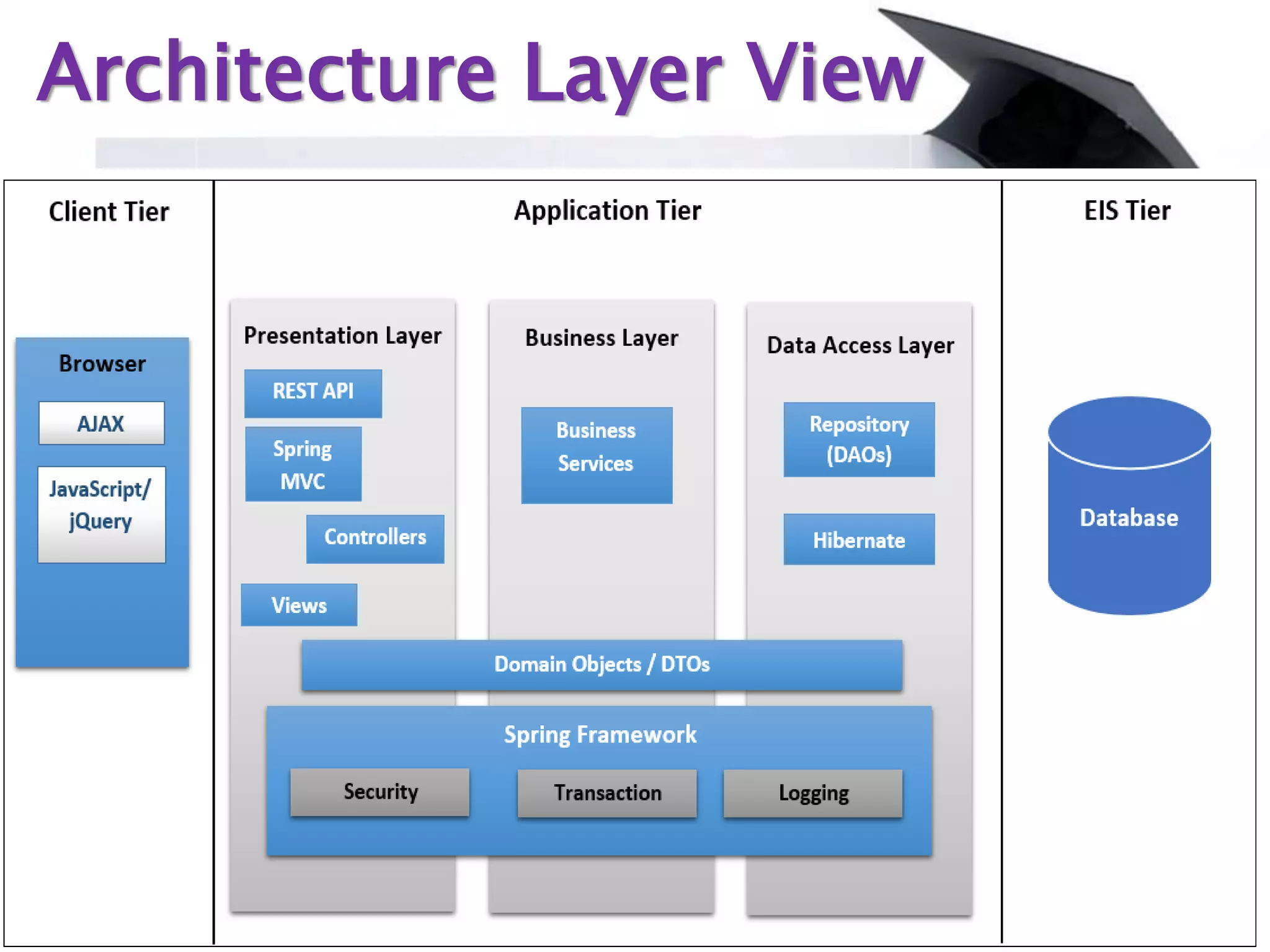
Architecture Layer View
User Interface
1. Program Management
2.Course Management
3.Student Management
Tools And Technologies
 Spring Framework, an open source application framework
which provides various services such as security,
transaction management, batch management, integration
framework and dependency injection
 Hibernate, a powerful, high performance Object-Relational
Persistence and Query service for Java
 Subversion, commonly known as SVN, a version control tool
 Maven, a project management and comprehension tool
 MySQL, a popular Relational database management system
 REST (Representational state transfer) web services
 Testing tools such as JUnit, JMeter, Spring Insight, VisualVM
Testing
• Link to be added
Conclusion
The Application is very flexible and can
be configured to be used at various
education institutes raging from school,
colleges, Universities and even coaching
classes.
Future Scope
 The quiz Management system can be
coupled with the solution provided by
other vendors to conduct online test.
 An attendance management module can
be developed which can interface with
biometrics.
 Companion mobile application can be
developed to further increases the
availability of the application.
Reference
 L. Zornada and T.B. Velkavrh. “Implementing ERP systems in
higher education institutions”.In: Information Technology
Interfaces, 2005. 27th International Conference on. 2005, pp.
307–313. DOI: 10.1109/ITI.2005.1491143.
 R.M. Tariqi et al. “A preliminary study on the implementation of
enterprise resource planning in Malaysian private higher
institution-A case study”. In: Information Technology (ITSim),
2010 International Symposium in. Vol. 1. 2010, pp. 1–6. DOI:
10.1109/ ITSIM.2010.5561342.
 Zhi gang Yue and You wei Jin. “The Development and Design of
the Student Management System Based on the Network
Environment”. In: Multimedia Communications (Mediacom), 2010
International Conference on. 2010, pp. 5–8. DOI: 10.1109/
MEDIACOM.2010.23.
 Zhibing Liu, Huixia Wang, and Hui Zan. “Design and
Implementation of Student Information Management System”. In:
Intelligence Information Processing and Trusted Computing
(IPTC), 2010 International Symposium on. 2010, pp. 607–610.
DOI: 10. 1109/IPTC.2010.160.
Educational Information Management System (EIMS)

Educational Information Management System (EIMS)

  • 1.
    Education Institute ManagementSystem (EIMS) Submitted By : Chetan Heireholi : 2BV10CS037 Kavya K Puranik : 2BV10CS042 Mugdha S Bhat : 2BV10CS050 Praneeth Shetty : 2BV10CS063 Rahul Kumar : 2BV10CS071 Under the Guidance of : Manjunath Hiremath eKlakshya Prof.Padmashri Desai BVBCET
  • 2.
    Problem Definition To developa generic platform for managing an entire education institute that can also to cater their need of achieving quality outcome via meticulous tracking of student activities.
  • 3.
    Scope and Objective 1.Hosted Solution for the Training Management and Content Delivery Management. On Campus Training (Full-time) Program – Infrastructure 2. Program Management 3. Course Management, Module, Sub-Module, Concepts, Activities Management 4. Student Management 5. Faculty Management 6. Batch Management 7. Assessment System for All courses, Modules, activities, Labs 8. Content Management — PDFs, PPTs, Videos. etc 9. Online Test/Quiz Management per Course, Modules, assignments, activities. 10.Lab Experiments Reviews — Complete Review System
  • 4.
    Common Infrastructure 11 AssessmentReports — Different Level of reports (per activity.Experiments, course, students, batch level) 12 Security Management — Administrator, Faculty, Students, etc 13 Bulk Import and Export for Students, Assessment, Course, etc.
  • 5.
    Advantage of Proposed System Easily adapted  Integration of personal details with academic details.  efficiently track the progress of the student.  Dynamic generation of reports.  Transparent assessment of activities.  Reduce the strain on the faculty by providing templates for evaluation that are available system wide.  Support offline evaluation of student assessment.  Robust online test module.  System generates automatic ID codes  Role based access.
  • 6.
  • 7.
    Program Management Program managementis a basic but important task in an education institute, program management allows an education institute to segregate the various types of formal training services provided by them.
  • 8.
    Course Management This moduleshall deal with course attributes such as course name, course weightage, marks split-up for internal and external exams, faculty(s) in charge for each course.
  • 9.
    Student Management This moduleshall maintain general student information such as batch information, individual assessment details and contact details.
  • 10.
    Faculty Management This moduleshall maintain general faculty information such as subjects to handle, contact information.
  • 11.
    ID Generation Management Generationof Identity variables such as roll numbers, Wi-Fi access passcodes to be used by the members of the community to utilize various resources available to them such as libraries, lab equipment and classroom utilities. This module helps in assigning roll numbers to students based on alphabetical ordering, also helps in generating patterns to be prefixed to roll number for internal identification purposes
  • 12.
    Report Management The purposeof this module is to provide visual aids such as bar graphs, pie charts to represent data in an aggregated way to audiences such as HODs, Principal, faculties and various academic welfare committees.
  • 14.
    Online Quiz Management Thismodule provides options to conduct quiz and evaluation of the same.
  • 15.
    Non-Functional Requirement  Performancerequirements. Safety requirements A database is prone to various types of failures, to accommodate for this we allow the system to take backup at regular intervals.
  • 16.
     Security Requirements Encryptionof few details. Such as User password, Phone Number etc.  Software Quality Attributes •System Availability •Interoperability •Portability •Reliability  User Documentation •User Manual • Manual for administrators or maintenance personnel.
  • 17.
  • 18.
  • 19.
  • 20.
  • 21.
  • 22.
    Tools And Technologies Spring Framework, an open source application framework which provides various services such as security, transaction management, batch management, integration framework and dependency injection  Hibernate, a powerful, high performance Object-Relational Persistence and Query service for Java  Subversion, commonly known as SVN, a version control tool  Maven, a project management and comprehension tool  MySQL, a popular Relational database management system  REST (Representational state transfer) web services  Testing tools such as JUnit, JMeter, Spring Insight, VisualVM
  • 23.
  • 24.
    Conclusion The Application isvery flexible and can be configured to be used at various education institutes raging from school, colleges, Universities and even coaching classes.
  • 25.
    Future Scope  Thequiz Management system can be coupled with the solution provided by other vendors to conduct online test.  An attendance management module can be developed which can interface with biometrics.  Companion mobile application can be developed to further increases the availability of the application.
  • 26.
    Reference  L. Zornadaand T.B. Velkavrh. “Implementing ERP systems in higher education institutions”.In: Information Technology Interfaces, 2005. 27th International Conference on. 2005, pp. 307–313. DOI: 10.1109/ITI.2005.1491143.  R.M. Tariqi et al. “A preliminary study on the implementation of enterprise resource planning in Malaysian private higher institution-A case study”. In: Information Technology (ITSim), 2010 International Symposium in. Vol. 1. 2010, pp. 1–6. DOI: 10.1109/ ITSIM.2010.5561342.  Zhi gang Yue and You wei Jin. “The Development and Design of the Student Management System Based on the Network Environment”. In: Multimedia Communications (Mediacom), 2010 International Conference on. 2010, pp. 5–8. DOI: 10.1109/ MEDIACOM.2010.23.  Zhibing Liu, Huixia Wang, and Hui Zan. “Design and Implementation of Student Information Management System”. In: Intelligence Information Processing and Trusted Computing (IPTC), 2010 International Symposium on. 2010, pp. 607–610. DOI: 10. 1109/IPTC.2010.160.