O P FOUSIYA
ATCW
Educational
management
04/08/2017fousimohd76@gmail.com
1
Education
04/08/2017fousimohd76@gmail.com
2
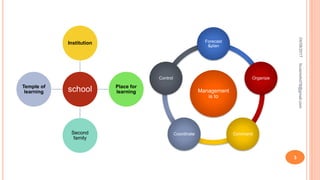
school
Institution
Place for
learning
Second
family
Temple of
learning Management
is to
Forecast
&plan
Organize
CommandCoordinate
Control
04/08/2017fousimohd76@gmail.com
3
Management
Management is the art and science of decision making and leadership.
A distinct process consisting of planning, organizing, directing, and
controlling and evaluating to accomplish the predetermined objectives of
an institution through the coordinated use of human and material
resources.
Is the accomplishment of results through the efforts of other people
04/08/2017fousimohd76@gmail.com
4
CONCEPT OF EDUCATION MANAGEMENT
Is the process of planning,
organizing, directing and
controlling the activities of an
institution by utilizing human and
material resources so as to
effectively and efficiently
accomplish functions of teaching,
extension work and research
04/08/2017fousimohd76@gmail.com
5
Need for educational management
To create a congenial environment
Scientific and systematic M of E is expected to
bring about qualitative changes
Education smoother
Helps to generate the situation without
generating negative consequences
For the use of scare and dwindling resources
04/08/2017fousimohd76@gmail.com
6
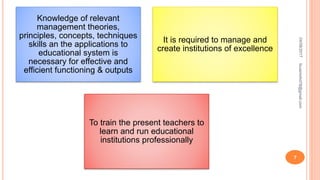
Knowledge of relevant
management theories,
principles, concepts, techniques
skills an the applications to
educational system is
necessary for effective and
efficient functioning & outputs
It is required to manage and
create institutions of excellence
To train the present teachers to
learn and run educational
institutions professionally
04/08/2017fousimohd76@gmail.com
7
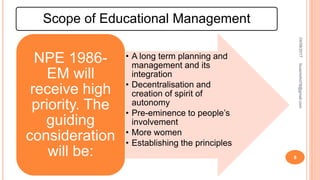
Scope of Educational Management
• A long term planning and
management and its
integration
• Decentralisation and
creation of spirit of
autonomy
• Pre-eminence to people’s
involvement
• More women
• Establishing the principles
NPE 1986-
EM will
receive high
priority. The
guiding
consideration
will be:
04/08/2017fousimohd76@gmail.com
8
The POA further elaborated the scope of management of
education in the following words
 Making the system work
 Decentralisation of management and establishment of district board of
education, district institutes of education and training (DIETS)
provision of autonomy and establishing accountability of institution
system and teacher
 Working out the detail, mechanics, funding arrangement for the
national system of education
 Man power planning and demand forecasting
 Media of educational technology with special reference to adult
education , non formal education ,open and continuing education
 Development & periodic review of curricula and teaching learning
process
04/08/2017fousimohd76@gmail.com
9
SCOPE OF EM
 History , theories, roles and responsibilities
 Study of educational planning
 Decision making, problem solving, communication and managing
information
 Provide both human as well as material equipment
 Co-curricular planning
 Time table, school records , financing and budgeting
 Motivation
 Counselling and guidance
 Health and PE, exhibitions , fairs etc ….
04/08/2017fousimohd76@gmail.com
10
FUNCTIONS OF EM
 Decision of work
 Authority
 Discipline
 Unity of command
 Unity of direction
 Subordination of individual
interest
 Remuneration
 Centralisation
 Scalar chain
 Material and social order
 Equity
 Stability
 Initiatives
 Espirit de corps
Based on the principles by HENRY FAYOL IN 1916
04/08/2017fousimohd76@gmail.com
11
FUNCTIONS
OF EM
Planning
Organisation
Direction
ControlCoordination
Evaluation
Recording
04/08/2017fousimohd76@gmail.com
12
CHARACTERISTICS OF A DEMOCRATIC INSTITUTIONAL CLIMATE
Norris Haynes “Organizational
Climate is the sum total of a dynamic
interaction among the psycho, social,
academic and physical dimensions of
the school environment.”
04/08/2017fousimohd76@gmail.com
13
Principle of Democratic
leadership
Principal of sharing responsibility
Principal of Equality
Principle of Freedom of
Expression:
Principal of Justice.
Principle of Recognition of the
individual Worth
Cohesion
Excellence and Quality
Participation and
involvement
Motivation
Recognition of individual
work.
04/08/2017fousimohd76@gmail.com
14
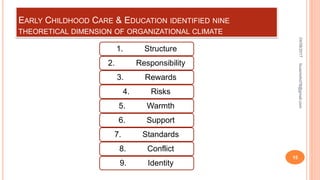
EARLY CHILDHOOD CARE & EDUCATION IDENTIFIED NINE
THEORETICAL DIMENSION OF ORGANIZATIONAL CLIMATE
1. Structure
2. Responsibility
3. Rewards
4. Risks
5. Warmth
6. Support
7. Standards
8. Conflict
9. Identity
04/08/2017fousimohd76@gmail.com
15

Educational management

  • 1.
  • 2.
  • 3.
    school Institution Place for learning Second family Temple of learningManagement is to Forecast &plan Organize CommandCoordinate Control 04/08/2017fousimohd76@gmail.com 3
  • 4.
    Management Management is theart and science of decision making and leadership. A distinct process consisting of planning, organizing, directing, and controlling and evaluating to accomplish the predetermined objectives of an institution through the coordinated use of human and material resources. Is the accomplishment of results through the efforts of other people 04/08/2017fousimohd76@gmail.com 4
  • 5.
    CONCEPT OF EDUCATIONMANAGEMENT Is the process of planning, organizing, directing and controlling the activities of an institution by utilizing human and material resources so as to effectively and efficiently accomplish functions of teaching, extension work and research 04/08/2017fousimohd76@gmail.com 5
  • 6.
    Need for educationalmanagement To create a congenial environment Scientific and systematic M of E is expected to bring about qualitative changes Education smoother Helps to generate the situation without generating negative consequences For the use of scare and dwindling resources 04/08/2017fousimohd76@gmail.com 6
  • 7.
    Knowledge of relevant managementtheories, principles, concepts, techniques skills an the applications to educational system is necessary for effective and efficient functioning & outputs It is required to manage and create institutions of excellence To train the present teachers to learn and run educational institutions professionally 04/08/2017fousimohd76@gmail.com 7
  • 8.
    Scope of EducationalManagement • A long term planning and management and its integration • Decentralisation and creation of spirit of autonomy • Pre-eminence to people’s involvement • More women • Establishing the principles NPE 1986- EM will receive high priority. The guiding consideration will be: 04/08/2017fousimohd76@gmail.com 8
  • 9.
    The POA furtherelaborated the scope of management of education in the following words  Making the system work  Decentralisation of management and establishment of district board of education, district institutes of education and training (DIETS) provision of autonomy and establishing accountability of institution system and teacher  Working out the detail, mechanics, funding arrangement for the national system of education  Man power planning and demand forecasting  Media of educational technology with special reference to adult education , non formal education ,open and continuing education  Development & periodic review of curricula and teaching learning process 04/08/2017fousimohd76@gmail.com 9
  • 10.
    SCOPE OF EM History , theories, roles and responsibilities  Study of educational planning  Decision making, problem solving, communication and managing information  Provide both human as well as material equipment  Co-curricular planning  Time table, school records , financing and budgeting  Motivation  Counselling and guidance  Health and PE, exhibitions , fairs etc …. 04/08/2017fousimohd76@gmail.com 10
  • 11.
    FUNCTIONS OF EM Decision of work  Authority  Discipline  Unity of command  Unity of direction  Subordination of individual interest  Remuneration  Centralisation  Scalar chain  Material and social order  Equity  Stability  Initiatives  Espirit de corps Based on the principles by HENRY FAYOL IN 1916 04/08/2017fousimohd76@gmail.com 11
  • 12.
  • 13.
    CHARACTERISTICS OF ADEMOCRATIC INSTITUTIONAL CLIMATE Norris Haynes “Organizational Climate is the sum total of a dynamic interaction among the psycho, social, academic and physical dimensions of the school environment.” 04/08/2017fousimohd76@gmail.com 13
  • 14.
    Principle of Democratic leadership Principalof sharing responsibility Principal of Equality Principle of Freedom of Expression: Principal of Justice. Principle of Recognition of the individual Worth Cohesion Excellence and Quality Participation and involvement Motivation Recognition of individual work. 04/08/2017fousimohd76@gmail.com 14
  • 15.
    EARLY CHILDHOOD CARE& EDUCATION IDENTIFIED NINE THEORETICAL DIMENSION OF ORGANIZATIONAL CLIMATE 1. Structure 2. Responsibility 3. Rewards 4. Risks 5. Warmth 6. Support 7. Standards 8. Conflict 9. Identity 04/08/2017fousimohd76@gmail.com 15