2. LiAlH4
Dr. Shivendra Singh
UGC-NET-JRF, PhD-IIT Indore
…Lithiumaluminiumhydride
 LiAlH4 is a reducing agent. More specifically, nucleophilic reducing
agent and used to reduce polar multiple bonds like C=O.
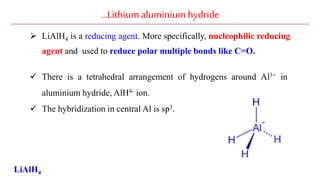
 There is a tetrahedral arrangement of hydrogens around Al3+ in
aluminium hydride, AlH4- ion.
 The hybridization in central Al is sp3.
LiAlH4
…Lithiumaluminiumhydride: Preparation
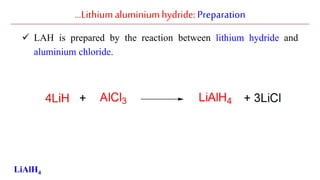
 LAH is prepared by the reaction between lithium hydride and
aluminium chloride.
LiAlH4
…Lithiumaluminiumhydride: Properties
1. LAH is a white solid but the commercial samples are usually gray
(due to presence of impurities).
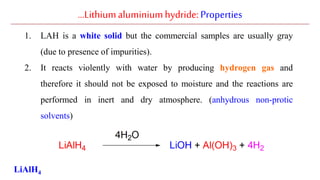
2. It reacts violently with water by producing hydrogen gas and
therefore it should not be exposed to moisture and the reactions are
performed in inert and dry atmosphere. (anhydrous non-protic
solvents)
LiAlH4
…Lithiumaluminiumhydride: Properties
3. As far as the preference of solvent is concerned, it is highly soluble in
diethyl ether. However it may spontaneously decompose in it due to
presence of catalytic impurities. Therefore the preferred solvent for LAH
is THF despite the low solubility.
LiAlH4
…Lithiumaluminiumhydride: Properties
Workup:
During the workup, the reaction mixture is initially chilled in an ice bath
and then the Lithium aluminium hydride is quenched by careful and very
slow addition of ethyl acetate followed by the addition of methanol and
then cold water.
LiAlH4
…LAH:Mechanismofreduction
 The reduction of a carbonyl group by LiAlH4 is initiated by the attack of
nucleophilic hydride ion on the carbonyl carbon to give a tetrahedral
intermediate.
 LiAlH4 is a nucleophilic reducing agent since the hydride transfer to the
carbonyl carbon occurs prior to the coordination to the carbonyl oxygen.
 It reacts faster with electron deficient carbonyl groups. The reactivity of
carbonyl compounds with this reagent follows the order:
Aldehydes > Ketones > Ester > Amide > Carboxylic acid
LiAlH4
…LAH:Mechanismofreduction
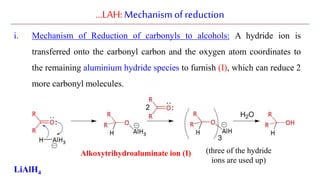
i. Mechanism of Reduction of carbonyls to alcohols: A hydride ion is
transferred onto the carbonyl carbon and the oxygen atom coordinates to
the remaining aluminium hydride species to furnish (I), which can reduce 2
more carbonyl molecules.
LiAlH4
(three of the hydride
ions are used up)
Alkoxytrihydroaluminate ion (I)
…LAH:Mechanismofreduction
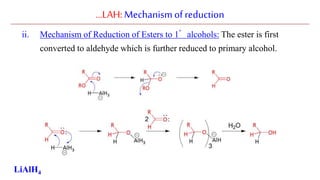
ii. Mechanism of Reduction of Esters to 1° alcohols: The ester is first
converted to aldehyde which is further reduced to primary alcohol.
LiAlH4
…LAH:Mechanismofreduction
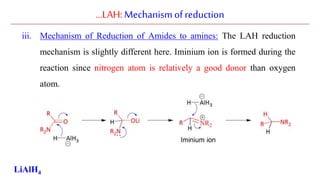
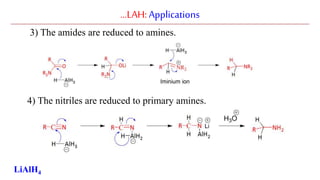
iii. Mechanism of Reduction of Amides to amines: The LAH reduction
mechanism is slightly different here. Iminium ion is formed during the
reaction since nitrogen atom is relatively a good donor than oxygen
atom.
LiAlH4
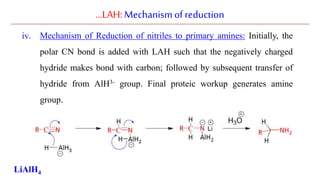
iv. Mechanism of Reduction of nitriles to primary amines: Initially, the
polar CN bond is added with LAH such that the negatively charged
hydride makes bond with carbon; followed by subsequent transfer of
hydride from AlH3- group. Final proteic workup generates amine
group.
…LAH:Mechanismofreduction
LiAlH4
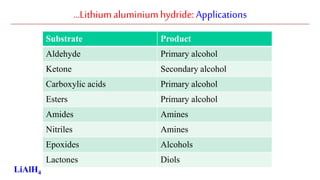
…Lithiumaluminiumhydride: Applications
LiAlH4
Substrate Product
Aldehyde Primary alcohol
Ketone Secondary alcohol
Carboxylic acids Primary alcohol
Esters Primary alcohol
Amides Amines
Nitriles Amines
Epoxides Alcohols
Lactones Diols
…Lithiumaluminiumhydride: Applications
 Lithium aluminium hydride, LAH reagent cannot reduce an isolated non-
polar multiple bond like C=C. However, the double or triple bonds in
conjugation with the polar multiple bonds can be reduced.
LiAlH4
…LAH:Applications
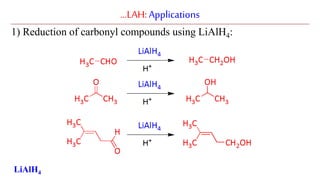
1) Reduction of carbonyl compounds using LiAlH4:
LiAlH4
…LAH:Applications
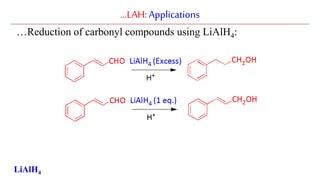
…Reduction of carbonyl compounds using LiAlH4:
LiAlH4
…LAH:Applications
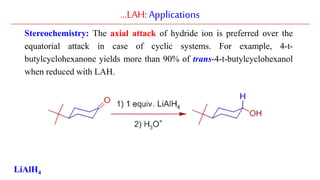
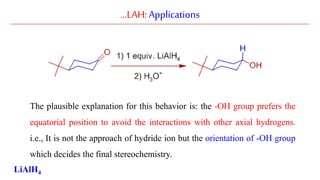
Stereochemistry: The axial attack of hydride ion is preferred over the
equatorial attack in case of cyclic systems. For example, 4-t-
butylcyclohexanone yields more than 90% of trans-4-t-butylcyclohexanol
when reduced with LAH.
LiAlH4
…LAH:Applications
The plausible explanation for this behavior is: the -OH group prefers the
equatorial position to avoid the interactions with other axial hydrogens.
i.e., It is not the approach of hydride ion but the orientation of -OH group
which decides the final stereochemistry.
LiAlH4
…LAH:Applications
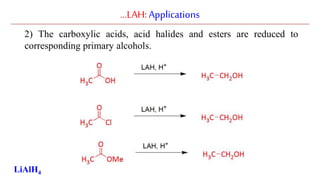
2) The carboxylic acids, acid halides and esters are reduced to
corresponding primary alcohols.
LiAlH4
…LAH:Applications
3) The amides are reduced to amines.
4) The nitriles are reduced to primary amines.
LiAlH4
…LAH:Applications
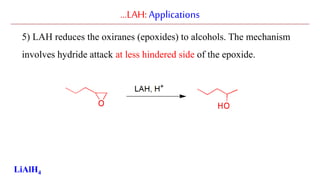
5) LAH reduces the oxiranes (epoxides) to alcohols. The mechanism
involves hydride attack at less hindered side of the epoxide.
LiAlH4
…LAH:Applications
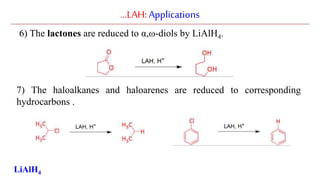
6) The lactones are reduced to α,ω-diols by LiAlH4.
7) The haloalkanes and haloarenes are reduced to corresponding
hydrocarbons .
LiAlH4
…LAH:Applications
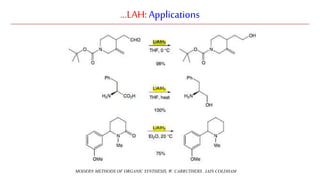
MODERN METHODS OF ORGANIC SYNTHESIS, W. CARRUTHERS , IAIN COLDHAM
…LAH:SUMMARY
1. Structure
2. Preparation
3. Properties (3)
4. Mechanism
(Carbonyls, esters,
amides, nitriles)
5. Application (7)
i. Carbonyls
ii. Carboxylic acids
iii. Amides
iv. Nitriles
v. Epoxides
vi. Lactones
vii. Haloalkanes & haloarenes
Next: NaBH4
Thanks for watching…

2. LiAlH4

  • 1.
    2. LiAlH4 Dr. ShivendraSingh UGC-NET-JRF, PhD-IIT Indore
  • 2.
    …Lithiumaluminiumhydride  LiAlH4 isa reducing agent. More specifically, nucleophilic reducing agent and used to reduce polar multiple bonds like C=O.  There is a tetrahedral arrangement of hydrogens around Al3+ in aluminium hydride, AlH4- ion.  The hybridization in central Al is sp3. LiAlH4
  • 3.
    …Lithiumaluminiumhydride: Preparation  LAHis prepared by the reaction between lithium hydride and aluminium chloride. LiAlH4
  • 4.
    …Lithiumaluminiumhydride: Properties 1. LAHis a white solid but the commercial samples are usually gray (due to presence of impurities). 2. It reacts violently with water by producing hydrogen gas and therefore it should not be exposed to moisture and the reactions are performed in inert and dry atmosphere. (anhydrous non-protic solvents) LiAlH4
  • 5.
    …Lithiumaluminiumhydride: Properties 3. Asfar as the preference of solvent is concerned, it is highly soluble in diethyl ether. However it may spontaneously decompose in it due to presence of catalytic impurities. Therefore the preferred solvent for LAH is THF despite the low solubility. LiAlH4
  • 6.
    …Lithiumaluminiumhydride: Properties Workup: During theworkup, the reaction mixture is initially chilled in an ice bath and then the Lithium aluminium hydride is quenched by careful and very slow addition of ethyl acetate followed by the addition of methanol and then cold water. LiAlH4
  • 7.
    …LAH:Mechanismofreduction  The reductionof a carbonyl group by LiAlH4 is initiated by the attack of nucleophilic hydride ion on the carbonyl carbon to give a tetrahedral intermediate.  LiAlH4 is a nucleophilic reducing agent since the hydride transfer to the carbonyl carbon occurs prior to the coordination to the carbonyl oxygen.  It reacts faster with electron deficient carbonyl groups. The reactivity of carbonyl compounds with this reagent follows the order: Aldehydes > Ketones > Ester > Amide > Carboxylic acid LiAlH4
  • 8.
    …LAH:Mechanismofreduction i. Mechanism ofReduction of carbonyls to alcohols: A hydride ion is transferred onto the carbonyl carbon and the oxygen atom coordinates to the remaining aluminium hydride species to furnish (I), which can reduce 2 more carbonyl molecules. LiAlH4 (three of the hydride ions are used up) Alkoxytrihydroaluminate ion (I)
  • 9.
    …LAH:Mechanismofreduction ii. Mechanism ofReduction of Esters to 1° alcohols: The ester is first converted to aldehyde which is further reduced to primary alcohol. LiAlH4
  • 10.
    …LAH:Mechanismofreduction iii. Mechanism ofReduction of Amides to amines: The LAH reduction mechanism is slightly different here. Iminium ion is formed during the reaction since nitrogen atom is relatively a good donor than oxygen atom. LiAlH4
  • 11.
    iv. Mechanism ofReduction of nitriles to primary amines: Initially, the polar CN bond is added with LAH such that the negatively charged hydride makes bond with carbon; followed by subsequent transfer of hydride from AlH3- group. Final proteic workup generates amine group. …LAH:Mechanismofreduction LiAlH4
  • 12.
    …Lithiumaluminiumhydride: Applications LiAlH4 Substrate Product AldehydePrimary alcohol Ketone Secondary alcohol Carboxylic acids Primary alcohol Esters Primary alcohol Amides Amines Nitriles Amines Epoxides Alcohols Lactones Diols
  • 13.
    …Lithiumaluminiumhydride: Applications  Lithiumaluminium hydride, LAH reagent cannot reduce an isolated non- polar multiple bond like C=C. However, the double or triple bonds in conjugation with the polar multiple bonds can be reduced. LiAlH4
  • 14.
    …LAH:Applications 1) Reduction ofcarbonyl compounds using LiAlH4: LiAlH4
  • 15.
    …LAH:Applications …Reduction of carbonylcompounds using LiAlH4: LiAlH4
  • 16.
    …LAH:Applications Stereochemistry: The axialattack of hydride ion is preferred over the equatorial attack in case of cyclic systems. For example, 4-t- butylcyclohexanone yields more than 90% of trans-4-t-butylcyclohexanol when reduced with LAH. LiAlH4
  • 17.
    …LAH:Applications The plausible explanationfor this behavior is: the -OH group prefers the equatorial position to avoid the interactions with other axial hydrogens. i.e., It is not the approach of hydride ion but the orientation of -OH group which decides the final stereochemistry. LiAlH4
  • 18.
    …LAH:Applications 2) The carboxylicacids, acid halides and esters are reduced to corresponding primary alcohols. LiAlH4
  • 19.
    …LAH:Applications 3) The amidesare reduced to amines. 4) The nitriles are reduced to primary amines. LiAlH4
  • 20.
    …LAH:Applications 5) LAH reducesthe oxiranes (epoxides) to alcohols. The mechanism involves hydride attack at less hindered side of the epoxide. LiAlH4
  • 21.
    …LAH:Applications 6) The lactonesare reduced to α,ω-diols by LiAlH4. 7) The haloalkanes and haloarenes are reduced to corresponding hydrocarbons . LiAlH4
  • 22.
    …LAH:Applications MODERN METHODS OFORGANIC SYNTHESIS, W. CARRUTHERS , IAIN COLDHAM
  • 23.
    …LAH:SUMMARY 1. Structure 2. Preparation 3.Properties (3) 4. Mechanism (Carbonyls, esters, amides, nitriles) 5. Application (7) i. Carbonyls ii. Carboxylic acids iii. Amides iv. Nitriles v. Epoxides vi. Lactones vii. Haloalkanes & haloarenes
  • 24.

Editor's Notes