Organo-magnesium Reagents
(R-Mg-X)
Dr. Mishu Singh
Pt. D. D. U Govt. Girls P.G. College, Lucknow
• The organomagnesium halides (RMgX), known as
Grignard reagents.
• (RMgX ) are useful synthetic intermediates in organic
chemistry for carbon-carbon bond formation.
• They may be regarded as polar compounds and are
sources of nuleophilic carbanions.
Dr. Mishu Singh
Pt. D. D. U Govt. Girls P.G. College, Lucknow
General
• Although the Grignard reagents are usually formulated
as R-Mg-X, but in reality they are a mixture of a variety
of species.
• The ratio of the species in solution varies with the
organic group, the halogen, the solvent, the concentration
and the temperature.
• It is believed that in case of organo-magnesium chlorides
(R-Mg-Cl) in diethyl ether, the predominant species over a
wide range of concentrations is a solvated, halogen-
bridged dimer -1 (as shown in next slide).
•The degree of association varies as the halide is changed
to Br or I.
Dr. Mishu Singh
Pt. D. D. U Govt. Girls P.G. College, Lucknow
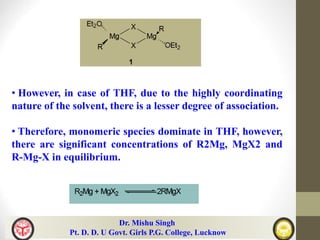
• However, in case of THF, due to the highly coordinating
nature of the solvent, there is a lesser degree of association.
• Therefore, monomeric species dominate in THF, however,
there are significant concentrations of R2Mg, MgX2 and
R-Mg-X in equilibrium.
Dr. Mishu Singh
Pt. D. D. U Govt. Girls P.G. College, Lucknow
Preparation
• The RMgX are prepared by the action of Mg on alkyl, aryl
or vinyl halides in either dry ether or THF, and the
resultant solution is used for the subsequent reactions.
• In case the reaction is sluggish, small amount of iodine is
added to initiate the reaction.
• The rate of the formation of the organomagnesium halides
can be significantly accelerated by sonication.
Dr. Mishu Singh
Pt. D. D. U Govt. Girls P.G. College, Lucknow
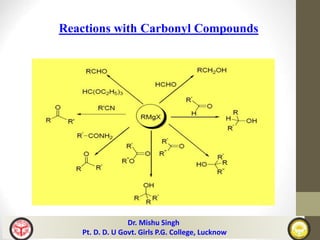
Reactions with Carbonyl Compounds
Dr. Mishu Singh
Pt. D. D. U Govt. Girls P.G. College, Lucknow
Mechanism
• Being nucleophilic in nature, the R-Mg-X undergo 1,2-
addition to the carbonyl group of aldehydes, ketones,
esters, anhydrides, acid chlorides and amides.
• In these reactions, the alkyl, aryl or vinyl group having
carban-ionic character become attached to the carbonyl
carbon and the Mg-X to the oxygen of the carbonyl
group to give a complex (addition product).
• These addition products on decomposition with proton
source give the corresponding alcohols.
Dr. Mishu Singh
Pt. D. D. U Govt. Girls P.G. College, Lucknow
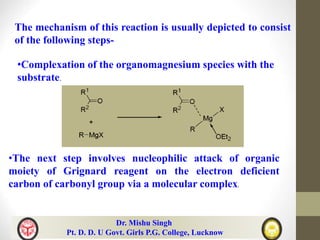
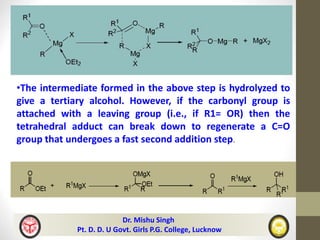
The mechanism of this reaction is usually depicted to consist
of the following steps-
•Complexation of the organomagnesium species with the
substrate.
•The next step involves nucleophilic attack of organic
moiety of Grignard reagent on the electron deficient
carbon of carbonyl group via a molecular complex.
Dr. Mishu Singh
Pt. D. D. U Govt. Girls P.G. College, Lucknow
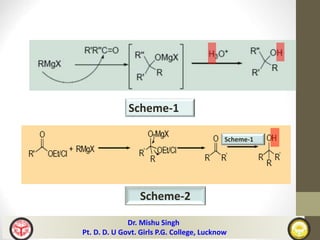
•The intermediate formed in the above step is hydrolyzed to
give a tertiary alcohol. However, if the carbonyl group is
attached with a leaving group (i.e., if R1= OR) then the
tetrahedral adduct can break down to regenerate a C=O
group that undergoes a fast second addition step.
Dr. Mishu Singh
Pt. D. D. U Govt. Girls P.G. College, Lucknow
Scheme-1
Scheme-2
Scheme-1
Dr. Mishu Singh
Pt. D. D. U Govt. Girls P.G. College, Lucknow
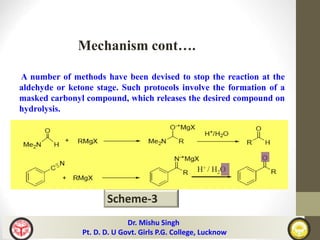
A number of methods have been devised to stop the reaction at the
aldehyde or ketone stage. Such protocols involve the formation of a
masked carbonyl compound, which releases the desired compound on
hydrolysis.
Mechanism cont….
Scheme-3
H+ / H2O
Dr. Mishu Singh
Pt. D. D. U Govt. Girls P.G. College, Lucknow
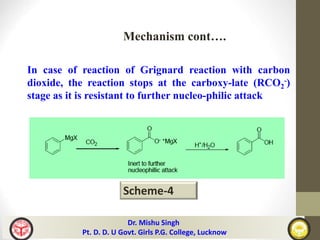
Mechanism cont….
In case of reaction of Grignard reaction with carbon
dioxide, the reaction stops at the carboxy-late (RCO2
-)
stage as it is resistant to further nucleo-philic attack
Scheme-4
Dr. Mishu Singh
Pt. D. D. U Govt. Girls P.G. College, Lucknow
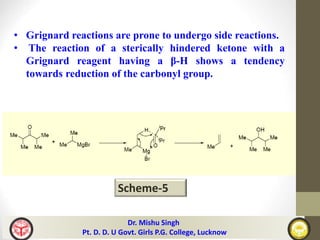
• Grignard reactions are prone to undergo side reactions.

• The reaction of a sterically hindered ketone with a
Grignard reagent having a β-H shows a tendency
towards reduction of the carbonyl group.
Scheme-5
Dr. Mishu Singh
Pt. D. D. U Govt. Girls P.G. College, Lucknow
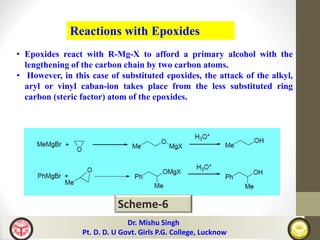
Reactions with Epoxides
• Epoxides react with R-Mg-X to afford a primary alcohol with the
lengthening of the carbon chain by two carbon atoms.
• However, in this case of substituted epoxides, the attack of the alkyl,
aryl or vinyl caban-ion takes place from the less substituted ring
carbon (steric factor) atom of the epoxides.
Scheme-6
Dr. Mishu Singh
Pt. D. D. U Govt. Girls P.G. College, Lucknow
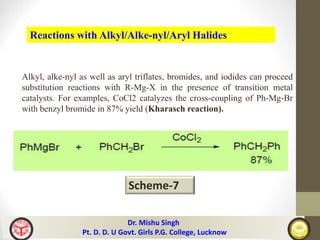
Reactions with Alkyl/Alke-nyl/Aryl Halides
Alkyl, alke-nyl as well as aryl triflates, bromides, and iodides can proceed
substitution reactions with R-Mg-X in the presence of transition metal
catalysts. For examples, CoCl2 catalyzes the cross-coupling of Ph-Mg-Br
with benzyl bromide in 87% yield (Kharasch reaction).
Scheme-7
Dr. Mishu Singh
Pt. D. D. U Govt. Girls P.G. College, Lucknow
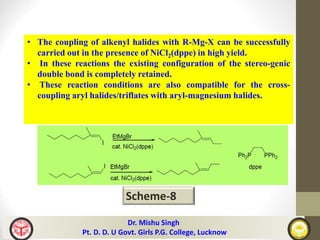
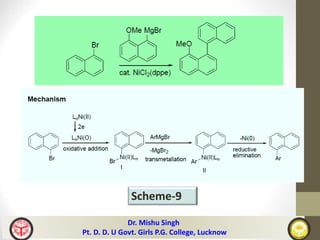
• The coupling of alkenyl halides with R-Mg-X can be successfully
carried out in the presence of NiCl2(dppe) in high yield.
• In these reactions the existing configuration of the stereo-genic
double bond is completely retained.
• These reaction conditions are also compatible for the cross-
coupling aryl halides/triflates with aryl-magnesium halides.
Scheme-8
Dr. Mishu Singh
Pt. D. D. U Govt. Girls P.G. College, Lucknow
Scheme-9
Dr. Mishu Singh
Pt. D. D. U Govt. Girls P.G. College, Lucknow
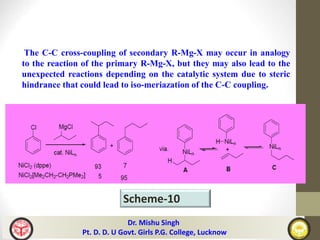
The C-C cross-coupling of secondary R-Mg-X may occur in analogy
to the reaction of the primary R-Mg-X, but they may also lead to the
unexpected reactions depending on the catalytic system due to steric
hindrance that could lead to iso-meriazation of the C-C coupling.
Scheme-10
Dr. Mishu Singh
Pt. D. D. U Govt. Girls P.G. College, Lucknow
Dr. Mishu Singh
Pt. D. D. U Govt. Girls P.G. College, Lucknow
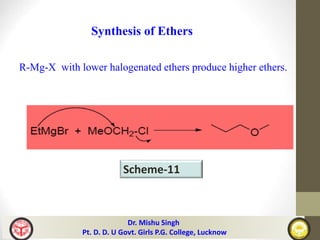
Synthesis of Ethers
R-Mg-X with lower halogenated ethers produce higher ethers.
Scheme-11
Dr. Mishu Singh
Pt. D. D. U Govt. Girls P.G. College, Lucknow
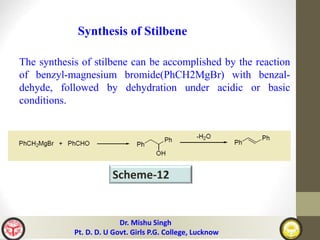
Synthesis of Stilbene
The synthesis of stilbene can be accomplished by the reaction
of benzyl-magnesium bromide(PhCH2MgBr) with benzal-
dehyde, followed by dehydration under acidic or basic
conditions.
Scheme-12
Dr. Mishu Singh
Pt. D. D. U Govt. Girls P.G. College, Lucknow
Synthesis of Alkyl cyanide
The reaction of alkyl-magnesium halides with cyanogens or
cyanogens chloride gives alkyl cyanides .
Scheme-13
chloride
Dr. Mishu Singh
Pt. D. D. U Govt. Girls P.G. College, Lucknow
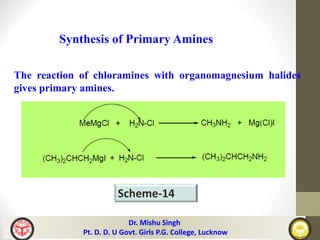
Synthesis of Primary Amines
The reaction of chloramines with organomagnesium halides
gives primary amines.
Scheme-14
Dr. Mishu Singh
Pt. D. D. U Govt. Girls P.G. College, Lucknow
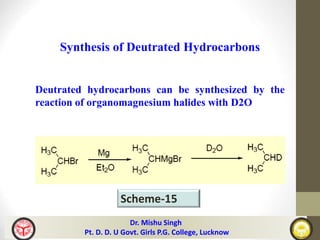
Scheme-15
Synthesis of Deutrated Hydrocarbons
Deutrated hydrocarbons can be synthesized by the
reaction of organomagnesium halides with D2O
Dr. Mishu Singh
Pt. D. D. U Govt. Girls P.G. College, Lucknow
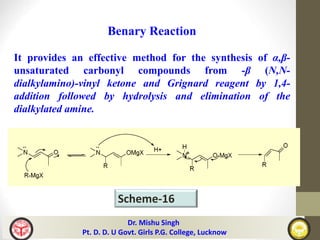
Scheme-16
Benary Reaction
It provides an effective method for the synthesis of α,β-
unsaturated carbonyl compounds from -β (N,N-
dialkylamino)-vinyl ketone and Grignard reagent by 1,4-
addition followed by hydrolysis and elimination of the
dialkylated amine.
Dr. Mishu Singh
Pt. D. D. U Govt. Girls P.G. College, Lucknow
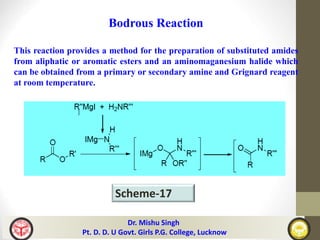
Bodrous Reaction
This reaction provides a method for the preparation of substituted amides
from aliphatic or aromatic esters and an aminomaganesium halide which
can be obtained from a primary or secondary amine and Grignard reagent
at room temperature.
Scheme-17
Dr. Mishu Singh
Pt. D. D. U Govt. Girls P.G. College, Lucknow
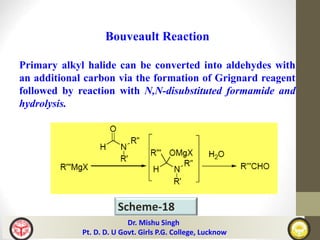
Scheme-18
Bouveault Reaction
Primary alkyl halide can be converted into aldehydes with
an additional carbon via the formation of Grignard reagent
followed by reaction with N,N-disubstituted formamide and
hydrolysis.
Dr. Mishu Singh
Pt. D. D. U Govt. Girls P.G. College, Lucknow
Dr. Mishu Singh
Pt. D. D. U Govt. Girls P.G. College, Lucknow
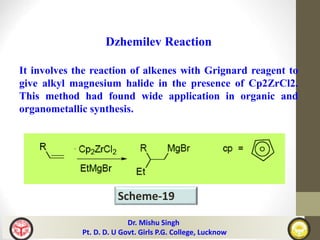
Scheme-19
Dzhemilev Reaction
It involves the reaction of alkenes with Grignard reagent to
give alkyl magnesium halide in the presence of Cp2ZrCl2.
This method had found wide application in organic and
organometallic synthesis.
Dr. Mishu Singh
Pt. D. D. U Govt. Girls P.G. College, Lucknow
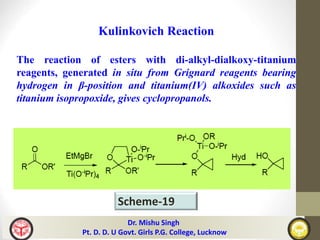
Scheme-19
Kulinkovich Reaction
The reaction of esters with di-alkyl-dialkoxy-titanium
reagents, generated in situ from Grignard reagents bearing
hydrogen in β-position and titanium(IV) alkoxides such as
titanium isopropoxide, gives cyclopropanols.
Dr. Mishu Singh
Pt. D. D. U Govt. Girls P.G. College, Lucknow

organomagnesium-compounds.ppt

  • 1.
    Organo-magnesium Reagents (R-Mg-X) Dr. MishuSingh Pt. D. D. U Govt. Girls P.G. College, Lucknow
  • 2.
    • The organomagnesiumhalides (RMgX), known as Grignard reagents. • (RMgX ) are useful synthetic intermediates in organic chemistry for carbon-carbon bond formation. • They may be regarded as polar compounds and are sources of nuleophilic carbanions. Dr. Mishu Singh Pt. D. D. U Govt. Girls P.G. College, Lucknow
  • 3.
    General • Although theGrignard reagents are usually formulated as R-Mg-X, but in reality they are a mixture of a variety of species. • The ratio of the species in solution varies with the organic group, the halogen, the solvent, the concentration and the temperature. • It is believed that in case of organo-magnesium chlorides (R-Mg-Cl) in diethyl ether, the predominant species over a wide range of concentrations is a solvated, halogen- bridged dimer -1 (as shown in next slide). •The degree of association varies as the halide is changed to Br or I. Dr. Mishu Singh Pt. D. D. U Govt. Girls P.G. College, Lucknow
  • 4.
    • However, incase of THF, due to the highly coordinating nature of the solvent, there is a lesser degree of association. • Therefore, monomeric species dominate in THF, however, there are significant concentrations of R2Mg, MgX2 and R-Mg-X in equilibrium. Dr. Mishu Singh Pt. D. D. U Govt. Girls P.G. College, Lucknow
  • 5.
    Preparation • The RMgXare prepared by the action of Mg on alkyl, aryl or vinyl halides in either dry ether or THF, and the resultant solution is used for the subsequent reactions. • In case the reaction is sluggish, small amount of iodine is added to initiate the reaction. • The rate of the formation of the organomagnesium halides can be significantly accelerated by sonication. Dr. Mishu Singh Pt. D. D. U Govt. Girls P.G. College, Lucknow
  • 6.
    Reactions with CarbonylCompounds Dr. Mishu Singh Pt. D. D. U Govt. Girls P.G. College, Lucknow
  • 7.
    Mechanism • Being nucleophilicin nature, the R-Mg-X undergo 1,2- addition to the carbonyl group of aldehydes, ketones, esters, anhydrides, acid chlorides and amides. • In these reactions, the alkyl, aryl or vinyl group having carban-ionic character become attached to the carbonyl carbon and the Mg-X to the oxygen of the carbonyl group to give a complex (addition product). • These addition products on decomposition with proton source give the corresponding alcohols. Dr. Mishu Singh Pt. D. D. U Govt. Girls P.G. College, Lucknow
  • 8.
    The mechanism ofthis reaction is usually depicted to consist of the following steps- •Complexation of the organomagnesium species with the substrate. •The next step involves nucleophilic attack of organic moiety of Grignard reagent on the electron deficient carbon of carbonyl group via a molecular complex. Dr. Mishu Singh Pt. D. D. U Govt. Girls P.G. College, Lucknow
  • 9.
    •The intermediate formedin the above step is hydrolyzed to give a tertiary alcohol. However, if the carbonyl group is attached with a leaving group (i.e., if R1= OR) then the tetrahedral adduct can break down to regenerate a C=O group that undergoes a fast second addition step. Dr. Mishu Singh Pt. D. D. U Govt. Girls P.G. College, Lucknow
  • 10.
    Scheme-1 Scheme-2 Scheme-1 Dr. Mishu Singh Pt.D. D. U Govt. Girls P.G. College, Lucknow
  • 11.
    A number ofmethods have been devised to stop the reaction at the aldehyde or ketone stage. Such protocols involve the formation of a masked carbonyl compound, which releases the desired compound on hydrolysis. Mechanism cont…. Scheme-3 H+ / H2O Dr. Mishu Singh Pt. D. D. U Govt. Girls P.G. College, Lucknow
  • 12.
    Mechanism cont…. In caseof reaction of Grignard reaction with carbon dioxide, the reaction stops at the carboxy-late (RCO2 -) stage as it is resistant to further nucleo-philic attack Scheme-4 Dr. Mishu Singh Pt. D. D. U Govt. Girls P.G. College, Lucknow
  • 13.
    • Grignard reactionsare prone to undergo side reactions. • The reaction of a sterically hindered ketone with a Grignard reagent having a β-H shows a tendency towards reduction of the carbonyl group. Scheme-5 Dr. Mishu Singh Pt. D. D. U Govt. Girls P.G. College, Lucknow
  • 14.
    Reactions with Epoxides •Epoxides react with R-Mg-X to afford a primary alcohol with the lengthening of the carbon chain by two carbon atoms. • However, in this case of substituted epoxides, the attack of the alkyl, aryl or vinyl caban-ion takes place from the less substituted ring carbon (steric factor) atom of the epoxides. Scheme-6 Dr. Mishu Singh Pt. D. D. U Govt. Girls P.G. College, Lucknow
  • 15.
    Reactions with Alkyl/Alke-nyl/ArylHalides Alkyl, alke-nyl as well as aryl triflates, bromides, and iodides can proceed substitution reactions with R-Mg-X in the presence of transition metal catalysts. For examples, CoCl2 catalyzes the cross-coupling of Ph-Mg-Br with benzyl bromide in 87% yield (Kharasch reaction). Scheme-7 Dr. Mishu Singh Pt. D. D. U Govt. Girls P.G. College, Lucknow
  • 16.
    • The couplingof alkenyl halides with R-Mg-X can be successfully carried out in the presence of NiCl2(dppe) in high yield. • In these reactions the existing configuration of the stereo-genic double bond is completely retained. • These reaction conditions are also compatible for the cross- coupling aryl halides/triflates with aryl-magnesium halides. Scheme-8 Dr. Mishu Singh Pt. D. D. U Govt. Girls P.G. College, Lucknow
  • 17.
    Scheme-9 Dr. Mishu Singh Pt.D. D. U Govt. Girls P.G. College, Lucknow
  • 18.
    The C-C cross-couplingof secondary R-Mg-X may occur in analogy to the reaction of the primary R-Mg-X, but they may also lead to the unexpected reactions depending on the catalytic system due to steric hindrance that could lead to iso-meriazation of the C-C coupling. Scheme-10 Dr. Mishu Singh Pt. D. D. U Govt. Girls P.G. College, Lucknow
  • 19.
    Dr. Mishu Singh Pt.D. D. U Govt. Girls P.G. College, Lucknow
  • 20.
    Synthesis of Ethers R-Mg-Xwith lower halogenated ethers produce higher ethers. Scheme-11 Dr. Mishu Singh Pt. D. D. U Govt. Girls P.G. College, Lucknow
  • 21.
    Synthesis of Stilbene Thesynthesis of stilbene can be accomplished by the reaction of benzyl-magnesium bromide(PhCH2MgBr) with benzal- dehyde, followed by dehydration under acidic or basic conditions. Scheme-12 Dr. Mishu Singh Pt. D. D. U Govt. Girls P.G. College, Lucknow
  • 22.
    Synthesis of Alkylcyanide The reaction of alkyl-magnesium halides with cyanogens or cyanogens chloride gives alkyl cyanides . Scheme-13 chloride Dr. Mishu Singh Pt. D. D. U Govt. Girls P.G. College, Lucknow
  • 23.
    Synthesis of PrimaryAmines The reaction of chloramines with organomagnesium halides gives primary amines. Scheme-14 Dr. Mishu Singh Pt. D. D. U Govt. Girls P.G. College, Lucknow
  • 24.
    Scheme-15 Synthesis of DeutratedHydrocarbons Deutrated hydrocarbons can be synthesized by the reaction of organomagnesium halides with D2O Dr. Mishu Singh Pt. D. D. U Govt. Girls P.G. College, Lucknow
  • 25.
    Scheme-16 Benary Reaction It providesan effective method for the synthesis of α,β- unsaturated carbonyl compounds from -β (N,N- dialkylamino)-vinyl ketone and Grignard reagent by 1,4- addition followed by hydrolysis and elimination of the dialkylated amine. Dr. Mishu Singh Pt. D. D. U Govt. Girls P.G. College, Lucknow
  • 26.
    Bodrous Reaction This reactionprovides a method for the preparation of substituted amides from aliphatic or aromatic esters and an aminomaganesium halide which can be obtained from a primary or secondary amine and Grignard reagent at room temperature. Scheme-17 Dr. Mishu Singh Pt. D. D. U Govt. Girls P.G. College, Lucknow
  • 27.
    Scheme-18 Bouveault Reaction Primary alkylhalide can be converted into aldehydes with an additional carbon via the formation of Grignard reagent followed by reaction with N,N-disubstituted formamide and hydrolysis. Dr. Mishu Singh Pt. D. D. U Govt. Girls P.G. College, Lucknow
  • 28.
    Dr. Mishu Singh Pt.D. D. U Govt. Girls P.G. College, Lucknow Scheme-19 Dzhemilev Reaction It involves the reaction of alkenes with Grignard reagent to give alkyl magnesium halide in the presence of Cp2ZrCl2. This method had found wide application in organic and organometallic synthesis.
  • 29.
    Dr. Mishu Singh Pt.D. D. U Govt. Girls P.G. College, Lucknow Scheme-19 Kulinkovich Reaction The reaction of esters with di-alkyl-dialkoxy-titanium reagents, generated in situ from Grignard reagents bearing hydrogen in β-position and titanium(IV) alkoxides such as titanium isopropoxide, gives cyclopropanols.
  • 30.
    Dr. Mishu Singh Pt.D. D. U Govt. Girls P.G. College, Lucknow