UNIT 3
SYNTHESIS REACTIONS &
MEDICINAL USES OF
PYRROLE
Presented by
SOWMIYA PERINBARAJ
Assistant Professor
Dept. of Pharmaceutical Chemistry
SVCP
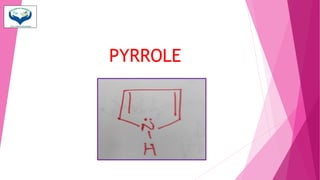
PYRROLE
PYRROLE
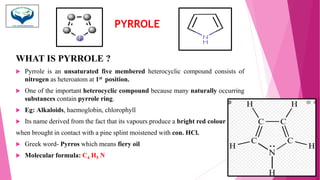
WHAT IS PYRROLE ?
 Pyrrole is an unsaturated five membered heterocyclic compound consists of
nitrogen as heteroatom at 1st position.
 One of the important heterocyclic compound because many naturally occurring
substances contain pyrrole ring.
 Eg: Alkaloids, haemoglobin, chlorophyll
 Its name derived from the fact that its vapours produce a bright red colour
when brought in contact with a pine splint moistened with con. HCl.
 Greek word- Pyrros which means fiery oil
 Molecular formula: C4 H5 N
SOURCE:
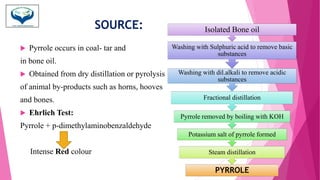
 Pyrrole occurs in coal- tar and
in bone oil.
 Obtained from dry distillation or pyrolysis
of animal by-products such as horns, hooves
and bones.
 Ehrlich Test:
Pyrrole + p-dimethylaminobenzaldehyde
Intense Red colour
PYRROLE
Steam distillation
Potassium salt of pyrrole formed
Pyrrole removed by boiling with KOH
Fractional distillation
Washing with dil.alkali to remove acidic
substances
Washing with Sulphuric acid to remove basic
substances
Isolated Bone oil
SYNTHESIS PREPARATION
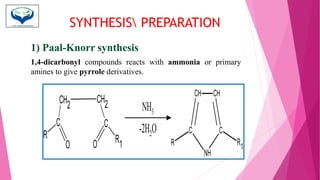
1) Paal-Knorr synthesis
1,4-dicarbonyl compounds reacts with ammonia or primary
amines to give pyrrole derivatives.
CH2
CH2
C
C
O O R1
R C
NH
C
CH
CH
R1
R
NH3
-2H2O
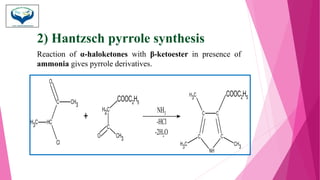
2) Hantzsch pyrrole synthesis
Reaction of α-haloketones with β-ketoester in presence of
ammonia gives pyrrole derivatives.
C CH3
O
C
H
C
H3
Cl
+
C
H2
C
O CH3
COOC2H5
NH3
-HCl
-2H2O C
NH
C
C
C
CH3
C
H3
C
H3
COOC2H5
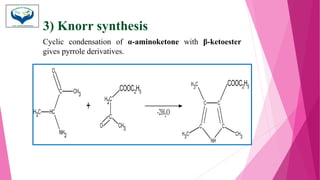
3) Knorr synthesis
Cyclic condensation of α-aminoketone with β-ketoester
gives pyrrole derivatives.
C CH3
O
C
H
C
H3
NH2
+
C
H2
C
O CH3
COOC2H5
C
NH
C
C
C
CH3
C
H3
C
H3
COOC2H5
-2H2O
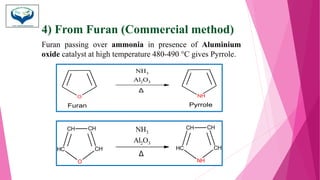
4) From Furan (Commercial method)
Furan passing over ammonia in presence of Aluminium
oxide catalyst at high temperature 480-490 °C gives Pyrrole.
O
C
H
CH
CH
CH NH3
Al2O3
Δ
NH
C
H
CH
CH
CH
O
NH3
Al2O3
Δ
NH
Furan Pyrrole
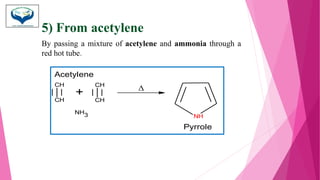
5) From acetylene
By passing a mixture of acetylene and ammonia through a
red hot tube.
CH
CH
CH
CH
+
NH3
Δ
NH
Acetylene
Pyrrole
REACTIONS
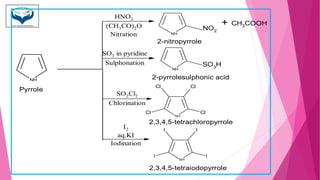
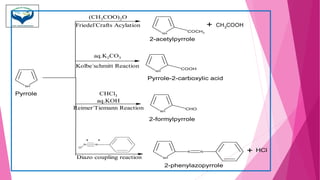
1.ELECTROPHILIC SUBSTITUTION:
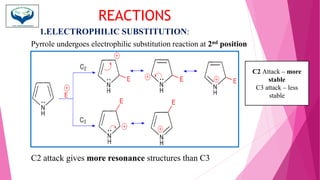
Pyrrole undergoes electrophilic substitution reaction at 2nd position
C2 attack gives more resonance structures than C3
C2 Attack – more
stable
C3 attack – less
stable
NH
HNO3
(CH3CO)2O
Nitration NH
NO2
SO3 in pyridine
Sulphonation
NH
SO3H
Pyrrole
2-nitropyrrole
2-pyrrolesulphonic acid
SO2Cl2
Chlorination
NH
Cl
Cl
Cl
Cl
2,3,4,5-tetrachloropyrrole
NH
I
I
I
I
I2
aq.KI
Iodination
2,3,4,5-tetraiodopyrrole
CH3COOH
+
NH
(CH3COO)2O
Friedel-
Crafts Acylation
NH
COCH3
CH3COOH
+
2-acetylpyrrole
aq.K2CO3
Kolbe-
schmitt Reaction
NH
COOH
Pyrrole-2-carboxylic acid
CHCl3
aq.KOH
Reimer-
Tiemann Reaction NH
CHO
2-formylpyrrole
Diazo coupling reaction NH
N N
N
+
N
+
Cl
2-phenylazopyrrole
+ HCl
Pyrrole
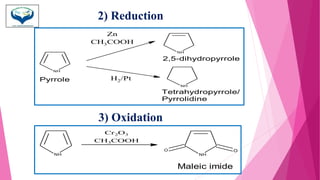
2) Reduction
3) Oxidation
NH
Pyrrole
Zn
CH3COOH
H2/Pt
NH
NH
2,5-dihydropyrrole
Tetrahydropyrrole/
Pyrrolidine
NH
Cr2O3
CH3COOH
NH
O
O
Maleic imide
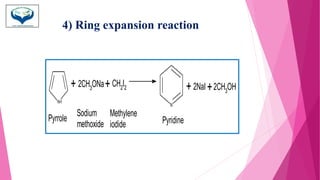
4) Ring expansion reaction
NH
+ 2CH3ONa CH2I2
+
N
2NaI 2CH3OH
+ +
Pyrrole
Sodium
methoxide Pyridine
Methylene
iodide
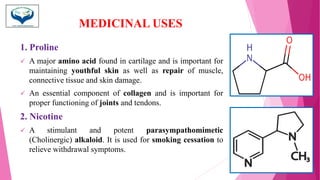
MEDICINAL USES
1. Proline
✓ A major amino acid found in cartilage and is important for
maintaining youthful skin as well as repair of muscle,
connective tissue and skin damage.
✓ An essential component of collagen and is important for
proper functioning of joints and tendons.
2. Nicotine
✓ A stimulant and potent parasympathomimetic
(Cholinergic) alkaloid. It is used for smoking cessation to
relieve withdrawal symptoms.
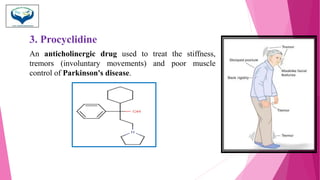
3. Procyclidine
An anticholinergic drug used to treat the stiffness,
tremors (involuntary movements) and poor muscle
control of Parkinson's disease.
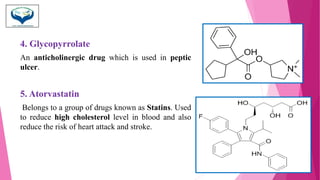
4. Glycopyrrolate
An anticholinergic drug which is used in peptic
ulcer.
5. Atorvastatin
Belongs to a group of drugs known as Statins. Used
to reduce high cholesterol level in blood and also
reduce the risk of heart attack and stroke.

Unit 3 Pyrrole

  • 1.
    UNIT 3 SYNTHESIS REACTIONS& MEDICINAL USES OF PYRROLE Presented by SOWMIYA PERINBARAJ Assistant Professor Dept. of Pharmaceutical Chemistry SVCP
  • 2.
  • 3.
    PYRROLE WHAT IS PYRROLE?  Pyrrole is an unsaturated five membered heterocyclic compound consists of nitrogen as heteroatom at 1st position.  One of the important heterocyclic compound because many naturally occurring substances contain pyrrole ring.  Eg: Alkaloids, haemoglobin, chlorophyll  Its name derived from the fact that its vapours produce a bright red colour when brought in contact with a pine splint moistened with con. HCl.  Greek word- Pyrros which means fiery oil  Molecular formula: C4 H5 N
  • 4.
    SOURCE:  Pyrrole occursin coal- tar and in bone oil.  Obtained from dry distillation or pyrolysis of animal by-products such as horns, hooves and bones.  Ehrlich Test: Pyrrole + p-dimethylaminobenzaldehyde Intense Red colour PYRROLE Steam distillation Potassium salt of pyrrole formed Pyrrole removed by boiling with KOH Fractional distillation Washing with dil.alkali to remove acidic substances Washing with Sulphuric acid to remove basic substances Isolated Bone oil
  • 5.
    SYNTHESIS PREPARATION 1) Paal-Knorrsynthesis 1,4-dicarbonyl compounds reacts with ammonia or primary amines to give pyrrole derivatives. CH2 CH2 C C O O R1 R C NH C CH CH R1 R NH3 -2H2O
  • 6.
    2) Hantzsch pyrrolesynthesis Reaction of α-haloketones with β-ketoester in presence of ammonia gives pyrrole derivatives. C CH3 O C H C H3 Cl + C H2 C O CH3 COOC2H5 NH3 -HCl -2H2O C NH C C C CH3 C H3 C H3 COOC2H5
  • 7.
    3) Knorr synthesis Cycliccondensation of α-aminoketone with β-ketoester gives pyrrole derivatives. C CH3 O C H C H3 NH2 + C H2 C O CH3 COOC2H5 C NH C C C CH3 C H3 C H3 COOC2H5 -2H2O
  • 8.
    4) From Furan(Commercial method) Furan passing over ammonia in presence of Aluminium oxide catalyst at high temperature 480-490 °C gives Pyrrole. O C H CH CH CH NH3 Al2O3 Δ NH C H CH CH CH O NH3 Al2O3 Δ NH Furan Pyrrole
  • 9.
    5) From acetylene Bypassing a mixture of acetylene and ammonia through a red hot tube. CH CH CH CH + NH3 Δ NH Acetylene Pyrrole
  • 10.
    REACTIONS 1.ELECTROPHILIC SUBSTITUTION: Pyrrole undergoeselectrophilic substitution reaction at 2nd position C2 attack gives more resonance structures than C3 C2 Attack – more stable C3 attack – less stable
  • 11.
    NH HNO3 (CH3CO)2O Nitration NH NO2 SO3 inpyridine Sulphonation NH SO3H Pyrrole 2-nitropyrrole 2-pyrrolesulphonic acid SO2Cl2 Chlorination NH Cl Cl Cl Cl 2,3,4,5-tetrachloropyrrole NH I I I I I2 aq.KI Iodination 2,3,4,5-tetraiodopyrrole CH3COOH +
  • 12.
    NH (CH3COO)2O Friedel- Crafts Acylation NH COCH3 CH3COOH + 2-acetylpyrrole aq.K2CO3 Kolbe- schmitt Reaction NH COOH Pyrrole-2-carboxylicacid CHCl3 aq.KOH Reimer- Tiemann Reaction NH CHO 2-formylpyrrole Diazo coupling reaction NH N N N + N + Cl 2-phenylazopyrrole + HCl Pyrrole
  • 13.
  • 14.
    4) Ring expansionreaction NH + 2CH3ONa CH2I2 + N 2NaI 2CH3OH + + Pyrrole Sodium methoxide Pyridine Methylene iodide
  • 15.
    MEDICINAL USES 1. Proline ✓A major amino acid found in cartilage and is important for maintaining youthful skin as well as repair of muscle, connective tissue and skin damage. ✓ An essential component of collagen and is important for proper functioning of joints and tendons. 2. Nicotine ✓ A stimulant and potent parasympathomimetic (Cholinergic) alkaloid. It is used for smoking cessation to relieve withdrawal symptoms.
  • 16.
    3. Procyclidine An anticholinergicdrug used to treat the stiffness, tremors (involuntary movements) and poor muscle control of Parkinson's disease.
  • 17.
    4. Glycopyrrolate An anticholinergicdrug which is used in peptic ulcer. 5. Atorvastatin Belongs to a group of drugs known as Statins. Used to reduce high cholesterol level in blood and also reduce the risk of heart attack and stroke.