-Minhaj Sohail Shakil Patel
(MC/2019/15)
1
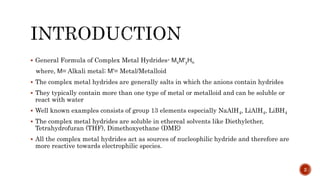
 General Formula of Complex Metal Hydrides- MxM'yHn
where, M= Alkali metal; M'= Metal/Metalloid
 The complex metal hydrides are generally salts in which the anions contain hydrides
 They typically contain more than one type of metal or metalloid and can be soluble or
react with water
 Well known examples consists of group 13 elements especially NaAlH4, LiAlH4, LiBH4
 The complex metal hydrides are soluble in ethereal solvents like Diethylether,
Tetrahydrofuran (THF), Dimethoxyethane (DME)
 All the complex metal hydrides act as sources of nucleophilic hydride and therefore are
more reactive towards electrophilic species.
2
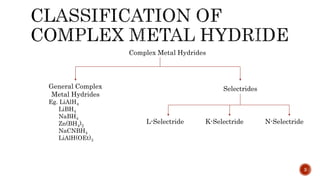
Complex Metal Hydrides
General Complex
Metal Hydrides
Eg. LiAlH4
LiBH4
NaBH4
Zn(BH4)2
NaCNBH4
LiAlH(OEt)3
Selectrides
L-Selectride K-Selectride N-Selectride
3
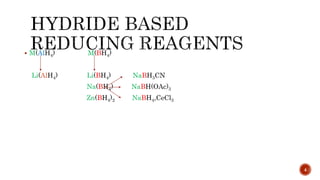
 M(AlH4) M(BH4)
Li(AlH4) Li(BH4) NaBH3CN
Na(BH4) NaBH(OAc)3
Zn(BH4)2 NaBH4,CeCl3
4
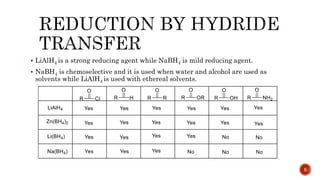
 LiAlH4 is a strong reducing agent while NaBH4 is mild reducing agent.
 NaBH4 is chemoselective and it is used when water and alcohol are used as
solvents while LiAlH4 is used with ethereal solvents.
5
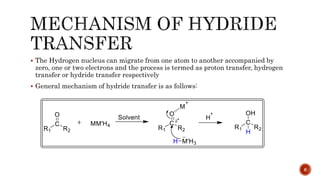
 The Hydrogen nucleus can migrate from one atom to another accompanied by
zero, one or two electrons and the process is termed as proton transfer, hydrogen
transfer or hydride transfer respectively
 General mechanism of hydride transfer is as follows:
6
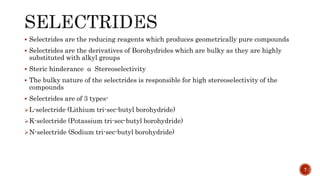
 Selectrides are the reducing reagents which produces geometrically pure compounds
 Selectrides are the derivatives of Borohydrides which are bulky as they are highly
substituted with alkyl groups
 Steric hinderance α Stereoselectivity
 The bulky nature of the selectrides is responsible for high stereoselectivity of the
compounds
 Selectrides are of 3 types-
L-selectride (Lithium tri-sec-butyl borohydride)
K-selectride (Potassium tri-sec-butyl borohydride)
N-selectride (Sodium tri-sec-butyl borohydride)
7
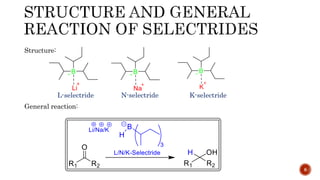
Structure:
L-selectride N-selectride K-selectride
General reaction:
8
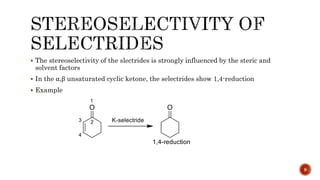
 The stereoselectivity of the slectrides is strongly influenced by the steric and
solvent factors
 In the α,β unsaturated cyclic ketone, the selectrides show 1,4-reduction
 Example
9
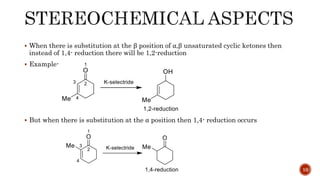
 When there is substitution at the β position of α,β unsaturated cyclic ketones then
instead of 1,4- reduction there will be 1,2-reduction
 Example-
 But when there is substitution at the α position then 1,4- reduction occurs
10
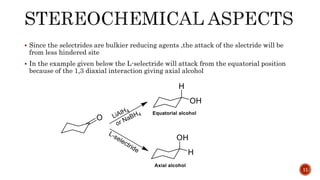
 Since the selectrides are bulkier reducing agents ,the attack of the slectride will be
from less hindered site
 In the example given below the L-selectride will attack from the equatorial position
because of the 1,3 diaxial interaction giving axial alcohol
11
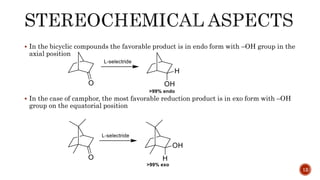
 In the bicyclic compounds the favorable product is in endo form with –OH group in the
axial position
 In the case of camphor, the most favorable reduction product is in exo form with –OH
group on the equatorial position
12
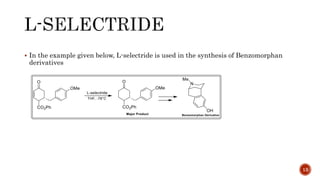
 In the example given below, L-selectride is used in the synthesis of Benzomorphan
derivatives
13
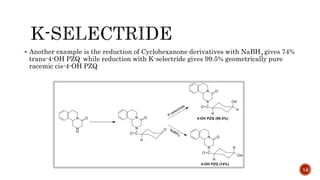
 Another example is the reduction of Cyclohexanone derivatives with NaBH4 gives 74%
trans-4-OH PZQ while reduction with K-selectride gives 99.5% geometrically pure
racemic cis-4-OH PZQ
14
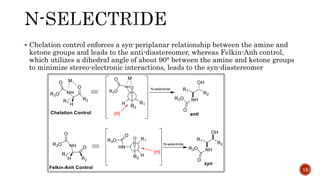
 Chelation control enforces a syn-periplanar relationship between the amine and
ketone groups and leads to the anti-diastereomer, whereas Felkin-Anh control,
which utilizes a dihedral angle of about 90° between the amine and ketone groups
to minimize stereo-electronic interactions, leads to the syn-diastereomer
15
1. https://en.wikipedia.org/wiki/Complex_metal_hydride
2. https://en.chem-station.com/reactions-2/2017/05/lnk-selectride.html
3. Hoffman RV, Maslouh N. A Highly Stereoselective Synthesis of Carbamate
Protected anti-1, 2-Aminoalcohols.
4. Comins DL, Zhang YM, Joseph SP. Enantiopure N-acyldihydropyridones as
synthetic intermediates: Asymmetric synthesis of benzomorphans. Organic Letters.
1999 Aug 26;1(4):657-60.
5. Kiec‐Kononowicz K, Farghaly ZS, Blaschke G. Synthesis and Properties of cis‐and
trans‐4‐Hydroxypraziquantel. Archiv der Pharmazie. 1991;324(4):235-7.
16
17
THANK
YOU

Complex metal hydrides and selectrides

  • 1.
    -Minhaj Sohail ShakilPatel (MC/2019/15) 1
  • 2.
     General Formulaof Complex Metal Hydrides- MxM'yHn where, M= Alkali metal; M'= Metal/Metalloid  The complex metal hydrides are generally salts in which the anions contain hydrides  They typically contain more than one type of metal or metalloid and can be soluble or react with water  Well known examples consists of group 13 elements especially NaAlH4, LiAlH4, LiBH4  The complex metal hydrides are soluble in ethereal solvents like Diethylether, Tetrahydrofuran (THF), Dimethoxyethane (DME)  All the complex metal hydrides act as sources of nucleophilic hydride and therefore are more reactive towards electrophilic species. 2
  • 3.
    Complex Metal Hydrides GeneralComplex Metal Hydrides Eg. LiAlH4 LiBH4 NaBH4 Zn(BH4)2 NaCNBH4 LiAlH(OEt)3 Selectrides L-Selectride K-Selectride N-Selectride 3
  • 4.
     M(AlH4) M(BH4) Li(AlH4)Li(BH4) NaBH3CN Na(BH4) NaBH(OAc)3 Zn(BH4)2 NaBH4,CeCl3 4
  • 5.
     LiAlH4 isa strong reducing agent while NaBH4 is mild reducing agent.  NaBH4 is chemoselective and it is used when water and alcohol are used as solvents while LiAlH4 is used with ethereal solvents. 5
  • 6.
     The Hydrogennucleus can migrate from one atom to another accompanied by zero, one or two electrons and the process is termed as proton transfer, hydrogen transfer or hydride transfer respectively  General mechanism of hydride transfer is as follows: 6
  • 7.
     Selectrides arethe reducing reagents which produces geometrically pure compounds  Selectrides are the derivatives of Borohydrides which are bulky as they are highly substituted with alkyl groups  Steric hinderance α Stereoselectivity  The bulky nature of the selectrides is responsible for high stereoselectivity of the compounds  Selectrides are of 3 types- L-selectride (Lithium tri-sec-butyl borohydride) K-selectride (Potassium tri-sec-butyl borohydride) N-selectride (Sodium tri-sec-butyl borohydride) 7
  • 8.
  • 9.
     The stereoselectivityof the slectrides is strongly influenced by the steric and solvent factors  In the α,β unsaturated cyclic ketone, the selectrides show 1,4-reduction  Example 9
  • 10.
     When thereis substitution at the β position of α,β unsaturated cyclic ketones then instead of 1,4- reduction there will be 1,2-reduction  Example-  But when there is substitution at the α position then 1,4- reduction occurs 10
  • 11.
     Since theselectrides are bulkier reducing agents ,the attack of the slectride will be from less hindered site  In the example given below the L-selectride will attack from the equatorial position because of the 1,3 diaxial interaction giving axial alcohol 11
  • 12.
     In thebicyclic compounds the favorable product is in endo form with –OH group in the axial position  In the case of camphor, the most favorable reduction product is in exo form with –OH group on the equatorial position 12
  • 13.
     In theexample given below, L-selectride is used in the synthesis of Benzomorphan derivatives 13
  • 14.
     Another exampleis the reduction of Cyclohexanone derivatives with NaBH4 gives 74% trans-4-OH PZQ while reduction with K-selectride gives 99.5% geometrically pure racemic cis-4-OH PZQ 14
  • 15.
     Chelation controlenforces a syn-periplanar relationship between the amine and ketone groups and leads to the anti-diastereomer, whereas Felkin-Anh control, which utilizes a dihedral angle of about 90° between the amine and ketone groups to minimize stereo-electronic interactions, leads to the syn-diastereomer 15
  • 16.
    1. https://en.wikipedia.org/wiki/Complex_metal_hydride 2. https://en.chem-station.com/reactions-2/2017/05/lnk-selectride.html 3.Hoffman RV, Maslouh N. A Highly Stereoselective Synthesis of Carbamate Protected anti-1, 2-Aminoalcohols. 4. Comins DL, Zhang YM, Joseph SP. Enantiopure N-acyldihydropyridones as synthetic intermediates: Asymmetric synthesis of benzomorphans. Organic Letters. 1999 Aug 26;1(4):657-60. 5. Kiec‐Kononowicz K, Farghaly ZS, Blaschke G. Synthesis and Properties of cis‐and trans‐4‐Hydroxypraziquantel. Archiv der Pharmazie. 1991;324(4):235-7. 16
  • 17.