Fused Heterocyclic compound
ISOQUINOLINE
Lecture by
S.Mathivanan., M.pharm
Asst Professor
Pharmacy
Isoquinoline is a heterocyclic aromatic organic
compound. It is a structural isomer of quinoline.
Isoquinoline and quinoline are benzopyridines,
which are composed of a benzene ring fused to
a pyridine ring.
Other names
Benzo[c]pyridine
2-benzazine
Production
• Isoquinoline was first isolated from coal tar in
1885 by Hoogewerf and van Dorp.
• They isolated it by fractional crystallization of the
acid sulfate.
• Weissgerber developed a more rapid route in
1914 by selective extraction of coal tar, exploiting
the fact that isoquinoline is more basic than
quinoline.
• Isoquinoline can then be isolated from the
mixture by fractional crystallization of the acid
sulfate.
The structural backbone in naturally
occurring alkaloids including papaverine.
Physical properties
• Isoquinoline is a colorless hygroscopic liquid
• Unpleasant odour
• Impure samples can appear brownish,
• It crystallizes in platelets that have a low solubility in water but
dissolve well in ethanol, acetone, diethyl ether, carbon
disulfide, and other common organic solvents.
• It is also soluble in dilute acids as the protonated derivative.
• Density1.099 g/cm3
• Melting point26–28 °C
• Boiling point242 °C
Properties
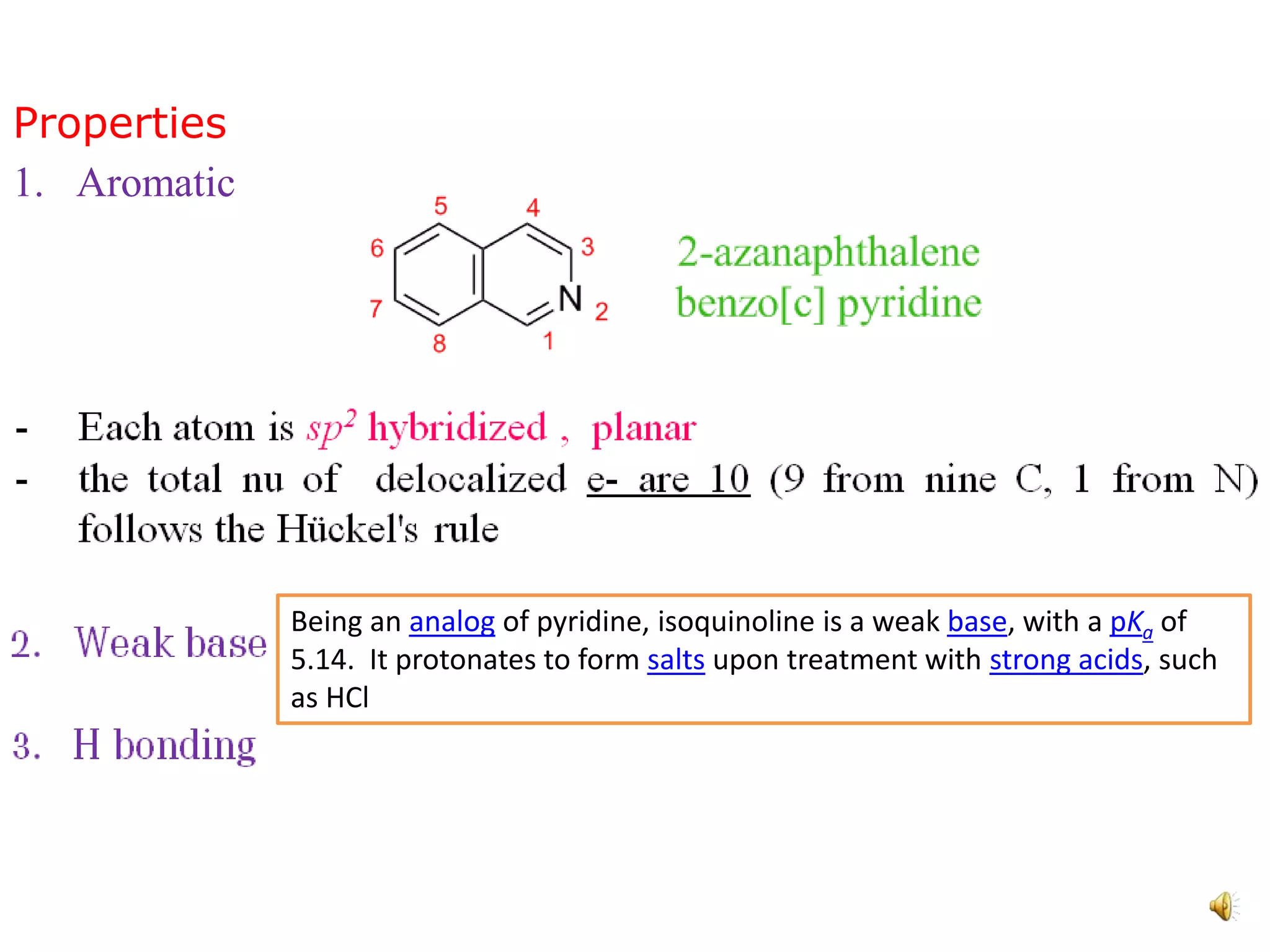
1. Aromatic
Being an analog of pyridine, isoquinoline is a weak base, with a pKa of
5.14. It protonates to form salts upon treatment with strong acids, such
as HCl
• In isoquinoline all ring atoms (9 carbons and 1
nitrogen) are SP2 hybridized.
• Two SP2 orbitals on each atom overlap with each
other to form the C-C and C-N σ bonds. The third
SP2 orbital on each carbon atom overlaps with an
S orbital of hydrogen and forms C-H σ bonds.
• The third SP2 orbital of nitrogen is occupied by
the nitrogen lone pair of electrons.
• Each ring atom possess one un hybridized p –
orbital containing one electron and those are
perpendicular to the plane containing the σ
bonds.
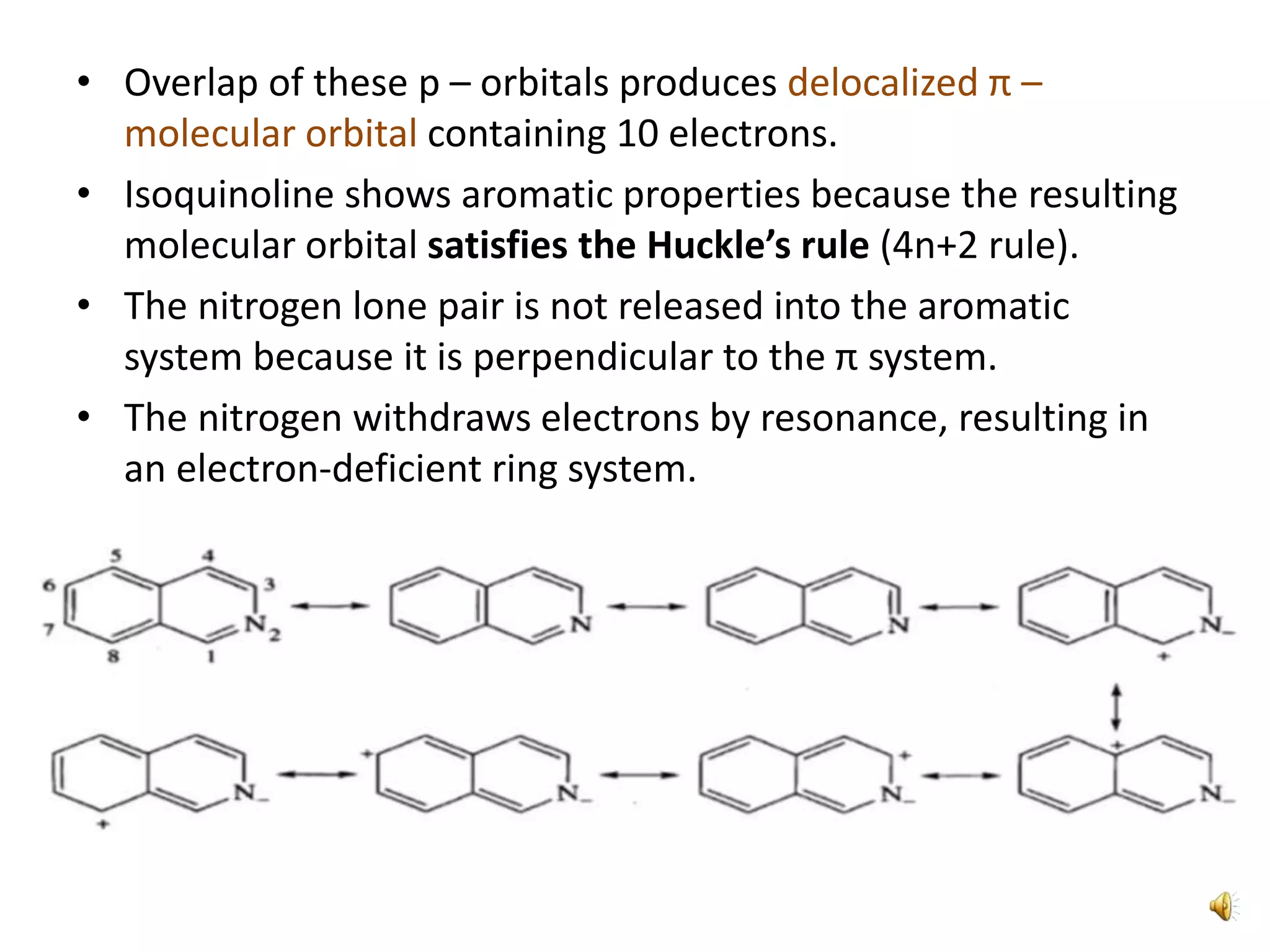
• Overlap of these p – orbitals produces delocalized π –
molecular orbital containing 10 electrons.
• Isoquinoline shows aromatic properties because the resulting
molecular orbital satisfies the Huckle’s rule (4n+2 rule).
• The nitrogen lone pair is not released into the aromatic
system because it is perpendicular to the π system.
• The nitrogen withdraws electrons by resonance, resulting in
an electron-deficient ring system.
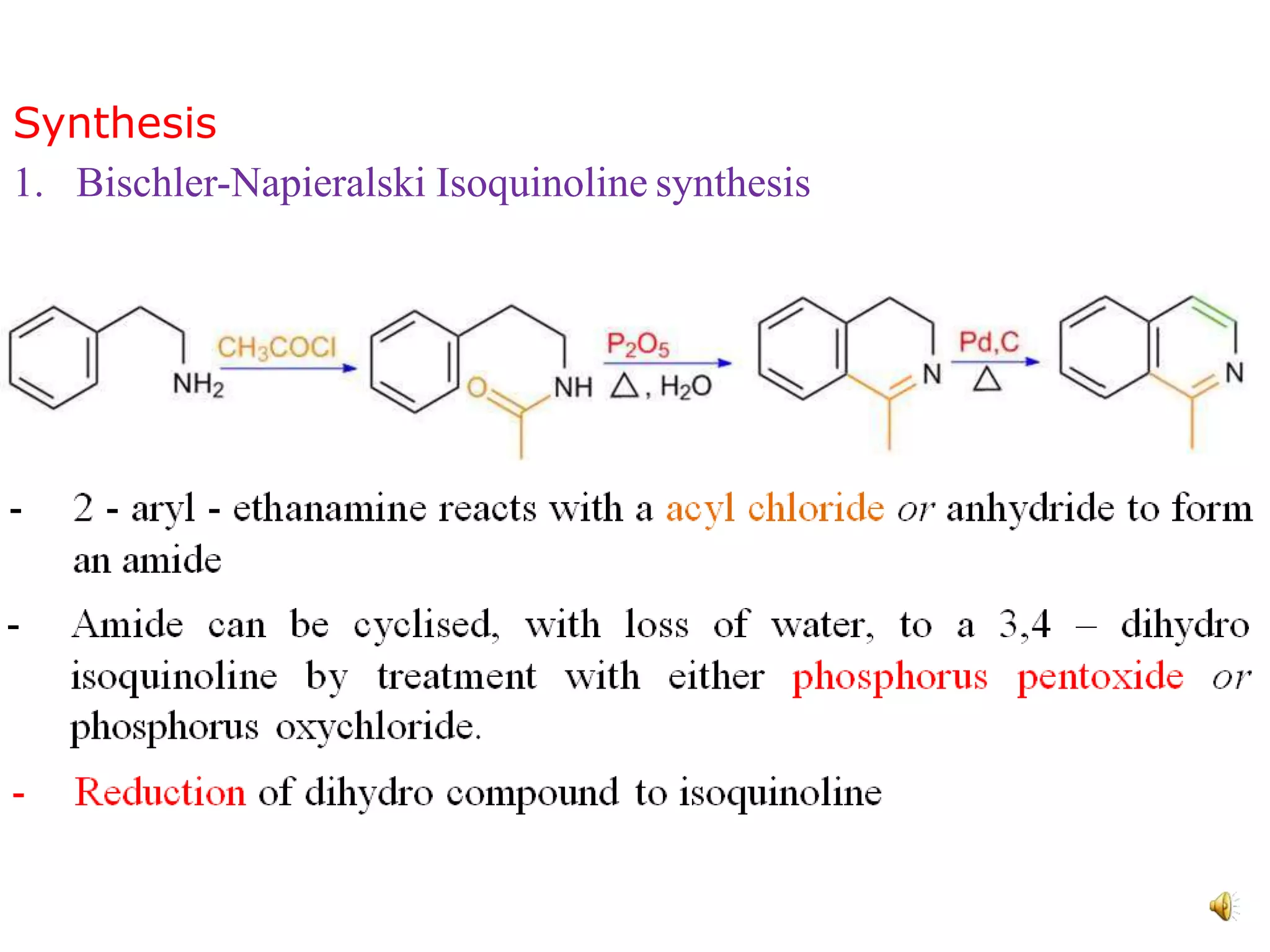
Synthesis
1. Bischler-Napieralski Isoquinoline synthesis
Bischler Napieralski reaction Mechanism
Synthesis
2. The Pictet – Gams synthesis
Synthesis
3. Pomeranz–Fritsch synthesis
Reactions
1. Electrophilic addition to N
Reactions
2. Electrophilic aromatic substitution
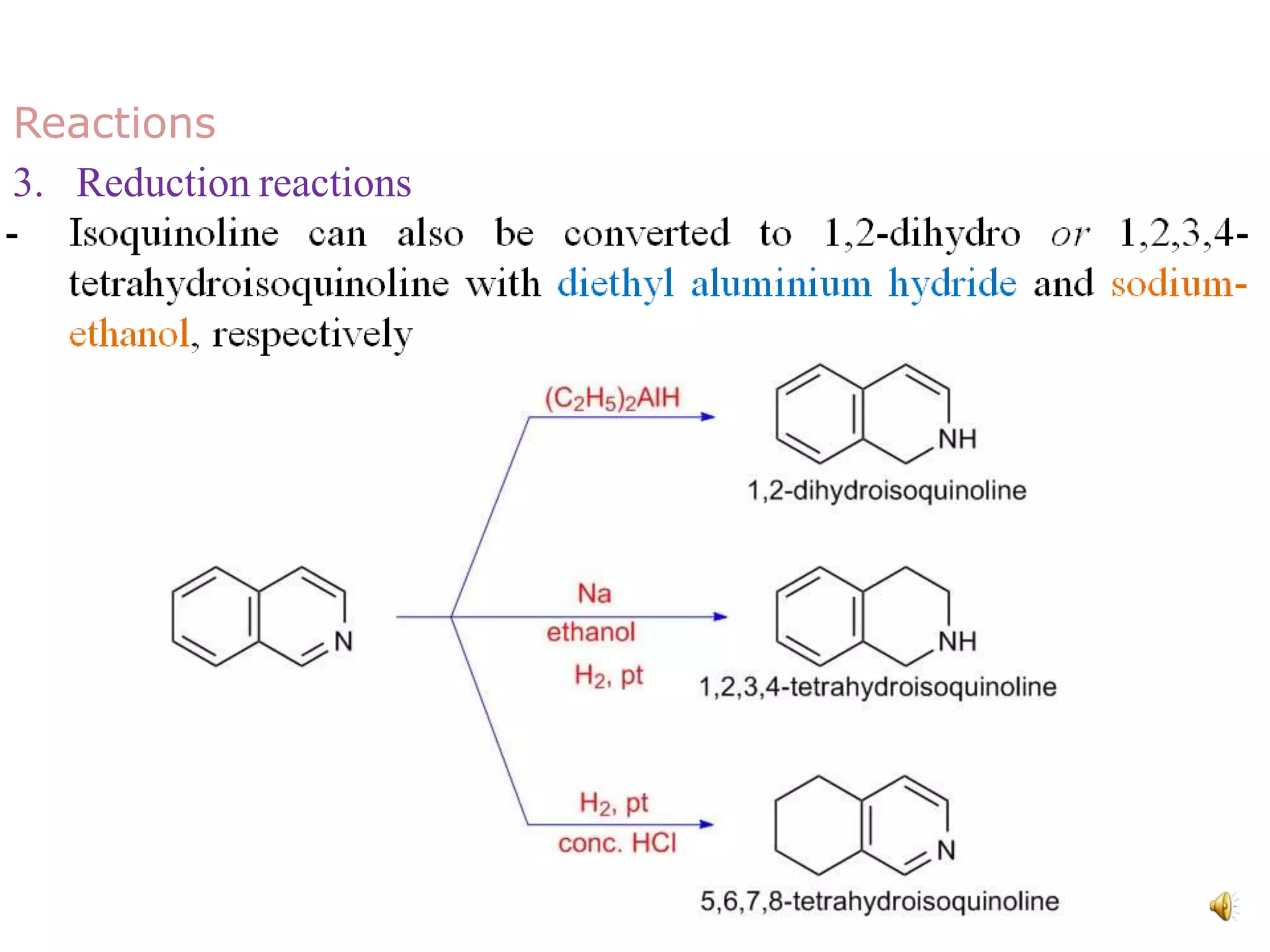
Reactions
3. Reduction reactions
Reactions
4. Oxidation
Reactions
5. Nucleophilic substitution
Medicinal uses
• Quinapril : used to treat high blood
pressure, heart failure, and diabetic kidney
disease
Medicinal uses
• Dimethisoquin : Anaesthetic
Thank you students..!!!
Stay home..stay safe..!!!

Fused heterocyclic compound isoquinoline

  • 1.
    Fused Heterocyclic compound ISOQUINOLINE Lectureby S.Mathivanan., M.pharm Asst Professor Pharmacy
  • 2.
    Isoquinoline is aheterocyclic aromatic organic compound. It is a structural isomer of quinoline. Isoquinoline and quinoline are benzopyridines, which are composed of a benzene ring fused to a pyridine ring. Other names Benzo[c]pyridine 2-benzazine
  • 3.
    Production • Isoquinoline wasfirst isolated from coal tar in 1885 by Hoogewerf and van Dorp. • They isolated it by fractional crystallization of the acid sulfate. • Weissgerber developed a more rapid route in 1914 by selective extraction of coal tar, exploiting the fact that isoquinoline is more basic than quinoline. • Isoquinoline can then be isolated from the mixture by fractional crystallization of the acid sulfate.
  • 4.
    The structural backbonein naturally occurring alkaloids including papaverine.
  • 5.
    Physical properties • Isoquinolineis a colorless hygroscopic liquid • Unpleasant odour • Impure samples can appear brownish, • It crystallizes in platelets that have a low solubility in water but dissolve well in ethanol, acetone, diethyl ether, carbon disulfide, and other common organic solvents. • It is also soluble in dilute acids as the protonated derivative. • Density1.099 g/cm3 • Melting point26–28 °C • Boiling point242 °C
  • 6.
    Properties 1. Aromatic Being ananalog of pyridine, isoquinoline is a weak base, with a pKa of 5.14. It protonates to form salts upon treatment with strong acids, such as HCl
  • 7.
    • In isoquinolineall ring atoms (9 carbons and 1 nitrogen) are SP2 hybridized. • Two SP2 orbitals on each atom overlap with each other to form the C-C and C-N σ bonds. The third SP2 orbital on each carbon atom overlaps with an S orbital of hydrogen and forms C-H σ bonds. • The third SP2 orbital of nitrogen is occupied by the nitrogen lone pair of electrons. • Each ring atom possess one un hybridized p – orbital containing one electron and those are perpendicular to the plane containing the σ bonds.
  • 8.
    • Overlap ofthese p – orbitals produces delocalized π – molecular orbital containing 10 electrons. • Isoquinoline shows aromatic properties because the resulting molecular orbital satisfies the Huckle’s rule (4n+2 rule). • The nitrogen lone pair is not released into the aromatic system because it is perpendicular to the π system. • The nitrogen withdraws electrons by resonance, resulting in an electron-deficient ring system.
  • 9.
  • 10.
  • 11.
    Synthesis 2. The Pictet– Gams synthesis
  • 12.
  • 14.
  • 15.
  • 16.
  • 17.
  • 18.
  • 19.
  • 20.
    • Quinapril :used to treat high blood pressure, heart failure, and diabetic kidney disease
  • 21.
  • 22.
  • 23.
    Thank you students..!!! Stayhome..stay safe..!!!