
Mannich reaction
Submitted by
Akshay
M.pharm(pharmaceutical chemistry)
1st sem
Contents
• Introduction
• Reaction
• Mechanism
• Limitations
• Applications
• References
Introduction
• The Mannich reaction is the amino alkylation reaction, involving the
condensation of an enolizable carbonyl compound with a non -
enolizable aldehyde (like formaldehyde) and ammonia, or a primary
or a secondary amine to furnish a β-amino carbonyl compound, also
known as Mannich base
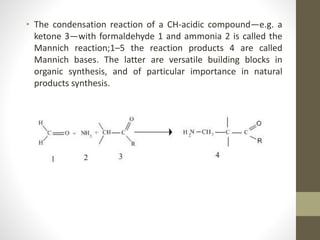
• The condensation reaction of a CH-acidic compound—e.g. a
ketone 3—with formaldehyde 1 and ammonia 2 is called the
Mannich reaction;1–5 the reaction products 4 are called
Mannich bases. The latter are versatile building blocks in
organic synthesis, and of particular importance in natural
products synthesis.
Mechanism
• There have been extensive investigations on the reaction
mechanism.6,7 In most cases the reaction proceeds via initial
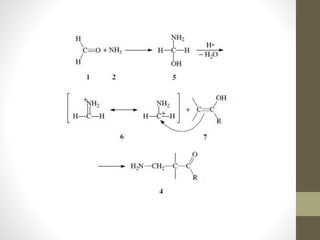
nucleophillic addition of ammonia 2 to formaldehyde 1 to give
adduct 5, which is converted into an iminium ion species 6
(note that a resonance structure—an aminocarbenium ion can
be formulated) through protonation and subsequent loss of
water. The iminium ion species 6 then reacts with the enol 7
of the CH-acidic substrate by overall loss of a proton:
Limitations
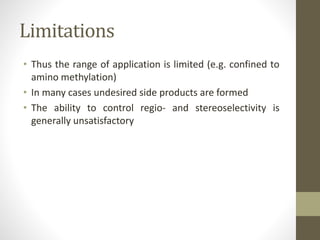
• Thus the range of application is limited (e.g. confined to
amino methylation)
• In many cases undesired side products are formed
• The ability to control regio- and stereoselectivity is
generally unsatisfactory
Applications
HN
N
H
O
O
HN
R1
R2
HCHO
HN
N
H
O
O
N
R1
R2
O
HCHO
Me2NH
HCl
O
N
F
F
F
O
HN
fluoxetin
O
(CH2O)n/AcOH
N
H
O
N HCLHCl
HO
O
N
Tramadol
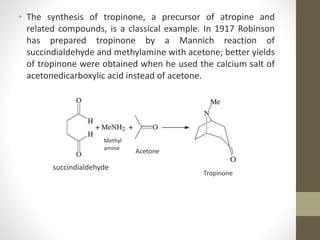
• The synthesis of tropinone, a precursor of atropine and
related compounds, is a classical example. In 1917 Robinson
has prepared tropinone by a Mannich reaction of
succindialdehyde and methylamine with acetone; better yields
of tropinone were obtained when he used the calcium salt of
acetonedicarboxylic acid instead of acetone.
succindialdehyde
Methyl
amine
Acetone
Tropinone
References
• Name reactions 2nd edition By Thomas Laue and Andreas
Plagens
Mannich reaction

Mannich reaction

  • 1.
  • 2.
    Contents • Introduction • Reaction •Mechanism • Limitations • Applications • References
  • 3.
    Introduction • The Mannichreaction is the amino alkylation reaction, involving the condensation of an enolizable carbonyl compound with a non - enolizable aldehyde (like formaldehyde) and ammonia, or a primary or a secondary amine to furnish a β-amino carbonyl compound, also known as Mannich base
  • 4.
    • The condensationreaction of a CH-acidic compound—e.g. a ketone 3—with formaldehyde 1 and ammonia 2 is called the Mannich reaction;1–5 the reaction products 4 are called Mannich bases. The latter are versatile building blocks in organic synthesis, and of particular importance in natural products synthesis.
  • 5.
    Mechanism • There havebeen extensive investigations on the reaction mechanism.6,7 In most cases the reaction proceeds via initial nucleophillic addition of ammonia 2 to formaldehyde 1 to give adduct 5, which is converted into an iminium ion species 6 (note that a resonance structure—an aminocarbenium ion can be formulated) through protonation and subsequent loss of water. The iminium ion species 6 then reacts with the enol 7 of the CH-acidic substrate by overall loss of a proton:
  • 7.
    Limitations • Thus therange of application is limited (e.g. confined to amino methylation) • In many cases undesired side products are formed • The ability to control regio- and stereoselectivity is generally unsatisfactory
  • 8.
  • 9.
    • The synthesisof tropinone, a precursor of atropine and related compounds, is a classical example. In 1917 Robinson has prepared tropinone by a Mannich reaction of succindialdehyde and methylamine with acetone; better yields of tropinone were obtained when he used the calcium salt of acetonedicarboxylic acid instead of acetone. succindialdehyde Methyl amine Acetone Tropinone
  • 10.
    References • Name reactions2nd edition By Thomas Laue and Andreas Plagens