Reactions and Reagents
POC-III Unit-V
1
B.Suresh MS.(Pharm.), (Ph.D).
Asst.Proff. Palamuru University, MBNR
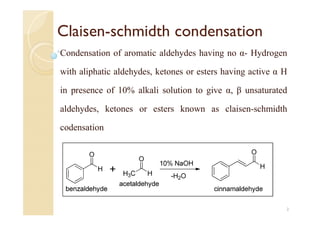
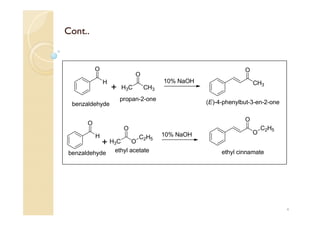
Claisen-schmidth condensation
Condensation of aromatic aldehydes having no α- Hydrogen
with aliphatic aldehydes, ketones or esters having active α H
in presence of 10% alkali solution to give α, β unsaturated
aldehydes, ketones or esters known as claisen-schmidth
codensation
2
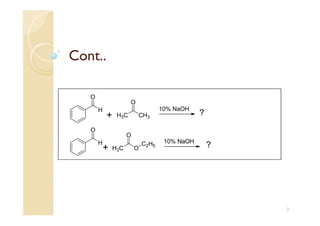
Cont..
H
O
H3C CH3
O
H
O
H3C O
O
10% NaOH
10% NaOHC2H5
+
+ ?
?
3
Cont..
H
O
H3C CH3
O
H
O
H3C O
O
10% NaOH
10% NaOH
CH3
O
O
O
C2H5
C2H5
+
+
ethyl cinnamate
(E)-4-phenylbut-3-en-2-one
ethyl acetate
propan-2-one
benzaldehyde
benzaldehyde
4
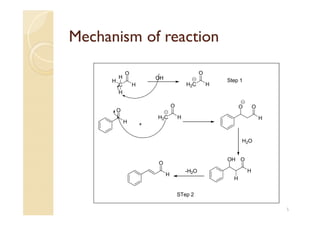
Mechanism of reaction
5
C H
O
OH
H
H
H
H2C H
O
H2C H
O
H
O
O
H
O
OH
H
O
H
H
O
-H2O
+
Step 1
STep 2
H2O
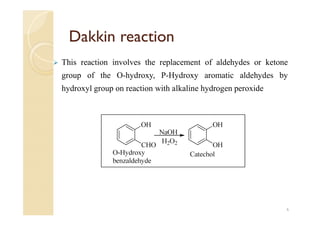
Dakkin reaction
 This reaction involves the replacement of aldehydes or ketone
group of the O-hydroxy, P-Hydroxy aromatic aldehydes by
hydroxyl group on reaction with alkaline hydrogen peroxide
6
7
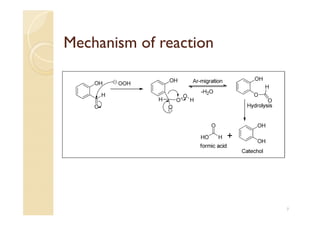
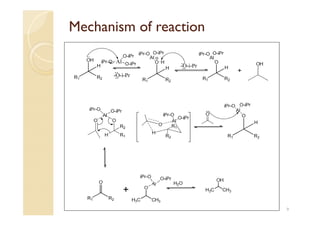
Mechanism of reaction
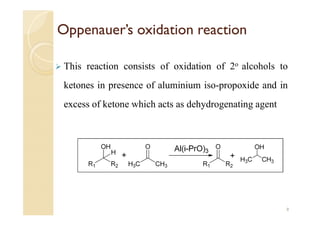
Oppenauer’s oxidation reaction
 This reaction consists of oxidation of 2o alcohols to
ketones in presence of aluminium iso-propoxide and in
excess of ketone which acts as dehydrogenating agent
8
Mechanism of reaction
9
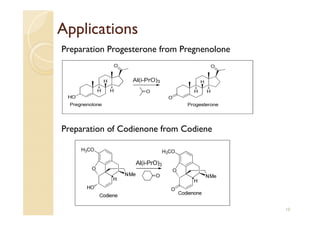
Applications
Preparation of Codienone from Codiene
Preparation Progesterone from Pregnenolone
10
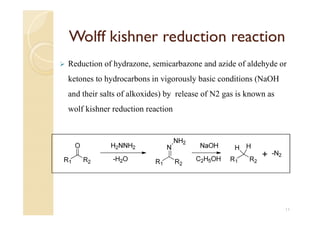
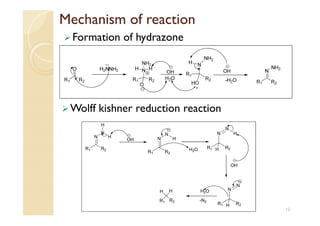
Wolff kishner reduction reaction
 Reduction of hydrazone, semicarbazone and azide of aldehyde or
ketones to hydrocarbons in vigorously basic conditions (NaOH
and their salts of alkoxides) by release of N2 gas is known as
wolf kishner reduction reaction
11
Mechanism of reaction
Formation of hydrazone
R1 R2
N
N
H
H
OH
R1 R2
N
N
H
H2O R1 R2
N
N
H
OH
H
R1 R2
N
N
H
H2O
-N2R1 R2
HH
Wolff kishner reduction reaction
12
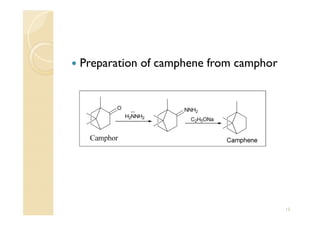
 Preparation of camphene from camphor
13
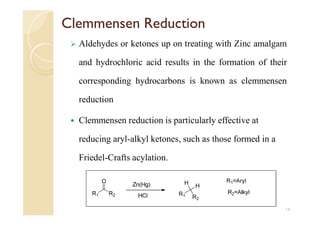
Clemmensen Reduction
 Aldehydes or ketones up on treating with Zinc amalgam
and hydrochloric acid results in the formation of their
corresponding hydrocarbons is known as clemmensen
reduction
 Clemmensen reduction is particularly effective at
reducing aryl-alkyl ketones, such as those formed in a
Friedel-Crafts acylation.
14
15
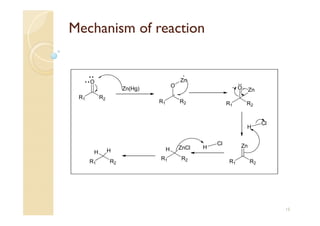
Mechanism of reaction
R1 R2
O
Zn(Hg)
R1 R2
O
Zn
R1 R2
O Zn
R1 R2
Zn
H
Cl
R1 R2
ZnClH H
Cl
R1 R2
HH
Applications
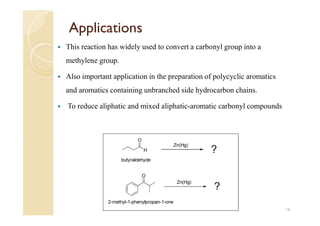
 This reaction has widely used to convert a carbonyl group into a
methylene group.
 Also important application in the preparation of polycyclic aromatics
and aromatics containing unbranched side hydrocarbon chains.
 To reduce aliphatic and mixed aliphatic-aromatic carbonyl compounds
16
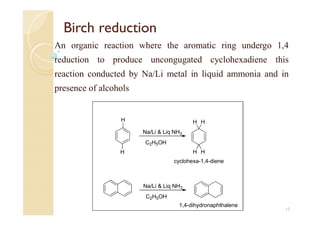
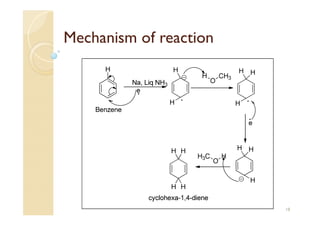
Birch reduction
An organic reaction where the aromatic ring undergo 1,4
reduction to produce uncongugated cyclohexadiene this
reaction conducted by Na/Li metal in liquid ammonia and in
presence of alcohols
17
H
H
HH
HH
Na/Li & Liq NH3
C2H5OH
Na/Li & Liq NH3
C2H5OH
1,4-dihydronaphthalene
cyclohexa-1,4-diene
18
Mechanism of reaction
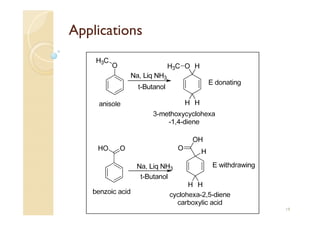
Applications
19
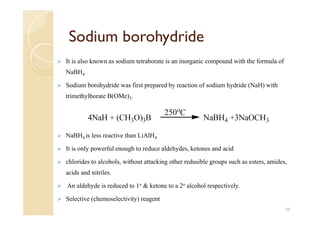
Sodium borohydride
 It is also known as sodium tetraborate is an inorganic compound with the formula of
NaBH4
 Sodium borohydride was first prepared by reaction of sodium hydride (NaH) with
trimethylborate B(OMe)3.
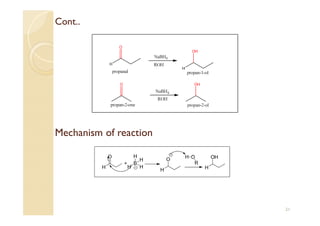
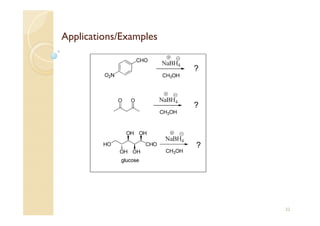
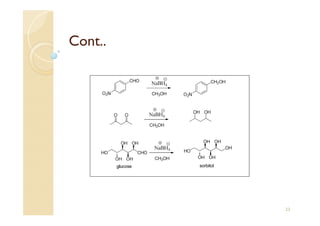
 NaBH4 is less reactive than LiAlH4
 It is only powerful enough to reduce aldehydes, ketones and acid
 chlorides to alcohols, without attacking other redusible groups such as esters, amides,
acids and nitriles.
 An aldehyde is reduced to 1o & ketone to a 2o alcohol respectively.
 Selective (chemoselectivity) reagent
20
21
Mechanism of reaction
Cont..
Applications/Examples
22
Cont..
23
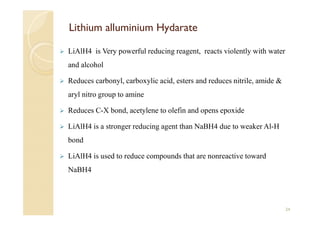
Lithium alluminium Hydarate
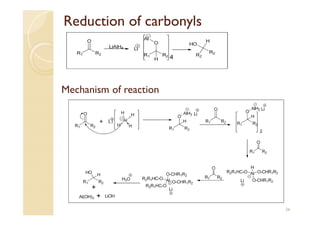
 LiAlH4 is Very powerful reducing reagent, reacts violently with water
and alcohol
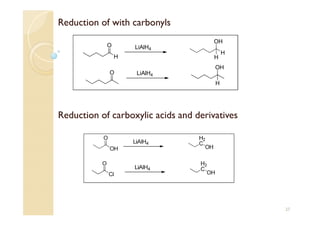
 Reduces carbonyl, carboxylic acid, esters and reduces nitrile, amide &
aryl nitro group to amine
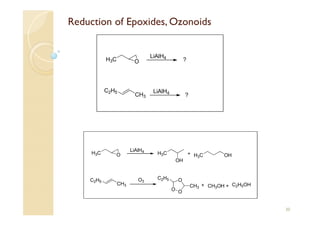
 Reduces C-X bond, acetylene to olefin and opens epoxide
 LiAlH4 is a stronger reducing agent than NaBH4 due to weaker Al-H
bond
 LiAlH4 is used to reduce compounds that are nonreactive toward
NaBH4
24
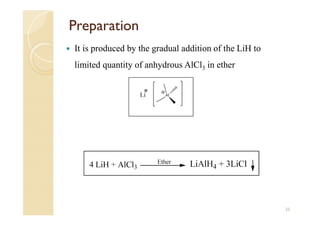
Preparation
 It is produced by the gradual addition of the LiH to
limited quantity of anhydrous AlCl3 in ether
25
Reduction of carbonyls
26
Mechanism of reaction
27
H
O LiAlH4
O LiAlH4
OH
H
H
OH
H
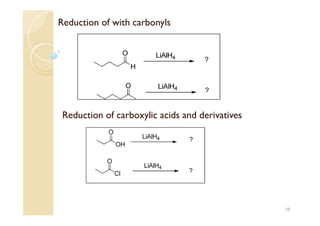
Reduction of with carbonyls
Reduction of carboxylic acids and derivatives
28
Reduction of with carbonyls
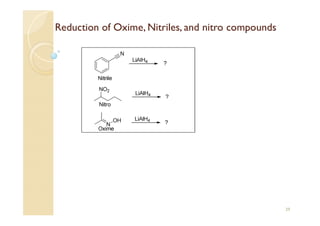
Reduction of Oxime, Nitriles, and nitro compounds
29
Reduction of Epoxides, Ozonoids
30
LiAlH4
?
LiAlH4
?H3C O
CH3
C2H5
O3
LiAlH4H3C O
CH3
C2H5
H3C
OH
H3C OH+
CH3
C2H5
O O
O
+ CH3OH + C2H5OH

B. pharmacy II Poc iii unit-v

  • 1.
    Reactions and Reagents POC-IIIUnit-V 1 B.Suresh MS.(Pharm.), (Ph.D). Asst.Proff. Palamuru University, MBNR
  • 2.
    Claisen-schmidth condensation Condensation ofaromatic aldehydes having no α- Hydrogen with aliphatic aldehydes, ketones or esters having active α H in presence of 10% alkali solution to give α, β unsaturated aldehydes, ketones or esters known as claisen-schmidth codensation 2
  • 3.
    Cont.. H O H3C CH3 O H O H3C O O 10%NaOH 10% NaOHC2H5 + + ? ? 3
  • 4.
    Cont.. H O H3C CH3 O H O H3C O O 10%NaOH 10% NaOH CH3 O O O C2H5 C2H5 + + ethyl cinnamate (E)-4-phenylbut-3-en-2-one ethyl acetate propan-2-one benzaldehyde benzaldehyde 4
  • 5.
    Mechanism of reaction 5 CH O OH H H H H2C H O H2C H O H O O H O OH H O H H O -H2O + Step 1 STep 2 H2O
  • 6.
    Dakkin reaction  Thisreaction involves the replacement of aldehydes or ketone group of the O-hydroxy, P-Hydroxy aromatic aldehydes by hydroxyl group on reaction with alkaline hydrogen peroxide 6
  • 7.
  • 8.
    Oppenauer’s oxidation reaction This reaction consists of oxidation of 2o alcohols to ketones in presence of aluminium iso-propoxide and in excess of ketone which acts as dehydrogenating agent 8
  • 9.
  • 10.
    Applications Preparation of Codienonefrom Codiene Preparation Progesterone from Pregnenolone 10
  • 11.
    Wolff kishner reductionreaction  Reduction of hydrazone, semicarbazone and azide of aldehyde or ketones to hydrocarbons in vigorously basic conditions (NaOH and their salts of alkoxides) by release of N2 gas is known as wolf kishner reduction reaction 11
  • 12.
    Mechanism of reaction Formationof hydrazone R1 R2 N N H H OH R1 R2 N N H H2O R1 R2 N N H OH H R1 R2 N N H H2O -N2R1 R2 HH Wolff kishner reduction reaction 12
  • 13.
     Preparation ofcamphene from camphor 13
  • 14.
    Clemmensen Reduction  Aldehydesor ketones up on treating with Zinc amalgam and hydrochloric acid results in the formation of their corresponding hydrocarbons is known as clemmensen reduction  Clemmensen reduction is particularly effective at reducing aryl-alkyl ketones, such as those formed in a Friedel-Crafts acylation. 14
  • 15.
    15 Mechanism of reaction R1R2 O Zn(Hg) R1 R2 O Zn R1 R2 O Zn R1 R2 Zn H Cl R1 R2 ZnClH H Cl R1 R2 HH
  • 16.
    Applications  This reactionhas widely used to convert a carbonyl group into a methylene group.  Also important application in the preparation of polycyclic aromatics and aromatics containing unbranched side hydrocarbon chains.  To reduce aliphatic and mixed aliphatic-aromatic carbonyl compounds 16
  • 17.
    Birch reduction An organicreaction where the aromatic ring undergo 1,4 reduction to produce uncongugated cyclohexadiene this reaction conducted by Na/Li metal in liquid ammonia and in presence of alcohols 17 H H HH HH Na/Li & Liq NH3 C2H5OH Na/Li & Liq NH3 C2H5OH 1,4-dihydronaphthalene cyclohexa-1,4-diene
  • 18.
  • 19.
  • 20.
    Sodium borohydride  Itis also known as sodium tetraborate is an inorganic compound with the formula of NaBH4  Sodium borohydride was first prepared by reaction of sodium hydride (NaH) with trimethylborate B(OMe)3.  NaBH4 is less reactive than LiAlH4  It is only powerful enough to reduce aldehydes, ketones and acid  chlorides to alcohols, without attacking other redusible groups such as esters, amides, acids and nitriles.  An aldehyde is reduced to 1o & ketone to a 2o alcohol respectively.  Selective (chemoselectivity) reagent 20
  • 21.
  • 22.
  • 23.
  • 24.
    Lithium alluminium Hydarate LiAlH4 is Very powerful reducing reagent, reacts violently with water and alcohol  Reduces carbonyl, carboxylic acid, esters and reduces nitrile, amide & aryl nitro group to amine  Reduces C-X bond, acetylene to olefin and opens epoxide  LiAlH4 is a stronger reducing agent than NaBH4 due to weaker Al-H bond  LiAlH4 is used to reduce compounds that are nonreactive toward NaBH4 24
  • 25.
    Preparation  It isproduced by the gradual addition of the LiH to limited quantity of anhydrous AlCl3 in ether 25
  • 26.
  • 27.
    27 H O LiAlH4 O LiAlH4 OH H H OH H Reductionof with carbonyls Reduction of carboxylic acids and derivatives
  • 28.
    Reduction of carboxylicacids and derivatives 28 Reduction of with carbonyls
  • 29.
    Reduction of Oxime,Nitriles, and nitro compounds 29
  • 30.
    Reduction of Epoxides,Ozonoids 30 LiAlH4 ? LiAlH4 ?H3C O CH3 C2H5 O3 LiAlH4H3C O CH3 C2H5 H3C OH H3C OH+ CH3 C2H5 O O O + CH3OH + C2H5OH