Reduction Reactions
Classification of reduction
reactions
   Catalytic hyrdogenation (H2 with metals)
   Hydride transfer reactions, using
    hydride sources such as LiAlH4,
    NaBH4,..
   Dissolving metal reductions (Na, Li in
    ammonia solution) (Birch reduction)
Classification of reduction
reactions
 Replacement of oxygen by hydrogen
 Removing oxygen from the substrate

 Reduction with cleavage

 Reductive coupling
Catalytic Hydrogenation

   Addition of H2 to unsat. bond (double ,
    triple bonds, NO2 , CN,..
 Without catalysts ,it needs 480 co


 Pt group metals (Pd, Ni ,Ru and Rh)
  used as catalysts
 Can be selective reduction, depends
  on conditions
Catalytic Hydrogenation
Pd/C reduction
   Pd powder spread on charcoal after
    reduction of PdCl2 with H2
   Homogenous catalyst, can be recovered by
    filtration
Raney Nickel

 Treatment of Al-Ni alloy with NaOH
 To reduce alkenes, alkynes, nitriles aromatics
  and carbonyl compounds
 Syn addition product
Raney Nickel
 Hydrogenolysis: removal of sulphur (C-S
  to C-H) in desulphurization reaction
 Use after open immediately????
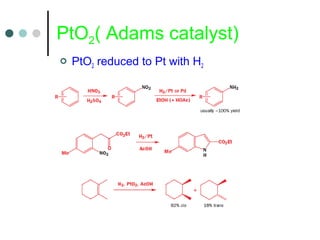
PtO2( Adams catalyst)
   PtO2 reduced to Pt with H2
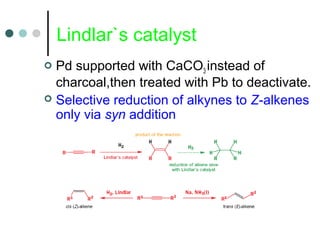
Lindlar`s catalyst
 Pd supported with CaCO3 instead of
  charcoal,then treated with Pb to deactivate.
 Selective reduction of alkynes to Z-alkenes
  only via syn addition
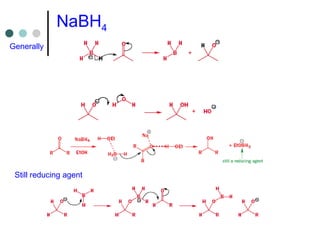
NaBH4
   Selective (chemoselectivity) reagent
   White crystals, safe and easy to handle
   Reduces aldehydes, ketones.
   Can`t reduce esters ,acids, amides
NaBH4
Generally


 Still reducing agent
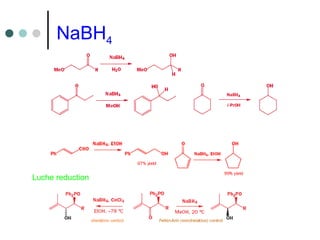
NaBH4


Luche reduction
LiAlH4

   Powerful reducing agent compared to
    NaBH4 due to weaker Al-H bond.
 Pure sample is white but commercially
  is grey????
 Dangerous, reacts violently with water

 Reduce aldehyde, ketones, esters,
  amides and nitro compounds.
LiAlH4
DIBAL
 Selective reagent (alkyne to alkene, ester
  or ketone to aldehyde).
 Specialist reductant of nitrile to aldehyde
Borane
   BH3 gas dissolved in THF or Et2O or DMS
 Selective reducing agent
 Hydroboration is syn addition, highly
  regioselective
Borane Regioselectivity
Borane chemoselectivity
Borane
                      Amide to amine


Dialkyl borane
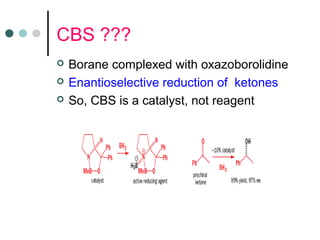
CBS ???
   Borane complexed with oxazoborolidine
   Enantioselective reduction of ketones
   So, CBS is a catalyst, not reagent
CBS ???
 R,R` difference is very important
 High ee, high yield

 Easy recovered
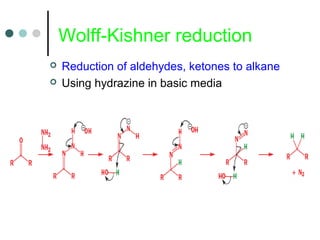
Wolff-Kishner reduction
   Reduction of aldehydes, ketones to alkane
   Using hydrazine in basic media
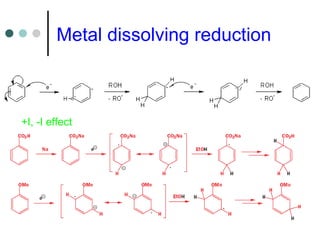
Metal dissolving reduction
   Dissolving Li or Na in NH3 solution
 Birch reduction in case of aromatics
 Good access to cyclohexadienes
Metal dissolving reduction


+I, -I effect
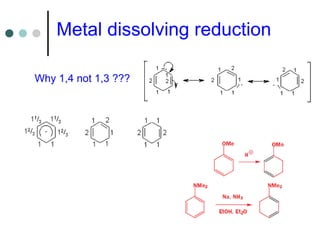
Metal dissolving reduction

Why 1,4 not 1,3 ???
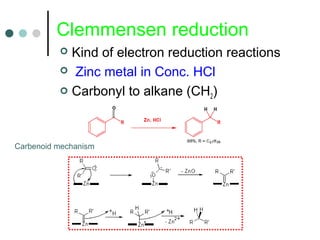
Clemmensen reduction
           Kind of electron reduction reactions
           Zinc metal in Conc. HCl

           Carbonyl to alkane (CH )
                                    2


Carbenoid mechanism
Asymmetric hydrogenation
   Using catalytic amounts of chiral ligands
    with H2.
Asymmetric hydrogenation
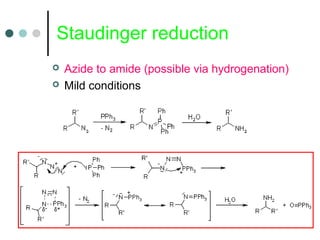
Staudinger reduction
   Azide to amide (possible via hydrogenation)
   Mild conditions

Reduction reactions