MASKED ION BEAM
LITHOGRAPHY
ARUNBALAJI.S
MIBL - INTRODUCTION
• Successing technology of Ion Beam Lithography
• New approach for Biomaterial Patterning
• It allows selected Ion beam to be allowed to fall on
the mask
• Ions of Ca,Mg,Na,P are used as Sources
• Technique of implanting the dopants in the
manufacturing process of semiconductors.
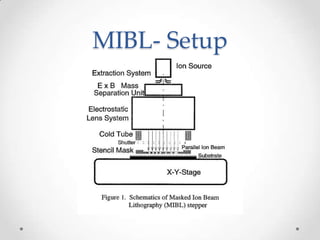
MIBL- Setup
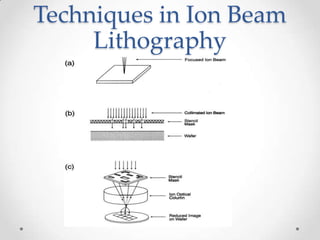
Techniques in Ion Beam
Lithography
• Hydrogen and helium ion beams a extracted from
the suitable ion source.
• M X B mass separation unit is included.
• Proper electrostatic setup is arranged to get the
parallel ion beam
• The Mask is made up of Silicon, copper.
• Ion Beam Induced heating on the mask is avoided
by arrangement of cooling setup for mask
MAJOR TYPES OF ION
SOURCES
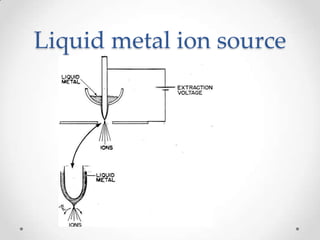
 Liquid metal ion sources
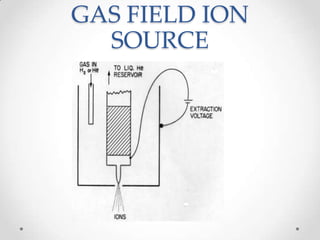
 Gas field ion sources
 Volume Plasma sources
Liquid metal ion source
GAS FIELD ION
SOURCE
Volume plasma Source
• Mostly used in ion implanters, ion milling machines
and other ion accelerators
• Sources of desired ions are introduced as gas.
• Electron bombardment is used to ionize it.
Importance of ion beam
over other techniques
• Nanofabrication without multistep process.
• When a focused beam of ions is traced over a
surface, it removes material to form a trench
approximately equal to the beam diameter.
• rewire integrated circuits by cutting or depositing
metal film conductors.
• useful in the pre-production development phase to
alter a circuit that may not be working because of
a design or fabrication error
Advantages of using ions
over electrons
 Ions are larger than electrons, so less change in
chemical nature of substrate,no x- ray emissions in
the sample.
 Ions are heavier than electrons . So ions gain high
momentum.
 Ion beam milling depends on the how much ions
needed to remove the material, it is independent of
the material’s chemical nature and material
strength.
 Material deposition on the specific sites of the
circuit.
MIBL - ADVANTAGES
• This method overcomes the problems of beam
dispersion and diffraction in the Optical and X-ray
lithographic systems
• It reduces the multiple steps like film
casting, exposure, developing and etching process
as in photolithography.
• The surface chemistry of substrate is tailored better
compared to photolithography.
• PMMA surface modification by calcium and
phosphorous ions are used to create microwells for
biomems devices
•
MIBL -APPLICATIONS
• High Volume gate level printing of Field emitter
Displays(FED).
• Fabrication of surface acousting wave and
microoptic devices.
• Deep trenching reactive ion beam etching in MEMS
and in particular for silicon Microsystems
THANK YOU

Masked ion beam lithography

  • 1.
  • 2.
    MIBL - INTRODUCTION •Successing technology of Ion Beam Lithography • New approach for Biomaterial Patterning • It allows selected Ion beam to be allowed to fall on the mask • Ions of Ca,Mg,Na,P are used as Sources • Technique of implanting the dopants in the manufacturing process of semiconductors.
  • 3.
  • 4.
    Techniques in IonBeam Lithography
  • 5.
    • Hydrogen andhelium ion beams a extracted from the suitable ion source. • M X B mass separation unit is included. • Proper electrostatic setup is arranged to get the parallel ion beam • The Mask is made up of Silicon, copper. • Ion Beam Induced heating on the mask is avoided by arrangement of cooling setup for mask
  • 6.
    MAJOR TYPES OFION SOURCES  Liquid metal ion sources  Gas field ion sources  Volume Plasma sources
  • 7.
  • 8.
  • 9.
    Volume plasma Source •Mostly used in ion implanters, ion milling machines and other ion accelerators • Sources of desired ions are introduced as gas. • Electron bombardment is used to ionize it.
  • 10.
    Importance of ionbeam over other techniques • Nanofabrication without multistep process. • When a focused beam of ions is traced over a surface, it removes material to form a trench approximately equal to the beam diameter. • rewire integrated circuits by cutting or depositing metal film conductors. • useful in the pre-production development phase to alter a circuit that may not be working because of a design or fabrication error
  • 11.
    Advantages of usingions over electrons  Ions are larger than electrons, so less change in chemical nature of substrate,no x- ray emissions in the sample.  Ions are heavier than electrons . So ions gain high momentum.  Ion beam milling depends on the how much ions needed to remove the material, it is independent of the material’s chemical nature and material strength.  Material deposition on the specific sites of the circuit.
  • 12.
    MIBL - ADVANTAGES •This method overcomes the problems of beam dispersion and diffraction in the Optical and X-ray lithographic systems • It reduces the multiple steps like film casting, exposure, developing and etching process as in photolithography. • The surface chemistry of substrate is tailored better compared to photolithography. • PMMA surface modification by calcium and phosphorous ions are used to create microwells for biomems devices •
  • 13.
    MIBL -APPLICATIONS • HighVolume gate level printing of Field emitter Displays(FED). • Fabrication of surface acousting wave and microoptic devices. • Deep trenching reactive ion beam etching in MEMS and in particular for silicon Microsystems
  • 14.