Laser Soldering
Prabodh V Dongre
20MMF0024
1. Laser Soldering
2. Types of laser soldering processes
3. Types of lasers used in soldering
4. Comparison
5. Industrial applications
6. Conclusion
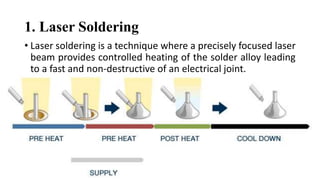
1. Laser Soldering
• Laser soldering is a technique where a precisely focused laser
beam provides controlled heating of the solder alloy leading
to a fast and non-destructive of an electrical joint.
Laser
Soldering
Solder
• Lead Free Solder Wire and Solder Paste are manufactured
using different composition and ratio. But the most popular
and widely used composition and ratio is SAC (Tin Silver
Copper) in the Ratio 96.5% Tin + 3.0% Silver and 0.5%
Copper.
• Used for Laser Soldering
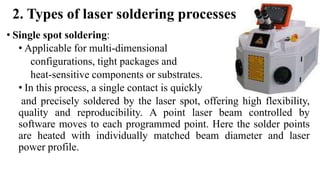
2. Types of laser soldering processes
• Single spot soldering:
• Applicable for multi-dimensional
configurations, tight packages and
heat-sensitive components or substrates.
• In this process, a single contact is quickly
and precisely soldered by the laser spot, offering high flexibility,
quality and reproducibility. A point laser beam controlled by
software moves to each programmed point. Here the solder points
are heated with individually matched beam diameter and laser
power profile.
• Simultaneous soldering:
• This concept allows fast soldering of individual components or
complete connection arrays. Several contact points are radiated and
soldered simultaneously and no relative movement between the
laser beam and the workpiece is necessary. Here line shaped laser
beams are used.
• it allows short cycle times with high output volume.
• Mask soldering:
• for very sensitive substrates or for the
soldering of fine contacts and structure.
• In this process, a mask is placed between
the collimated laser beam which is mostly line
shaped and the target. The mask covers all parts
which should not be exposed to the laser radiation
• The laser beam only passes through the openings
in the mask only where a contact to be soldered lies underneath
which ensures locally confined heating. The areas between the
contact points are protected and no damage is done to the substrate.
• It is fast and precise.
3. Types of lasers used in soldering
• carbon dioxide laser (gas laser),
• Nd:YAG laser (a solid state laser) and
• the semiconductor Laser (diode laser).
Carbon dioxide laser
• It is a gas laser and it has a wavelength of 10.6µm in the far
infrared region
• Reflected from metal surfaces but is strongly absorbed by
flux and the heated flux then in turn transfers heat to the
solder and metal in the joint
• This has an efficiency of up to 20% and is cooled by pumping
the gas through the heat exchanger.
Nd: YAG laser (neodymium-doped
yttrium aluminium garnet)
• This is a solid state laser
• It uses Yttrium aluminum garnet doped with neodymium as a
lasing substance.
• It emits at a wavelength of 1.06µm which is located in the
near infrared region
• Solder absorbs the thermal radiation of 1µm well which
means that the light from the Nd:YAG has a high heating
efficiency
Diode laser
• This is a semiconductor device that directly converts
electrical energy into laser light.
• Based on gallium arsenide (GaAs) and gallium aluminum
arsenide (GaAlAs).
• sometimes called a semiconductor diode offering wavelength
ranging from 790nm to 980nm. The size of diode laser is
small and this makes them easier to be integrated into
workstations.
• The energy density distribution of the laser beam generated
remains uniform through the
• spot regardless of its size.
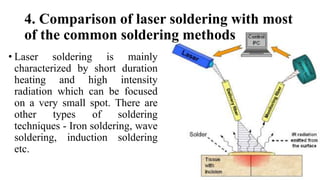
4. Comparison of laser soldering with most
of the common soldering methods
• Laser soldering is mainly
characterized by short duration
heating and high intensity
radiation which can be focused
on a very small spot. There are
other types of soldering
techniques - Iron soldering, wave
soldering, induction soldering
etc.
4.1 Iron Soldering
• Contact heating
• It requires high maintenance since the tips wear with use and
has to be replaced periodically.
• Inexpensive
• Iron’s heat spreads beyond the joint area and so the sensitive
components in close proximity may be destroyed.
• Regular cleaning of the tip to remove flux and oxide build up
• Long processing/soldering time
4.2. Induction Soldering
• It has high energy capacity –Ability to melt
high temperature solders
• Complexity of determining appropriate
settings based on material conductivity
• Nitrogen atmosphere is necessary.
• Appropriate for large scale production
• Flux application is necessary (Flux is a
chemical cleaning agent used before and
during the soldering process of electronic
components onto circuit boards. ... The flux
also protects the metal surfaces from re-
oxidation during soldering)
4.3. Wave Soldering
• The need for nitrogen atmosphere is necessary
• Low cost
• Separate preheating and flux application is necessary
• Appropriate for mass production
• Soldering is from underneath
4.4. Infrared Soldering
• High thermal stress.
• Difficult to heat components that are
in the shadows.
• Uneven heating (temperature
variations) arise in places being
soldered due to component shapes.
• Low cost
• Separate preheating and flux
application is necessary
5. Industrial applications
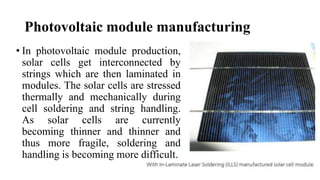
Photovoltaic module manufacturing
• In photovoltaic module production,
solar cells get interconnected by
strings which are then laminated in
modules. The solar cells are stressed
thermally and mechanically during
cell soldering and string handling.
As solar cells are currently
becoming thinner and thinner and
thus more fragile, soldering and
handling is becoming more difficult.
Electronic manufacturing
• Telecommunication equipment industry, miniaturization of
electronic devices in consumer electronics and other
biomedical applications which produces high density
microelectronics with fine-pitch leads and small pad
diameters
Automobile application
• Soldering permits highly automated production system,
providing enormous flexibility for a wide variety of
fabrication tasks at a very high processing speed because it is
a non-contact technique.
• The surface of the solder seam is smooth and clean and
normally requires no refinishing.
• making body parts such as car roofs or trunk lids
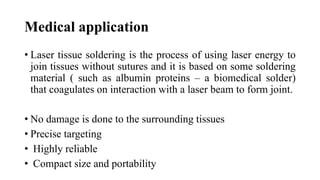
Medical application
• Laser tissue soldering is the process of using laser energy to
join tissues without sutures and it is based on some soldering
material ( such as albumin proteins – a biomedical solder)
that coagulates on interaction with a laser beam to form joint.
• No damage is done to the surrounding tissues
• Precise targeting
• Highly reliable
• Compact size and portability
Conclusion
• The growth of laser soldering is due to its capability to
exploit the high energy enclosed in the ray and focalized only
on the joint, a characteristic which avoids involving the
substrate and nearby components, even with the higher
working temperatures required for lead-free alloys.

Laser soldering

  • 1.
    Laser Soldering Prabodh VDongre 20MMF0024
  • 2.
    1. Laser Soldering 2.Types of laser soldering processes 3. Types of lasers used in soldering 4. Comparison 5. Industrial applications 6. Conclusion
  • 3.
    1. Laser Soldering •Laser soldering is a technique where a precisely focused laser beam provides controlled heating of the solder alloy leading to a fast and non-destructive of an electrical joint.
  • 4.
  • 6.
    Solder • Lead FreeSolder Wire and Solder Paste are manufactured using different composition and ratio. But the most popular and widely used composition and ratio is SAC (Tin Silver Copper) in the Ratio 96.5% Tin + 3.0% Silver and 0.5% Copper. • Used for Laser Soldering
  • 7.
    2. Types oflaser soldering processes • Single spot soldering: • Applicable for multi-dimensional configurations, tight packages and heat-sensitive components or substrates. • In this process, a single contact is quickly and precisely soldered by the laser spot, offering high flexibility, quality and reproducibility. A point laser beam controlled by software moves to each programmed point. Here the solder points are heated with individually matched beam diameter and laser power profile.
  • 8.
    • Simultaneous soldering: •This concept allows fast soldering of individual components or complete connection arrays. Several contact points are radiated and soldered simultaneously and no relative movement between the laser beam and the workpiece is necessary. Here line shaped laser beams are used. • it allows short cycle times with high output volume.
  • 9.
    • Mask soldering: •for very sensitive substrates or for the soldering of fine contacts and structure. • In this process, a mask is placed between the collimated laser beam which is mostly line shaped and the target. The mask covers all parts which should not be exposed to the laser radiation • The laser beam only passes through the openings in the mask only where a contact to be soldered lies underneath which ensures locally confined heating. The areas between the contact points are protected and no damage is done to the substrate. • It is fast and precise.
  • 10.
    3. Types oflasers used in soldering • carbon dioxide laser (gas laser), • Nd:YAG laser (a solid state laser) and • the semiconductor Laser (diode laser).
  • 11.
    Carbon dioxide laser •It is a gas laser and it has a wavelength of 10.6µm in the far infrared region • Reflected from metal surfaces but is strongly absorbed by flux and the heated flux then in turn transfers heat to the solder and metal in the joint • This has an efficiency of up to 20% and is cooled by pumping the gas through the heat exchanger.
  • 12.
    Nd: YAG laser(neodymium-doped yttrium aluminium garnet) • This is a solid state laser • It uses Yttrium aluminum garnet doped with neodymium as a lasing substance. • It emits at a wavelength of 1.06µm which is located in the near infrared region • Solder absorbs the thermal radiation of 1µm well which means that the light from the Nd:YAG has a high heating efficiency
  • 13.
    Diode laser • Thisis a semiconductor device that directly converts electrical energy into laser light. • Based on gallium arsenide (GaAs) and gallium aluminum arsenide (GaAlAs). • sometimes called a semiconductor diode offering wavelength ranging from 790nm to 980nm. The size of diode laser is small and this makes them easier to be integrated into workstations. • The energy density distribution of the laser beam generated remains uniform through the • spot regardless of its size.
  • 14.
    4. Comparison oflaser soldering with most of the common soldering methods • Laser soldering is mainly characterized by short duration heating and high intensity radiation which can be focused on a very small spot. There are other types of soldering techniques - Iron soldering, wave soldering, induction soldering etc.
  • 15.
    4.1 Iron Soldering •Contact heating • It requires high maintenance since the tips wear with use and has to be replaced periodically. • Inexpensive • Iron’s heat spreads beyond the joint area and so the sensitive components in close proximity may be destroyed. • Regular cleaning of the tip to remove flux and oxide build up • Long processing/soldering time
  • 16.
    4.2. Induction Soldering •It has high energy capacity –Ability to melt high temperature solders • Complexity of determining appropriate settings based on material conductivity • Nitrogen atmosphere is necessary. • Appropriate for large scale production • Flux application is necessary (Flux is a chemical cleaning agent used before and during the soldering process of electronic components onto circuit boards. ... The flux also protects the metal surfaces from re- oxidation during soldering)
  • 17.
    4.3. Wave Soldering •The need for nitrogen atmosphere is necessary • Low cost • Separate preheating and flux application is necessary • Appropriate for mass production • Soldering is from underneath
  • 18.
    4.4. Infrared Soldering •High thermal stress. • Difficult to heat components that are in the shadows. • Uneven heating (temperature variations) arise in places being soldered due to component shapes. • Low cost • Separate preheating and flux application is necessary
  • 19.
  • 20.
    Photovoltaic module manufacturing •In photovoltaic module production, solar cells get interconnected by strings which are then laminated in modules. The solar cells are stressed thermally and mechanically during cell soldering and string handling. As solar cells are currently becoming thinner and thinner and thus more fragile, soldering and handling is becoming more difficult.
  • 21.
    Electronic manufacturing • Telecommunicationequipment industry, miniaturization of electronic devices in consumer electronics and other biomedical applications which produces high density microelectronics with fine-pitch leads and small pad diameters
  • 22.
    Automobile application • Solderingpermits highly automated production system, providing enormous flexibility for a wide variety of fabrication tasks at a very high processing speed because it is a non-contact technique. • The surface of the solder seam is smooth and clean and normally requires no refinishing. • making body parts such as car roofs or trunk lids
  • 23.
    Medical application • Lasertissue soldering is the process of using laser energy to join tissues without sutures and it is based on some soldering material ( such as albumin proteins – a biomedical solder) that coagulates on interaction with a laser beam to form joint. • No damage is done to the surrounding tissues • Precise targeting • Highly reliable • Compact size and portability
  • 24.
    Conclusion • The growthof laser soldering is due to its capability to exploit the high energy enclosed in the ray and focalized only on the joint, a characteristic which avoids involving the substrate and nearby components, even with the higher working temperatures required for lead-free alloys.