BIOPOLYMER
NeethuAsokan
CONTENTS
 Introduction of polymers.
 Biodegradable polymers.
 Classification of biodegradable polymers.
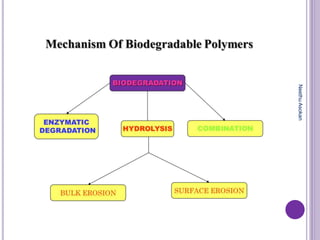
 Polymer Degradation mechanisms
a) Bioerosion mechanism.
b) Enzymatic or chemical degradation.
 Synthetic biodegradable polymers.
 Natural biodegradable polymers.
 Factors affecting biodegradation of polymers.
 Applications of biodegradable polymers.
 Conclusion.
 References.
NeethuAsokan
BIOPOLYMER
 The term "polymer" derives from the ancient Greek word
polus, meaning "many, much" and meros meaning "parts", and
refers to a molecule whose structure is composed of multiple
repeating units.
 The term was coined in 1833 by Jons Jacob Berzelius.
 Biopolymers are polymers produced by living organisms.
 Since they are polymers, biopolymers contain monomeric
units that are covalently bonded to form larger structures.
NeethuAsokan
BIOPOLYMERS AS MATERIALS
 Some biopolymers- such as Polylactic acid (PLA),
naturally occurring, and poly-3-hydroxybutyrate (PHB)
can be used as plastics, replacing the need for polystyrene
or polyethylene based plastics.
 Some plastics are now referred to as being 'degradable',
'oxy-degradable' or 'UV-degradable'. This means that they
break down when exposed to light or air, but these plastics
are still primarily (as much as 98 per cent) oil-based and are
not currently certified as 'biodegradable' under certain
international laws.
 Biopolymers, however, will break down and some are
suitable for domestic composting.
NeethuAsokan
BIODEGRADABLE POLYMERS
 Biodegradable polymers are defined as polymers
comprised of monomers linked to one another
through functional groups and have unstable links in
the backbone.
 They are broken down into biologically acceptable
molecules that are metabolized and removed from
the body via normal metabolic pathways.
 Based on biodegradability polymers are classified as:
1. Biodegradable polymers
eg: collagen, poly glycolic acid etc.,
2. Non biodegradable polymers
eg: poly vinyl chloride, polyethylene etc.,
NeethuAsokan
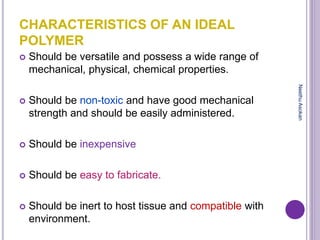
CHARACTERISTICS OF AN IDEAL
POLYMER
 Should be versatile and possess a wide range of
mechanical, physical, chemical properties.
 Should be non-toxic and have good mechanical
strength and should be easily administered.
 Should be inexpensive
 Should be easy to fabricate.
 Should be inert to host tissue and compatible with
environment.
NeethuAsokan
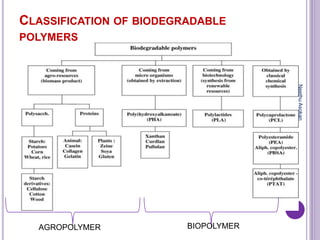
CLASSIFICATION OF BIODEGRADABLE
POLYMERS
BIOPOLYMERAGROPOLYMER
NeethuAsokan
NeethuAsokan
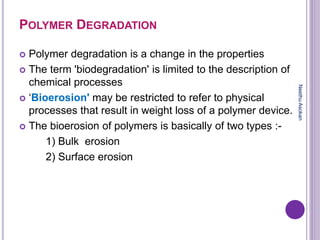
POLYMER DEGRADATION
 Polymer degradation is a change in the properties
 The term 'biodegradation' is limited to the description of
chemical processes
 ‘Bioerosion' may be restricted to refer to physical
processes that result in weight loss of a polymer device.
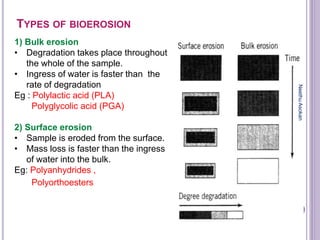
 The bioerosion of polymers is basically of two types :-
1) Bulk erosion
2) Surface erosion
NeethuAsokan
TYPES OF BIOEROSION
1) Bulk erosion
• Degradation takes place throughout
the whole of the sample.
• Ingress of water is faster than the
rate of degradation
Eg : Polylactic acid (PLA)
Polyglycolic acid (PGA)
2) Surface erosion
• Sample is eroded from the surface.
• Mass loss is faster than the ingress
of water into the bulk.
Eg: Polyanhydrides ,
Polyorthoesters
NeethuAsokan
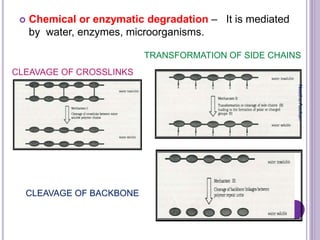
 Chemical or enzymatic degradation – It is mediated
by water, enzymes, microorganisms.
TRANSFORMATION OF SIDE CHAINS
CLEAVAGE OF CROSSLINKS
CLEAVAGE OF BACKBONE
NeethuAsokan
CLASSIFICATION OF BIODEGRADABLE
POLYMERS BASED ON THE SOURCE
1) Synthetic biodegradable polymers:
eg: Aliphatic poly(esters)
Polyanhydrides
Polyphosphazenes
polyaminoacids
Poly orthoesters etc.,
2) Natural biodegradable polymers:
eg: Albumin
Collagen
Dextran
Gelatin
Pectin, starch etc.,
NeethuAsokan
SYNTHETIC BIODEGRADABLE POLYMERS
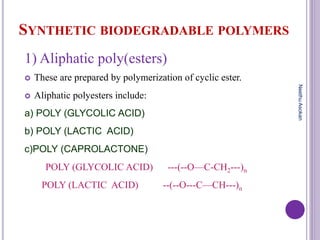
1) Aliphatic poly(esters)
 These are prepared by polymerization of cyclic ester.
 Aliphatic polyesters include:
a) POLY (GLYCOLIC ACID)
b) POLY (LACTIC ACID)
c)POLY (CAPROLACTONE)
POLY (GLYCOLIC ACID) ---(--O—C-CH2---)n
POLY (LACTIC ACID) --(--O---C—CH---)n
NeethuAsokan
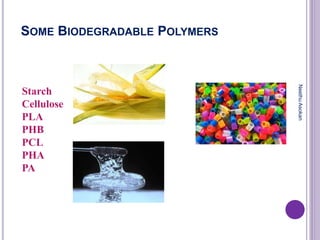
SOME BIODEGRADABLE POLYMERS
Starch
Cellulose
PLA
PHB
PCL
PHA
PA
NeethuAsokan
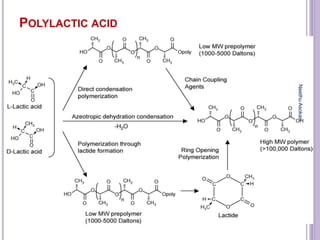
POLYLACTIC ACID
 Poly(lactic acid) or polylactide (PLA) is a thermoplastic
aliphatic polyester commonly derived from renewable
resources, such as
• corn starch (in the United States),
• tapioca products (roots, chips or starch mostly in Asia) or
• sugarcanes (in the rest of world).
 It can biodegrade under certain conditions, such as the
presence of oxygen, and is difficult to recycle.
NeethuAsokan
POLYGLYCOLIC ACID
 Biodegradable, thermoplastic polymer and the simplest
linear, aliphatic polyester.
 It is a tough fibre-forming polymer.
 Due to its hydrolytic instability its use has been limited.
 It has a glass transition elevated degree of temperature
between 35-40ºC., crystallinity, around 45ºC.
 Degraded by hydrolysis, and broken down by certain
enzymes.
Applications
 Used to deliver drugs in the form of microspheres, implants
etc.,
 Examples of drugs delivered include steroid hormones,
antibiotics, anti cancer agents etc.,
NeethuAsokan
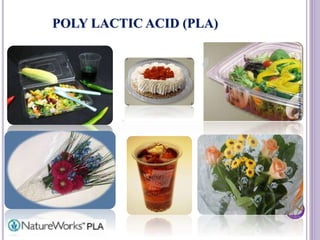
POLY LACTIC ACID (PLA)
NeethuAsokan
POLYLACTIC ACID
NeethuAsokan
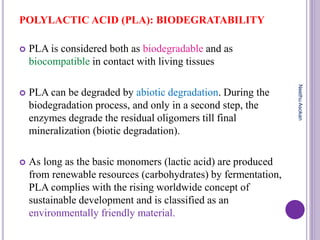
POLYLACTIC ACID (PLA): BIODEGRATABILITY
 PLA is considered both as biodegradable and as
biocompatible in contact with living tissues
 PLA can be degraded by abiotic degradation. During the
biodegradation process, and only in a second step, the
enzymes degrade the residual oligomers till final
mineralization (biotic degradation).
 As long as the basic monomers (lactic acid) are produced
from renewable resources (carbohydrates) by fermentation,
PLA complies with the rising worldwide concept of
sustainable development and is classified as an
environmentally friendly material.
NeethuAsokan
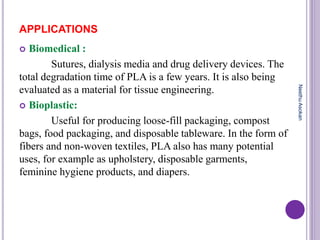
APPLICATIONS
 Biomedical :
Sutures, dialysis media and drug delivery devices. The
total degradation time of PLA is a few years. It is also being
evaluated as a material for tissue engineering.
 Bioplastic:
Useful for producing loose-fill packaging, compost
bags, food packaging, and disposable tableware. In the form of
fibers and non-woven textiles, PLA also has many potential
uses, for example as upholstery, disposable garments,
feminine hygiene products, and diapers.
NeethuAsokan
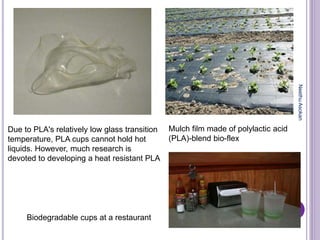
Due to PLA's relatively low glass transition
temperature, PLA cups cannot hold hot
liquids. However, much research is
devoted to developing a heat resistant PLA
Mulch film made of polylactic acid
(PLA)-blend bio-flex
Biodegradable cups at a restaurant
NeethuAsokan
NeethuAsokan
BIOPLASTICS FROM MICROORGANISMS
Benefits
• 100 % biodegradable
• Produced from natural,
renewable resources
• Able to be recycled,
composted or burned
without producing toxic
byproducts
Degradable polymers that are naturally degraded by
the action of microorganisms such as bacteria, fungi
and algae
NeethuAsokan
NeethuAsokan
NeethuAsokan
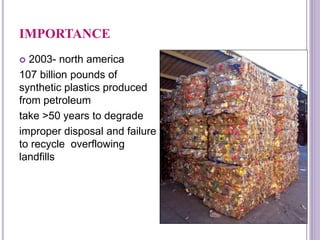
IMPORTANCE
 2003- north america
107 billion pounds of
synthetic plastics produced
from petroleum
take >50 years to degrade
improper disposal and failure
to recycle overflowing
landfills
NeethuAsokan
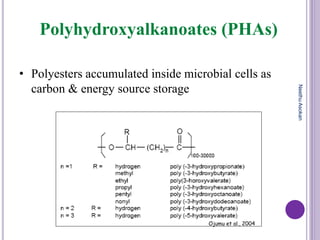
Polyhydroxyalkanoates (PHAs)
• Polyesters accumulated inside microbial cells as
carbon & energy source storage
Ojumu et al., 2004
NeethuAsokan
Polyhydroxyalkanoates (PHAs)
• Produced under conditions of:
– Low limiting nutrients (P, S, N, O)
– Excess carbon
 2 different types:
 Short-chain-length 3-5 Carbons
 Medium-chain-length 6-14 Carbons
 ~250 different bacteria have been found to produce
some form of PHAs
NeethuAsokan
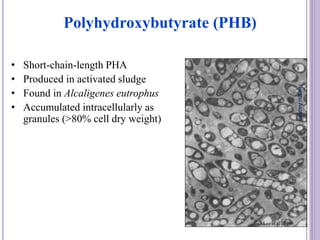
Polyhydroxybutyrate (PHB)
• Short-chain-length PHA
• Produced in activated sludge
• Found in Alcaligenes eutrophus
• Accumulated intracellularly as
granules (>80% cell dry weight)
Lee et al., 1996
NeethuAsokan
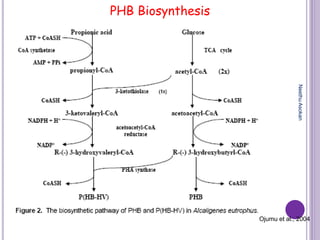
PHB Biosynthesis
Ojumu et al., 2004
NeethuAsokan
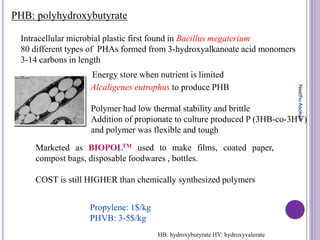
PHB: polyhydroxybutyrate
Intracellular microbial plastic first found in Bacillus megaterium
80 different types of PHAs formed from 3-hydroxyalkanoate acid monomers
3-14 carbons in length
Energy store when nutrient is limited
Alcaligenes eutrophus to produce PHB
Polymer had low thermal stability and brittle
Addition of propionate to culture produced P (3HB-co-3HV)
and polymer was flexible and tough
HB: hydroxybutyrate HV: hydroxyvalerate
Marketed as BIOPOLTM used to make films, coated paper,
compost bags, disposable foodwares , bottles.
COST is still HIGHER than chemically synthesized polymers
Propylene: 1$/kg
PHVB: 3-5$/kg
NeethuAsokan
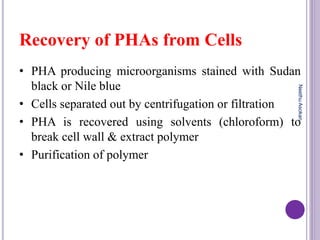
Recovery of PHAs from Cells
• PHA producing microorganisms stained with Sudan
black or Nile blue
• Cells separated out by centrifugation or filtration
• PHA is recovered using solvents (chloroform) to
break cell wall & extract polymer
• Purification of polymer
NeethuAsokan
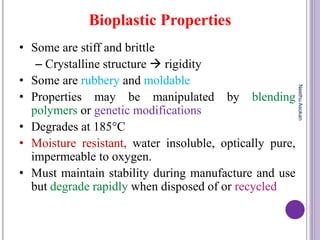
Bioplastic Properties
• Some are stiff and brittle
– Crystalline structure  rigidity
• Some are rubbery and moldable
• Properties may be manipulated by blending
polymers or genetic modifications
• Degrades at 185°C
• Moisture resistant, water insoluble, optically pure,
impermeable to oxygen.
• Must maintain stability during manufacture and use
but degrade rapidly when disposed of or recycled
NeethuAsokan
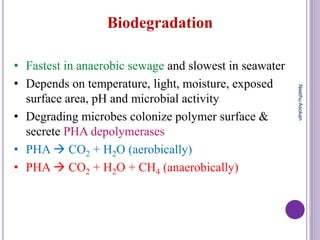
Biodegradation
• Fastest in anaerobic sewage and slowest in seawater
• Depends on temperature, light, moisture, exposed
surface area, pH and microbial activity
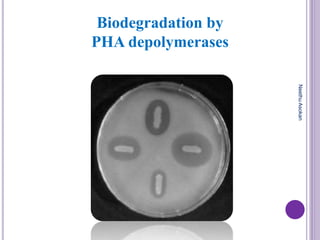
• Degrading microbes colonize polymer surface &
secrete PHA depolymerases
• PHA  CO2 + H2O (aerobically)
• PHA  CO2 + H2O + CH4 (anaerobically)
NeethuAsokan
Biodegradation by
PHA depolymerases
NeethuAsokan
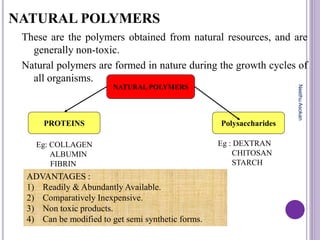
NATURAL POLYMERS
These are the polymers obtained from natural resources, and are
generally non-toxic.
Natural polymers are formed in nature during the growth cycles of
all organisms.
NATURAL POLYMERS
PROTEINS Polysaccharides
Eg: COLLAGEN
ALBUMIN
FIBRIN
Eg : DEXTRAN
CHITOSAN
STARCH
ADVANTAGES :
1) Readily & Abundantly Available.
2) Comparatively Inexpensive.
3) Non toxic products.
4) Can be modified to get semi synthetic forms.
NeethuAsokan
FACTORS AFFECTING BIODEGRADATION OF
POLYMERS
 Morphological factors
 Shape & size
 Variation of diffusion coefficient and mechanical stresses
 Chemical factors
 Chemical structure & composition
 Presence of ionic group and configuration structure
 Molecular weight and presence of low molecular weight
compounds
 Physical factors
 Processing condition
 Sterilization process
NeethuAsokan
CURRENT TRENDS IN BIOPOLYMER
 This study on biopolymers market estimates the
global demand for biopolymers and market value
for 2012 and projects the expected demand and
market value of the same by 2018.
 As a part of quantitative analysis, the study
segments the global market by type, application
and geography with current market estimation and
forecast till 2018.
 The segmentation by type includes bio-PET, bio-
PE, PLA, PHA, bio-PBS, starch blends, and
regenerated cellulose; while on the basis of its
application the segmentation includes packaging,
bottles, fibers, agriculture, automotive, injection
molding and others.
NeethuAsokan
APPLICATIONS OF BIODEGRADABLE POLYMERS
 Biodegradable polymer for ocular, tissue engineering, vascular,
orthopedic, skin adhesive & surgical glues.
 Bio degradable drug system for therapeutic agents such as anti
tumor, anti-inflammatory agent.
 Polymeric materials are used in and on soil to improve aeration, and
promote plant growth and health.
 Many biomaterials, especially heart valve replacements and blood
vessels, are made of polymers like Dacron, Teflon and polyurethane.
NeethuAsokan
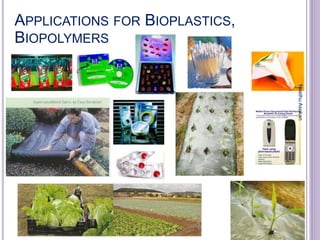
APPLICATIONS FOR BIOPLASTICS,
BIOPOLYMERS
AGRICULTURE
NeethuAsokan
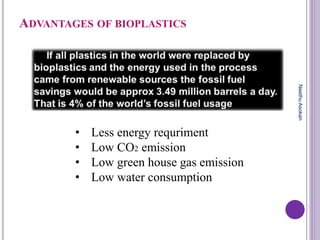
ADVANTAGES OF BIOPLASTICS
• Less energy requriment
• Low CO2 emission
• Low green house gas emission
• Low water consumption
NeethuAsokan
ADVANTAGES OF BIOPOLYMERS
 Localized delivery of drug
 Sustained delivery of drug
 Stabilization of drug
 Decrease in dosing frequency
 Reduce side effects
 Improved patient compliance
 Controllable degradation rate
NeethuAsokan
DISADVANTAGE
 Bioplastics don't always readily decompose. Some need
relatively high temperatures and can still take many years to
break down. Even then, they may leave behind toxic residues.
 Bioplastics are made from plants such as corn and maize, so
land that could be used to grow food for the world is being
used to "grow plastic" instead.
 Some bioplastics, such as PLA, are made from genetically
modified corn.
 Bioplastics cannot be easily recycled. To most people, PLA
looks very similar to PET but, if the two are mixed up in a
recycling bin, the whole collection becomes impossible to
recycle.
NeethuAsokan
 Numerous synthetic biodegradable polymers are available
and still being developed for sustained and targeted drug
delivery applications.
 Biodegradable polymers have proven their potential for the
development of new, advanced and efficient DDS and
capable of delivering a wide range of bioactive materials.
 However, only few have entered the market since many
drugs faces the problem of sensitivity to heat, shear forces
and interaction between polymers.
 These problems can be overcome by fully understanding
the degradation mechanism to adjust the release profile.
Conclusion
NeethuAsokan
REFERENCES
 Biotechnology/ U.Sathyanarayana.
 A text book of biotechnology/R.C.Dubey &
Maheshwari.
 Biodegradable polymers.ppt
 Bioplastic.1.ppt
 Recent Developments in Biopolymers/Vicki Flaris,
Gurpreet Singh(2009).
 Biopolymers in Medical Applications: Senthil S.
Kumar.
 www.bioplastics24.com
NeethuAsokan
NeethuAsokan

Biopolymer

  • 1.
  • 2.
    CONTENTS  Introduction ofpolymers.  Biodegradable polymers.  Classification of biodegradable polymers.  Polymer Degradation mechanisms a) Bioerosion mechanism. b) Enzymatic or chemical degradation.  Synthetic biodegradable polymers.  Natural biodegradable polymers.  Factors affecting biodegradation of polymers.  Applications of biodegradable polymers.  Conclusion.  References. NeethuAsokan
  • 3.
    BIOPOLYMER  The term"polymer" derives from the ancient Greek word polus, meaning "many, much" and meros meaning "parts", and refers to a molecule whose structure is composed of multiple repeating units.  The term was coined in 1833 by Jons Jacob Berzelius.  Biopolymers are polymers produced by living organisms.  Since they are polymers, biopolymers contain monomeric units that are covalently bonded to form larger structures. NeethuAsokan
  • 4.
    BIOPOLYMERS AS MATERIALS Some biopolymers- such as Polylactic acid (PLA), naturally occurring, and poly-3-hydroxybutyrate (PHB) can be used as plastics, replacing the need for polystyrene or polyethylene based plastics.  Some plastics are now referred to as being 'degradable', 'oxy-degradable' or 'UV-degradable'. This means that they break down when exposed to light or air, but these plastics are still primarily (as much as 98 per cent) oil-based and are not currently certified as 'biodegradable' under certain international laws.  Biopolymers, however, will break down and some are suitable for domestic composting. NeethuAsokan
  • 5.
    BIODEGRADABLE POLYMERS  Biodegradablepolymers are defined as polymers comprised of monomers linked to one another through functional groups and have unstable links in the backbone.  They are broken down into biologically acceptable molecules that are metabolized and removed from the body via normal metabolic pathways.  Based on biodegradability polymers are classified as: 1. Biodegradable polymers eg: collagen, poly glycolic acid etc., 2. Non biodegradable polymers eg: poly vinyl chloride, polyethylene etc., NeethuAsokan
  • 6.
    CHARACTERISTICS OF ANIDEAL POLYMER  Should be versatile and possess a wide range of mechanical, physical, chemical properties.  Should be non-toxic and have good mechanical strength and should be easily administered.  Should be inexpensive  Should be easy to fabricate.  Should be inert to host tissue and compatible with environment. NeethuAsokan
  • 7.
  • 8.
  • 9.
    POLYMER DEGRADATION  Polymerdegradation is a change in the properties  The term 'biodegradation' is limited to the description of chemical processes  ‘Bioerosion' may be restricted to refer to physical processes that result in weight loss of a polymer device.  The bioerosion of polymers is basically of two types :- 1) Bulk erosion 2) Surface erosion NeethuAsokan
  • 10.
    TYPES OF BIOEROSION 1)Bulk erosion • Degradation takes place throughout the whole of the sample. • Ingress of water is faster than the rate of degradation Eg : Polylactic acid (PLA) Polyglycolic acid (PGA) 2) Surface erosion • Sample is eroded from the surface. • Mass loss is faster than the ingress of water into the bulk. Eg: Polyanhydrides , Polyorthoesters NeethuAsokan
  • 11.
     Chemical orenzymatic degradation – It is mediated by water, enzymes, microorganisms. TRANSFORMATION OF SIDE CHAINS CLEAVAGE OF CROSSLINKS CLEAVAGE OF BACKBONE NeethuAsokan
  • 12.
    CLASSIFICATION OF BIODEGRADABLE POLYMERSBASED ON THE SOURCE 1) Synthetic biodegradable polymers: eg: Aliphatic poly(esters) Polyanhydrides Polyphosphazenes polyaminoacids Poly orthoesters etc., 2) Natural biodegradable polymers: eg: Albumin Collagen Dextran Gelatin Pectin, starch etc., NeethuAsokan
  • 13.
    SYNTHETIC BIODEGRADABLE POLYMERS 1)Aliphatic poly(esters)  These are prepared by polymerization of cyclic ester.  Aliphatic polyesters include: a) POLY (GLYCOLIC ACID) b) POLY (LACTIC ACID) c)POLY (CAPROLACTONE) POLY (GLYCOLIC ACID) ---(--O—C-CH2---)n POLY (LACTIC ACID) --(--O---C—CH---)n NeethuAsokan
  • 14.
  • 15.
    POLYLACTIC ACID  Poly(lacticacid) or polylactide (PLA) is a thermoplastic aliphatic polyester commonly derived from renewable resources, such as • corn starch (in the United States), • tapioca products (roots, chips or starch mostly in Asia) or • sugarcanes (in the rest of world).  It can biodegrade under certain conditions, such as the presence of oxygen, and is difficult to recycle. NeethuAsokan
  • 16.
    POLYGLYCOLIC ACID  Biodegradable,thermoplastic polymer and the simplest linear, aliphatic polyester.  It is a tough fibre-forming polymer.  Due to its hydrolytic instability its use has been limited.  It has a glass transition elevated degree of temperature between 35-40ºC., crystallinity, around 45ºC.  Degraded by hydrolysis, and broken down by certain enzymes. Applications  Used to deliver drugs in the form of microspheres, implants etc.,  Examples of drugs delivered include steroid hormones, antibiotics, anti cancer agents etc., NeethuAsokan
  • 17.
    POLY LACTIC ACID(PLA) NeethuAsokan
  • 18.
  • 19.
    POLYLACTIC ACID (PLA):BIODEGRATABILITY  PLA is considered both as biodegradable and as biocompatible in contact with living tissues  PLA can be degraded by abiotic degradation. During the biodegradation process, and only in a second step, the enzymes degrade the residual oligomers till final mineralization (biotic degradation).  As long as the basic monomers (lactic acid) are produced from renewable resources (carbohydrates) by fermentation, PLA complies with the rising worldwide concept of sustainable development and is classified as an environmentally friendly material. NeethuAsokan
  • 20.
    APPLICATIONS  Biomedical : Sutures,dialysis media and drug delivery devices. The total degradation time of PLA is a few years. It is also being evaluated as a material for tissue engineering.  Bioplastic: Useful for producing loose-fill packaging, compost bags, food packaging, and disposable tableware. In the form of fibers and non-woven textiles, PLA also has many potential uses, for example as upholstery, disposable garments, feminine hygiene products, and diapers. NeethuAsokan
  • 21.
    Due to PLA'srelatively low glass transition temperature, PLA cups cannot hold hot liquids. However, much research is devoted to developing a heat resistant PLA Mulch film made of polylactic acid (PLA)-blend bio-flex Biodegradable cups at a restaurant NeethuAsokan
  • 22.
  • 23.
    BIOPLASTICS FROM MICROORGANISMS Benefits •100 % biodegradable • Produced from natural, renewable resources • Able to be recycled, composted or burned without producing toxic byproducts Degradable polymers that are naturally degraded by the action of microorganisms such as bacteria, fungi and algae NeethuAsokan
  • 24.
  • 25.
  • 26.
    IMPORTANCE  2003- northamerica 107 billion pounds of synthetic plastics produced from petroleum take >50 years to degrade improper disposal and failure to recycle overflowing landfills NeethuAsokan
  • 27.
    Polyhydroxyalkanoates (PHAs) • Polyestersaccumulated inside microbial cells as carbon & energy source storage Ojumu et al., 2004 NeethuAsokan
  • 28.
    Polyhydroxyalkanoates (PHAs) • Producedunder conditions of: – Low limiting nutrients (P, S, N, O) – Excess carbon  2 different types:  Short-chain-length 3-5 Carbons  Medium-chain-length 6-14 Carbons  ~250 different bacteria have been found to produce some form of PHAs NeethuAsokan
  • 29.
    Polyhydroxybutyrate (PHB) • Short-chain-lengthPHA • Produced in activated sludge • Found in Alcaligenes eutrophus • Accumulated intracellularly as granules (>80% cell dry weight) Lee et al., 1996 NeethuAsokan
  • 30.
    PHB Biosynthesis Ojumu etal., 2004 NeethuAsokan
  • 31.
    PHB: polyhydroxybutyrate Intracellular microbialplastic first found in Bacillus megaterium 80 different types of PHAs formed from 3-hydroxyalkanoate acid monomers 3-14 carbons in length Energy store when nutrient is limited Alcaligenes eutrophus to produce PHB Polymer had low thermal stability and brittle Addition of propionate to culture produced P (3HB-co-3HV) and polymer was flexible and tough HB: hydroxybutyrate HV: hydroxyvalerate Marketed as BIOPOLTM used to make films, coated paper, compost bags, disposable foodwares , bottles. COST is still HIGHER than chemically synthesized polymers Propylene: 1$/kg PHVB: 3-5$/kg NeethuAsokan
  • 32.
    Recovery of PHAsfrom Cells • PHA producing microorganisms stained with Sudan black or Nile blue • Cells separated out by centrifugation or filtration • PHA is recovered using solvents (chloroform) to break cell wall & extract polymer • Purification of polymer NeethuAsokan
  • 33.
    Bioplastic Properties • Someare stiff and brittle – Crystalline structure  rigidity • Some are rubbery and moldable • Properties may be manipulated by blending polymers or genetic modifications • Degrades at 185°C • Moisture resistant, water insoluble, optically pure, impermeable to oxygen. • Must maintain stability during manufacture and use but degrade rapidly when disposed of or recycled NeethuAsokan
  • 34.
    Biodegradation • Fastest inanaerobic sewage and slowest in seawater • Depends on temperature, light, moisture, exposed surface area, pH and microbial activity • Degrading microbes colonize polymer surface & secrete PHA depolymerases • PHA  CO2 + H2O (aerobically) • PHA  CO2 + H2O + CH4 (anaerobically) NeethuAsokan
  • 35.
  • 36.
    NATURAL POLYMERS These arethe polymers obtained from natural resources, and are generally non-toxic. Natural polymers are formed in nature during the growth cycles of all organisms. NATURAL POLYMERS PROTEINS Polysaccharides Eg: COLLAGEN ALBUMIN FIBRIN Eg : DEXTRAN CHITOSAN STARCH ADVANTAGES : 1) Readily & Abundantly Available. 2) Comparatively Inexpensive. 3) Non toxic products. 4) Can be modified to get semi synthetic forms. NeethuAsokan
  • 37.
    FACTORS AFFECTING BIODEGRADATIONOF POLYMERS  Morphological factors  Shape & size  Variation of diffusion coefficient and mechanical stresses  Chemical factors  Chemical structure & composition  Presence of ionic group and configuration structure  Molecular weight and presence of low molecular weight compounds  Physical factors  Processing condition  Sterilization process NeethuAsokan
  • 38.
    CURRENT TRENDS INBIOPOLYMER  This study on biopolymers market estimates the global demand for biopolymers and market value for 2012 and projects the expected demand and market value of the same by 2018.  As a part of quantitative analysis, the study segments the global market by type, application and geography with current market estimation and forecast till 2018.  The segmentation by type includes bio-PET, bio- PE, PLA, PHA, bio-PBS, starch blends, and regenerated cellulose; while on the basis of its application the segmentation includes packaging, bottles, fibers, agriculture, automotive, injection molding and others. NeethuAsokan
  • 39.
    APPLICATIONS OF BIODEGRADABLEPOLYMERS  Biodegradable polymer for ocular, tissue engineering, vascular, orthopedic, skin adhesive & surgical glues.  Bio degradable drug system for therapeutic agents such as anti tumor, anti-inflammatory agent.  Polymeric materials are used in and on soil to improve aeration, and promote plant growth and health.  Many biomaterials, especially heart valve replacements and blood vessels, are made of polymers like Dacron, Teflon and polyurethane. NeethuAsokan
  • 40.
  • 41.
    ADVANTAGES OF BIOPLASTICS •Less energy requriment • Low CO2 emission • Low green house gas emission • Low water consumption NeethuAsokan
  • 42.
    ADVANTAGES OF BIOPOLYMERS Localized delivery of drug  Sustained delivery of drug  Stabilization of drug  Decrease in dosing frequency  Reduce side effects  Improved patient compliance  Controllable degradation rate NeethuAsokan
  • 43.
    DISADVANTAGE  Bioplastics don'talways readily decompose. Some need relatively high temperatures and can still take many years to break down. Even then, they may leave behind toxic residues.  Bioplastics are made from plants such as corn and maize, so land that could be used to grow food for the world is being used to "grow plastic" instead.  Some bioplastics, such as PLA, are made from genetically modified corn.  Bioplastics cannot be easily recycled. To most people, PLA looks very similar to PET but, if the two are mixed up in a recycling bin, the whole collection becomes impossible to recycle. NeethuAsokan
  • 44.
     Numerous syntheticbiodegradable polymers are available and still being developed for sustained and targeted drug delivery applications.  Biodegradable polymers have proven their potential for the development of new, advanced and efficient DDS and capable of delivering a wide range of bioactive materials.  However, only few have entered the market since many drugs faces the problem of sensitivity to heat, shear forces and interaction between polymers.  These problems can be overcome by fully understanding the degradation mechanism to adjust the release profile. Conclusion NeethuAsokan
  • 45.
    REFERENCES  Biotechnology/ U.Sathyanarayana. A text book of biotechnology/R.C.Dubey & Maheshwari.  Biodegradable polymers.ppt  Bioplastic.1.ppt  Recent Developments in Biopolymers/Vicki Flaris, Gurpreet Singh(2009).  Biopolymers in Medical Applications: Senthil S. Kumar.  www.bioplastics24.com NeethuAsokan
  • 46.