Poly Lactic
       Acid
Towards sustainable packaging
                Gioacchino dell'Aquila
                      Food Engineering MSc
                   İstanbul Aydın Üniversitesi
Background

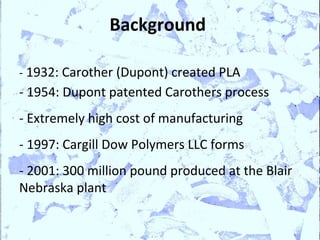
- 1932: Carother (Dupont) created PLA
- 1954: Dupont patented Carothers process
- Extremely high cost of manufacturing
- 1997: Cargill Dow Polymers LLC forms
- 2001: 300 million pound produced at the Blair
Nebraska plant
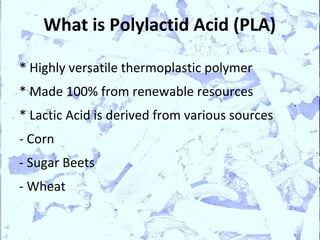
What is Polylactid Acid (PLA)

* Highly versatile thermoplastic polymer
* Made 100% from renewable resources
* Lactic Acid is derived from various sources
- Corn
- Sugar Beets
- Wheat
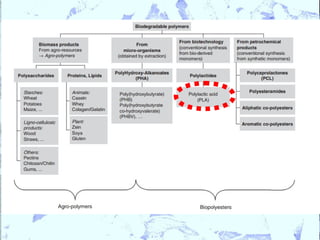
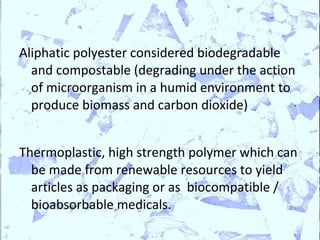
Aliphatic polyester considered biodegradable
  and compostable (degrading under the action
  of microorganism in a humid environment to
  produce biomass and carbon dioxide)


Thermoplastic, high strength polymer which can
  be made from renewable resources to yield
  articles as packaging or as biocompatible /
  bioabsorbable medicals.
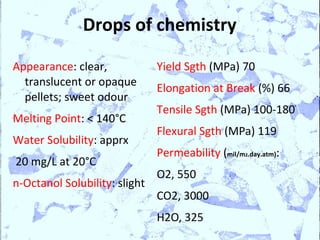
Drops of chemistry

Appearance: clear,             Yield Sgth (MPa) 70
  translucent or opaque
                               Elongation at Break (%) 66
  pellets; sweet odour
                               Tensile Sgth (MPa) 100-180
Melting Point: < 140°C
                               Flexural Sgth (MPa) 119
Water Solubility: apprx
                               Permeability (mil/m .day.atm):
                                                    2
20 mg/L at 20°C
                               O2, 550
n-Octanol Solubility: slight
                               CO2, 3000
                               H2O, 325
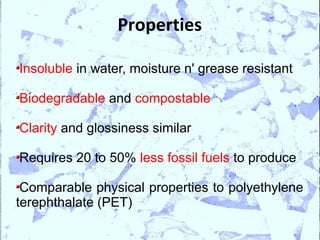
Properties

Insoluble in water, moisture n' grease resistant

Biodegradable and compostable

Clarity and glossiness similar

Requires 20 to 50% less fossil fuels to produce

 Comparable physical properties to polyethylene
terephthalate (PET)
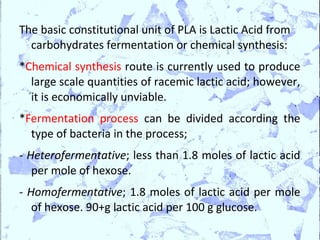
The basic constitutional unit of PLA is Lactic Acid from
  carbohydrates fermentation or chemical synthesis:
*Chemical synthesis route is currently used to produce
  large scale quantities of racemic lactic acid; however,
  it is economically unviable.
*Fermentation process can be divided according the
  type of bacteria in the process;
- Heterofermentative; less than 1.8 moles of lactic acid
   per mole of hexose.
- Homofermentative; 1.8 moles of lactic acid per mole
   of hexose. 90+g lactic acid per 100 g glucose.
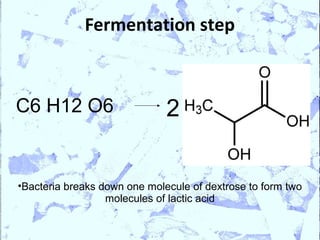
Fermentation step


C6 H12 O6                     2


•Bacteria breaks down one molecule of dextrose to form two
                  molecules of lactic acid
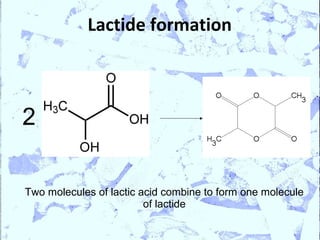
Lactide formation


2

Two molecules of lactic acid combine to form one molecule
                         of lactide
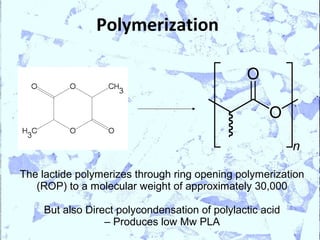
Polymerization


The lactide polymerizes through ring opening polymerization
   (ROP) to a molecular weight of approximately 30,000

     But also Direct polycondensation of polylactic acid
                  – Produces low Mw PLA
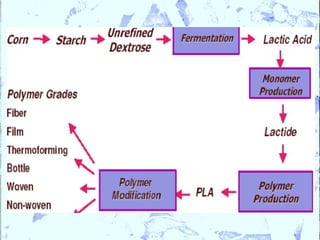
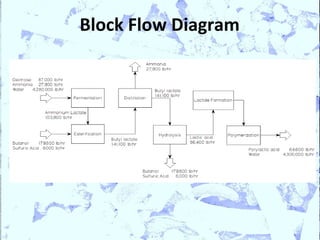
Block Flow Diagram
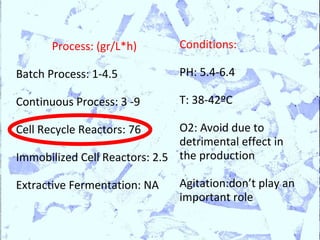
Process: (gr/L*h)       Conditions:

Batch Process: 1-4.5           PH: 5.4-6.4

Continuous Process: 3 -9       T: 38-42ºC

Cell Recycle Reactors: 76      O2: Avoid due to
                               detrimental effect in
Immobilized Cell Reactors: 2.5 the production

Extractive Fermentation: NA    Agitation:don’t play an
                               important role
Continuous reactor

Into the bioreactor at the same time fresh media is
   added and fluid is removed.
The cells thus continuously propagate on the fresh
  medium entering the reactor and products,
  metabolic waste products and cells are removed in
  the effluent.
Continuous culture reactors need to be shut down less
  frequently than batch systems. Cells can also be
  immobilized in the reactor to maximize their
  retention and thus increase productivity.
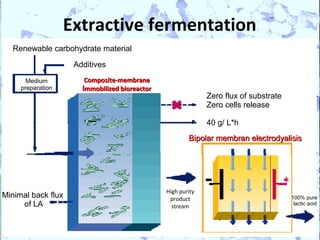
Extractive fermentation
  Renewable carbohydrate material

                    Additives
       Medium          Composite-membrane
     preparation      İmmobilized bioreactor
                                                             Zero flux of substrate
                                                             Zero cells release

                                                             40 g/ L*h
                                                       Bipolar membran electrodyalisis


                                               High purity
Minimal back flux                               product                               100% pure
     of LA                                       stream                                lactic acid
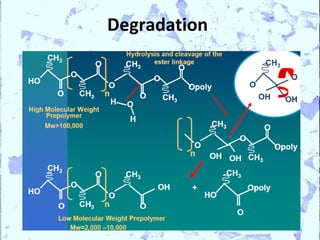
Degradation
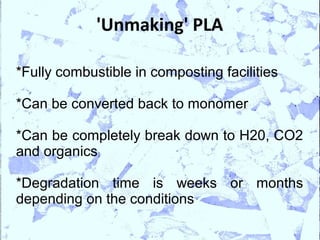
'Unmaking' PLA

*Fully combustible in composting facilities

*Can be converted back to monomer

*Can be completely break down to H20, CO2
and organics

*Degradation time is weeks or months
depending on the conditions
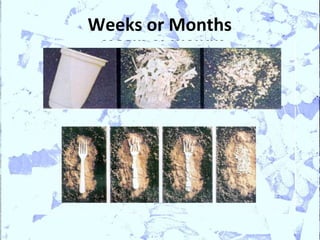
Weeks or Months
Criticisms

-the use of different additives in production
negate the composting credentials of PLA.
-for medical applications combined with other
Bioresins to withstand moisture and higher
heat, the biodegradation rate is slowed by
multiple times.
-made from corn with high energy waste,
significant CO2 release when manufacturing
and during degradation time
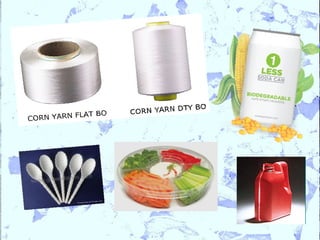
Uses and applications

*Single-use items: plates, cups, film wrap
*Plastic bottling and fast-food companies
*Textile industry
*Paper coatings, Clothing fibers, Compost bags
*Biomedical field sutures, stents, and dialysis
*Polylactic acid injections for skin rejuvenation
Current market
Plastics
2000: 150 million tons
2010: Expected to reach 258 million tons


Biodegradable Plastics
2000: 20 million pounds
2010: Expected to capture 20% of the market for plastics
(approximately 50 million tons)


Current selling price of PLA: $1.50/lb
Current selling price of PET: $0.60/lb
References

PLA 4030D, 4040D, 4041D Cargill-Dow LLC. (2000).
Polylactic acid as a new biodegradable commodity
  polymer. Auras, R., (2010).
Monomers, Polymers and composites from renewable
 sources, Belgacem, M.N., Gandini, A., (2008).
Polylactic Acid Technology. Henton, D.E., et al., (2010)
Thank you for your time!

Poly lactic acid

  • 1.
    Poly Lactic Acid Towards sustainable packaging Gioacchino dell'Aquila Food Engineering MSc İstanbul Aydın Üniversitesi
  • 3.
    Background - 1932: Carother(Dupont) created PLA - 1954: Dupont patented Carothers process - Extremely high cost of manufacturing - 1997: Cargill Dow Polymers LLC forms - 2001: 300 million pound produced at the Blair Nebraska plant
  • 4.
    What is PolylactidAcid (PLA) * Highly versatile thermoplastic polymer * Made 100% from renewable resources * Lactic Acid is derived from various sources - Corn - Sugar Beets - Wheat
  • 5.
    Aliphatic polyester consideredbiodegradable and compostable (degrading under the action of microorganism in a humid environment to produce biomass and carbon dioxide) Thermoplastic, high strength polymer which can be made from renewable resources to yield articles as packaging or as biocompatible / bioabsorbable medicals.
  • 6.
    Drops of chemistry Appearance:clear, Yield Sgth (MPa) 70 translucent or opaque Elongation at Break (%) 66 pellets; sweet odour Tensile Sgth (MPa) 100-180 Melting Point: < 140°C Flexural Sgth (MPa) 119 Water Solubility: apprx Permeability (mil/m .day.atm): 2 20 mg/L at 20°C O2, 550 n-Octanol Solubility: slight CO2, 3000 H2O, 325
  • 7.
    Properties Insoluble in water,moisture n' grease resistant Biodegradable and compostable Clarity and glossiness similar Requires 20 to 50% less fossil fuels to produce Comparable physical properties to polyethylene terephthalate (PET)
  • 8.
    The basic constitutionalunit of PLA is Lactic Acid from carbohydrates fermentation or chemical synthesis: *Chemical synthesis route is currently used to produce large scale quantities of racemic lactic acid; however, it is economically unviable. *Fermentation process can be divided according the type of bacteria in the process; - Heterofermentative; less than 1.8 moles of lactic acid per mole of hexose. - Homofermentative; 1.8 moles of lactic acid per mole of hexose. 90+g lactic acid per 100 g glucose.
  • 10.
    Fermentation step C6 H12O6 2 •Bacteria breaks down one molecule of dextrose to form two molecules of lactic acid
  • 11.
    Lactide formation 2 Two moleculesof lactic acid combine to form one molecule of lactide
  • 12.
    Polymerization The lactide polymerizesthrough ring opening polymerization (ROP) to a molecular weight of approximately 30,000 But also Direct polycondensation of polylactic acid – Produces low Mw PLA
  • 13.
  • 14.
    Process: (gr/L*h) Conditions: Batch Process: 1-4.5 PH: 5.4-6.4 Continuous Process: 3 -9 T: 38-42ºC Cell Recycle Reactors: 76 O2: Avoid due to detrimental effect in Immobilized Cell Reactors: 2.5 the production Extractive Fermentation: NA Agitation:don’t play an important role
  • 15.
    Continuous reactor Into thebioreactor at the same time fresh media is added and fluid is removed. The cells thus continuously propagate on the fresh medium entering the reactor and products, metabolic waste products and cells are removed in the effluent. Continuous culture reactors need to be shut down less frequently than batch systems. Cells can also be immobilized in the reactor to maximize their retention and thus increase productivity.
  • 16.
    Extractive fermentation Renewable carbohydrate material Additives Medium Composite-membrane preparation İmmobilized bioreactor Zero flux of substrate Zero cells release 40 g/ L*h Bipolar membran electrodyalisis High purity Minimal back flux product 100% pure of LA stream lactic acid
  • 17.
  • 18.
    'Unmaking' PLA *Fully combustiblein composting facilities *Can be converted back to monomer *Can be completely break down to H20, CO2 and organics *Degradation time is weeks or months depending on the conditions
  • 19.
  • 20.
    Criticisms -the use ofdifferent additives in production negate the composting credentials of PLA. -for medical applications combined with other Bioresins to withstand moisture and higher heat, the biodegradation rate is slowed by multiple times. -made from corn with high energy waste, significant CO2 release when manufacturing and during degradation time
  • 21.
    Uses and applications *Single-useitems: plates, cups, film wrap *Plastic bottling and fast-food companies *Textile industry *Paper coatings, Clothing fibers, Compost bags *Biomedical field sutures, stents, and dialysis *Polylactic acid injections for skin rejuvenation
  • 23.
    Current market Plastics 2000: 150million tons 2010: Expected to reach 258 million tons Biodegradable Plastics 2000: 20 million pounds 2010: Expected to capture 20% of the market for plastics (approximately 50 million tons) Current selling price of PLA: $1.50/lb Current selling price of PET: $0.60/lb
  • 24.
    References PLA 4030D, 4040D,4041D Cargill-Dow LLC. (2000). Polylactic acid as a new biodegradable commodity polymer. Auras, R., (2010). Monomers, Polymers and composites from renewable sources, Belgacem, M.N., Gandini, A., (2008). Polylactic Acid Technology. Henton, D.E., et al., (2010)
  • 25.
    Thank you foryour time!