1. Introduction
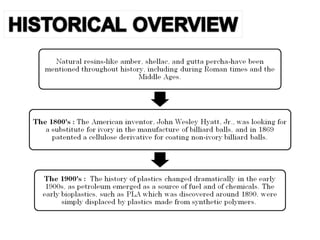
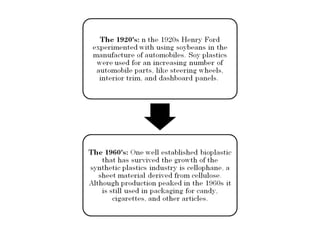
2. Historical Overview
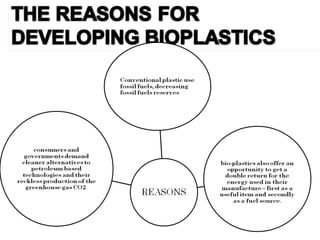
3. The reasons for developing Bioplastics
4. Producing Bioplastics
5. Case Study : PHB
6. Comparative Overview
7. Bioplastic Products
8. Conclusion
9. References
• Bioplastics are plastics derived from renewable biomass sources, such as vegetable
fats and oils, corn starch, or micro biota. (Hong Chua1 et. al,).
• Bioplastics can be made from agricultural byproducts and also from used plastic
bottles and other containers using microorganisms
• Common plastics, such as fossil-fuel plastics , are derived from petroleum or natural
gas. Production of such plastics tends to require more fossil fuels and to produce
more greenhouse gases than the production of biobased polymers (bioplastics).
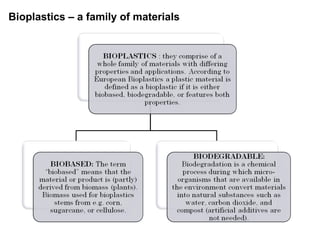
Bioplastics – a family of materials
Bioplastics are biobased, biodegradable or both.
“Biobased” does not equal “biodegradable”
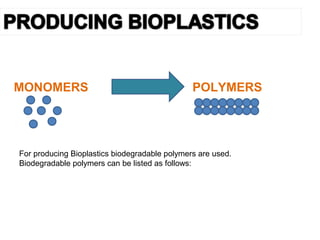
MONOMERS POLYMERS
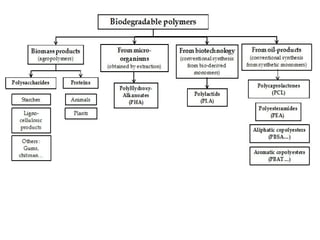
For producing Bioplastics biodegradable polymers are used.
Biodegradable polymers can be listed as follows:
WHY PHB?
• Purely biobased and completely Biodegradable.
• PLA and other oil based plastics are not completely biodegradable.
• Biocompatible and hence is suitable for medical applications.
Introduction:
Polyhydroxybutyrates (PHBs) are members from family of polyesters known as
Polyhydroxyalkanoates (PHAs).
Accumulated in intracellular granules by Gram-positive and Gram-negative
microorganisms.
PHB are produced when there is excess carbon source with the limitation of one of
the essential nutrients.
Also known as Biopolymers as they are produced from microorganisms.
They are thermoplastic polymers and are totally biodegradable
Many different types of PHAs are available and PHB is the most common one
Empirical formula - [C4H6O2]n
Structural formula for the linear chain of PHB
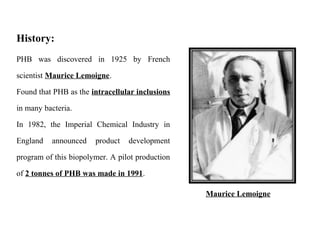
PHB was discovered in 1925 by French
scientist Maurice Lemoigne.
Found that PHB as the intracellular inclusions
in many bacteria.
In 1982, the Imperial Chemical Industry in
England announced product development
program of this biopolymer. A pilot production
of 2 tonnes of PHB was made in 1991.
History:
Maurice Lemoigne
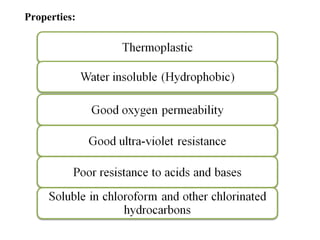
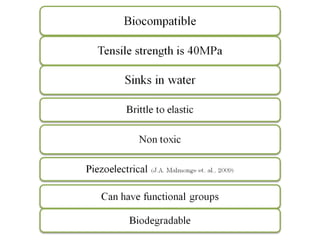
Properties:
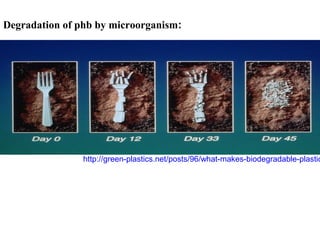
http://green-plastics.net/posts/96/what-makes-biodegradable-plastic
Degradation of phb by microorganism:
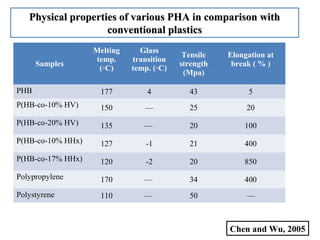
Physical properties of various PHA in comparison withPhysical properties of various PHA in comparison with
conventional plasticsconventional plastics
Samples
Melting
temp.
(◦C)
Glass
transition
temp. (◦C)
Tensile
strength
(Mpa)
Elongation at
break ( % )
PHB 177 4 43 5
P(HB-co-10% HV) 150 — 25 20
P(HB-co-20% HV) 135 — 20 100
P(HB-co-10% HHx) 127 -1 21 400
P(HB-co-17% HHx) 120 -2 20 850
Polypropylene 170 — 34 400
Polystyrene 110 — 50 —
Chen and Wu, 2005
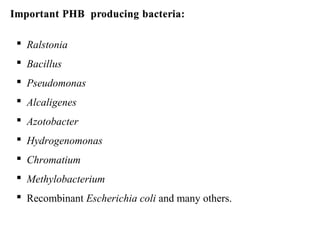
 Ralstonia
 Bacillus
 Pseudomonas
 Alcaligenes
 Azotobacter
 Hydrogenomonas
 Chromatium
 Methylobacterium
 Recombinant Escherichia coli and many others.
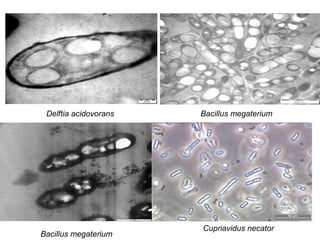
Delftia acidovorans Bacillus megaterium
Bacillus megaterium
Cupriavidus necator
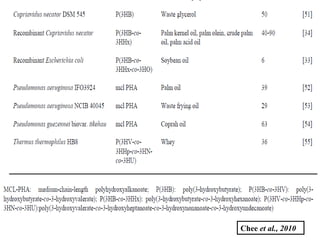
Chee et al., 2010
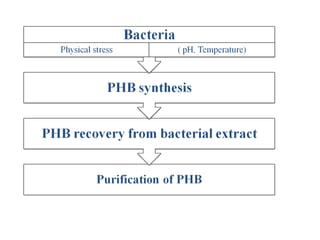
Polyhydroxybutyrates (PHBs) are polymers that bacteria produce under conditions of
low concentrations of important nutrients (typically nitrogen, but sometimes oxygen) and
high concentrations of carbon sources.
This process occurs because the excess carbon leads to bacteria creating carbon
reserves (PHAs) to save for a time with more plentiful nutrients in which they need
energy to carry out regular functions.
Bacteria store PHBs in granules for later use.
These polymers are accumulated intracellularly under conditions of nutrient stress and
act as a carbon and energy reserve.
Producing PHB:
Poly-β-hydroxybutyrate (PHB) is synthesized as an intracellular storage material
and accumulates as distinct white granules during unbalanced growth in the cell, these
are clearly visible in the cytoplasm of the cell.
Many bacteria including those in the soil, are capable of PHB production and
breakdown.
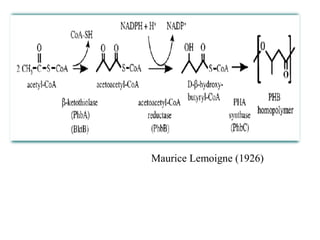
It consists of three enzymes
β-ketoacyl-CoA thiolase (phb A)
NADPH dependent Acetoacetyl-CoA dehydrogenase (phb B)
P(3HB) polymerase (phb C)
Maurice Lemoigne (1926)
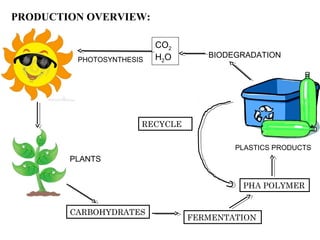
PRODUCTION OVERVIEW:
PLASTICS PRODUCTS
BIODEGRADATION
CO2
H2OPHOTOSYNTHESIS
PLANTS
CARBOHYDRATES
FERMENTATION
PHA POLYMER
RECYCLE
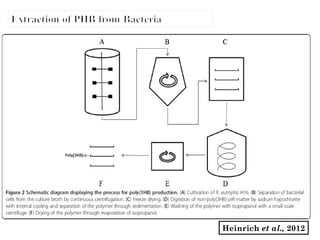
Heinrich et al., 2012
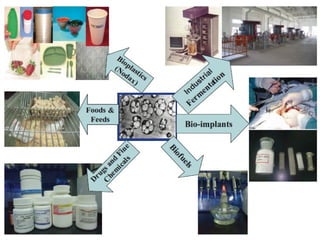
APPLICATIONS OF PHB:
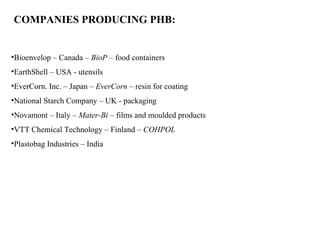
•Bioenvelop – Canada – BioP – food containers
•EarthShell – USA - utensils
•EverCorn. Inc. – Japan – EverCorn – resin for coating
•National Starch Company – UK - packaging
•Novamont – Italy – Mater-Bi – films and moulded products
•VTT Chemical Technology – Finland – COHPOL
•Plastobag Industries – India
COMPANIES PRODUCING PHB:
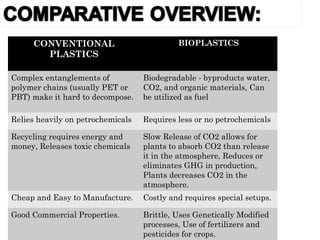
CONVENTIONAL
PLASTICS
BIOPLASTICS
Complex entanglements of
polymer chains (usually PET or
PBT) make it hard to decompose.
Biodegradable - byproducts water,
CO2, and organic materials, Can
be utilized as fuel
Relies heavily on petrochemicals Requires less or no petrochemicals
Recycling requires energy and
money, Releases toxic chemicals
Slow Release of CO2 allows for
plants to absorb CO2 than release
it in the atmosphere, Reduces or
eliminates GHG in production,
Plants decreases CO2 in the
atmosphere.
Cheap and Easy to Manufacture. Costly and requires special setups.
Good Commercial Properties. Brittle, Uses Genetically Modified
processes, Use of fertilizers and
pesticides for crops.
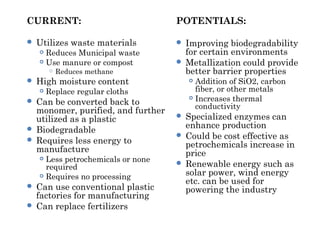
CURRENT:
 Utilizes waste materials
 Reduces Municipal waste
 Use manure or compost
 Reduces methane
 High moisture content
 Replace regular cloths
 Can be converted back to
monomer, purified, and further
utilized as a plastic
 Biodegradable
 Requires less energy to
manufacture
 Less petrochemicals or none
required
 Requires no processing
 Can use conventional plastic
factories for manufacturing
 Can replace fertilizers
POTENTIALS:
 Improving biodegradability
for certain environments
 Metallization could provide
better barrier properties
 Addition of SiO2, carbon
fiber, or other metals
 Increases thermal
conductivity
 Specialized enzymes can
enhance production
 Could be cost effective as
petrochemicals increase in
price
 Renewable energy such as
solar power, wind energy
etc. can be used for
powering the industry
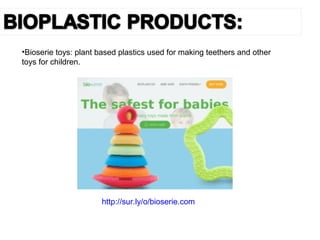
•Bioserie toys: plant based plastics used for making teethers and other
toys for children.
http://sur.ly/o/bioserie.com
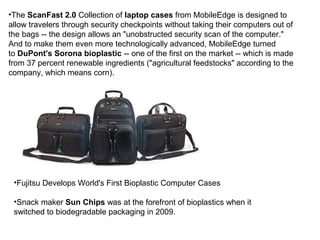
•The ScanFast 2.0 Collection of laptop cases from MobileEdge is designed to
allow travelers through security checkpoints without taking their computers out of
the bags -- the design allows an "unobstructed security scan of the computer."
And to make them even more technologically advanced, MobileEdge turned
to DuPont's Sorona bioplastic -- one of the first on the market -- which is made
from 37 percent renewable ingredients ("agricultural feedstocks" according to the
company, which means corn).
•Fujitsu Develops World's First Bioplastic Computer Cases
•Snack maker Sun Chips was at the forefront of bioplastics when it
switched to biodegradable packaging in 2009.
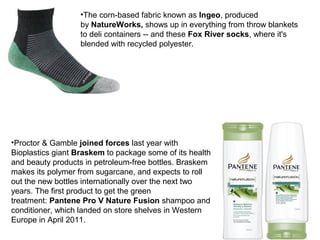
•Proctor & Gamble joined forces last year with
Bioplastics giant Braskem to package some of its health
and beauty products in petroleum-free bottles. Braskem
makes its polymer from sugarcane, and expects to roll
out the new bottles internationally over the next two
years. The first product to get the green
treatment: Pantene Pro V Nature Fusion shampoo and
conditioner, which landed on store shelves in Western
Europe in April 2011.
•The corn-based fabric known as Ingeo, produced
by NatureWorks, shows up in everything from throw blankets
to deli containers -- and these Fox River socks, where it's
blended with recycled polyester.
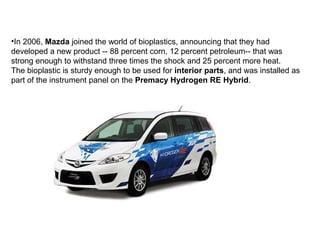
•In 2006, Mazda joined the world of bioplastics, announcing that they had
developed a new product -- 88 percent corn, 12 percent petroleum-- that was
strong enough to withstand three times the shock and 25 percent more heat.
The bioplastic is sturdy enough to be used for interior parts, and was installed as
part of the instrument panel on the Premacy Hydrogen RE Hybrid.
Overall even though bioplastics are generally more expensive than
regular plastic, the variety of uses and benefits could outweigh the
cost. It cuts down on municipal waste, reduces GHGs, it’s
environmentally friendly, and it can be used as a fuel. Lastly with
developing technologies, these benefits will improve and the cost
will be competitive in the market.
 http://www.nec.co.jp/eco/en/annual2006/02/2-1.html
 http://biopact.com/2007_09_25_archive.html
 http://www.greencarcongress.com/2007/03/researchers_dev_
1.html
 http://www.european-bioplastics.org
 http://www.environmentalleader.com/2007/10/23/bioplastics-
carve-out-niche/
 http://www.epo.org/topics/innovation-and-
economy/emerging-technologies/article-6.html
 http://www.thenakedscientists.com/HTML/articles/article/bio
plastics/
 http://www.waste-management-
world.com/display_article/273126/123/ARTCL/none/BIOTR/1
/Beauty-of-bioplastics/
 http://www.biobasics.gc.ca/english/View.asp?x=790
 http://www.immnet.com/articles?article=3135
  Hong Chua1, Peter H. F. Yu, and Chee K. Ma (March
1999). "Accumulation of biopolymers in activated sludge
biomass". Applied Biochemistry and Biotechnology(Humana
Press Inc.) 78: 389–399.
 
http://www.unep.org/ietc/Portals/136/Conventional%20vs
%20biodegradable%20plastics.pdf
http://www.packwebasia.com/trends/packaging-market-trends/3499-asia-
to-produce-75-of-world-s-bioplastics-by-2018
http://ficci.in/spdocument/20396/Knowledge-Paper-ps.pdf
 Malmonge, J.A., Malmonge, L.F., Fuzari, G.C., Malmonge, S.M. and
Sakamoto, W.K. (2009), Piezo and dielectric properties of PHB–PZT
composite. Polym Compos, 30: 1333–1337. doi: 10.1002/pc.20719

Bioplastics

  • 3.
    1. Introduction 2. HistoricalOverview 3. The reasons for developing Bioplastics 4. Producing Bioplastics 5. Case Study : PHB 6. Comparative Overview 7. Bioplastic Products 8. Conclusion 9. References
  • 4.
    • Bioplastics areplastics derived from renewable biomass sources, such as vegetable fats and oils, corn starch, or micro biota. (Hong Chua1 et. al,). • Bioplastics can be made from agricultural byproducts and also from used plastic bottles and other containers using microorganisms • Common plastics, such as fossil-fuel plastics , are derived from petroleum or natural gas. Production of such plastics tends to require more fossil fuels and to produce more greenhouse gases than the production of biobased polymers (bioplastics).
  • 5.
    Bioplastics – afamily of materials
  • 6.
    Bioplastics are biobased,biodegradable or both. “Biobased” does not equal “biodegradable”
  • 10.
    MONOMERS POLYMERS For producingBioplastics biodegradable polymers are used. Biodegradable polymers can be listed as follows:
  • 12.
    WHY PHB? • Purelybiobased and completely Biodegradable. • PLA and other oil based plastics are not completely biodegradable. • Biocompatible and hence is suitable for medical applications.
  • 13.
    Introduction: Polyhydroxybutyrates (PHBs) aremembers from family of polyesters known as Polyhydroxyalkanoates (PHAs). Accumulated in intracellular granules by Gram-positive and Gram-negative microorganisms. PHB are produced when there is excess carbon source with the limitation of one of the essential nutrients. Also known as Biopolymers as they are produced from microorganisms. They are thermoplastic polymers and are totally biodegradable Many different types of PHAs are available and PHB is the most common one Empirical formula - [C4H6O2]n Structural formula for the linear chain of PHB
  • 14.
    PHB was discoveredin 1925 by French scientist Maurice Lemoigne. Found that PHB as the intracellular inclusions in many bacteria. In 1982, the Imperial Chemical Industry in England announced product development program of this biopolymer. A pilot production of 2 tonnes of PHB was made in 1991. History: Maurice Lemoigne
  • 15.
  • 17.
  • 18.
    Physical properties ofvarious PHA in comparison withPhysical properties of various PHA in comparison with conventional plasticsconventional plastics Samples Melting temp. (◦C) Glass transition temp. (◦C) Tensile strength (Mpa) Elongation at break ( % ) PHB 177 4 43 5 P(HB-co-10% HV) 150 — 25 20 P(HB-co-20% HV) 135 — 20 100 P(HB-co-10% HHx) 127 -1 21 400 P(HB-co-17% HHx) 120 -2 20 850 Polypropylene 170 — 34 400 Polystyrene 110 — 50 — Chen and Wu, 2005
  • 19.
     Ralstonia  Bacillus Pseudomonas  Alcaligenes  Azotobacter  Hydrogenomonas  Chromatium  Methylobacterium  Recombinant Escherichia coli and many others.
  • 20.
    Delftia acidovorans Bacillusmegaterium Bacillus megaterium Cupriavidus necator
  • 22.
  • 23.
    Polyhydroxybutyrates (PHBs) arepolymers that bacteria produce under conditions of low concentrations of important nutrients (typically nitrogen, but sometimes oxygen) and high concentrations of carbon sources. This process occurs because the excess carbon leads to bacteria creating carbon reserves (PHAs) to save for a time with more plentiful nutrients in which they need energy to carry out regular functions. Bacteria store PHBs in granules for later use. These polymers are accumulated intracellularly under conditions of nutrient stress and act as a carbon and energy reserve. Producing PHB:
  • 24.
    Poly-β-hydroxybutyrate (PHB) issynthesized as an intracellular storage material and accumulates as distinct white granules during unbalanced growth in the cell, these are clearly visible in the cytoplasm of the cell. Many bacteria including those in the soil, are capable of PHB production and breakdown. It consists of three enzymes β-ketoacyl-CoA thiolase (phb A) NADPH dependent Acetoacetyl-CoA dehydrogenase (phb B) P(3HB) polymerase (phb C)
  • 25.
  • 26.
  • 28.
  • 29.
  • 31.
    •Bioenvelop – Canada– BioP – food containers •EarthShell – USA - utensils •EverCorn. Inc. – Japan – EverCorn – resin for coating •National Starch Company – UK - packaging •Novamont – Italy – Mater-Bi – films and moulded products •VTT Chemical Technology – Finland – COHPOL •Plastobag Industries – India COMPANIES PRODUCING PHB:
  • 32.
    CONVENTIONAL PLASTICS BIOPLASTICS Complex entanglements of polymerchains (usually PET or PBT) make it hard to decompose. Biodegradable - byproducts water, CO2, and organic materials, Can be utilized as fuel Relies heavily on petrochemicals Requires less or no petrochemicals Recycling requires energy and money, Releases toxic chemicals Slow Release of CO2 allows for plants to absorb CO2 than release it in the atmosphere, Reduces or eliminates GHG in production, Plants decreases CO2 in the atmosphere. Cheap and Easy to Manufacture. Costly and requires special setups. Good Commercial Properties. Brittle, Uses Genetically Modified processes, Use of fertilizers and pesticides for crops.
  • 33.
    CURRENT:  Utilizes wastematerials  Reduces Municipal waste  Use manure or compost  Reduces methane  High moisture content  Replace regular cloths  Can be converted back to monomer, purified, and further utilized as a plastic  Biodegradable  Requires less energy to manufacture  Less petrochemicals or none required  Requires no processing  Can use conventional plastic factories for manufacturing  Can replace fertilizers POTENTIALS:  Improving biodegradability for certain environments  Metallization could provide better barrier properties  Addition of SiO2, carbon fiber, or other metals  Increases thermal conductivity  Specialized enzymes can enhance production  Could be cost effective as petrochemicals increase in price  Renewable energy such as solar power, wind energy etc. can be used for powering the industry
  • 34.
    •Bioserie toys: plantbased plastics used for making teethers and other toys for children. http://sur.ly/o/bioserie.com
  • 35.
    •The ScanFast 2.0Collection of laptop cases from MobileEdge is designed to allow travelers through security checkpoints without taking their computers out of the bags -- the design allows an "unobstructed security scan of the computer." And to make them even more technologically advanced, MobileEdge turned to DuPont's Sorona bioplastic -- one of the first on the market -- which is made from 37 percent renewable ingredients ("agricultural feedstocks" according to the company, which means corn). •Fujitsu Develops World's First Bioplastic Computer Cases •Snack maker Sun Chips was at the forefront of bioplastics when it switched to biodegradable packaging in 2009.
  • 36.
    •Proctor & Gamblejoined forces last year with Bioplastics giant Braskem to package some of its health and beauty products in petroleum-free bottles. Braskem makes its polymer from sugarcane, and expects to roll out the new bottles internationally over the next two years. The first product to get the green treatment: Pantene Pro V Nature Fusion shampoo and conditioner, which landed on store shelves in Western Europe in April 2011. •The corn-based fabric known as Ingeo, produced by NatureWorks, shows up in everything from throw blankets to deli containers -- and these Fox River socks, where it's blended with recycled polyester.
  • 37.
    •In 2006, Mazdajoined the world of bioplastics, announcing that they had developed a new product -- 88 percent corn, 12 percent petroleum-- that was strong enough to withstand three times the shock and 25 percent more heat. The bioplastic is sturdy enough to be used for interior parts, and was installed as part of the instrument panel on the Premacy Hydrogen RE Hybrid.
  • 38.
    Overall even thoughbioplastics are generally more expensive than regular plastic, the variety of uses and benefits could outweigh the cost. It cuts down on municipal waste, reduces GHGs, it’s environmentally friendly, and it can be used as a fuel. Lastly with developing technologies, these benefits will improve and the cost will be competitive in the market.
  • 39.
     http://www.nec.co.jp/eco/en/annual2006/02/2-1.html  http://biopact.com/2007_09_25_archive.html http://www.greencarcongress.com/2007/03/researchers_dev_ 1.html  http://www.european-bioplastics.org  http://www.environmentalleader.com/2007/10/23/bioplastics- carve-out-niche/  http://www.epo.org/topics/innovation-and- economy/emerging-technologies/article-6.html  http://www.thenakedscientists.com/HTML/articles/article/bio plastics/  http://www.waste-management- world.com/display_article/273126/123/ARTCL/none/BIOTR/1 /Beauty-of-bioplastics/  http://www.biobasics.gc.ca/english/View.asp?x=790  http://www.immnet.com/articles?article=3135   Hong Chua1, Peter H. F. Yu, and Chee K. Ma (March 1999). "Accumulation of biopolymers in activated sludge biomass". Applied Biochemistry and Biotechnology(Humana Press Inc.) 78: 389–399.  
  • 40.