BIOPLASTIC
FROM WASTE
FOOD
J AY D I P PA R A D AVA
M . S C . M I C R O B I O LO G Y
J & J C O L L E G E O F S C I E N C E
OVERVIEW
• WHAT IS BIOPLASTIC
• WHY BIOPLASTIC?
• How Biodegradable are Bioplastics?
• Bioplastic Properties
• Types of Bioplastic
• Environmental impacts
• Uses of Bioplastic
• Biodegradation
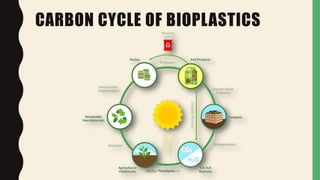
• Carbon Cycle of Bioplastics
• The Truth About Bioplastics
Jaydip Paradava
WHAT IS BIOPLASTIC?
• Bioplastics are plastic materials produced from renewable biomass sources, such
as vegetable fats and oils, corn starch, straw, woodchips, sawdust, recycled food
waste, etc.
• Bioplastic can be made from agricultural by-products and also from used plastic
bottles and other containers using microorganisms
• Bioplastics are usually derived from sugar derivatives, including starch, cellulose,
and lactic acid.
• As of 2014, bioplastics represented approximately 0.2% of the global polymer market
(300 million tons)
Jaydip Paradava
WHY BIOPLASTIC?
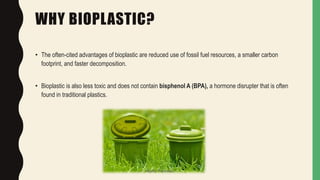
• The often-cited advantages of bioplastic are reduced use of fossil fuel resources, a smaller carbon
footprint, and faster decomposition.
• Bioplastic is also less toxic and does not contain bisphenol A (BPA), a hormone disrupter that is often
found in traditional plastics.
Jaydip Paradava
HOW BIODEGRADABLE ARE
BIOPLASTICS?
• Since there is often confusion when talking about bioplastics, let’s clarify some
terms first.
• Degradable –
• All plastic is degradable, even traditional plastic, but just because it can be
broken down into tiny fragments or powder does not mean the materials will
ever return to nature.
• Some additives to traditional plastics make them degrade more quickly.
Photodegradable plastic breaks down more readily in sunlight; oxo-
degradable plastic disintegrates more quickly when exposed to heat and light.
Jaydip Paradava
• Biodegradable –
• Biodegradable plastic can be broken down completely into water, carbon
microorganisms under the right conditions.
• “Biodegradable” implies that the decomposition happens in weeks to months.
• Bioplastics that don’t biodegrade that quickly are called “durable,” and some
biomass that cannot easily be broken down by microorganisms are considered
• Compostable –
• Compostable plastic will biodegrade in a compost site.
• Microorganisms break it down into carbon dioxide, water, inorganic
rate as other organic materials in the compost pile, leaving no toxic residue.
Jaydip Paradava
BIOPLASTIC PROPERTIES
• Some are stiff and brittle.
• Some are rubbery and moldable.
• Properties may be manipulated by blending polymers or genetic modifications.
• Degrades at 185°C.
• Moisture resistant, water insoluble, optically pure, impermeable to oxygen.
• Must maintain stability during manufacture and use but degrade rapidly when
disposed of or recycled.
Jaydip Paradava
TYPES OF BIOPLASTIC
• Bioplastics are currently used in disposable items like packaging, containers,
straws, bags and bottles, and in non-disposable carpet, plastic piping, phone
casings, 3D printing, car insulation and medical implants.
• The global bioplastic market is projected to grow from $17 billion this year to
almost $44 billion in 2022.
• There are two main types of bioplastics.
• PLA (polyactic acid)
• PHA (polyhydroxyalkanoate)
Jaydip Paradava
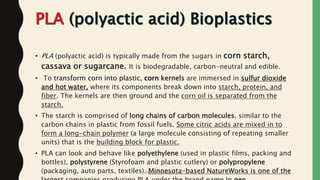
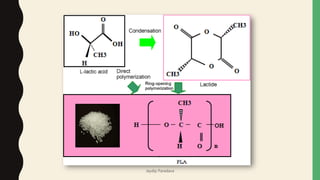
• PLA (polyactic acid) is typically made from the sugars in corn starch,
cassava or sugarcane. It is biodegradable, carbon-neutral and edible.
• To transform corn into plastic, corn kernels are immersed in sulfur dioxide
and hot water, where its components break down into starch, protein, and
fiber. The kernels are then ground and the corn oil is separated from the
starch.
• The starch is comprised of long chains of carbon molecules, similar to the
carbon chains in plastic from fossil fuels. Some citric acids are mixed in to
form a long-chain polymer (a large molecule consisting of repeating smaller
units) that is the building block for plastic.
• PLA can look and behave like polyethylene (used in plastic films, packing and
bottles), polystyrene (Styrofoam and plastic cutlery) or polypropylene
(packaging, auto parts, textiles). Minnesota-based NatureWorks is one of theJaydip Paradava
Jaydip Paradava
STARCH-BASED PLASTICS
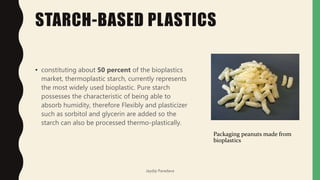
• constituting about 50 percent of the bioplastics
market, thermoplastic starch, currently represents
the most widely used bioplastic. Pure starch
possesses the characteristic of being able to
absorb humidity, therefore Flexibly and plasticizer
such as sorbitol and glycerin are added so the
starch can also be processed thermo-plastically.
Packaging peanuts made from
bioplastics
Jaydip Paradava
CELLULOSE-BASED PLASTICS
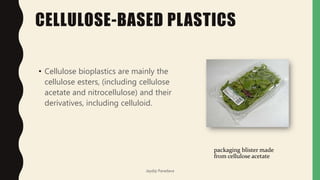
• Cellulose bioplastics are mainly the
cellulose esters, (including cellulose
acetate and nitrocellulose) and their
derivatives, including celluloid.
packaging blister made
from cellulose acetate
Jaydip Paradava
PHA (POLYHYDROXYALKANOATE)
• PHA (polyhydroxyalkanoate) is made by microorganisms, sometimes
genetically engineered, that produce plastic from organic materials.
• The microbes are deprived of nutrients like nitrogen, oxygen and phosphorus,
but given high levels of carbon.
• They produce PHA as carbon reserves, which they store in granules until they
have more of the other nutrients they need to grow and reproduce.
• Companies can then harvest the microbe-made PHA, which has a chemical
structure similar to that of traditional plastics.
• Because it is biodegradable and will not harm living tissue, PHA is often used
for medical applications such as sutures, slings, bone plates and skin
substitutes; it is also used for single-use food packaging.Jaydip Paradava
HOW DOES IT MADE FROM
MICROORGANISMS!
• PHAs are polyesters containing monomers of mediumchain length (mclPHAs, C5–C14) or
long-chain length (lclPHAs, >C14).
• The organisation of the mclPHA biosynthetic genes in Pseudomonas oleovorans and in P.
putida.
PHAs in Pseudomonas oleovorans
Jaydip Paradava
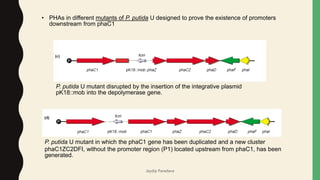
• PHAs in different mutants of P. putida U designed to prove the existence of promoters
downstream from phaC1
P. putida U mutant disrupted by the insertion of the integrative plasmid
pK18::mob into the depolymerase gene.
P. putida U mutant in which the phaC1 gene has been duplicated and a new cluster
phaC1ZC2DFI, without the promoter region (P1) located upstream from phaC1, has been
generated.
Jaydip Paradava
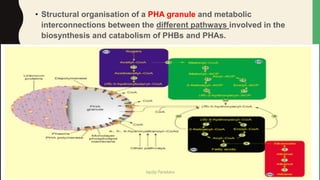
• Structural organisation of a PHA granule and metabolic
interconnections between the different pathways involved in the
biosynthesis and catabolism of PHBs and PHAs.
Jaydip Paradava
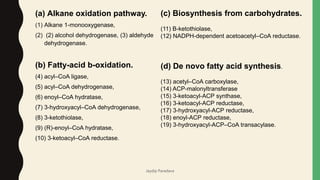
(a) Alkane oxidation pathway.
(1) Alkane 1-monooxygenase,
(2) (2) alcohol dehydrogenase, (3) aldehyde
dehydrogenase.
(b) Fatty-acid b-oxidation.
(4) acyl–CoA ligase,
(5) acyl–CoA dehydrogenase,
(6) enoyl–CoA hydratase,
(7) 3-hydroxyacyl–CoA dehydrogenase,
(8) 3-ketothiolase,
(9) (R)-enoyl–CoA hydratase,
(10) 3-ketoacyl–CoA reductase.
(c) Biosynthesis from carbohydrates.
(11) B-ketothiolase,
(12) NADPH-dependent acetoacetyl–CoA reductase.
(d) De novo fatty acid synthesis.
(13) acetyl–CoA carboxylase,
(14) ACP-malonyltransferase
(15) 3-ketoacyl-ACP synthase,
(16) 3-ketoacyl-ACP reductase,
(17) 3-hydroxyacyl-ACP reductase,
(18) enoyl-ACP reductase,
(19) 3-hydroxyacyl-ACP–CoA transacylase.
Jaydip Paradava
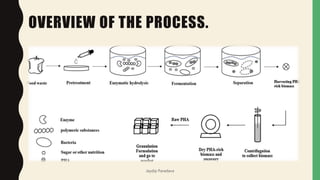
• They can be observed intracellularly as light-refracting granules or as electronlucent
bodies that, in overproducing mutants, cause a striking alteration of the bacterial
shape.
transmission microscope of P. putida electron microphotographs of P. putida
Jaydip Paradava
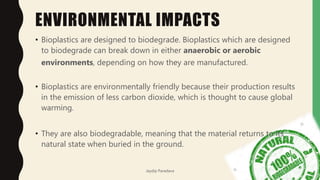
OVERVIEW OF THE PROCESS.
Jaydip Paradava
ENVIRONMENTAL IMPACTS
• Bioplastics are designed to biodegrade. Bioplastics which are designed
to biodegrade can break down in either anaerobic or aerobic
environments, depending on how they are manufactured.
• Bioplastics are environmentally friendly because their production results
in the emission of less carbon dioxide, which is thought to cause global
warming.
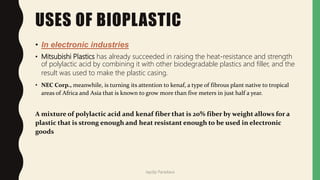
• They are also biodegradable, meaning that the material returns to its
natural state when buried in the ground.
Jaydip Paradava
USES OF BIOPLASTIC
• In electronic industries
• Mitsubishi Plastics has already succeeded in raising the heat-resistance and strength
of polylactic acid by combining it with other biodegradable plastics and filler, and the
result was used to make the plastic casing.
• NEC Corp., meanwhile, is turning its attention to kenaf, a type of fibrous plant native to tropical
areas of Africa and Asia that is known to grow more than five meters in just half a year.
A mixture of polylactic acid and kenaf fiber that is 20% fiber by weight allows for a
plastic that is strong enough and heat resistant enough to be used in electronic
goods
Jaydip Paradava
Packaging:-
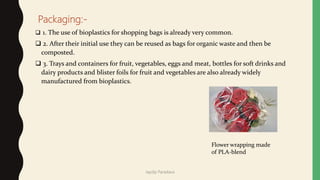
 1. The use of bioplastics for shopping bags is already very common.
 2. After their initial use they can be reused as bags for organic waste and then be
composted.
 3. Trays and containers for fruit, vegetables, eggs and meat, bottles for soft drinks and
dairy products and blister foils for fruit and vegetables are also already widely
manufactured from bioplastics.
Flower wrapping made
of PLA-blend
Jaydip Paradava
Catering products:
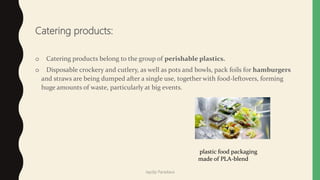
o Catering products belong to the group of perishable plastics.
o Disposable crockery and cutlery, as well as pots and bowls, pack foils for hamburgers
and straws are being dumped after a single use, together with food-leftovers, forming
huge amounts of waste, particularly at big events.
plastic food packaging
made of PLA-blend
Jaydip Paradava
Medical Products:-
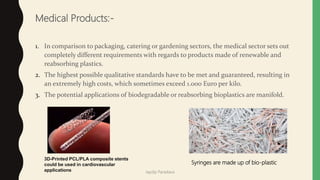
1. In comparison to packaging, catering or gardening sectors, the medical sector sets out
completely different requirements with regards to products made of renewable and
reabsorbing plastics.
2. The highest possible qualitative standards have to be met and guaranteed, resulting in
an extremely high costs, which sometimes exceed 1.000 Euro per kilo.
3. The potential applications of biodegradable or reabsorbing bioplastics are manifold.
3D-Printed PCL/PLA composite stents
could be used in cardiovascular
applications
Syringes are made up of bio-plastic
Jaydip Paradava
BIODEGRADATION
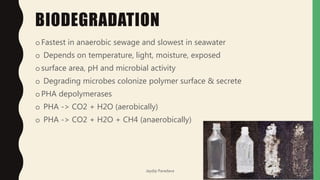
o Fastest in anaerobic sewage and slowest in seawater
o Depends on temperature, light, moisture, exposed
osurface area, pH and microbial activity
o Degrading microbes colonize polymer surface & secrete
o PHA depolymerases
o PHA -> CO2 + H2O (aerobically)
o PHA -> CO2 + H2O + CH4 (anaerobically)
Jaydip Paradava
CARBON CYCLE OF BIOPLASTICS
Jaydip Paradava
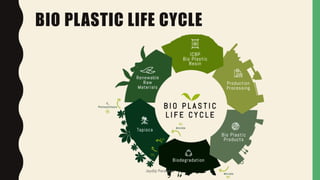
BIO PLASTIC LIFE CYCLE
Jaydip Paradava
THE TRUTH ABOUT BIOPLASTICS
Traditional plastic is made from petroleum-based raw materials.
Some say bioplastics—made from 20 percent or more of renewable materials—could be
the solution to plastic pollution.
Kartik Chandran, a professor in the Earth and Environmental Engineering
at Columbia University who is working on bioplastics, believes that compared to
traditional plastics, “bioplastics are a significant improvement.”
However, it turns out that bioplastics are not yet the silver bullet to our
plastic problem.
Jaydip Paradava
• First, bioplastics are generally NOT cost-competitive compared to their
oil-based counterparts. They are generally two or three times more
expensive than the major conventional plastics such as PE or PET, and
their production is plagued by low yields and being expensive.
• There is a concern that bioplastics based on terrestrial crops could
harm food supplies; however, new innovations using food waste could
be helpful in this regard and the concerns would seem to be
as: ‘Perhaps 300,000 hectares are used to grow the crops which the
industry processes into plastics.
Jaydip Paradava
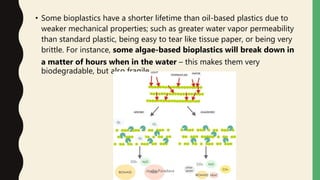
• Some bioplastics have a shorter lifetime than oil-based plastics due to
weaker mechanical properties; such as greater water vapor permeability
than standard plastic, being easy to tear like tissue paper, or being very
brittle. For instance, some algae-based bioplastics will break down in
a matter of hours when in the water – this makes them very
biodegradable, but also fragile.
Jaydip Paradava
• Crop-based bioplastics require fertile land, water, fertilizers, and are reliant on weather
conditions. This means that the supply of raw materials for bioplastics are at risk of
natural phenomena, such as drought.
Jaydip Paradava
REFERENCES
• WIKIPEDIA
• SLIDESHARE
• https://blogs.ei.columbia.edu/2017/12/13/the-truth-about-
bioplastics/#:~:text=The%20often%2Dcited%20advantages%20of,often%20found%20i
n%20traditional%20plastics.
• Image source : www.Google.com
• https://qualityinspection.org/advantages-of-bioplastics-vs-
disadvantages/#:~:text=Disadvantages%20of%20bioplastics&text=They%20are%20ge
nerally%20two%20or,benefit%20from%20economies%20of%20scale
• https://www.sciencedirect.com/science/article/abs/pii/S1369527403000407?via%3Dihu
b
Jaydip Paradava
THANK YOU

Bioplastic from food waste

  • 1.
    BIOPLASTIC FROM WASTE FOOD J AYD I P PA R A D AVA M . S C . M I C R O B I O LO G Y J & J C O L L E G E O F S C I E N C E
  • 2.
    OVERVIEW • WHAT ISBIOPLASTIC • WHY BIOPLASTIC? • How Biodegradable are Bioplastics? • Bioplastic Properties • Types of Bioplastic • Environmental impacts • Uses of Bioplastic • Biodegradation • Carbon Cycle of Bioplastics • The Truth About Bioplastics Jaydip Paradava
  • 3.
    WHAT IS BIOPLASTIC? •Bioplastics are plastic materials produced from renewable biomass sources, such as vegetable fats and oils, corn starch, straw, woodchips, sawdust, recycled food waste, etc. • Bioplastic can be made from agricultural by-products and also from used plastic bottles and other containers using microorganisms • Bioplastics are usually derived from sugar derivatives, including starch, cellulose, and lactic acid. • As of 2014, bioplastics represented approximately 0.2% of the global polymer market (300 million tons) Jaydip Paradava
  • 4.
    WHY BIOPLASTIC? • Theoften-cited advantages of bioplastic are reduced use of fossil fuel resources, a smaller carbon footprint, and faster decomposition. • Bioplastic is also less toxic and does not contain bisphenol A (BPA), a hormone disrupter that is often found in traditional plastics. Jaydip Paradava
  • 5.
    HOW BIODEGRADABLE ARE BIOPLASTICS? •Since there is often confusion when talking about bioplastics, let’s clarify some terms first. • Degradable – • All plastic is degradable, even traditional plastic, but just because it can be broken down into tiny fragments or powder does not mean the materials will ever return to nature. • Some additives to traditional plastics make them degrade more quickly. Photodegradable plastic breaks down more readily in sunlight; oxo- degradable plastic disintegrates more quickly when exposed to heat and light. Jaydip Paradava
  • 6.
    • Biodegradable – •Biodegradable plastic can be broken down completely into water, carbon microorganisms under the right conditions. • “Biodegradable” implies that the decomposition happens in weeks to months. • Bioplastics that don’t biodegrade that quickly are called “durable,” and some biomass that cannot easily be broken down by microorganisms are considered • Compostable – • Compostable plastic will biodegrade in a compost site. • Microorganisms break it down into carbon dioxide, water, inorganic rate as other organic materials in the compost pile, leaving no toxic residue. Jaydip Paradava
  • 7.
    BIOPLASTIC PROPERTIES • Someare stiff and brittle. • Some are rubbery and moldable. • Properties may be manipulated by blending polymers or genetic modifications. • Degrades at 185°C. • Moisture resistant, water insoluble, optically pure, impermeable to oxygen. • Must maintain stability during manufacture and use but degrade rapidly when disposed of or recycled. Jaydip Paradava
  • 8.
    TYPES OF BIOPLASTIC •Bioplastics are currently used in disposable items like packaging, containers, straws, bags and bottles, and in non-disposable carpet, plastic piping, phone casings, 3D printing, car insulation and medical implants. • The global bioplastic market is projected to grow from $17 billion this year to almost $44 billion in 2022. • There are two main types of bioplastics. • PLA (polyactic acid) • PHA (polyhydroxyalkanoate) Jaydip Paradava
  • 9.
    • PLA (polyacticacid) is typically made from the sugars in corn starch, cassava or sugarcane. It is biodegradable, carbon-neutral and edible. • To transform corn into plastic, corn kernels are immersed in sulfur dioxide and hot water, where its components break down into starch, protein, and fiber. The kernels are then ground and the corn oil is separated from the starch. • The starch is comprised of long chains of carbon molecules, similar to the carbon chains in plastic from fossil fuels. Some citric acids are mixed in to form a long-chain polymer (a large molecule consisting of repeating smaller units) that is the building block for plastic. • PLA can look and behave like polyethylene (used in plastic films, packing and bottles), polystyrene (Styrofoam and plastic cutlery) or polypropylene (packaging, auto parts, textiles). Minnesota-based NatureWorks is one of theJaydip Paradava
  • 10.
  • 11.
    STARCH-BASED PLASTICS • constitutingabout 50 percent of the bioplastics market, thermoplastic starch, currently represents the most widely used bioplastic. Pure starch possesses the characteristic of being able to absorb humidity, therefore Flexibly and plasticizer such as sorbitol and glycerin are added so the starch can also be processed thermo-plastically. Packaging peanuts made from bioplastics Jaydip Paradava
  • 12.
    CELLULOSE-BASED PLASTICS • Cellulosebioplastics are mainly the cellulose esters, (including cellulose acetate and nitrocellulose) and their derivatives, including celluloid. packaging blister made from cellulose acetate Jaydip Paradava
  • 13.
    PHA (POLYHYDROXYALKANOATE) • PHA(polyhydroxyalkanoate) is made by microorganisms, sometimes genetically engineered, that produce plastic from organic materials. • The microbes are deprived of nutrients like nitrogen, oxygen and phosphorus, but given high levels of carbon. • They produce PHA as carbon reserves, which they store in granules until they have more of the other nutrients they need to grow and reproduce. • Companies can then harvest the microbe-made PHA, which has a chemical structure similar to that of traditional plastics. • Because it is biodegradable and will not harm living tissue, PHA is often used for medical applications such as sutures, slings, bone plates and skin substitutes; it is also used for single-use food packaging.Jaydip Paradava
  • 14.
    HOW DOES ITMADE FROM MICROORGANISMS! • PHAs are polyesters containing monomers of mediumchain length (mclPHAs, C5–C14) or long-chain length (lclPHAs, >C14). • The organisation of the mclPHA biosynthetic genes in Pseudomonas oleovorans and in P. putida. PHAs in Pseudomonas oleovorans Jaydip Paradava
  • 15.
    • PHAs indifferent mutants of P. putida U designed to prove the existence of promoters downstream from phaC1 P. putida U mutant disrupted by the insertion of the integrative plasmid pK18::mob into the depolymerase gene. P. putida U mutant in which the phaC1 gene has been duplicated and a new cluster phaC1ZC2DFI, without the promoter region (P1) located upstream from phaC1, has been generated. Jaydip Paradava
  • 16.
    • Structural organisationof a PHA granule and metabolic interconnections between the different pathways involved in the biosynthesis and catabolism of PHBs and PHAs. Jaydip Paradava
  • 17.
    (a) Alkane oxidationpathway. (1) Alkane 1-monooxygenase, (2) (2) alcohol dehydrogenase, (3) aldehyde dehydrogenase. (b) Fatty-acid b-oxidation. (4) acyl–CoA ligase, (5) acyl–CoA dehydrogenase, (6) enoyl–CoA hydratase, (7) 3-hydroxyacyl–CoA dehydrogenase, (8) 3-ketothiolase, (9) (R)-enoyl–CoA hydratase, (10) 3-ketoacyl–CoA reductase. (c) Biosynthesis from carbohydrates. (11) B-ketothiolase, (12) NADPH-dependent acetoacetyl–CoA reductase. (d) De novo fatty acid synthesis. (13) acetyl–CoA carboxylase, (14) ACP-malonyltransferase (15) 3-ketoacyl-ACP synthase, (16) 3-ketoacyl-ACP reductase, (17) 3-hydroxyacyl-ACP reductase, (18) enoyl-ACP reductase, (19) 3-hydroxyacyl-ACP–CoA transacylase. Jaydip Paradava
  • 18.
    • They canbe observed intracellularly as light-refracting granules or as electronlucent bodies that, in overproducing mutants, cause a striking alteration of the bacterial shape. transmission microscope of P. putida electron microphotographs of P. putida Jaydip Paradava
  • 19.
    OVERVIEW OF THEPROCESS. Jaydip Paradava
  • 20.
    ENVIRONMENTAL IMPACTS • Bioplasticsare designed to biodegrade. Bioplastics which are designed to biodegrade can break down in either anaerobic or aerobic environments, depending on how they are manufactured. • Bioplastics are environmentally friendly because their production results in the emission of less carbon dioxide, which is thought to cause global warming. • They are also biodegradable, meaning that the material returns to its natural state when buried in the ground. Jaydip Paradava
  • 21.
    USES OF BIOPLASTIC •In electronic industries • Mitsubishi Plastics has already succeeded in raising the heat-resistance and strength of polylactic acid by combining it with other biodegradable plastics and filler, and the result was used to make the plastic casing. • NEC Corp., meanwhile, is turning its attention to kenaf, a type of fibrous plant native to tropical areas of Africa and Asia that is known to grow more than five meters in just half a year. A mixture of polylactic acid and kenaf fiber that is 20% fiber by weight allows for a plastic that is strong enough and heat resistant enough to be used in electronic goods Jaydip Paradava
  • 22.
    Packaging:-  1. Theuse of bioplastics for shopping bags is already very common.  2. After their initial use they can be reused as bags for organic waste and then be composted.  3. Trays and containers for fruit, vegetables, eggs and meat, bottles for soft drinks and dairy products and blister foils for fruit and vegetables are also already widely manufactured from bioplastics. Flower wrapping made of PLA-blend Jaydip Paradava
  • 23.
    Catering products: o Cateringproducts belong to the group of perishable plastics. o Disposable crockery and cutlery, as well as pots and bowls, pack foils for hamburgers and straws are being dumped after a single use, together with food-leftovers, forming huge amounts of waste, particularly at big events. plastic food packaging made of PLA-blend Jaydip Paradava
  • 24.
    Medical Products:- 1. Incomparison to packaging, catering or gardening sectors, the medical sector sets out completely different requirements with regards to products made of renewable and reabsorbing plastics. 2. The highest possible qualitative standards have to be met and guaranteed, resulting in an extremely high costs, which sometimes exceed 1.000 Euro per kilo. 3. The potential applications of biodegradable or reabsorbing bioplastics are manifold. 3D-Printed PCL/PLA composite stents could be used in cardiovascular applications Syringes are made up of bio-plastic Jaydip Paradava
  • 25.
    BIODEGRADATION o Fastest inanaerobic sewage and slowest in seawater o Depends on temperature, light, moisture, exposed osurface area, pH and microbial activity o Degrading microbes colonize polymer surface & secrete o PHA depolymerases o PHA -> CO2 + H2O (aerobically) o PHA -> CO2 + H2O + CH4 (anaerobically) Jaydip Paradava
  • 26.
    CARBON CYCLE OFBIOPLASTICS Jaydip Paradava
  • 27.
    BIO PLASTIC LIFECYCLE Jaydip Paradava
  • 28.
    THE TRUTH ABOUTBIOPLASTICS Traditional plastic is made from petroleum-based raw materials. Some say bioplastics—made from 20 percent or more of renewable materials—could be the solution to plastic pollution. Kartik Chandran, a professor in the Earth and Environmental Engineering at Columbia University who is working on bioplastics, believes that compared to traditional plastics, “bioplastics are a significant improvement.” However, it turns out that bioplastics are not yet the silver bullet to our plastic problem. Jaydip Paradava
  • 29.
    • First, bioplasticsare generally NOT cost-competitive compared to their oil-based counterparts. They are generally two or three times more expensive than the major conventional plastics such as PE or PET, and their production is plagued by low yields and being expensive. • There is a concern that bioplastics based on terrestrial crops could harm food supplies; however, new innovations using food waste could be helpful in this regard and the concerns would seem to be as: ‘Perhaps 300,000 hectares are used to grow the crops which the industry processes into plastics. Jaydip Paradava
  • 30.
    • Some bioplasticshave a shorter lifetime than oil-based plastics due to weaker mechanical properties; such as greater water vapor permeability than standard plastic, being easy to tear like tissue paper, or being very brittle. For instance, some algae-based bioplastics will break down in a matter of hours when in the water – this makes them very biodegradable, but also fragile. Jaydip Paradava
  • 31.
    • Crop-based bioplasticsrequire fertile land, water, fertilizers, and are reliant on weather conditions. This means that the supply of raw materials for bioplastics are at risk of natural phenomena, such as drought. Jaydip Paradava
  • 32.
    REFERENCES • WIKIPEDIA • SLIDESHARE •https://blogs.ei.columbia.edu/2017/12/13/the-truth-about- bioplastics/#:~:text=The%20often%2Dcited%20advantages%20of,often%20found%20i n%20traditional%20plastics. • Image source : www.Google.com • https://qualityinspection.org/advantages-of-bioplastics-vs- disadvantages/#:~:text=Disadvantages%20of%20bioplastics&text=They%20are%20ge nerally%20two%20or,benefit%20from%20economies%20of%20scale • https://www.sciencedirect.com/science/article/abs/pii/S1369527403000407?via%3Dihu b Jaydip Paradava
  • 33.