BIOMEDICAL
POLYMERS
Submitted to: Dr. R.S.
Yadav
Submitted by: Anjali
Rani
M.Sc. 4th Semester
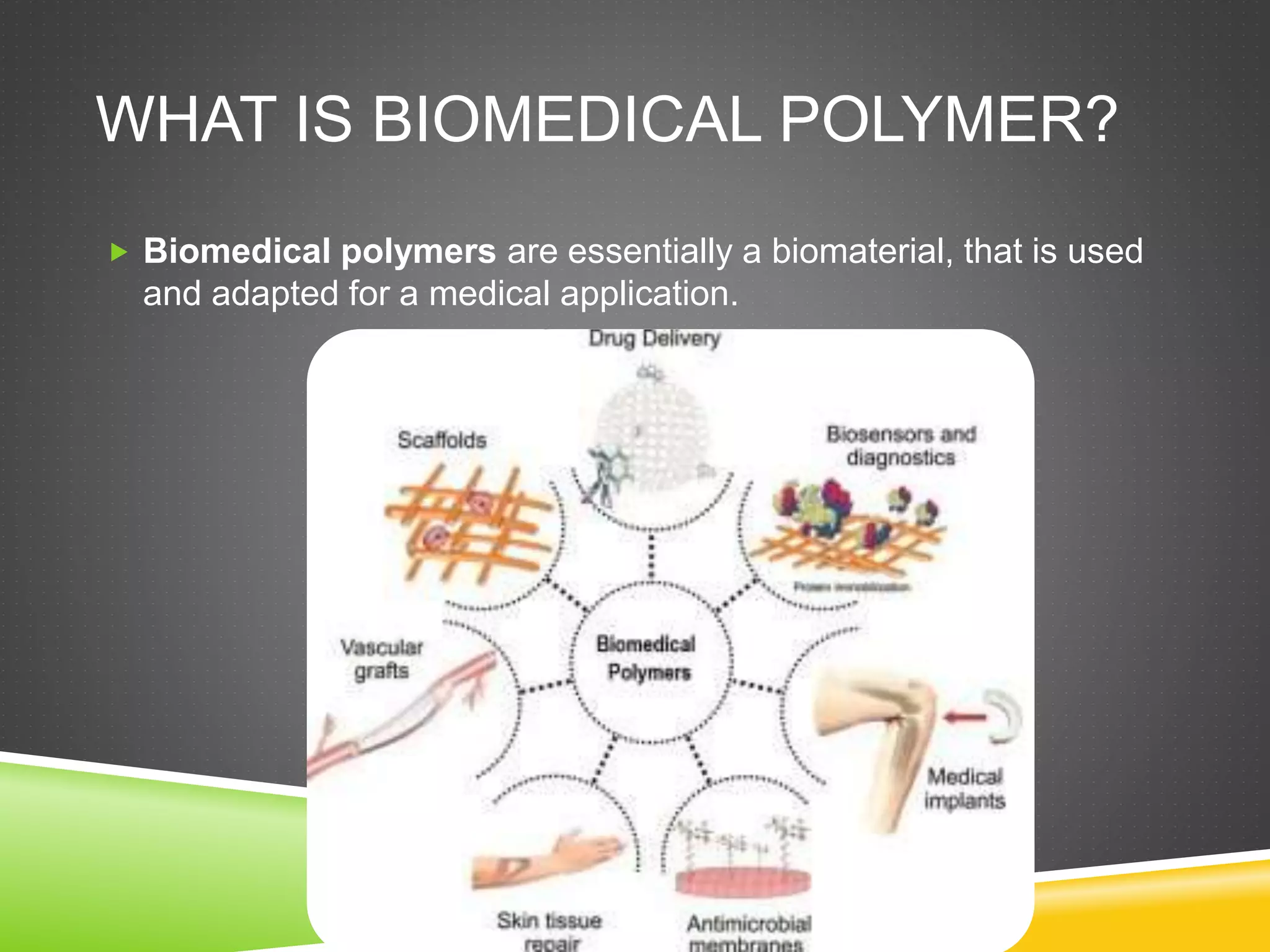
WHAT IS BIOMEDICAL POLYMER?
 Biomedical polymers are essentially a biomaterial, that is used
and adapted for a medical application.
PROPERTIES OF BIOMEDICAL
POLYMERS
 Flexibility
 Resistance to biochemical attack
 Good biocompatibility
 Light weight
 Available in a wide variety of compositions with
adequate physical and mechanical properties and
 Can be easily manufactured into products with the
desired shape.
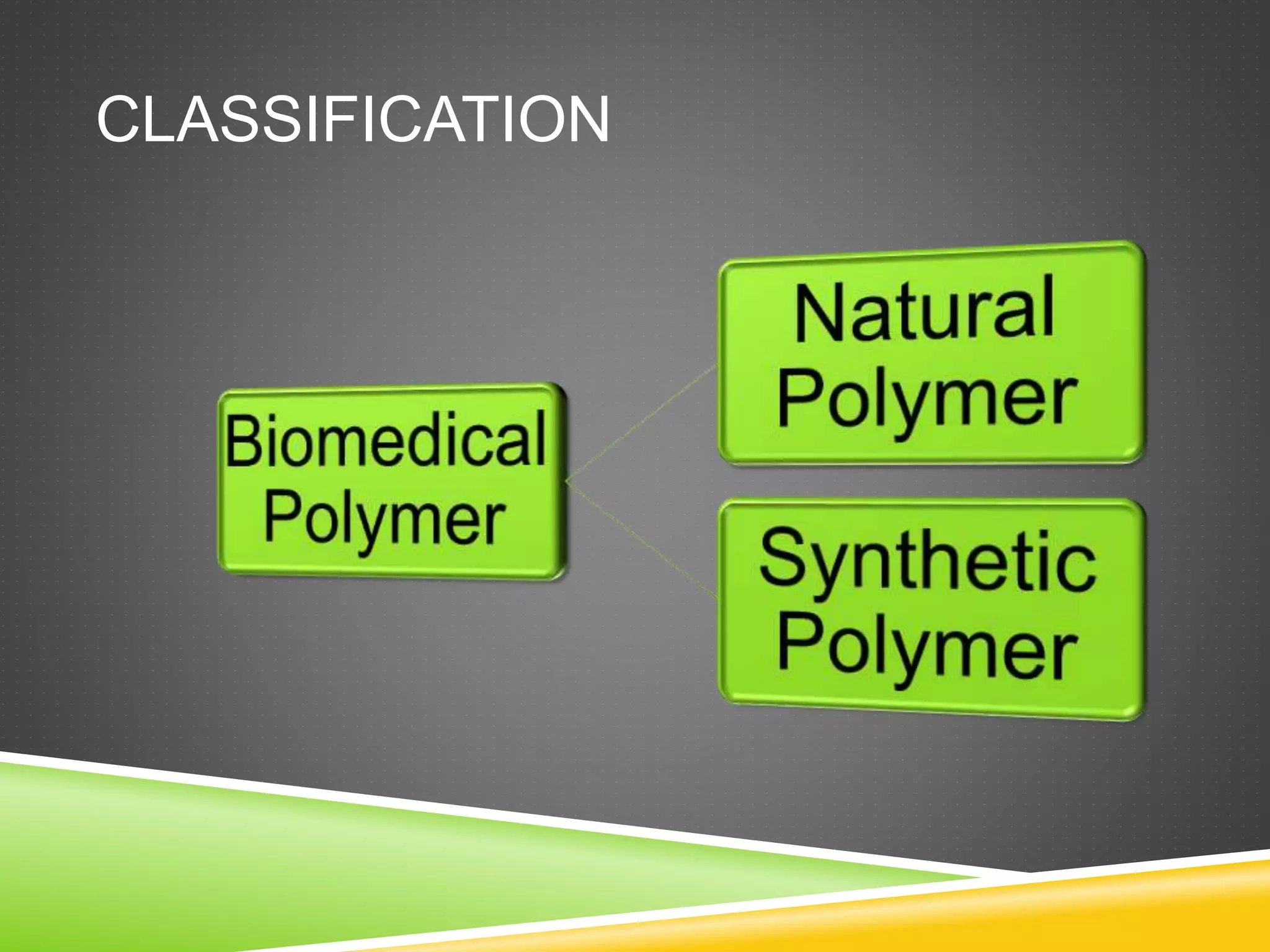
CLASSIFICATION
NATURAL POLYMER
Natural polymers, or polymers obtained naturally , are of great interest
in the biomaterials field.
Example of natural polymers
 Collagen
 Cellulose
 Alginates
 Dextrans
 Chitosan
 Fibrin
COLLAGEN
 Consist of three intertwined protein chains, helical structure.
 Collagen is non-toxic, minimal immune response.
 Can be processed into a variety formats – porous sponges,
gels, and sheets.
 Applications:
 Surgery, drug delivery, prosthetic implants and tissue-
engineering of multiple organs.
Nanometer scaffolds
CHITOSAN
 Derived from chitin, present in hard exoskeletons of
shellfish like shrimp and crab.
 Its desirable properties –
 Minimal foreign body reaction
 Controllable properties mechanical biodegradation
 Applications:
 In the engineering of cartilage, nerve, and liver
tissue,
 Wound dressing and drug delivery devices
ALGINATE
 A polysaccharide derived from brown seaweed
 Can be processed easily in water
 Non-toxic
 Biodegradable
 Controllable porosity
 Forms a solid gel under mild processing conditions
 Applications:
 Liver, nerve, heart, cartilage & tissue-
engineering
SYNTHETIC POLYMERS
 Synthetic polymers are also commonly used in tissue
engineering.
 They are much more reproducible and have better
mechanical properties in comparison to natural polymers.
 Example of synthetic polymers :
 Polytetrafluoroethylene (PTFE)
 Polyethylene (PE)
 Polypropylene (PP)
 Poly (caprolactone) (PCL)
 Poly (methyl methacrylate) (PMMA)
 Materials in maxillofacial prosthetic
POLY (CAPROLACTONE) (PCL)
 Poly(caprolactone) (PCL) is the semi-crystalline aliphatic
polyester.
 Properties such as great organic solvent solubility, a melting
temperature of about 55–60∘C and glass transition
temperature of −54∘C.
 Applications:
 Commonly used as tissue regeneration support
structures.
 Due to relatively long degradation profile PCL is suitable
for use in tissues with longer regeneration process.
CLASSIFICATION OF SYNTHETIC
POLYMERS
Synthetic
Polymers
Biostable
Polymer
Bioerodible
Polymer
Water soluble
Polymer
Other
Polymers
BIOSTABLE POLYMERS
 The term “biostability” commonly refers to the relative
stability of biomedical polymers in the physiological
environment as a function of time.
 Applications:
 Polymers that are sufficiently biostable allow their
long term use in artificial organs blood pumps,
blood vessel prostheses, heart valves, skeletal
joints, kidney prostheses.
BIOERODIBLE POLYMERS
 Polymers that are bioerodible materials that will serve
a short term purpose in the body and then decompose
to small molecules that can be metabolized or
excreted, sometimes with the concurrent release of
drug molecules.
 Applications:
 Mostly bioerodible polymers are used as surgical
sutures, tissue in growth materials, or controlled
release of drug.
WATER SOLUBLE POLYMERS
 Water-soluble polymers (usually bioerodible) include
polymers that form part of plasma or whole blood
substitute solutions or which may function as
macromolecular drugs.
 Applications:
 Improvement in the behavior of pharmaceuticals.
 Used in synthetic bloodsubstitutes as viscosity
enhancers or as oxygen-transport macromolecules.
SELECTION PARAMETERS FOR
BIOMEDICAL POLYMERS
The design and selection of biomaterials depend on different
properties:
 Biocompatibility
 Purity
 Stability
 Tolerability
 Sterilizability
 Fabrication
 Foreign body reaction.
 Mechanical, physical and chemical properties.
APPLICATIONS OF BIOMEDICAL
POLYMER
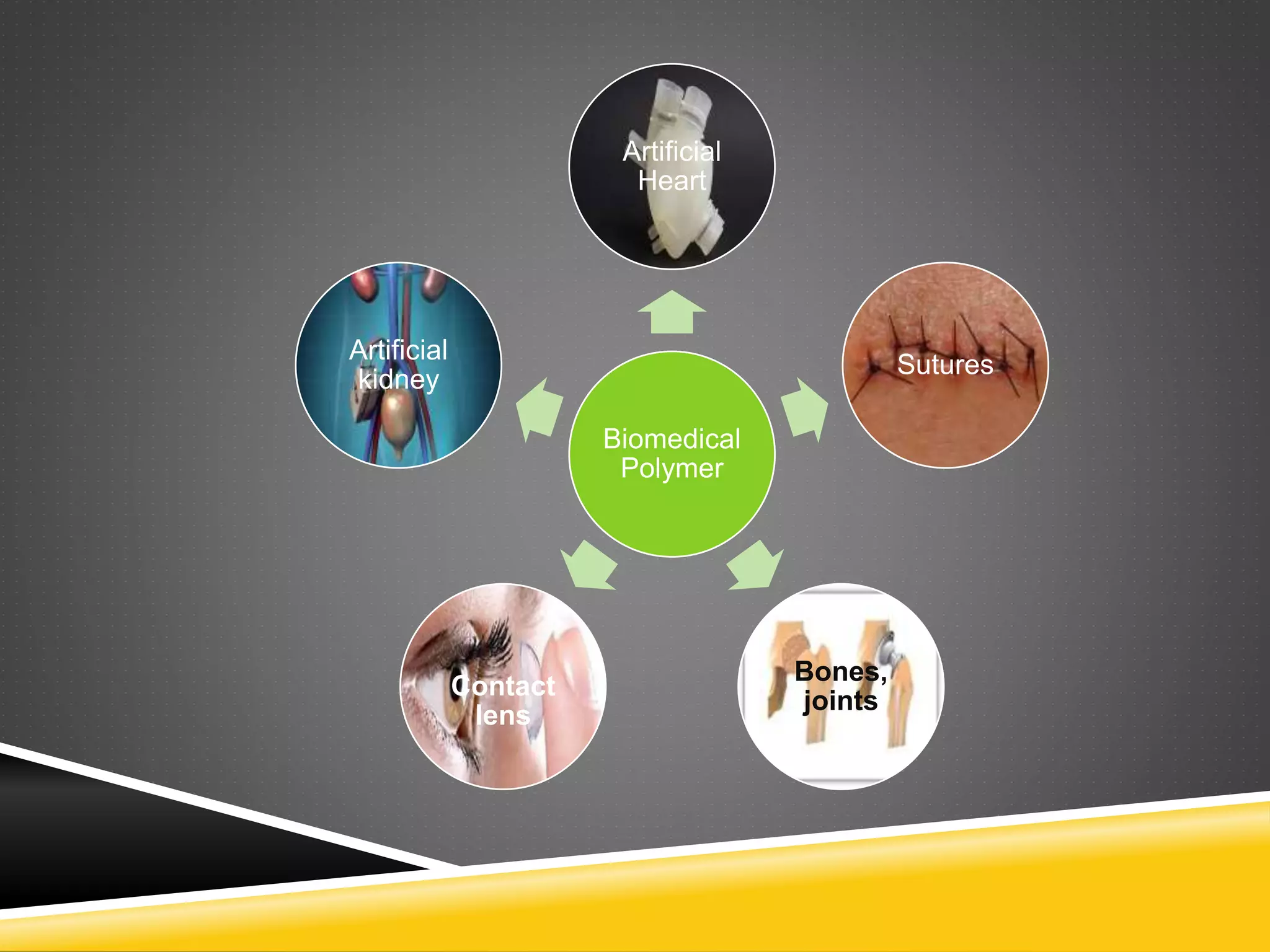
 Cardiovascular applications
 Bones, joints, and teeth
 Contact lenses and intraocular lenses
 Artificial kidney and hemodialysis materials
 oxygen-transport membranes
 Surgical sutures tissue ingrowth polymers
 Controlled release of drugs
Biomedical
Polymer
Artificial
Heart
Sutures
Bones,
joints
Contact
lens
Artificial
kidney
REFERENCES
 http://polybiolab.ippt.pan.pl/polymers-for-medical-
applications
 https://www.ncbi.nlm.nih.gov/pmc/articles/PMC313687
1/
 https://www.cambridge.org/core/journals/mrs-
bulletin/article/biostability-of-biomedical-
polymers/0FC3680E735F04BE8E92A71F70A83D7F
 Polymer Chemistry by Alka L. Gupta
Biomedical polymers

Biomedical polymers

  • 1.
    BIOMEDICAL POLYMERS Submitted to: Dr.R.S. Yadav Submitted by: Anjali Rani M.Sc. 4th Semester
  • 2.
    WHAT IS BIOMEDICALPOLYMER?  Biomedical polymers are essentially a biomaterial, that is used and adapted for a medical application.
  • 3.
    PROPERTIES OF BIOMEDICAL POLYMERS Flexibility  Resistance to biochemical attack  Good biocompatibility  Light weight  Available in a wide variety of compositions with adequate physical and mechanical properties and  Can be easily manufactured into products with the desired shape.
  • 4.
  • 5.
    NATURAL POLYMER Natural polymers,or polymers obtained naturally , are of great interest in the biomaterials field. Example of natural polymers  Collagen  Cellulose  Alginates  Dextrans  Chitosan  Fibrin
  • 6.
    COLLAGEN  Consist ofthree intertwined protein chains, helical structure.  Collagen is non-toxic, minimal immune response.  Can be processed into a variety formats – porous sponges, gels, and sheets.  Applications:  Surgery, drug delivery, prosthetic implants and tissue- engineering of multiple organs. Nanometer scaffolds
  • 7.
    CHITOSAN  Derived fromchitin, present in hard exoskeletons of shellfish like shrimp and crab.  Its desirable properties –  Minimal foreign body reaction  Controllable properties mechanical biodegradation  Applications:  In the engineering of cartilage, nerve, and liver tissue,  Wound dressing and drug delivery devices
  • 8.
    ALGINATE  A polysaccharidederived from brown seaweed  Can be processed easily in water  Non-toxic  Biodegradable  Controllable porosity  Forms a solid gel under mild processing conditions  Applications:  Liver, nerve, heart, cartilage & tissue- engineering
  • 9.
    SYNTHETIC POLYMERS  Syntheticpolymers are also commonly used in tissue engineering.  They are much more reproducible and have better mechanical properties in comparison to natural polymers.  Example of synthetic polymers :  Polytetrafluoroethylene (PTFE)  Polyethylene (PE)  Polypropylene (PP)  Poly (caprolactone) (PCL)  Poly (methyl methacrylate) (PMMA)  Materials in maxillofacial prosthetic
  • 10.
    POLY (CAPROLACTONE) (PCL) Poly(caprolactone) (PCL) is the semi-crystalline aliphatic polyester.  Properties such as great organic solvent solubility, a melting temperature of about 55–60∘C and glass transition temperature of −54∘C.  Applications:  Commonly used as tissue regeneration support structures.  Due to relatively long degradation profile PCL is suitable for use in tissues with longer regeneration process.
  • 11.
  • 12.
    BIOSTABLE POLYMERS  Theterm “biostability” commonly refers to the relative stability of biomedical polymers in the physiological environment as a function of time.  Applications:  Polymers that are sufficiently biostable allow their long term use in artificial organs blood pumps, blood vessel prostheses, heart valves, skeletal joints, kidney prostheses.
  • 13.
    BIOERODIBLE POLYMERS  Polymersthat are bioerodible materials that will serve a short term purpose in the body and then decompose to small molecules that can be metabolized or excreted, sometimes with the concurrent release of drug molecules.  Applications:  Mostly bioerodible polymers are used as surgical sutures, tissue in growth materials, or controlled release of drug.
  • 14.
    WATER SOLUBLE POLYMERS Water-soluble polymers (usually bioerodible) include polymers that form part of plasma or whole blood substitute solutions or which may function as macromolecular drugs.  Applications:  Improvement in the behavior of pharmaceuticals.  Used in synthetic bloodsubstitutes as viscosity enhancers or as oxygen-transport macromolecules.
  • 15.
    SELECTION PARAMETERS FOR BIOMEDICALPOLYMERS The design and selection of biomaterials depend on different properties:  Biocompatibility  Purity  Stability  Tolerability  Sterilizability  Fabrication  Foreign body reaction.  Mechanical, physical and chemical properties.
  • 16.
    APPLICATIONS OF BIOMEDICAL POLYMER Cardiovascular applications  Bones, joints, and teeth  Contact lenses and intraocular lenses  Artificial kidney and hemodialysis materials  oxygen-transport membranes  Surgical sutures tissue ingrowth polymers  Controlled release of drugs
  • 17.
  • 18.
    REFERENCES  http://polybiolab.ippt.pan.pl/polymers-for-medical- applications  https://www.ncbi.nlm.nih.gov/pmc/articles/PMC313687 1/ https://www.cambridge.org/core/journals/mrs- bulletin/article/biostability-of-biomedical- polymers/0FC3680E735F04BE8E92A71F70A83D7F  Polymer Chemistry by Alka L. Gupta