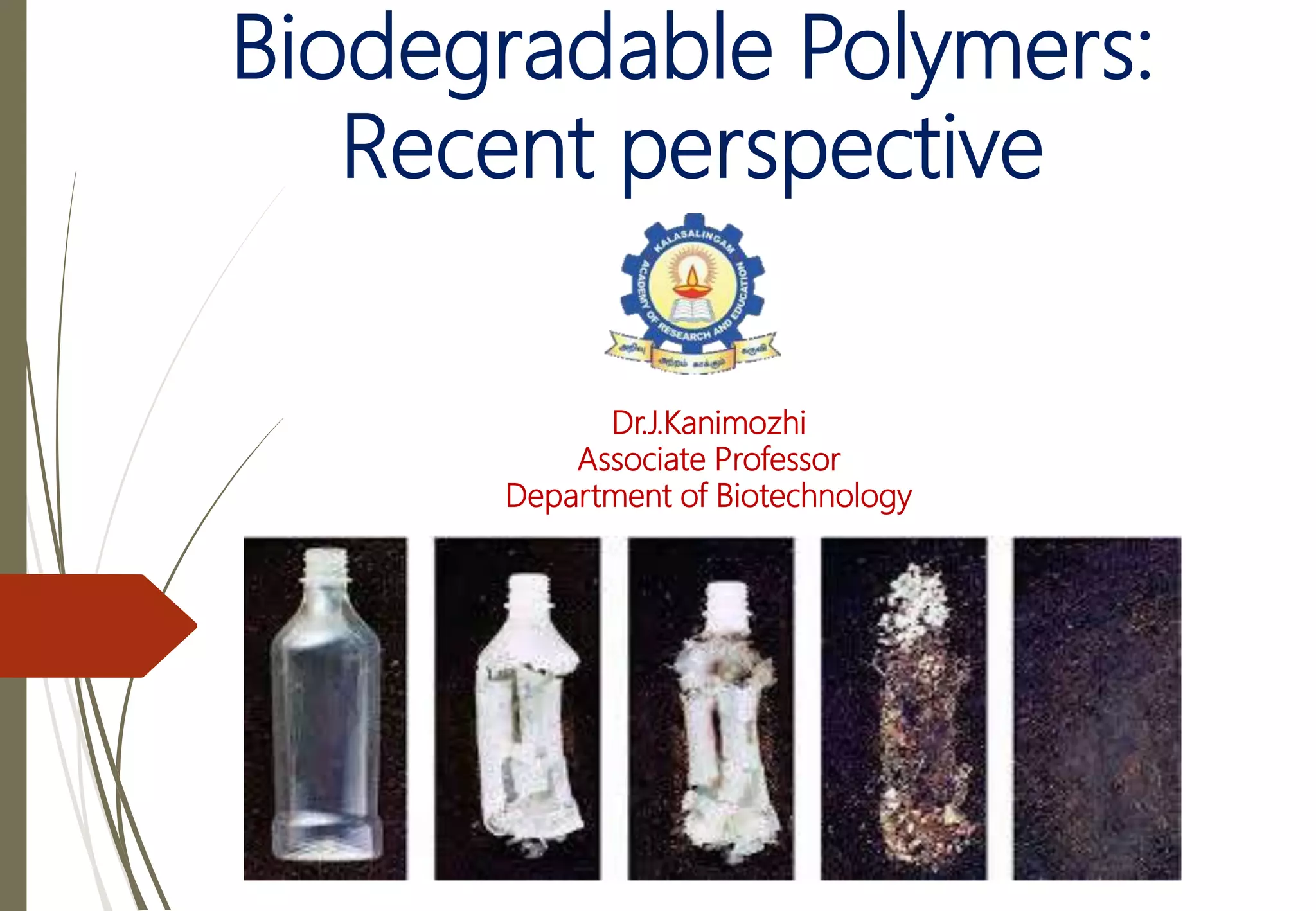

Biodegradable Polymers:
Recent perspective
Dr.J.Kanimozhi
Associate Professor
Department of Biotechnology
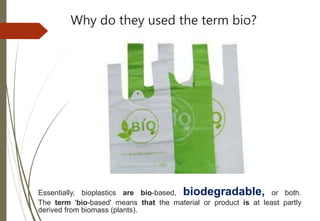
Why do they used the term bio?
Essentially, bioplastics are bio-based, biodegradable, or both.
The term 'bio-based' means that the material or product is at least partly
derived from biomass (plants).
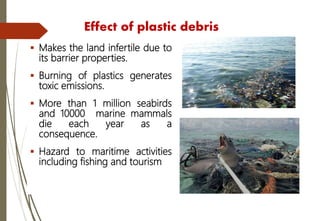
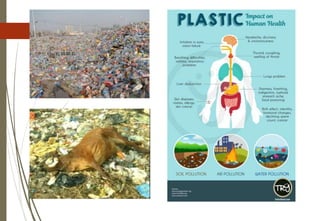
Effect of plastic debris
 Makes the land infertile due to
its barrier properties.
 Burning of plastics generates
toxic emissions.
 More than 1 million seabirds
and 10000 marine mammals
die each year as a
consequence.
 Hazard to maritime activities
including fishing and tourism
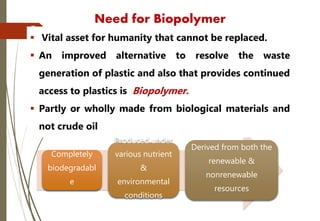
Completely
biodegradabl
e
Produced under
various nutrient
&
environmental
conditions
Derived from both the
renewable &
nonrenewable
resources
Need for Biopolymer
7
 Vital asset for humanity that cannot be replaced.
 An improved alternative to resolve the waste
generation of plastic and also that provides continued
access to plastics is Biopolymer.
 Partly or wholly made from biological materials and
not crude oil
Biopolymers
 Biopolymers are made partly or
wholly from polymers derived from
biological sources such as
microorganisms, sugar cane, potato
starch, or the cellulose from trees,
and are biodegradable with the
action of microorganisms, heat, and
moisture.
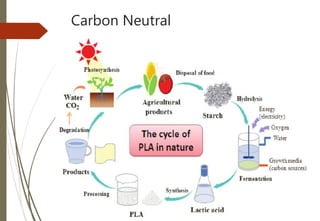
 Biopolymers are sustainable, carbon
neutral, and are always renewable.
 Biopolymers are synthesized as
intracellular carbon and energy
reserves by a variety of
microorganisms, especially when
cultured in limiting nutritional
conditions.
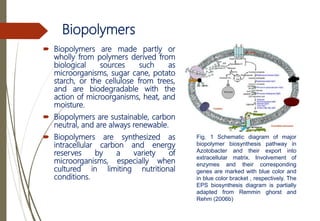
Fig. 1 Schematic diagram of major
biopolymer biosynthesis pathway in
Azotobacter and their export into
extracellular matrix. Involvement of
enzymes and their corresponding
genes are marked with blue color and
in blue color bracket , respectively. The
EPS biosynthesis diagram is partially
adapted from Remmin ghorst and
Rehm (2006b)
Biodegradable Polymers
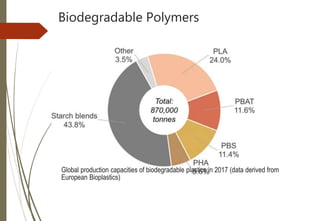
Global production capacities of biodegradable plastics in 2017 (data derived from
European Bioplastics)
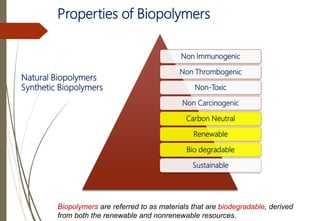
Properties of Biopolymers
Non Immunogenic
Non Thrombogenic
Non-Toxic
Non Carcinogenic
Carbon Neutral
Renewable
Bio degradable
Sustainable
Biopolymers are referred to as materials that are biodegradable, derived
from both the renewable and nonrenewable resources.
Natural Biopolymers
Synthetic Biopolymers
Bio(degradable) Polymers
CO2
H2O
Biomass
Biodegradable
Polymers
Microbial Enzymes
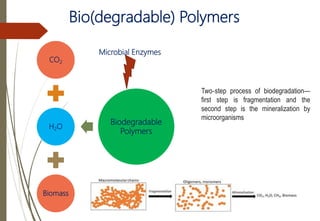
Two‐step process of biodegradation—
first step is fragmentation and the
second step is the mineralization by
microorganisms
Carbon Neutral
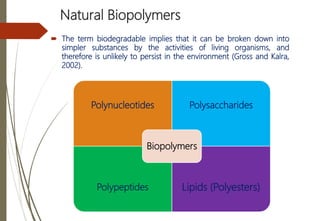
Natural Biopolymers
 The term biodegradable implies that it can be broken down into
simpler substances by the activities of living organisms, and
therefore is unlikely to persist in the environment (Gross and Kalra,
2002).
Polynucleotides Polysaccharides
Polypeptides Lipids (Polyesters)
Biopolymers
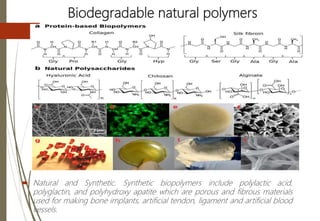
Biodegradable natural polymers
 Natural and Synthetic. Synthetic biopolymers include polylactic acid,
polyglactin, and polyhydroxy apatite which are porous and fibrous materials
used for making bone implants, artificial tendon, ligament and artificial blood
vessels.
Synthetic Polymers
 Synthetic polymers susceptible to biodegradation can be of different
types, e.g. polymers containing hydrolyzable backbone polyesters.
 Recent research activity on biodegradable synthetic polymers has often
been focused on the simulation of different biopolymers or polymers
with degradable backbones, e.g. polyanhydrides, polycarbonates,
polylactones, etc.
 Other concepts in the search for new biodegradable materials include
the use of microorganisms which can produce polymers, e.g. poly(β-
hydroxybutyrate) (PHB; 1) and copolymers of PHB.
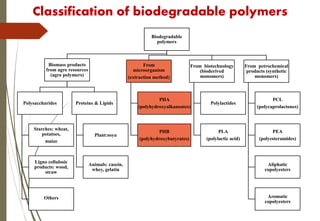
Classification of biodegradable polymers
16
Biodegradable
polymers
Biomass products
from agro resources
(agro polymers)
Polysaccharides
Starches: wheat,
potatoes,
maize
Ligno cellulosic
products: wood,
straw
Others
Proteins & Lipids
Plant:soya
Animals: casein,
whey, gelatin
From
microorganism
(extraction method)
PHA
(polyhydroxyalkanoates)
PHB
(polyhydroxybutyrates)
From biotechnology
(bioderived
monomers)
Polylactides
PLA
(polylactic acid)
From petrochemical
products (synthetic
monomers)
PCL
(polycaprolactones)
PEA
(polyesteramides)
Aliphatic
copolyesters
Aromatic
copolyesters
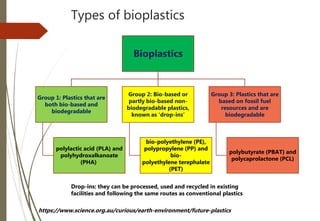
Types of bioplastics
Bioplastics
Group 1: Plastics that are
both bio-based and
biodegradable
polylactic acid (PLA) and
polyhydroxalkanoate
(PHA)
Group 2: Bio-based or
partly bio-based non-
biodegradable plastics,
known as ‘drop-ins’
bio-polyethylene (PE),
polypropylene (PP) and
bio-
polyethylene terephalate
(PET)
Group 3: Plastics that are
based on fossil fuel
resources and are
biodegradable
polybutyrate (PBAT) and
polycaprolactone (PCL)
https://www.science.org.au/curious/earth-environment/future-plastics
Drop-ins: they can be processed, used and recycled in existing
facilities and following the same routes as conventional plastics
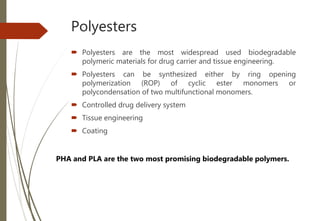
Polyesters
 Polyesters are the most widespread used biodegradable
polymeric materials for drug carrier and tissue engineering.
 Polyesters can be synthesized either by ring opening
polymerization (ROP) of cyclic ester monomers or
polycondensation of two multifunctional monomers.
 Controlled drug delivery system
 Tissue engineering
 Coating
PHA and PLA are the two most promising biodegradable polymers.
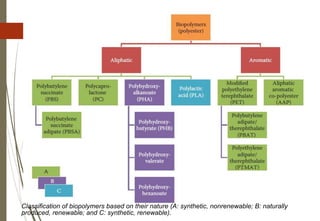
Classification of biopolymers based on their nature (A: synthetic, nonrenewable; B: naturally
produced, renewable; and C: synthetic, renewable).
Recent Perspectives
 Vegetable oil based polyesters
 Exploring biodegradable polymer production from
microbes (marine microbes)
 In packaging applications, a biodegradable additive
is often included as a way to promote
environmental degradation e.g. starch in
polyethylene (PE).
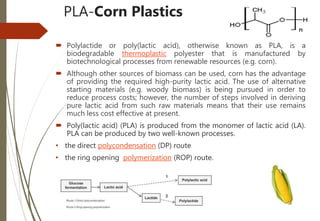
PLA-Corn Plastics
 Polylactide or poly(lactic acid), otherwise known as PLA, is a
biodegradable thermoplastic polyester that is manufactured by
biotechnological processes from renewable resources (e.g. corn).
 Although other sources of biomass can be used, corn has the advantage
of providing the required high-purity lactic acid. The use of alternative
starting materials (e.g. woody biomass) is being pursued in order to
reduce process costs; however, the number of steps involved in deriving
pure lactic acid from such raw materials means that their use remains
much less cost effective at present.
 Poly(lactic acid) (PLA) is produced from the monomer of lactic acid (LA).
PLA can be produced by two well-known processes.
• the direct polycondensation (DP) route
• the ring opening polymerization (ROP) route.
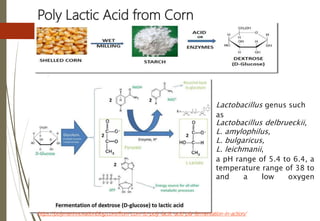
Poly Lactic Acid from Corn
https://polymerinnovationblog.com/from-corn-to-poly-lactic-acid-pla-fermentation-in-action/
Lactobacillus genus such
as
Lactobacillus delbrueckii,
L. amylophilus,
L. bulgaricus,
L. leichmanii,
a pH range of 5.4 to 6.4, a
temperature range of 38 to
and a low oxygen
Cons of Polylactic Acid (PLA) or “Corn
Plastics”
 PLA production depends on large fields of crops
 PLA plastics are only compostable in a commercial composting
facility
 Improperly disposed PLA plastics can contaminate recycling
processes
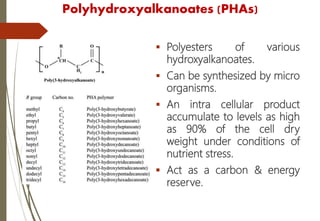
Polyhydroxyalkanoates (PHAs)
 Polyesters of various
hydroxyalkanoates.
 Can be synthesized by micro
organisms.
 An intra cellular product
accumulate to levels as high
as 90% of the cell dry
weight under conditions of
nutrient stress.
 Act as a carbon & energy
reserve.
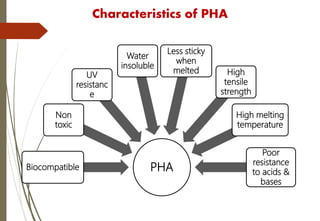
Characteristics of PHA
PHABiocompatible
Non
toxic
UV
resistanc
e
Water
insoluble
Less sticky
when
melted High
tensile
strength
High melting
temperature
Poor
resistance
to acids &
bases
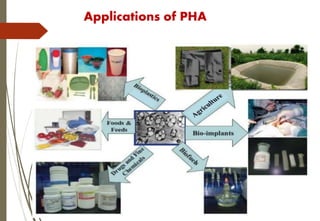
Applications of PHA
Economic drawbacks in current
production methods
 Cost
 Raw material availability (agricultural land and
biomasses)
 Possibility of industrial and structural application
development (short, medium, long term)
 Ageing and durability
 Biodegradability and/or compostability of high thickness
moulded part.
Research Focus
 Identification of alternative cost-effective substrates for the
production of PHA.
 Utilisation of agro industrial materials in production of PHB
will ensure the low production cost and also solve the
problem of waste management to certain level.
 Continued research and development in this area creates
high quality products.
 The three drivers of growth – the importance of brand
image to consumer goods companies, the value of joint
composting and the reduction of litter – will provide the spur
for continued growth in bioplastics across the world.
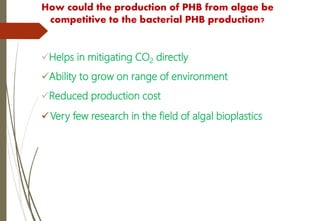
How could the production of PHB from algae be
competitive to the bacterial PHB production?
Helps in mitigating CO2 directly
Ability to grow on range of environment
Reduced production cost
Very few research in the field of algal bioplastics
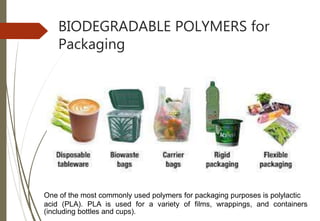
BIODEGRADABLE POLYMERS for
Packaging
One of the most commonly used polymers for packaging purposes is polylactic
acid (PLA). PLA is used for a variety of films, wrappings, and containers
(including bottles and cups).
Blends
 Both PLA and PHB are fairly hard and brittle materials, and not very
useful for many industrial applications.
 On the Use of PLA-PHB Blends for Sustainable Food Packaging
Applications: P(3HB)/PLA blend
 Polyhydroxyalkanoates (PHAs), their Blends, Composites and
Nanocomposites
 (3HB)/PCL Blends
 Ethyl-cellulose (EtC) and PHB
 P(3HB)/starch
 P(3HB)/chitosan
 P(3HB)/cellulose propionate (CP)
 P(3HB)/cellulose acetate butyrate (CAB)
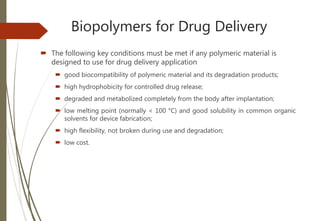
Biopolymers for Drug Delivery
 The following key conditions must be met if any polymeric material is
designed to use for drug delivery application
 good biocompatibility of polymeric material and its degradation products;
 high hydrophobicity for controlled drug release;
 degraded and metabolized completely from the body after implantation;
 low melting point (normally < 100 °C) and good solubility in common organic
solvents for device fabrication;
 high flexibility, not broken during use and degradation;
 low cost.
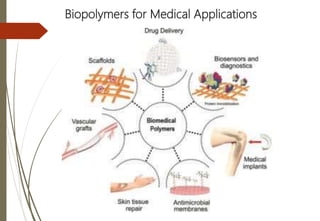
Biopolymers for Medical Applications
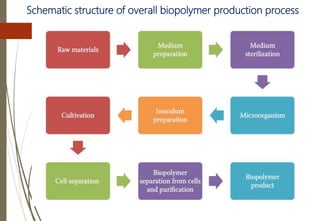
Schematic structure of overall biopolymer production process
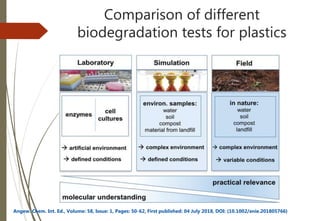
Comparison of different
biodegradation tests for plastics
Angew. Chem. Int. Ed., Volume: 58, Issue: 1, Pages: 50-62, First published: 04 July 2018, DOI: (10.1002/anie.201805766)
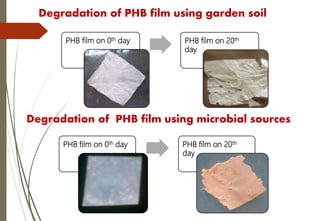
Degradation of PHB film using garden soil
Degradation of PHB film using microbial sources
PHB film on 0th day PHB film on 20th
day
PHB film on 0th day PHB film on 20th
day
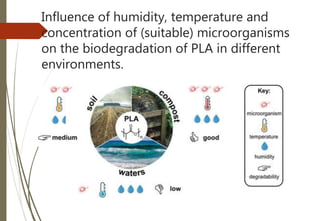
Influence of humidity, temperature and
concentration of (suitable) microorganisms
on the biodegradation of PLA in different
environments.
ARE BIODEGRADABLE POLYMERS
THE FUTURE?
 New ASTM guidelines are under preparation for testing
biodegradable polymers, as opposed to photodegradable and
oxidatively and hydrolytically degradable ones.
 Several countries have taken action against non-degradable
polymers, in particular Japan, where the Ministry of International
Trade and Industry conducted a feasibility study on the development
of biodegradable plastics in 1989.
 Biopolymers will be developed by microorganisms, chemical
synthesis of biopolymers and the commercial use of natural
macromolecules. A biodegradable plastic research group was also
organized by about 50 companies in 1989 in Japan.
Thank you

Biopolymers presentation

  • 1.
  • 4.
    Why do theyused the term bio? Essentially, bioplastics are bio-based, biodegradable, or both. The term 'bio-based' means that the material or product is at least partly derived from biomass (plants).
  • 5.
    Effect of plasticdebris  Makes the land infertile due to its barrier properties.  Burning of plastics generates toxic emissions.  More than 1 million seabirds and 10000 marine mammals die each year as a consequence.  Hazard to maritime activities including fishing and tourism
  • 7.
    Completely biodegradabl e Produced under various nutrient & environmental conditions Derivedfrom both the renewable & nonrenewable resources Need for Biopolymer 7  Vital asset for humanity that cannot be replaced.  An improved alternative to resolve the waste generation of plastic and also that provides continued access to plastics is Biopolymer.  Partly or wholly made from biological materials and not crude oil
  • 8.
    Biopolymers  Biopolymers aremade partly or wholly from polymers derived from biological sources such as microorganisms, sugar cane, potato starch, or the cellulose from trees, and are biodegradable with the action of microorganisms, heat, and moisture.  Biopolymers are sustainable, carbon neutral, and are always renewable.  Biopolymers are synthesized as intracellular carbon and energy reserves by a variety of microorganisms, especially when cultured in limiting nutritional conditions. Fig. 1 Schematic diagram of major biopolymer biosynthesis pathway in Azotobacter and their export into extracellular matrix. Involvement of enzymes and their corresponding genes are marked with blue color and in blue color bracket , respectively. The EPS biosynthesis diagram is partially adapted from Remmin ghorst and Rehm (2006b)
  • 9.
    Biodegradable Polymers Global productioncapacities of biodegradable plastics in 2017 (data derived from European Bioplastics)
  • 10.
    Properties of Biopolymers NonImmunogenic Non Thrombogenic Non-Toxic Non Carcinogenic Carbon Neutral Renewable Bio degradable Sustainable Biopolymers are referred to as materials that are biodegradable, derived from both the renewable and nonrenewable resources. Natural Biopolymers Synthetic Biopolymers
  • 11.
    Bio(degradable) Polymers CO2 H2O Biomass Biodegradable Polymers Microbial Enzymes Two‐stepprocess of biodegradation— first step is fragmentation and the second step is the mineralization by microorganisms
  • 12.
  • 13.
    Natural Biopolymers  Theterm biodegradable implies that it can be broken down into simpler substances by the activities of living organisms, and therefore is unlikely to persist in the environment (Gross and Kalra, 2002). Polynucleotides Polysaccharides Polypeptides Lipids (Polyesters) Biopolymers
  • 14.
    Biodegradable natural polymers Natural and Synthetic. Synthetic biopolymers include polylactic acid, polyglactin, and polyhydroxy apatite which are porous and fibrous materials used for making bone implants, artificial tendon, ligament and artificial blood vessels.
  • 15.
    Synthetic Polymers  Syntheticpolymers susceptible to biodegradation can be of different types, e.g. polymers containing hydrolyzable backbone polyesters.  Recent research activity on biodegradable synthetic polymers has often been focused on the simulation of different biopolymers or polymers with degradable backbones, e.g. polyanhydrides, polycarbonates, polylactones, etc.  Other concepts in the search for new biodegradable materials include the use of microorganisms which can produce polymers, e.g. poly(β- hydroxybutyrate) (PHB; 1) and copolymers of PHB.
  • 16.
    Classification of biodegradablepolymers 16 Biodegradable polymers Biomass products from agro resources (agro polymers) Polysaccharides Starches: wheat, potatoes, maize Ligno cellulosic products: wood, straw Others Proteins & Lipids Plant:soya Animals: casein, whey, gelatin From microorganism (extraction method) PHA (polyhydroxyalkanoates) PHB (polyhydroxybutyrates) From biotechnology (bioderived monomers) Polylactides PLA (polylactic acid) From petrochemical products (synthetic monomers) PCL (polycaprolactones) PEA (polyesteramides) Aliphatic copolyesters Aromatic copolyesters
  • 17.
    Types of bioplastics Bioplastics Group1: Plastics that are both bio-based and biodegradable polylactic acid (PLA) and polyhydroxalkanoate (PHA) Group 2: Bio-based or partly bio-based non- biodegradable plastics, known as ‘drop-ins’ bio-polyethylene (PE), polypropylene (PP) and bio- polyethylene terephalate (PET) Group 3: Plastics that are based on fossil fuel resources and are biodegradable polybutyrate (PBAT) and polycaprolactone (PCL) https://www.science.org.au/curious/earth-environment/future-plastics Drop-ins: they can be processed, used and recycled in existing facilities and following the same routes as conventional plastics
  • 18.
    Polyesters  Polyesters arethe most widespread used biodegradable polymeric materials for drug carrier and tissue engineering.  Polyesters can be synthesized either by ring opening polymerization (ROP) of cyclic ester monomers or polycondensation of two multifunctional monomers.  Controlled drug delivery system  Tissue engineering  Coating PHA and PLA are the two most promising biodegradable polymers.
  • 19.
    Classification of biopolymersbased on their nature (A: synthetic, nonrenewable; B: naturally produced, renewable; and C: synthetic, renewable).
  • 20.
    Recent Perspectives  Vegetableoil based polyesters  Exploring biodegradable polymer production from microbes (marine microbes)  In packaging applications, a biodegradable additive is often included as a way to promote environmental degradation e.g. starch in polyethylene (PE).
  • 21.
    PLA-Corn Plastics  Polylactideor poly(lactic acid), otherwise known as PLA, is a biodegradable thermoplastic polyester that is manufactured by biotechnological processes from renewable resources (e.g. corn).  Although other sources of biomass can be used, corn has the advantage of providing the required high-purity lactic acid. The use of alternative starting materials (e.g. woody biomass) is being pursued in order to reduce process costs; however, the number of steps involved in deriving pure lactic acid from such raw materials means that their use remains much less cost effective at present.  Poly(lactic acid) (PLA) is produced from the monomer of lactic acid (LA). PLA can be produced by two well-known processes. • the direct polycondensation (DP) route • the ring opening polymerization (ROP) route.
  • 22.
    Poly Lactic Acidfrom Corn https://polymerinnovationblog.com/from-corn-to-poly-lactic-acid-pla-fermentation-in-action/ Lactobacillus genus such as Lactobacillus delbrueckii, L. amylophilus, L. bulgaricus, L. leichmanii, a pH range of 5.4 to 6.4, a temperature range of 38 to and a low oxygen
  • 23.
    Cons of PolylacticAcid (PLA) or “Corn Plastics”  PLA production depends on large fields of crops  PLA plastics are only compostable in a commercial composting facility  Improperly disposed PLA plastics can contaminate recycling processes
  • 24.
    Polyhydroxyalkanoates (PHAs)  Polyestersof various hydroxyalkanoates.  Can be synthesized by micro organisms.  An intra cellular product accumulate to levels as high as 90% of the cell dry weight under conditions of nutrient stress.  Act as a carbon & energy reserve.
  • 25.
    Characteristics of PHA PHABiocompatible Non toxic UV resistanc e Water insoluble Lesssticky when melted High tensile strength High melting temperature Poor resistance to acids & bases
  • 26.
  • 27.
    Economic drawbacks incurrent production methods  Cost  Raw material availability (agricultural land and biomasses)  Possibility of industrial and structural application development (short, medium, long term)  Ageing and durability  Biodegradability and/or compostability of high thickness moulded part.
  • 28.
    Research Focus  Identificationof alternative cost-effective substrates for the production of PHA.  Utilisation of agro industrial materials in production of PHB will ensure the low production cost and also solve the problem of waste management to certain level.  Continued research and development in this area creates high quality products.  The three drivers of growth – the importance of brand image to consumer goods companies, the value of joint composting and the reduction of litter – will provide the spur for continued growth in bioplastics across the world.
  • 29.
    How could theproduction of PHB from algae be competitive to the bacterial PHB production? Helps in mitigating CO2 directly Ability to grow on range of environment Reduced production cost Very few research in the field of algal bioplastics
  • 30.
    BIODEGRADABLE POLYMERS for Packaging Oneof the most commonly used polymers for packaging purposes is polylactic acid (PLA). PLA is used for a variety of films, wrappings, and containers (including bottles and cups).
  • 31.
    Blends  Both PLAand PHB are fairly hard and brittle materials, and not very useful for many industrial applications.  On the Use of PLA-PHB Blends for Sustainable Food Packaging Applications: P(3HB)/PLA blend  Polyhydroxyalkanoates (PHAs), their Blends, Composites and Nanocomposites  (3HB)/PCL Blends  Ethyl-cellulose (EtC) and PHB  P(3HB)/starch  P(3HB)/chitosan  P(3HB)/cellulose propionate (CP)  P(3HB)/cellulose acetate butyrate (CAB)
  • 32.
    Biopolymers for DrugDelivery  The following key conditions must be met if any polymeric material is designed to use for drug delivery application  good biocompatibility of polymeric material and its degradation products;  high hydrophobicity for controlled drug release;  degraded and metabolized completely from the body after implantation;  low melting point (normally < 100 °C) and good solubility in common organic solvents for device fabrication;  high flexibility, not broken during use and degradation;  low cost.
  • 33.
  • 34.
    Schematic structure ofoverall biopolymer production process
  • 35.
    Comparison of different biodegradationtests for plastics Angew. Chem. Int. Ed., Volume: 58, Issue: 1, Pages: 50-62, First published: 04 July 2018, DOI: (10.1002/anie.201805766)
  • 36.
    Degradation of PHBfilm using garden soil Degradation of PHB film using microbial sources PHB film on 0th day PHB film on 20th day PHB film on 0th day PHB film on 20th day
  • 37.
    Influence of humidity,temperature and concentration of (suitable) microorganisms on the biodegradation of PLA in different environments.
  • 38.
    ARE BIODEGRADABLE POLYMERS THEFUTURE?  New ASTM guidelines are under preparation for testing biodegradable polymers, as opposed to photodegradable and oxidatively and hydrolytically degradable ones.  Several countries have taken action against non-degradable polymers, in particular Japan, where the Ministry of International Trade and Industry conducted a feasibility study on the development of biodegradable plastics in 1989.  Biopolymers will be developed by microorganisms, chemical synthesis of biopolymers and the commercial use of natural macromolecules. A biodegradable plastic research group was also organized by about 50 companies in 1989 in Japan.
  • 39.