PLASTICS Two main reasons why they are so widespread.  An enormous range of possible structures, giving a huge variety of properties.  Easy to process and shape, leading to simple manufacture.
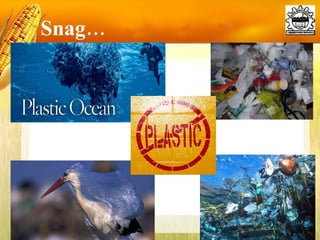
Snag…
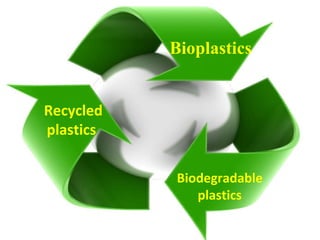
Bioplastics Biodegradable  plastics   Recycled plastics
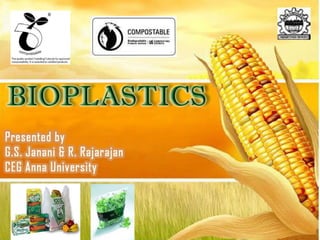
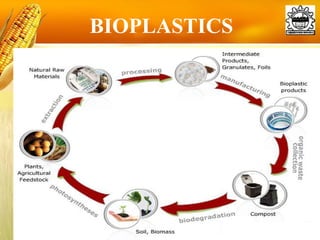
BIOPLASTICS Bioplastics are a form of plastics derived from renewable biomass sources, such as vegetable oil, corn starch, pea starch, or micro biota, rather than fossil-fuel plastics (which are derived from petroleum). Bio-plastics are based on the principle of the natural cycle i.e. organic material is generated by photo-synthesis and is broken down by microbial degradation into the initial products of CO 2  and water.
Types of Bioplastics Starch and Starch Blends PLA/ Poly Lactic acid PHB Poly-3-hydroxybutyrates
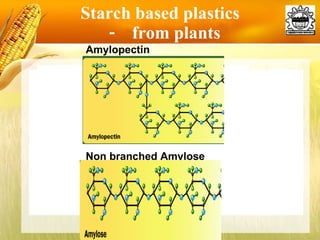
Starch based plastics   -  from plants  Amylopectin Non branched Amylose
Cont… Partially crystalline Higher density low resistance to oil and solvents Easy to process but vulnerable to degradation Sensitive to moisture and high water vapour permeability
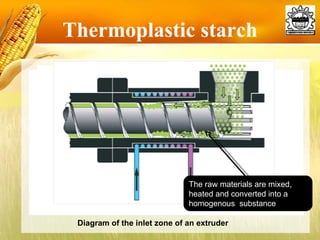
Thermoplastic starch Diagram of the inlet zone of an extruder The raw materials are mixed, heated and converted into a homogenous  substance
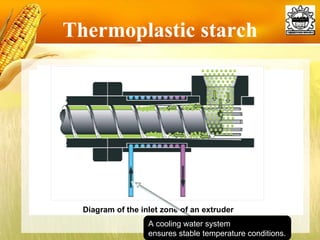
Thermoplastic starch Diagram of the inlet zone of an extruder A cooling water system ensures stable temperature conditions.
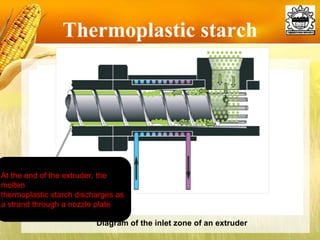
Thermoplastic starch Diagram of the inlet zone of an extruder At the end of the extruder, the molten thermoplastic starch discharges as a strand through a nozzle plate
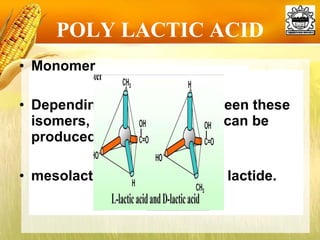
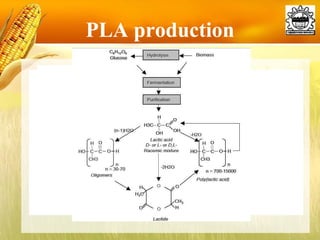
POLY LACTIC ACID Monomer Depending on the links between these isomers, 3 different lactides can be produced:  mesolactide, D-lactide and L lactide.
PLA production
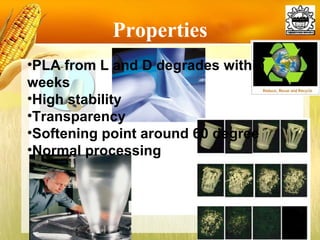
Properties PLA from L and D degrades within weeks High stability Transparency Softening point around 60 degree Normal processing
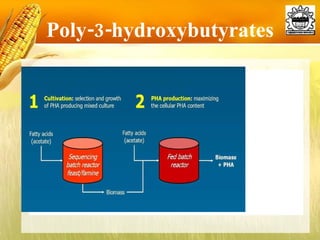
Poly-3-hydroxybutyrates
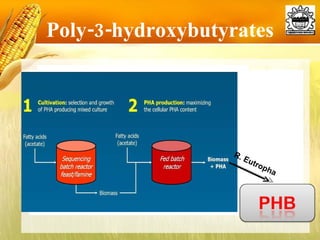
Poly-3-hydroxybutyrates R. Eutropha
Properties Good thermoplastic material Wide temperature range Lower crystallinity Tendency to creep and shrinkage 1.3% Higher melt viscosity UV resistance
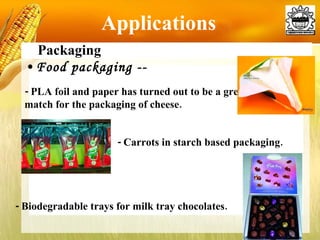
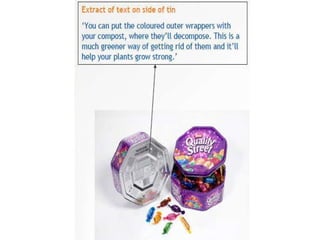
Applications Packaging Food packaging --  -  PLA foil and paper has turned out to be a great match for the packaging of cheese. -  Carrots in starch based packaging. - Biodegradable trays for milk tray chocolates.
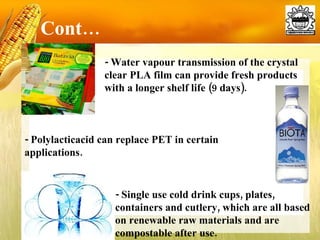
Cont… - Water vapour transmission of the crystal clear PLA film can provide fresh products with a longer shelf life (9 days). - Polylacticacid can replace PET in certain applications. - Single use cold drink cups, plates, containers and cutlery, which are all based on renewable raw materials and are compostable after use.
 
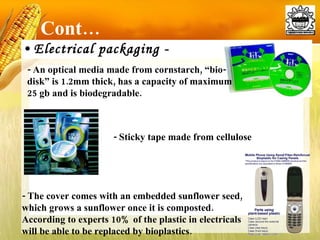
Cont… Electrical packaging - - An optical media made from cornstarch, “bio-disk” is 1.2mm thick, has a capacity of maximum 25 gb and is biodegradable. - Sticky tape made from cellulose - The cover comes with an embedded sunflower seed, which grows a sunflower once it is composted. According to experts 10% of the plastic in electricals will be able to be replaced by bioplastics.
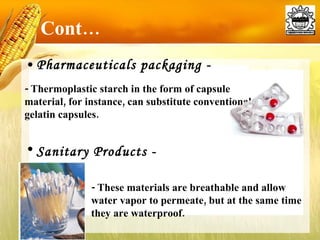
Pharmaceuticals packaging - Cont… - Thermoplastic starch in the form of capsule material, for instance, can substitute conventional gelatin capsules.  - These materials are breathable and allow water vapor to permeate, but at the same time they are waterproof.  Sanitary Products -
Advantages
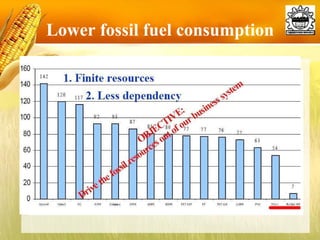
Lower fossil fuel consumption
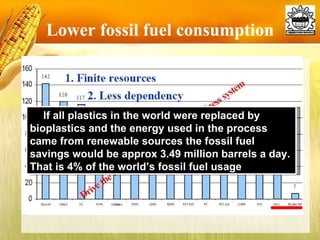
Lower fossil fuel consumption If all plastics in the world were replaced by bioplastics and the energy used in the process came from renewable sources the fossil fuel savings would be approx 3.49 million barrels a day. That is 4% of the world’s fossil fuel usage
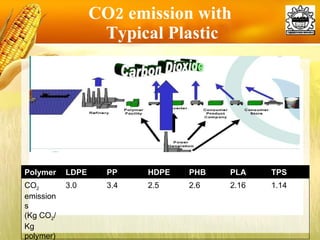
CO2 emission with  Typical Plastic Polymer LDPE PP HDPE PHB PLA TPS CO 2  emissions  (Kg CO 2 / Kg polymer) 3.0 3.4 2.5 2.6 2.16 1.14
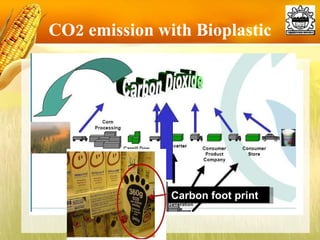
CO2 emission with Bioplastic Carbon foot print
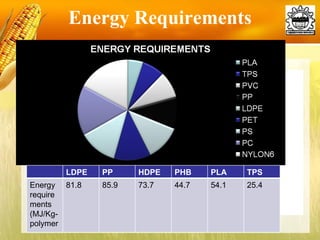
Energy Requirements LDPE PP HDPE PHB PLA TPS Energy requirements (MJ/Kg-polymer 81.8 85.9 73.7 44.7 54.1 25.4
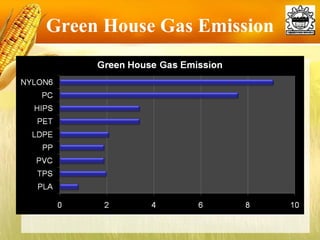
Green House Gas Emission
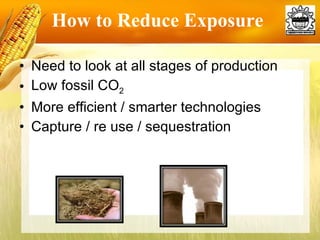
How to Reduce Exposure  Need to look at all stages of production  Low fossil CO 2 More efficient / smarter technologies  Capture / re use / sequestration
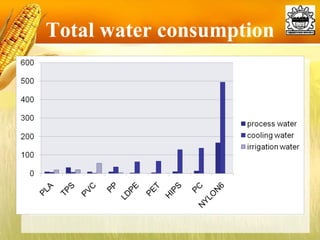
Total water consumption
DISADVANTAGE Bioplastics don't always readily decompose. Some need relatively high temperatures and can still take many years to break down. Even then, they may leave behind toxic residues. Bioplastics are made from plants such as corn and maize, so land that could be used to grow food for the world is being used to "grow plastic" instead.  Some bioplastics, such as PLA, are made from genetically modified corn.  Bioplastics cannot be easily recycled. To most people, PLA looks very similar to PET but, if the two are mixed up in a recycling bin, the whole collection becomes impossible to recycle.

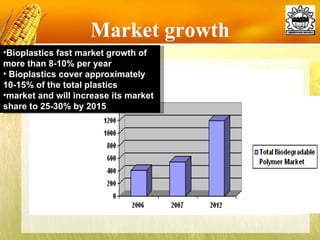
Market growth Bioplastics fast market growth of more than 8-10% per year Bioplastics cover approximately 10-15% of the total plastics market and will increase its market share to 25-30% by 2015
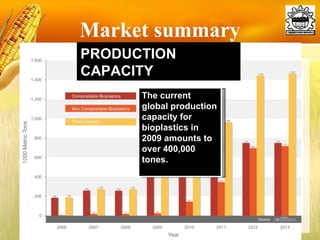
Market summary The current global production capacity for bioplastics in 2009 amounts to over 400,000 tones.  PRODUCTION CAPACITY
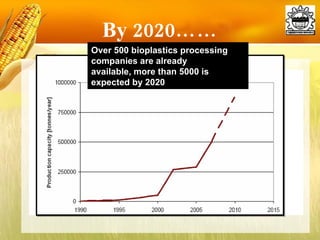
By 2020…… Over 500 bioplastics processing companies are already available, more than 5000 is expected by 2020
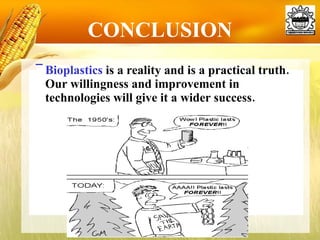
CONCLUSION Bioplastics  is a reality and is a practical truth. Our willingness and improvement in technologies will give it a wider success.
Special thanks to….. CIPET- Central Institute of Plastics Engineering and Technology Chennai. Dr.B.Naazar Sulthan Department of Polymer Science, AC  Tech, Anna University, Chennai Dr. SSM. Abdul Majeed Department of Polymer Science Crescent College Chennai.
References http://www.hkc22.com/bioplastics.html http://www.bccresearch.com/index.htm www.fnr.de www.natureworksllc.com www.bioplastics24.com www.bpf.co.uk www.nnfcc.com
Thank you

Bioplastic

  • 1.
  • 2.
    PLASTICS Two mainreasons why they are so widespread. An enormous range of possible structures, giving a huge variety of properties. Easy to process and shape, leading to simple manufacture.
  • 3.
  • 4.
    Bioplastics Biodegradable plastics Recycled plastics
  • 5.
    BIOPLASTICS Bioplastics area form of plastics derived from renewable biomass sources, such as vegetable oil, corn starch, pea starch, or micro biota, rather than fossil-fuel plastics (which are derived from petroleum). Bio-plastics are based on the principle of the natural cycle i.e. organic material is generated by photo-synthesis and is broken down by microbial degradation into the initial products of CO 2 and water.
  • 6.
    Types of BioplasticsStarch and Starch Blends PLA/ Poly Lactic acid PHB Poly-3-hydroxybutyrates
  • 7.
    Starch based plastics - from plants Amylopectin Non branched Amylose
  • 8.
    Cont… Partially crystallineHigher density low resistance to oil and solvents Easy to process but vulnerable to degradation Sensitive to moisture and high water vapour permeability
  • 9.
    Thermoplastic starch Diagramof the inlet zone of an extruder The raw materials are mixed, heated and converted into a homogenous substance
  • 10.
    Thermoplastic starch Diagramof the inlet zone of an extruder A cooling water system ensures stable temperature conditions.
  • 11.
    Thermoplastic starch Diagramof the inlet zone of an extruder At the end of the extruder, the molten thermoplastic starch discharges as a strand through a nozzle plate
  • 12.
    POLY LACTIC ACIDMonomer Depending on the links between these isomers, 3 different lactides can be produced: mesolactide, D-lactide and L lactide.
  • 13.
  • 14.
    Properties PLA fromL and D degrades within weeks High stability Transparency Softening point around 60 degree Normal processing
  • 15.
  • 16.
  • 17.
    Properties Good thermoplasticmaterial Wide temperature range Lower crystallinity Tendency to creep and shrinkage 1.3% Higher melt viscosity UV resistance
  • 18.
    Applications Packaging Foodpackaging -- - PLA foil and paper has turned out to be a great match for the packaging of cheese. - Carrots in starch based packaging. - Biodegradable trays for milk tray chocolates.
  • 19.
    Cont… - Watervapour transmission of the crystal clear PLA film can provide fresh products with a longer shelf life (9 days). - Polylacticacid can replace PET in certain applications. - Single use cold drink cups, plates, containers and cutlery, which are all based on renewable raw materials and are compostable after use.
  • 20.
  • 21.
    Cont… Electrical packaging- - An optical media made from cornstarch, “bio-disk” is 1.2mm thick, has a capacity of maximum 25 gb and is biodegradable. - Sticky tape made from cellulose - The cover comes with an embedded sunflower seed, which grows a sunflower once it is composted. According to experts 10% of the plastic in electricals will be able to be replaced by bioplastics.
  • 22.
    Pharmaceuticals packaging -Cont… - Thermoplastic starch in the form of capsule material, for instance, can substitute conventional gelatin capsules. - These materials are breathable and allow water vapor to permeate, but at the same time they are waterproof. Sanitary Products -
  • 23.
  • 24.
    Lower fossil fuelconsumption
  • 25.
    Lower fossil fuelconsumption If all plastics in the world were replaced by bioplastics and the energy used in the process came from renewable sources the fossil fuel savings would be approx 3.49 million barrels a day. That is 4% of the world’s fossil fuel usage
  • 26.
    CO2 emission with Typical Plastic Polymer LDPE PP HDPE PHB PLA TPS CO 2 emissions (Kg CO 2 / Kg polymer) 3.0 3.4 2.5 2.6 2.16 1.14
  • 27.
    CO2 emission withBioplastic Carbon foot print
  • 28.
    Energy Requirements LDPEPP HDPE PHB PLA TPS Energy requirements (MJ/Kg-polymer 81.8 85.9 73.7 44.7 54.1 25.4
  • 29.
  • 30.
    How to ReduceExposure Need to look at all stages of production Low fossil CO 2 More efficient / smarter technologies Capture / re use / sequestration
  • 31.
  • 32.
    DISADVANTAGE Bioplastics don'talways readily decompose. Some need relatively high temperatures and can still take many years to break down. Even then, they may leave behind toxic residues. Bioplastics are made from plants such as corn and maize, so land that could be used to grow food for the world is being used to "grow plastic" instead. Some bioplastics, such as PLA, are made from genetically modified corn. Bioplastics cannot be easily recycled. To most people, PLA looks very similar to PET but, if the two are mixed up in a recycling bin, the whole collection becomes impossible to recycle.
  • 33.
    Market growth Bioplasticsfast market growth of more than 8-10% per year Bioplastics cover approximately 10-15% of the total plastics market and will increase its market share to 25-30% by 2015
  • 34.
    Market summary Thecurrent global production capacity for bioplastics in 2009 amounts to over 400,000 tones. PRODUCTION CAPACITY
  • 35.
    By 2020…… Over500 bioplastics processing companies are already available, more than 5000 is expected by 2020
  • 36.
    CONCLUSION Bioplastics is a reality and is a practical truth. Our willingness and improvement in technologies will give it a wider success.
  • 37.
    Special thanks to…..CIPET- Central Institute of Plastics Engineering and Technology Chennai. Dr.B.Naazar Sulthan Department of Polymer Science, AC Tech, Anna University, Chennai Dr. SSM. Abdul Majeed Department of Polymer Science Crescent College Chennai.
  • 38.
    References http://www.hkc22.com/bioplastics.html http://www.bccresearch.com/index.htmwww.fnr.de www.natureworksllc.com www.bioplastics24.com www.bpf.co.uk www.nnfcc.com
  • 39.