Submitted by:-
Jatin garg
Overview
 Background
 Introduction
 Projected biomaterial trends
 Properties
 Environmental impacts
 Types
 production
 Uses
 Carbon cycle
Background
 About 140 million tons of plastic are consumed every
year worldwide, which necessitates the processing of
approximately 150 million tons of fossil fuels and
directly causes immense amounts of waste that can
take thousands of years to naturally deteriorate, if it
degrades at all . Consequently, bioplastics are a feasible
alternative in that they are not based on fossil
resources and can easily be biodegraded.
Why bioplastic ?
 Plastics derived from crude oil(such as petroleum) rely
more on scarce fossil fuels.
 When plastics made from petroleum are burned, they
release the carbon dioxide contained in the petroleum into
the atmosphere, leading to global warming.
 Due to lack of proper disposal of these plastics, these effect
wild life and aquatic life.
Introduction
Bioplastics are a form of plastics derived from
renewable biomass sources, such as vegetable fats and
oils, corn starch, pea starch or microbiota.
 some of these are…thermoplastic starch, Polylactic acid
(PLA) plastics, Poly-3-hydroxybutyrate (PHB)
Projected Biomaterials
Trends
Global
Production
of bioplastics was
1.5
million
tonnes
by 2011.
up from 262,000
tonnes in 2007.
(European
Bioplastics)
Production
Capacity
of bio-based
plastics is projected
to increase from
360,000 tonnes
in 2007 to about
2.3
MILLION tonnes
by 2013.
(European
Bioplastics)
Bioplastics will still only be
1.5% of the approximate 150 million tonnes
of plastics will be in use.
Projected Biomaterials
Trends
Bioplastic Properties
 Some are stiff and brittle.
 Some are rubbery and moldable.
 Properties may be manipulated by blending polymers
or genetic modifications.
 Degrades at 185°C.
 Moisture resistant, water insoluble, optically pure,
impermeable to oxygen.
 Must maintain stability during manufacture and use
but degrade rapidly when disposed of or recycled.
Environmental impacts
 Bioplastics are designed to biodegrade. Bioplastics
which are designed to biodegrade can break down in
either anaerobic or aerobic environments, depending
on how they are manufactured.
 Bioplastics are environmentally friendly because their
production results in the emission of less carbon dioxide,
which is thought to cause global warming.
 They are also biodegradable, meaning that the material
returns to its natural state when buried in the ground.
Types of Bioplastics
 Starch-based plastics
constituting about 50 percent of the bioplastics
market, thermoplastic starch, currently represents the
most widely used bioplastic. Pure starch possesses the
characteristic of being able to absorb humidity,
therefore Flexibiliser and plasticiser such as sorbitol
and glycerine are added so the starch can also be
processed thermo-plastically.
Packaging peanuts made from
bioplastics
 Cellulose-based plastics
Cellulose bioplastics are mainly
the cellulose esters, (including
cellulose acetate and nitrocellulose)
and their derivatives, including
celluloid.
 Some aliphatic polyesters
The aliphatic biopolyesters are mainly
polyhydroxyalkanoates (PHA), poly-3-hydroxybutyrate
(PHB), Polylactic acid (PLA) plastics etc.
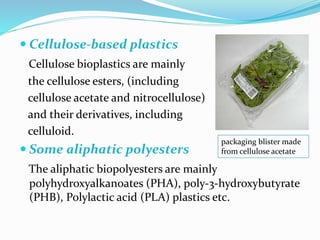
packaging blister made
from cellulose acetate
1. Polylactic acid (PLA)
Polylactic acid (PLA) is a transparent plastic produced
from cane sugar or glucose.
Enzymes are used to break starch
in the plants down into glucose,
which is fermented and made into
lactic acid. This lactic acid is
polymerized and converted into
a plastic called polylactic acid.
These are used in the plastic processing industry for
the production of foil, moulds, cups and bottles.
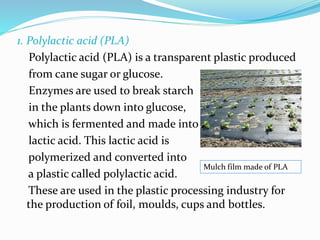
Mulch film made of PLA
2. Poly-3-hydroxybutyrate (PHB)
The biopolymer poly-3-hydroxybutyrate (PHB) is a
polyester produced by certain bacteria processing
glucose, corn starch or wastewater. It produces
transparent film at a melting point higher than 130
degrees Celsius, and is biodegradable without residue.
3. Polyhydroxyalkanoates(PHA)
These are linear polyesters produced in nature by
bacterial fermentation of sugar . They are produced by
the bacteria to store carbon and energy. In industrial
production, the polyester is extracted and purified
from the bacteria by optimizing the conditions for the
fermentation of sugar. These plastics are being widely
used in the medical industry.
 Bio-derived polyethylene
The basic building block of polyethylene is ethylene. This
is just one small chemical step from ethanol, which can
be produced by fermentation of agricultural feedstock's
such as sugar cane or corn. Bio-derived polyethylene is
chemically and physically identical to traditional
polyethylene – it does not biodegrade but can be
recycled. It can also considerably reduce greenhouse gas
emissions. It is used in packaging such as bottles and
tubs.
Production process for polylactic
acid (PLA)
 PLA is the most common bioplastic in use today. First,
corn or other raw materials are fermented to produce
lactic acid, which is then polymerized to make PLA.
Bioplastics are expected to make major contributions
to environmental protection, because they reduce CO2
and because they are biodegradable. The range of
applications for bioplastics is growing, from materials
used in automobile interiors to packaging for foods
and cosmetics, to agricultural sheeting, to household
appliances.
There are two methods for manufacturing PLA from
lactic acid: the first method uses the cyclic lactic acid
dimer called lactide as an intermediate stage; the
second method is direct polymerization of lactic acid.
The method using the lactide intermediary yields PLA
with greater molecular weight.
Uses of Bioplastic
 In electronic industries
1. Mitsubishi Plastics has already succeeded in raising the
heat-resistance and strength of polylactic acid by
combining it with other biodegradable plastics and filler,
and the result was used to make the plastic casing.
2. NEC Corp., meanwhile, is turning its attention to kenaf,
a type of fibrous plant native to tropical areas of Africa
and Asia that is known to grow more than five meters in
just half a year.
A mixture of polylactic acid and kenaf fibre that is 20%
fibre by weight allows for a plastic that is strong enough
and heat resistant enough to be used in electronic goods.
 Packaging
1. The use of bioplastics for shopping bags is already very
common.
2. After their initial use they can be reused as bags for organic
waste and then be composted.
3. Trays and containers for fruit, vegetables, eggs and meat,
bottles for soft drinks and dairy products and blister foils
for fruit and vegetables are also already widely
manufactured from bioplastics.
Flower wrapping made of
PLA-blend
 Catering products
1. Catering products belong to the group of perishable
plastics.
2. Disposable crockery and cutlery, as well as pots and
bowls, pack foils for hamburgers and straws are being
dumped after a single use, together with food-leftovers,
forming huge amounts of waste, particularly at big
events.
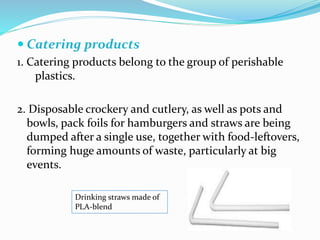
Drinking straws made of
PLA-blend
 Gardening
1. Within the agricultural economy and the gardening
sector mulch foils made of biodegradable material
and flower pots made of decomposable bioplastics
are predominantly used due to their adjustable
lifespan and the fact that these materials do not
leave residues in the soil.
2. This helps reduce work and time (and thus cost) as
these products can simply be left to decompose, after
which they are ploughed in to the soil.
3. Plant pots used for flowering and vegetable plants can
be composted along with gardening and kitchen litter.
 Medical Products
1. In comparison to packaging, catering or gardening
sectors, the medical sector sets out completely
different requirements with regards to products
made of renewable and reabsorbing plastics.
2. The highest possible qualitative standards have
to be met and guaranteed, resulting in an extremely
high costs, which sometimes exceed 1.000 Euro per kilo.
3. The potential applications of biodegradable or reabsorbing
bioplastics are manifold.
 Sanitary Products
1. Due to their specific characteristics, bioplastics are used
as a basis for the production of sanitary products.
2. These materials are breathable and allow water
vapour to permeate, but at the same time they are
waterproof.
3. Foils made of soft bioplastic are already used as diaper foil,
bed underlay, for incontinence products, ladies sanitary
products and as disposable gloves.
Biodegradation
 Fastest in anaerobic sewage and slowest in seawater
 Depends on temperature, light, moisture, exposed
surface area, pH and microbial activity
 Degrading microbes colonize polymer surface & secrete
PHA depolymerases
 PHA  CO2 + H2O (aerobically)
 PHA  CO2 + H2O + CH4 (anaerobically)
Carbon Cycle of Bioplastics
CO2
H2O
Biodegradation
Carbohydrates
Plastic Products
Plants
Fermentation
PHA Polymer
Photosynthesis
Recycle
Thanks..

Bioplastic

  • 1.
  • 2.
    Overview  Background  Introduction Projected biomaterial trends  Properties  Environmental impacts  Types  production  Uses  Carbon cycle
  • 3.
    Background  About 140million tons of plastic are consumed every year worldwide, which necessitates the processing of approximately 150 million tons of fossil fuels and directly causes immense amounts of waste that can take thousands of years to naturally deteriorate, if it degrades at all . Consequently, bioplastics are a feasible alternative in that they are not based on fossil resources and can easily be biodegraded.
  • 4.
    Why bioplastic ? Plastics derived from crude oil(such as petroleum) rely more on scarce fossil fuels.  When plastics made from petroleum are burned, they release the carbon dioxide contained in the petroleum into the atmosphere, leading to global warming.  Due to lack of proper disposal of these plastics, these effect wild life and aquatic life.
  • 5.
    Introduction Bioplastics are aform of plastics derived from renewable biomass sources, such as vegetable fats and oils, corn starch, pea starch or microbiota.  some of these are…thermoplastic starch, Polylactic acid (PLA) plastics, Poly-3-hydroxybutyrate (PHB)
  • 6.
    Projected Biomaterials Trends Global Production of bioplasticswas 1.5 million tonnes by 2011. up from 262,000 tonnes in 2007. (European Bioplastics) Production Capacity of bio-based plastics is projected to increase from 360,000 tonnes in 2007 to about 2.3 MILLION tonnes by 2013. (European Bioplastics)
  • 7.
    Bioplastics will stillonly be 1.5% of the approximate 150 million tonnes of plastics will be in use. Projected Biomaterials Trends
  • 8.
    Bioplastic Properties  Someare stiff and brittle.  Some are rubbery and moldable.  Properties may be manipulated by blending polymers or genetic modifications.  Degrades at 185°C.  Moisture resistant, water insoluble, optically pure, impermeable to oxygen.  Must maintain stability during manufacture and use but degrade rapidly when disposed of or recycled.
  • 9.
    Environmental impacts  Bioplasticsare designed to biodegrade. Bioplastics which are designed to biodegrade can break down in either anaerobic or aerobic environments, depending on how they are manufactured.  Bioplastics are environmentally friendly because their production results in the emission of less carbon dioxide, which is thought to cause global warming.  They are also biodegradable, meaning that the material returns to its natural state when buried in the ground.
  • 10.
    Types of Bioplastics Starch-based plastics constituting about 50 percent of the bioplastics market, thermoplastic starch, currently represents the most widely used bioplastic. Pure starch possesses the characteristic of being able to absorb humidity, therefore Flexibiliser and plasticiser such as sorbitol and glycerine are added so the starch can also be processed thermo-plastically. Packaging peanuts made from bioplastics
  • 11.
     Cellulose-based plastics Cellulosebioplastics are mainly the cellulose esters, (including cellulose acetate and nitrocellulose) and their derivatives, including celluloid.  Some aliphatic polyesters The aliphatic biopolyesters are mainly polyhydroxyalkanoates (PHA), poly-3-hydroxybutyrate (PHB), Polylactic acid (PLA) plastics etc. packaging blister made from cellulose acetate
  • 12.
    1. Polylactic acid(PLA) Polylactic acid (PLA) is a transparent plastic produced from cane sugar or glucose. Enzymes are used to break starch in the plants down into glucose, which is fermented and made into lactic acid. This lactic acid is polymerized and converted into a plastic called polylactic acid. These are used in the plastic processing industry for the production of foil, moulds, cups and bottles. Mulch film made of PLA
  • 13.
    2. Poly-3-hydroxybutyrate (PHB) Thebiopolymer poly-3-hydroxybutyrate (PHB) is a polyester produced by certain bacteria processing glucose, corn starch or wastewater. It produces transparent film at a melting point higher than 130 degrees Celsius, and is biodegradable without residue. 3. Polyhydroxyalkanoates(PHA) These are linear polyesters produced in nature by bacterial fermentation of sugar . They are produced by the bacteria to store carbon and energy. In industrial production, the polyester is extracted and purified from the bacteria by optimizing the conditions for the fermentation of sugar. These plastics are being widely used in the medical industry.
  • 14.
     Bio-derived polyethylene Thebasic building block of polyethylene is ethylene. This is just one small chemical step from ethanol, which can be produced by fermentation of agricultural feedstock's such as sugar cane or corn. Bio-derived polyethylene is chemically and physically identical to traditional polyethylene – it does not biodegrade but can be recycled. It can also considerably reduce greenhouse gas emissions. It is used in packaging such as bottles and tubs.
  • 15.
    Production process forpolylactic acid (PLA)  PLA is the most common bioplastic in use today. First, corn or other raw materials are fermented to produce lactic acid, which is then polymerized to make PLA. Bioplastics are expected to make major contributions to environmental protection, because they reduce CO2 and because they are biodegradable. The range of applications for bioplastics is growing, from materials used in automobile interiors to packaging for foods and cosmetics, to agricultural sheeting, to household appliances.
  • 16.
    There are twomethods for manufacturing PLA from lactic acid: the first method uses the cyclic lactic acid dimer called lactide as an intermediate stage; the second method is direct polymerization of lactic acid. The method using the lactide intermediary yields PLA with greater molecular weight.
  • 18.
    Uses of Bioplastic In electronic industries 1. Mitsubishi Plastics has already succeeded in raising the heat-resistance and strength of polylactic acid by combining it with other biodegradable plastics and filler, and the result was used to make the plastic casing. 2. NEC Corp., meanwhile, is turning its attention to kenaf, a type of fibrous plant native to tropical areas of Africa and Asia that is known to grow more than five meters in just half a year. A mixture of polylactic acid and kenaf fibre that is 20% fibre by weight allows for a plastic that is strong enough and heat resistant enough to be used in electronic goods.
  • 19.
     Packaging 1. Theuse of bioplastics for shopping bags is already very common. 2. After their initial use they can be reused as bags for organic waste and then be composted. 3. Trays and containers for fruit, vegetables, eggs and meat, bottles for soft drinks and dairy products and blister foils for fruit and vegetables are also already widely manufactured from bioplastics. Flower wrapping made of PLA-blend
  • 20.
     Catering products 1.Catering products belong to the group of perishable plastics. 2. Disposable crockery and cutlery, as well as pots and bowls, pack foils for hamburgers and straws are being dumped after a single use, together with food-leftovers, forming huge amounts of waste, particularly at big events. Drinking straws made of PLA-blend
  • 21.
     Gardening 1. Withinthe agricultural economy and the gardening sector mulch foils made of biodegradable material and flower pots made of decomposable bioplastics are predominantly used due to their adjustable lifespan and the fact that these materials do not leave residues in the soil. 2. This helps reduce work and time (and thus cost) as these products can simply be left to decompose, after which they are ploughed in to the soil. 3. Plant pots used for flowering and vegetable plants can be composted along with gardening and kitchen litter.
  • 22.
     Medical Products 1.In comparison to packaging, catering or gardening sectors, the medical sector sets out completely different requirements with regards to products made of renewable and reabsorbing plastics. 2. The highest possible qualitative standards have to be met and guaranteed, resulting in an extremely high costs, which sometimes exceed 1.000 Euro per kilo. 3. The potential applications of biodegradable or reabsorbing bioplastics are manifold.
  • 23.
     Sanitary Products 1.Due to their specific characteristics, bioplastics are used as a basis for the production of sanitary products. 2. These materials are breathable and allow water vapour to permeate, but at the same time they are waterproof. 3. Foils made of soft bioplastic are already used as diaper foil, bed underlay, for incontinence products, ladies sanitary products and as disposable gloves.
  • 24.
    Biodegradation  Fastest inanaerobic sewage and slowest in seawater  Depends on temperature, light, moisture, exposed surface area, pH and microbial activity  Degrading microbes colonize polymer surface & secrete PHA depolymerases  PHA  CO2 + H2O (aerobically)  PHA  CO2 + H2O + CH4 (anaerobically)
  • 25.
    Carbon Cycle ofBioplastics CO2 H2O Biodegradation Carbohydrates Plastic Products Plants Fermentation PHA Polymer Photosynthesis Recycle
  • 26.