Presented by G.Vijayalakshmi B.Sc.,M.Sc.,
20PY10
Ayya Nadar Janaki Ammal College
Sivakasi
> Submitted to DR.M.Vijayasanthi
MSc.,M.Phil.,Ph.D.
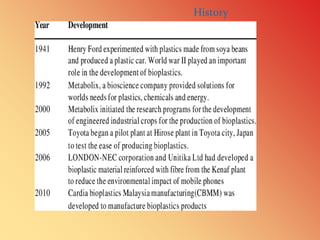
History
Why bioplastics?
Bioplastic, moldable plastic material made
up of chemical compounds that are derived
from or synthesized by microbes such
as bacteria or by genetically modified plants
. Unlike traditional plastics, which are
derived from petroleum, bioplastics are
obtained from renewable resources, and some
bioplastics are biodegradable.
 Plastics are polymers—assemblies of
identical chemical subunits, called monomers,
that are linked together in the form of a chain.
 Cross-linking of the monomers increases a
polymer’s rigidity and thermal stability.
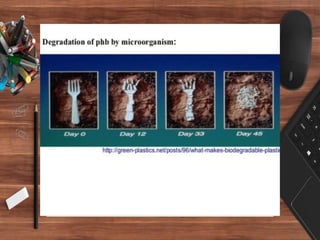
Degradation of the chemical links between
the monomers in these plastics is brought about
by microorganisms or by water, making
bioplastics highly desirable materials for
fabrication into biodegradable bottles and
packaging film.
Properties of bioplastics
 Some are stiff and brittle
 Some are rubbery and moldable
 Properties may ne manipulated by blending
> polymers or genetic modification
 Degrades at 185 degree C
 Moisture resistant ,water insoluble ,optically
pure,impermeable to oxygen
 Must maintain stability during manufaccture and
 use but degrade rapidly when disposed of oe
recycled
 Antistatic properties –suitable for electronic
> packaging
Environmental impacts
> Bioplastics are designed to biodegrade.Bioplastics which
are designed to biodegrade can break down in either
anaerobic or aerobic environments ,depending on how they
are manufactured.
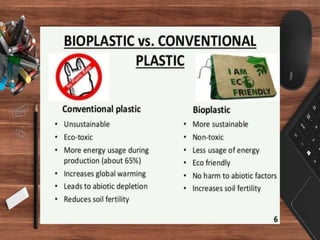
> Bioplastics are environmentally friendly because their
production results in the emission of less carbon
dioxide,which is though to cause global warming.
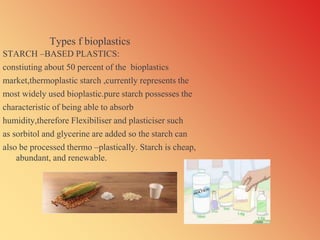
STARCH –BASED PLASTICS:
constiuting about 50 percent of the bioplastics
market,thermoplastic starch ,currently represents the
most widely used bioplastic.pure starch possesses the
characteristic of being able to absorb
humidity,therefore Flexibiliser and plasticiser such
as sorbitol and glycerine are added so the starch can
also be processed thermo –plastically. Starch is cheap,
abundant, and renewable.
Types f bioplastics
cellulose based bioplastics
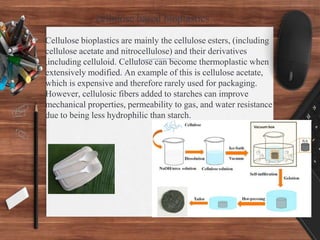
> Cellulose bioplastics are mainly the cellulose esters, (including
cellulose acetate and nitrocellulose) and their derivatives
,including celluloid. Cellulose can become thermoplastic when
extensively modified. An example of this is cellulose acetate,
which is expensive and therefore rarely used for packaging.
However, cellulosic fibers added to starches can improve
mechanical properties, permeability to gas, and water resistance
due to being less hydrophilic than starch.
Some aliphatic polyeysters
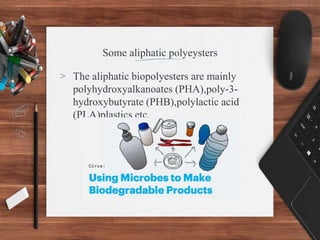
> The aliphatic biopolyesters are mainly
polyhydroxyalkanoates (PHA),poly-3-
hydroxybutyrate (PHB),polylactic acid
(PLA)plastics etc.
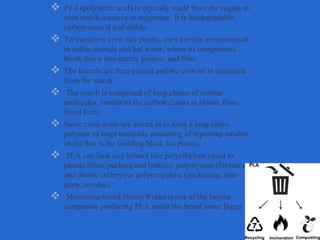
 PLA (polylactic acid) is typically made from the sugars in
corn starch, cassava or sugarcane. It is biodegradable,
carbon-neutral and edible.
 To transform corn into plastic, corn kernels are immersed
in sulfur dioxide and hot water, where its components
break down into starch, protein, and fiber.
 The kernels are then ground and the corn oil is separated
from the starch.
 The starch is comprised of long chains of carbon
molecules, similar to the carbon chains in plastic from
fossil fuels.
 Some citric acids are mixed in to form a long-chain
polymer (a large molecule consisting of repeating smaller
units) that is the building block for plastic.
 PLA can look and behave like polyethylene (used in
plastic films, packing and bottles), polystyrene (Styrofoam
and plastic cutlery) or polypropylene (packaging, auto
parts, textiles).
 Minnesota-based NatureWorks is one of the largest
companies producing PLA under the brand name Ingeo.
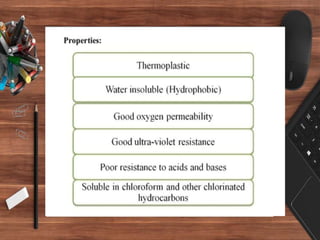
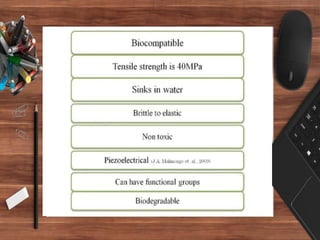
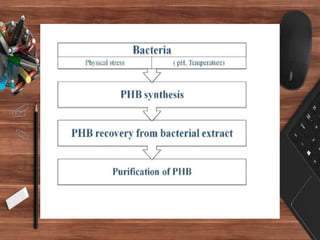
PHA (polyhydroxyalkanoate) is made by microorganisms,
sometimes genetically engineered, that produce plastic from
organic materials.
 The microbes are deprived of nutrients like nitrogen, oxygen
and phosphorus, but given high levels of carbon.
They produce PHA as carbon reserves, which they store in
granules until they have more of the other nutrients they need to
grow and reproduce.
 Companies can then harvest the microbe-made PHA, which
has a chemical structure similar to that of traditional plastics.
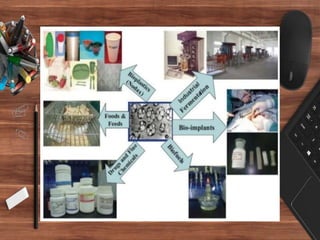
Because it is biodegradable and will not harm living tissue,
PHA is often used for medical applications such as sutures, slings,
bone plates and skin substitutes; it is also used for single-use food
packaging.
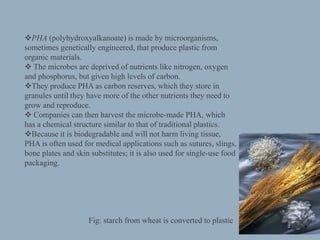
Fig: starch from wheat is converted to plastic
PHA s
> Polysetres accumulated inside microbial cells as
carbon and energy storage
> 2different types:
> Short –chain- length (3-5)carbon
> Medium –Chain –length(6-14 carbons)
> Produced under of conditions of:
> low limiting nutrients (p,n.s.o)
> Excess carbon
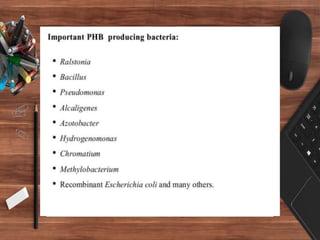
> 250 different bacteria have been found to produce
some form of PHAs.
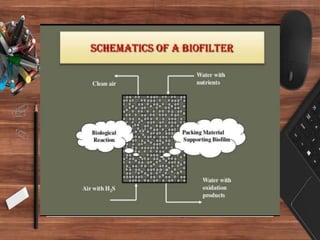
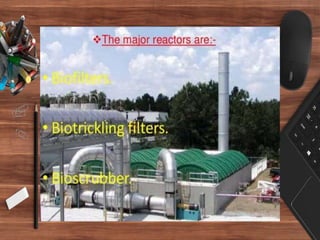
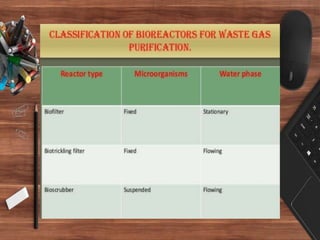
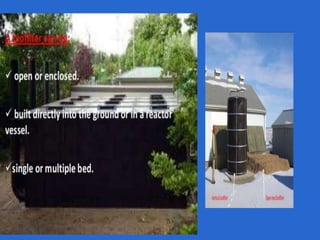
Biofilter
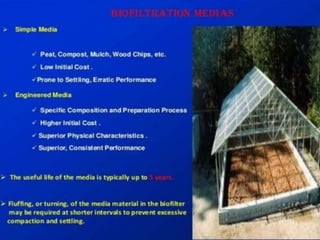
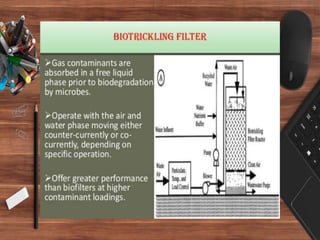
> It involves passing a contaminated air stream through
a media bed that is porous and moist
> As the air passes through the media ,the
contaminants are absorbed into the water within the
media
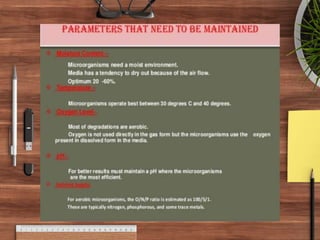
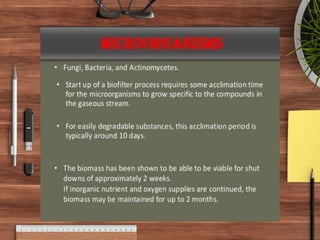
> Bacteria that are present within the media
continuously consume the absorbes contaminants
> 80-95% odor reduction of air through biofilter
Microbial products (bioplastic ,bioscrubber,biofilter

Microbial products (bioplastic ,bioscrubber,biofilter

  • 1.
    Presented by G.VijayalakshmiB.Sc.,M.Sc., 20PY10 Ayya Nadar Janaki Ammal College Sivakasi > Submitted to DR.M.Vijayasanthi MSc.,M.Phil.,Ph.D.
  • 3.
  • 4.
    Why bioplastics? Bioplastic, moldableplastic material made up of chemical compounds that are derived from or synthesized by microbes such as bacteria or by genetically modified plants . Unlike traditional plastics, which are derived from petroleum, bioplastics are obtained from renewable resources, and some bioplastics are biodegradable.  Plastics are polymers—assemblies of identical chemical subunits, called monomers, that are linked together in the form of a chain.  Cross-linking of the monomers increases a polymer’s rigidity and thermal stability. Degradation of the chemical links between the monomers in these plastics is brought about by microorganisms or by water, making bioplastics highly desirable materials for fabrication into biodegradable bottles and packaging film.
  • 5.
    Properties of bioplastics Some are stiff and brittle  Some are rubbery and moldable  Properties may ne manipulated by blending > polymers or genetic modification  Degrades at 185 degree C  Moisture resistant ,water insoluble ,optically pure,impermeable to oxygen  Must maintain stability during manufaccture and  use but degrade rapidly when disposed of oe recycled  Antistatic properties –suitable for electronic > packaging
  • 6.
    Environmental impacts > Bioplasticsare designed to biodegrade.Bioplastics which are designed to biodegrade can break down in either anaerobic or aerobic environments ,depending on how they are manufactured. > Bioplastics are environmentally friendly because their production results in the emission of less carbon dioxide,which is though to cause global warming.
  • 7.
    STARCH –BASED PLASTICS: constiutingabout 50 percent of the bioplastics market,thermoplastic starch ,currently represents the most widely used bioplastic.pure starch possesses the characteristic of being able to absorb humidity,therefore Flexibiliser and plasticiser such as sorbitol and glycerine are added so the starch can also be processed thermo –plastically. Starch is cheap, abundant, and renewable. Types f bioplastics
  • 8.
    cellulose based bioplastics >Cellulose bioplastics are mainly the cellulose esters, (including cellulose acetate and nitrocellulose) and their derivatives ,including celluloid. Cellulose can become thermoplastic when extensively modified. An example of this is cellulose acetate, which is expensive and therefore rarely used for packaging. However, cellulosic fibers added to starches can improve mechanical properties, permeability to gas, and water resistance due to being less hydrophilic than starch.
  • 9.
    Some aliphatic polyeysters >The aliphatic biopolyesters are mainly polyhydroxyalkanoates (PHA),poly-3- hydroxybutyrate (PHB),polylactic acid (PLA)plastics etc.
  • 10.
     PLA (polylacticacid) is typically made from the sugars in corn starch, cassava or sugarcane. It is biodegradable, carbon-neutral and edible.  To transform corn into plastic, corn kernels are immersed in sulfur dioxide and hot water, where its components break down into starch, protein, and fiber.  The kernels are then ground and the corn oil is separated from the starch.  The starch is comprised of long chains of carbon molecules, similar to the carbon chains in plastic from fossil fuels.  Some citric acids are mixed in to form a long-chain polymer (a large molecule consisting of repeating smaller units) that is the building block for plastic.  PLA can look and behave like polyethylene (used in plastic films, packing and bottles), polystyrene (Styrofoam and plastic cutlery) or polypropylene (packaging, auto parts, textiles).  Minnesota-based NatureWorks is one of the largest companies producing PLA under the brand name Ingeo.
  • 11.
    PHA (polyhydroxyalkanoate) ismade by microorganisms, sometimes genetically engineered, that produce plastic from organic materials.  The microbes are deprived of nutrients like nitrogen, oxygen and phosphorus, but given high levels of carbon. They produce PHA as carbon reserves, which they store in granules until they have more of the other nutrients they need to grow and reproduce.  Companies can then harvest the microbe-made PHA, which has a chemical structure similar to that of traditional plastics. Because it is biodegradable and will not harm living tissue, PHA is often used for medical applications such as sutures, slings, bone plates and skin substitutes; it is also used for single-use food packaging. Fig: starch from wheat is converted to plastic
  • 12.
    PHA s > Polysetresaccumulated inside microbial cells as carbon and energy storage > 2different types: > Short –chain- length (3-5)carbon > Medium –Chain –length(6-14 carbons) > Produced under of conditions of: > low limiting nutrients (p,n.s.o) > Excess carbon > 250 different bacteria have been found to produce some form of PHAs.
  • 33.
    Biofilter > It involvespassing a contaminated air stream through a media bed that is porous and moist > As the air passes through the media ,the contaminants are absorbed into the water within the media > Bacteria that are present within the media continuously consume the absorbes contaminants > 80-95% odor reduction of air through biofilter