BIOPLASTICS
Submitted by :- Pramod kumar
Class :- M.Sc.(MBT) 3nd sem
department of microbiology
Maharshi dayanand university rohtak
Bioplastics
• Plastics derived from renewable biomass sources,
such as vegetable fats and oil , cornstarch and
pea starch.
• Bio-plastics are designed to biodegrade.
• Biodegradable bio-plastics can break down in
either anaerobic or aerobic environments,
depending on how they are manufactured.
• There is a variety of materials that bio-plastics
can be of including: starches, cellulose or
other biopolymers.
TYPES OF BIOPLASTICS
• Natural biodegradable plastics are based
primarily on:
• 1. Renewable resources (such as starch) and
can be either naturally produced or
synthesized from renewable resources.
2. Non-renewable synthetic biodegradable
plastics are petroleum-based.
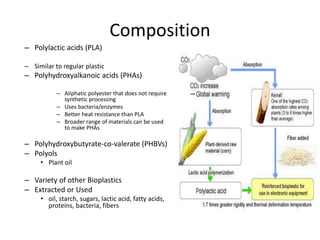
Composition
– Polylactic acids (PLA)
– Similar to regular plastic
– Polyhydroxyalkanoic acids (PHAs)
– Aliphatic polyester that does not require
synthetic processing
– Uses bacteria/enzymes
– Better heat resistance than PLA
– Broader range of materials can be used
to make PHAs
– Polyhydroxybutyrate-co-valerate (PHBVs)
– Polyols
• Plant oil
– Variety of other Bioplastics
– Extracted or Used
• oil, starch, sugars, lactic acid, fatty acids,
proteins, bacteria, fibers
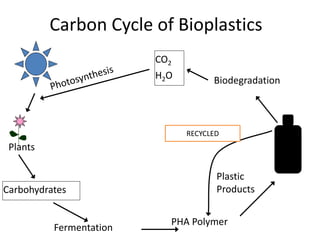
Carbon Cycle of Bioplastics
CO2
H2O
Carbohydrates
Plastic
Products
Plants
Fermentation
PHA Polymer
Biodegradation
RECYCLED
Synthesis of PHA and PHB
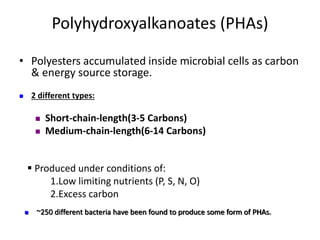
Polyhydroxyalkanoates (PHAs)
• Polyesters accumulated inside microbial cells as carbon
& energy source storage.
 2 different types:
 Short-chain-length(3-5 Carbons)
 Medium-chain-length(6-14 Carbons)
 Produced under conditions of:
1.Low limiting nutrients (P, S, N, O)
2.Excess carbon
 ~250 different bacteria have been found to produce some form of PHAs.
PHA
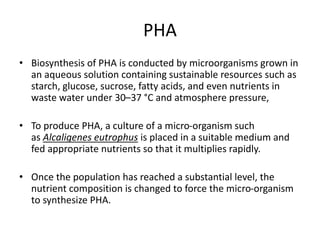
• Biosynthesis of PHA is conducted by microorganisms grown in
an aqueous solution containing sustainable resources such as
starch, glucose, sucrose, fatty acids, and even nutrients in
waste water under 30–37 °C and atmosphere pressure,
• To produce PHA, a culture of a micro-organism such
as Alcaligenes eutrophus is placed in a suitable medium and
fed appropriate nutrients so that it multiplies rapidly.
• Once the population has reached a substantial level, the
nutrient composition is changed to force the micro-organism
to synthesize PHA.
Cont....
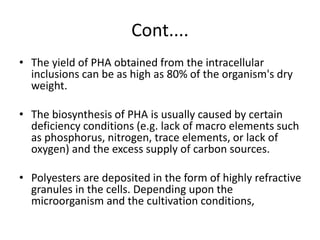
• The yield of PHA obtained from the intracellular
inclusions can be as high as 80% of the organism's dry
weight.
• The biosynthesis of PHA is usually caused by certain
deficiency conditions (e.g. lack of macro elements such
as phosphorus, nitrogen, trace elements, or lack of
oxygen) and the excess supply of carbon sources.
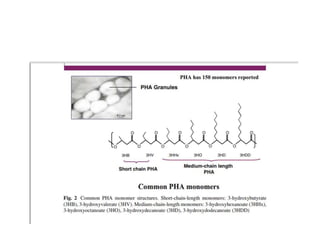
• Polyesters are deposited in the form of highly refractive
granules in the cells. Depending upon the
microorganism and the cultivation conditions,
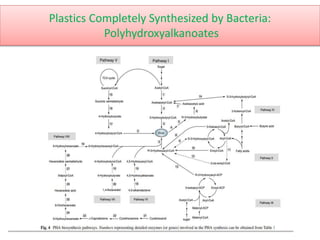
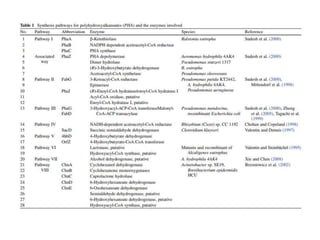
Plastics Completely Synthesized by Bacteria:
Polyhydroxyalkanoates
PHB
• PHB is produced by microorganisms (such as Ralstonia
eutrophus, Bacillus megaterium) apparently in response to
conditions of physiological stressmainly conditions in which
nutrients are limited.
• The polymer is primarily a product of carbon assimilation
(from glucose or starch) and is employed by
microorganisms as a form of energy storage molecule to be
metabolized when other common energy sources are not
available.
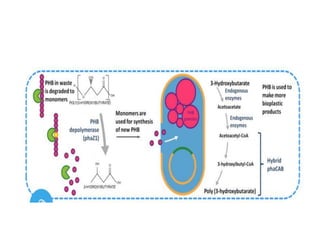
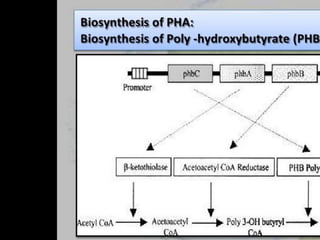
• Microbial biosynthesis of PHB starts with
the condensation of two molecules of acetyl-CoA to give
acetoacetyl-CoA which is subsequently reduced to
hydroxybutyryl-CoA.
• A new isolated Bacillus megaterium strain was characterized based
on 16S rRNA gene sequences (1,411 bp) and studied in terms of its
ability for producing polyhydroxybutyrate (PHB)
• By implementing different fermentation configurations on
formulated media. The isolated strain was able to produce PHB up
to 59 and 60% of its dry cell weight during bioreactor experiments
employing glucose and glycerol as carbon source, respectively.
• This latter compound is then used as a monomer to polymerize
PHB. PHAs granules are then recovered by disrupting the cells
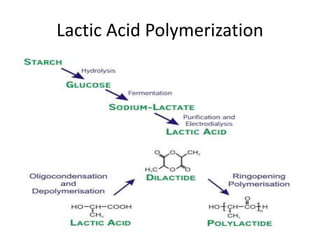
Lactic Acid Polymerization
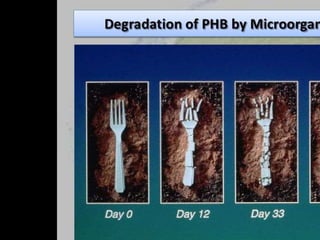
BIODEGRADATION
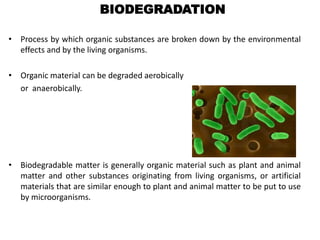
• Process by which organic substances are broken down by the environmental
effects and by the living organisms.
• Organic material can be degraded aerobically
or anaerobically.
• Biodegradable matter is generally organic material such as plant and animal
matter and other substances originating from living organisms, or artificial
materials that are similar enough to plant and animal matter to be put to use
by microorganisms.
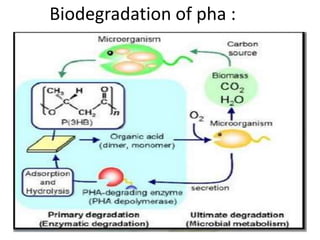
Biodegradation of pha :
ASTM defines ‘biodegradable’ :
• “capable of undergoing decomposition into
carbon dioxide, methane, water, inorganic
compounds, or biomass in which the predominant
mechanism is the enzymatic action of
microorganisms, that can be measured by
standardized tests, in a specified period of time,
reflecting available disposal condition.”
PLASTIC THAT IS BIODEGRADABLE IS KNOWN AS “
BIOPLASTIC “.
o Biodegradable plastics are a kind of materials which are
degraded biologically.
o The biodegradability of plastics is dependent on the:
1. chemical structure of the material.
2. on the constituent of the final product, not just on the
basic materials used in the production.
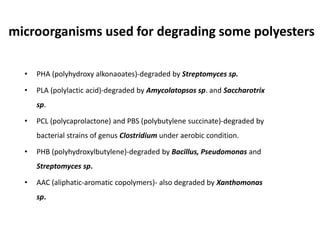
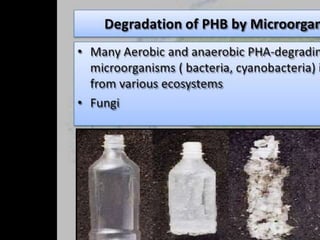
microorganisms used for degrading some polyesters
• PHA (polyhydroxy alkonaoates)-degraded by Streptomyces sp.
• PLA (polylactic acid)-degraded by Amycolatopsos sp. and Saccharotrix
sp.
• PCL (polycaprolactone) and PBS (polybutylene succinate)-degraded by
bacterial strains of genus Clostridium under aerobic condition.
• PHB (polyhydroxylbutylene)-degraded by Bacillus, Pseudomonas and
Streptomyces sp.
• AAC (aliphatic-aromatic copolymers)- also degraded by Xanthomonas
sp.
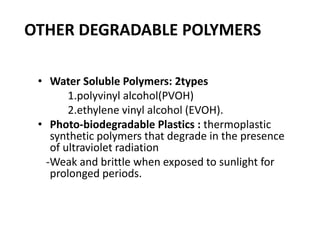
OTHER DEGRADABLE POLYMERS
• Water Soluble Polymers: 2types
1.polyvinyl alcohol(PVOH)
2.ethylene vinyl alcohol (EVOH).
• Photo-biodegradable Plastics : thermoplastic
synthetic polymers that degrade in the presence
of ultraviolet radiation
-Weak and brittle when exposed to sunlight for
prolonged periods.
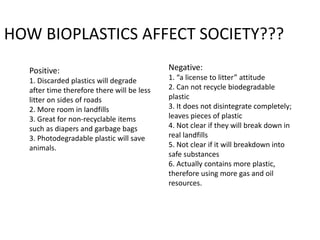
Positive:
1. Discarded plastics will degrade
after time therefore there will be less
litter on sides of roads
2. More room in landfills
3. Great for non-recyclable items
such as diapers and garbage bags
3. Photodegradable plastic will save
animals.
Negative:
1. “a license to litter” attitude
2. Can not recycle biodegradable
plastic
3. It does not disintegrate completely;
leaves pieces of plastic
4. Not clear if they will break down in
real landfills
5. Not clear if it will breakdown into
safe substances
6. Actually contains more plastic,
therefore using more gas and oil
resources.
HOW BIOPLASTICS AFFECT SOCIETY???
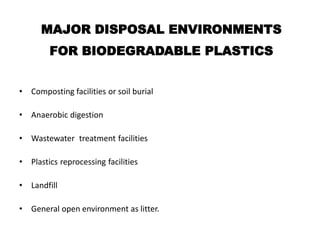
MAJOR DISPOSAL ENVIRONMENTS
FOR BIODEGRADABLE PLASTICS
• Composting facilities or soil burial
• Anaerobic digestion
• Wastewater treatment facilities
• Plastics reprocessing facilities
• Landfill
• General open environment as litter.
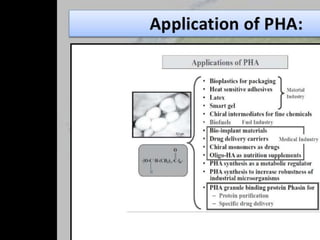
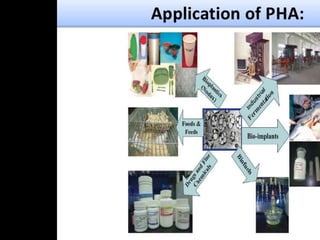
Applications
• Packaging
• The use of bioplastics for shopping bags is already
very common (J&K Agro Industries Ltd along with
Earthsoul India).
• Trays and containers for fruit, vegetables, eggs and
meat, bottles for soft drinks and dairy products and
blister foils for fruit and vegetables are also already
widely manufactured from bioplastics (Ravi
Industries in Maharashtra).
• Catering products
• Catering products belong to the group of
perishable plastics.
• Disposable crockery and cutlery, as well as
pots and bowls, pack foils for hamburgers and
straws are being dumped after a single use,
together with food-leftovers, forming huge
amounts of waste, particularly at big events
(Harita NTI Ltd and Biotec Bags in Tamilnadu).
• Gardening
• Within the agricultural economy and the gardening
sector mulch foils made of biodegradable material
and flower pots made of decomposable bioplastics
are predominantly used due to their adjustable
lifespan and the fact that these materials do not
leave residues in the soil.
• This helps reduce work and time (and thus cost) as
these products can simply be left to decompose,
after which they are ploughed in to the soil.
• Plant pots used for flowering and vegetable plants
can be composted along with gardening and kitchen
litter.
• Medical Products
• In comparison to packaging, catering or gardening
sectors, the medical sector sets out completely
different requirements with regards to products
made of renewable and reabsorbing plastics.
• The highest possible qualitative standards have to be
met and guaranteed, resulting in an extremely high
costs, which sometimes exceed 1.000 Euro per kilo.
• The potential applications of biodegradable or
reabsorbing bioplastics are manifold.
• Sanitary Products
• Due to their specific characteristics, bioplastics are
used as a basis for the production of sanitary
products.
• These materials are breathable and allow water
vapor to permeate, but at the same time they are
waterproof.
• Foils made of soft bioplastic are already used as
diaper foil, bed underlay, for incontinence products,
ladies sanitary products and as disposable gloves.
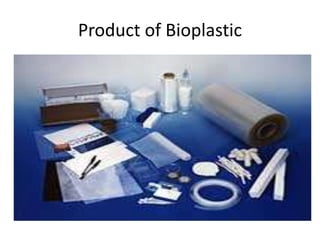
Product of Bioplastic
References
• Bonartsev and Myshkina et.al Biosynthesis, biodegradation,
and application of poly(3-hydroxybutyrate) and its copolymers
natural polyesters produced by diazotrophic bacteria. (2007),
pg.no. 2-5
• Guo-Qiang Chen, Plastics Completely Synthesized by Bacteria:
Polyhydroxyalkanoates. (2010), pg.no. 19-22
• https://en.wikipedia.org/wiki/Polyhydroxyalkanoates
• https://en.wikipedia.org/wiki/Polyhydroxybutyrate
THANKYOU

bioplastics by microorganisms Polyhydroxyalkanoates And Polyhydroxybutyrate

  • 1.
    BIOPLASTICS Submitted by :-Pramod kumar Class :- M.Sc.(MBT) 3nd sem department of microbiology Maharshi dayanand university rohtak
  • 2.
    Bioplastics • Plastics derivedfrom renewable biomass sources, such as vegetable fats and oil , cornstarch and pea starch. • Bio-plastics are designed to biodegrade. • Biodegradable bio-plastics can break down in either anaerobic or aerobic environments, depending on how they are manufactured. • There is a variety of materials that bio-plastics can be of including: starches, cellulose or other biopolymers.
  • 3.
    TYPES OF BIOPLASTICS •Natural biodegradable plastics are based primarily on: • 1. Renewable resources (such as starch) and can be either naturally produced or synthesized from renewable resources. 2. Non-renewable synthetic biodegradable plastics are petroleum-based.
  • 4.
    Composition – Polylactic acids(PLA) – Similar to regular plastic – Polyhydroxyalkanoic acids (PHAs) – Aliphatic polyester that does not require synthetic processing – Uses bacteria/enzymes – Better heat resistance than PLA – Broader range of materials can be used to make PHAs – Polyhydroxybutyrate-co-valerate (PHBVs) – Polyols • Plant oil – Variety of other Bioplastics – Extracted or Used • oil, starch, sugars, lactic acid, fatty acids, proteins, bacteria, fibers
  • 5.
    Carbon Cycle ofBioplastics CO2 H2O Carbohydrates Plastic Products Plants Fermentation PHA Polymer Biodegradation RECYCLED
  • 6.
  • 7.
    Polyhydroxyalkanoates (PHAs) • Polyestersaccumulated inside microbial cells as carbon & energy source storage.  2 different types:  Short-chain-length(3-5 Carbons)  Medium-chain-length(6-14 Carbons)  Produced under conditions of: 1.Low limiting nutrients (P, S, N, O) 2.Excess carbon  ~250 different bacteria have been found to produce some form of PHAs.
  • 9.
    PHA • Biosynthesis ofPHA is conducted by microorganisms grown in an aqueous solution containing sustainable resources such as starch, glucose, sucrose, fatty acids, and even nutrients in waste water under 30–37 °C and atmosphere pressure, • To produce PHA, a culture of a micro-organism such as Alcaligenes eutrophus is placed in a suitable medium and fed appropriate nutrients so that it multiplies rapidly. • Once the population has reached a substantial level, the nutrient composition is changed to force the micro-organism to synthesize PHA.
  • 10.
    Cont.... • The yieldof PHA obtained from the intracellular inclusions can be as high as 80% of the organism's dry weight. • The biosynthesis of PHA is usually caused by certain deficiency conditions (e.g. lack of macro elements such as phosphorus, nitrogen, trace elements, or lack of oxygen) and the excess supply of carbon sources. • Polyesters are deposited in the form of highly refractive granules in the cells. Depending upon the microorganism and the cultivation conditions,
  • 11.
    Plastics Completely Synthesizedby Bacteria: Polyhydroxyalkanoates
  • 13.
    PHB • PHB isproduced by microorganisms (such as Ralstonia eutrophus, Bacillus megaterium) apparently in response to conditions of physiological stressmainly conditions in which nutrients are limited. • The polymer is primarily a product of carbon assimilation (from glucose or starch) and is employed by microorganisms as a form of energy storage molecule to be metabolized when other common energy sources are not available. • Microbial biosynthesis of PHB starts with the condensation of two molecules of acetyl-CoA to give acetoacetyl-CoA which is subsequently reduced to hydroxybutyryl-CoA.
  • 14.
    • A newisolated Bacillus megaterium strain was characterized based on 16S rRNA gene sequences (1,411 bp) and studied in terms of its ability for producing polyhydroxybutyrate (PHB) • By implementing different fermentation configurations on formulated media. The isolated strain was able to produce PHB up to 59 and 60% of its dry cell weight during bioreactor experiments employing glucose and glycerol as carbon source, respectively. • This latter compound is then used as a monomer to polymerize PHB. PHAs granules are then recovered by disrupting the cells
  • 16.
  • 17.
    BIODEGRADATION • Process bywhich organic substances are broken down by the environmental effects and by the living organisms. • Organic material can be degraded aerobically or anaerobically. • Biodegradable matter is generally organic material such as plant and animal matter and other substances originating from living organisms, or artificial materials that are similar enough to plant and animal matter to be put to use by microorganisms.
  • 18.
  • 19.
    ASTM defines ‘biodegradable’: • “capable of undergoing decomposition into carbon dioxide, methane, water, inorganic compounds, or biomass in which the predominant mechanism is the enzymatic action of microorganisms, that can be measured by standardized tests, in a specified period of time, reflecting available disposal condition.” PLASTIC THAT IS BIODEGRADABLE IS KNOWN AS “ BIOPLASTIC “.
  • 20.
    o Biodegradable plasticsare a kind of materials which are degraded biologically. o The biodegradability of plastics is dependent on the: 1. chemical structure of the material. 2. on the constituent of the final product, not just on the basic materials used in the production.
  • 21.
    microorganisms used fordegrading some polyesters • PHA (polyhydroxy alkonaoates)-degraded by Streptomyces sp. • PLA (polylactic acid)-degraded by Amycolatopsos sp. and Saccharotrix sp. • PCL (polycaprolactone) and PBS (polybutylene succinate)-degraded by bacterial strains of genus Clostridium under aerobic condition. • PHB (polyhydroxylbutylene)-degraded by Bacillus, Pseudomonas and Streptomyces sp. • AAC (aliphatic-aromatic copolymers)- also degraded by Xanthomonas sp.
  • 22.
    OTHER DEGRADABLE POLYMERS •Water Soluble Polymers: 2types 1.polyvinyl alcohol(PVOH) 2.ethylene vinyl alcohol (EVOH). • Photo-biodegradable Plastics : thermoplastic synthetic polymers that degrade in the presence of ultraviolet radiation -Weak and brittle when exposed to sunlight for prolonged periods.
  • 23.
    Positive: 1. Discarded plasticswill degrade after time therefore there will be less litter on sides of roads 2. More room in landfills 3. Great for non-recyclable items such as diapers and garbage bags 3. Photodegradable plastic will save animals. Negative: 1. “a license to litter” attitude 2. Can not recycle biodegradable plastic 3. It does not disintegrate completely; leaves pieces of plastic 4. Not clear if they will break down in real landfills 5. Not clear if it will breakdown into safe substances 6. Actually contains more plastic, therefore using more gas and oil resources. HOW BIOPLASTICS AFFECT SOCIETY???
  • 24.
    MAJOR DISPOSAL ENVIRONMENTS FORBIODEGRADABLE PLASTICS • Composting facilities or soil burial • Anaerobic digestion • Wastewater treatment facilities • Plastics reprocessing facilities • Landfill • General open environment as litter.
  • 25.
    Applications • Packaging • Theuse of bioplastics for shopping bags is already very common (J&K Agro Industries Ltd along with Earthsoul India). • Trays and containers for fruit, vegetables, eggs and meat, bottles for soft drinks and dairy products and blister foils for fruit and vegetables are also already widely manufactured from bioplastics (Ravi Industries in Maharashtra).
  • 26.
    • Catering products •Catering products belong to the group of perishable plastics. • Disposable crockery and cutlery, as well as pots and bowls, pack foils for hamburgers and straws are being dumped after a single use, together with food-leftovers, forming huge amounts of waste, particularly at big events (Harita NTI Ltd and Biotec Bags in Tamilnadu).
  • 27.
    • Gardening • Withinthe agricultural economy and the gardening sector mulch foils made of biodegradable material and flower pots made of decomposable bioplastics are predominantly used due to their adjustable lifespan and the fact that these materials do not leave residues in the soil. • This helps reduce work and time (and thus cost) as these products can simply be left to decompose, after which they are ploughed in to the soil. • Plant pots used for flowering and vegetable plants can be composted along with gardening and kitchen litter.
  • 28.
    • Medical Products •In comparison to packaging, catering or gardening sectors, the medical sector sets out completely different requirements with regards to products made of renewable and reabsorbing plastics. • The highest possible qualitative standards have to be met and guaranteed, resulting in an extremely high costs, which sometimes exceed 1.000 Euro per kilo. • The potential applications of biodegradable or reabsorbing bioplastics are manifold.
  • 29.
    • Sanitary Products •Due to their specific characteristics, bioplastics are used as a basis for the production of sanitary products. • These materials are breathable and allow water vapor to permeate, but at the same time they are waterproof. • Foils made of soft bioplastic are already used as diaper foil, bed underlay, for incontinence products, ladies sanitary products and as disposable gloves.

  • 30.
  • 38.
    References • Bonartsev andMyshkina et.al Biosynthesis, biodegradation, and application of poly(3-hydroxybutyrate) and its copolymers natural polyesters produced by diazotrophic bacteria. (2007), pg.no. 2-5 • Guo-Qiang Chen, Plastics Completely Synthesized by Bacteria: Polyhydroxyalkanoates. (2010), pg.no. 19-22 • https://en.wikipedia.org/wiki/Polyhydroxyalkanoates • https://en.wikipedia.org/wiki/Polyhydroxybutyrate
  • 39.