RHEUMATIC FEVER
/RHEUMATIC HEART
DISEASE
 Acute , immunologically mediated, multisystem
inflammatory disease.
 Occurs 10 days to 6 weeks after an episode of
group A streptococcal pharyngitis.
 Affects usually children (5-15 yrs) but 20% cases
can be seen in adults.
 Active phase of RF may progress to chronic
RHD.
 RF does not occur after a streptococcal inf at
other sites eg skin.
 Is an important public health problem in
poor socioeconomic localities
 Incidence has < due to better living
standards, rapid diagnosis, good drug
therapy & unexplained < in virulence of gp
A streptococci
Systems involved are:
- Heart esp cardiac valves, endocardium.
- Joints esp large ones (migratory
polyarthritis).
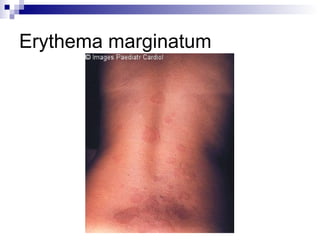
- Skin (erythema marginatum).
- Subcutaneous nodules.
- Neurological disorder called SYNDENHAM
CHOREA (involuntary purposeless rapid
movements).
Morphology
 HEART LESIONS:
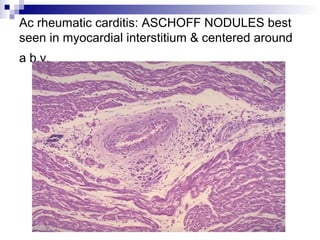
- Acute RF: characterized by distinctive lesions
called ASCHOFF BODIES in the myocardial
interstitium.
- They are circumscribed lesions consisting of a
central focus of necrotic,swollen eosinophilic
collagen surrounded by T-lymphocytes,
occasional plasma cells & plump macrophages
called Anitschkow cells (abundant cytoplasm
central round to ovoid nuclei with chromatin
disposed in a central, slender, wavy ribbon).
- also called caterpillar cells - pathognomonic for
RF.
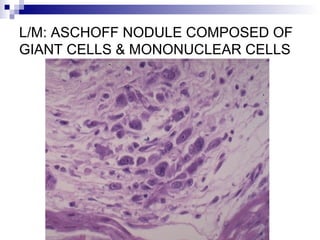
- some large macrophages become multinucleated
Aschoff Giant Cells.
 During acute RF, diffuse inflammation &
Aschoff bodies may be found in all 3
layers of heart (PANCARDITIS)
PERICARDIAL LESIONS:
 Fibrinous or serofibrinous pericardial
exudate called “bread & butter”
pericarditis.
 This generally resolves without any
sequelae.
MYOCARDIAL LESIONS:
- Myocarditis
 Scattered Aschoff bodies within the interstitial
connective tissue
ENDOCARDIAL LESIONS:
 Simultaneous involvement of endocardium &
left sided cardiac valves by inflammatory foci
causes fibrinoid necrosis of cusps or chordae
tendinae.
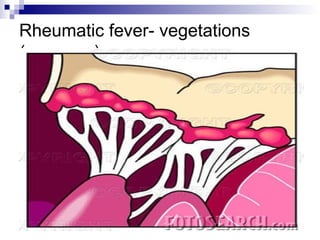
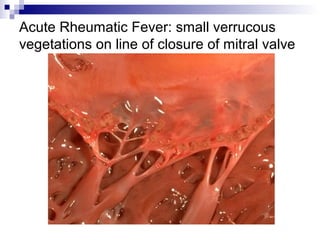
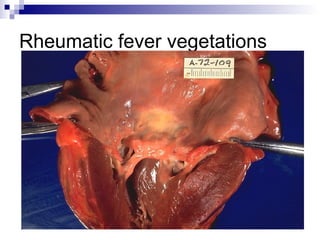
 Small 1-2 mm vegetations called “verruca”
situated along the line of closure of the valves.
 They are irregular & wart-like
 Cause little disturbance in cardiac function
 Formed due to precipitation of fibrin & collagen
degeneration at sites of closure
 Left atrium shows irregular, subendocardial
lesions called MacCallum plaques
PATHOGENESIS
 Acute RF is a hypersensitivity reaction
caused by gp A Streptococci
 Antibodies against M protein of certain
strains of streptococci cross-react with
glycoprotein antigens in the heart, joints &
other tissues
 Streptococcal infection evokes an
autoimmune response against self-
antigens
 Genetic suseptibility also plays a major
role in pathogenesis of this disease
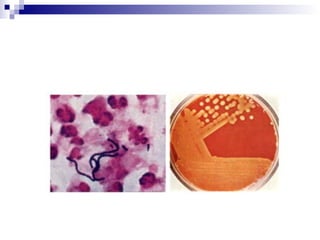
 Group A streptococci elaborate the
cytolytic toxins streptolysins S and O.
 Streptolysin O induces persistently
high antibody titers that provide a useful
marker of group A streptococcal
infection and its nonsuppurative
complications (ASO Ab test).
 Rheumatogenic strains often are
encapsulated mucoid strains rich in M
proteins and resistant to phagocytosis.
 The presence of the M protein in the cell
wall is the most important virulence factor for
group A streptococcal infection in humans.
CHRONIC RHD
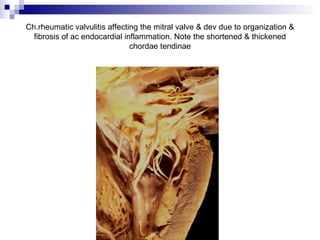
 Characterized by organization of acute
inflammation & fibrosis
 Permanent valvular deformity (esp mitral valve)
due to retraction & thickening of leaflets
 Mitral & tricuspid valves show leaflet thickening,
commissural fusion, shortening, thickening &
fusion of tendinous cords
VALVULAR LESIONS of CH.RHD
 Mitral valve alone is affected in 65-70%
cases of RHD.
 RHD is responsible for 99% cases of
mitral stenosis
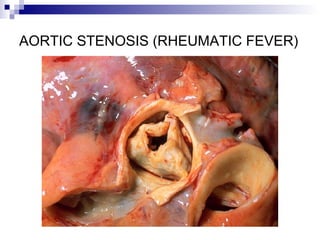
 Concomitant involvement of mitral & aortic
valve is seen in 25% cases
 Less severe damage may also occur in
the tricuspid & pulmonary valves
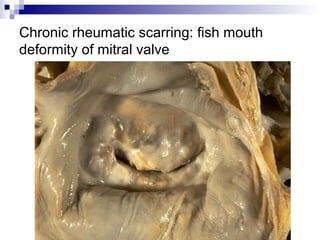
 Fibrous bridging & calcification across
valvular commissures creates “fish
mouth” or “buttonhole” stenosis.
 Mitral stenosis causes progressive left
atrial dilatation, harbouring a mural
thrombus in its appendage or along its
wall.
 Lungs show congestive changes
ultimately leading to rt ventricular
hypertrophy.
 Left ventricle is essentially normal with
isolated mitral stenosis
Microscopy (RHD)
 Diffuse & dense fibrosis.
 Neovascularization of valves.
 Aschoff bodies are replaced by fibrous
scar therefore not seen in autopsy
specimens of ch CHD
Diagnosis of ARF
JONES CRITERIA:-
 Clinical features &
 Lab investigations
Major Criteria (JONES)
1. Migratory polyarthritis of large joints
2. Carditis
3. Subcutaneous nodules
4. Erythema marginatum of skin
5. Syndenham chorea
JONES (Major Criteria)
 J =Joints (migratory polyarthritis).
 O=(imagine heart shape) Carditis.
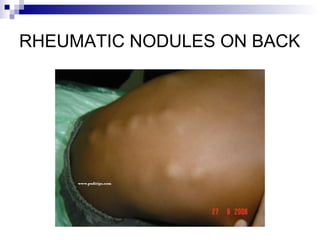
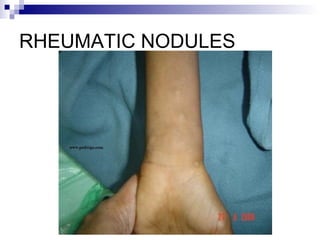
 N=Nodules (s/c nodules), painless collections of
collagen fibres on back of wrists, front of knees.
 E= Erythema marginatum (long lasting rash that
begins on trunk or arms.)
 S= Syndenhams chorea ( rapid purposeless
movements of limbs & face.)
CANCER (Major Jones
Criteria)
 C=Carditis
 A= Arthritis
 N=Nodules
 C=Chorea
 ER=ERythema marginatum.
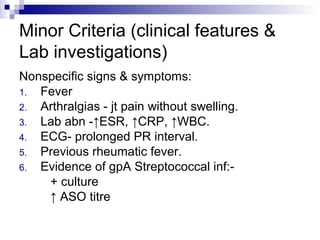
Minor Criteria (clinical features &
Lab investigations)
Nonspecific signs & symptoms:
1. Fever
2. Arthralgias - jt pain without swelling.
3. Lab abn -↑ESR, ↑CRP, ↑WBC.
4. ECG- prolonged PR interval.
5. Previous rheumatic fever.
6. Evidence of gpA Streptococcal inf:-
+ culture
↑ ASO titre
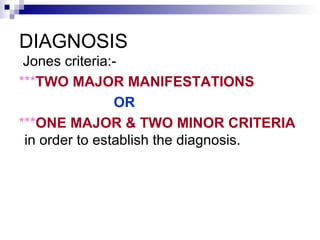
DIAGNOSIS
Jones criteria:-
***TWO MAJOR MANIFESTATIONS
OR
***ONE MAJOR & TWO MINOR CRITERIA
in order to establish the diagnosis.
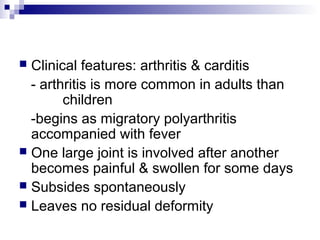
 Clinical features: arthritis & carditis
- arthritis is more common in adults than
children
-begins as migratory polyarthritis
accompanied with fever
 One large joint is involved after another
becomes painful & swollen for some days
 Subsides spontaneously
 Leaves no residual deformity
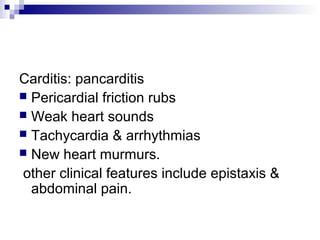
Carditis: pancarditis
 Pericardial friction rubs
 Weak heart sounds
 Tachycardia & arrhythmias
 New heart murmurs.
other clinical features include epistaxis &
abdominal pain.
 Myocarditis may cause cardiac dilatation
leading to mitral valve insufficiency or
even heart failure.
PROGNOSIS
In cases of primary attack is excellent with
only 1% cases dying from fulminant RF
COMPLICATIONS
 RECURRENCES are liable to occur after
each subsequent pharnygeal attack with
similar clinical manifestations.
 CARDITIS TENDS TO MORE SEVERE in
recurrent episodes.
 EMBOLIZATION from mural thrombi
within atria or their appendages.
 INFECTIVE ENDOCARDITIS
superimposed on deformed valves.
 Ch rheumatic carditis does not cause
clinical manifestations for years or even
decades after the initial episode of RF
 CARDIAC MURMURS
 CARDIAC HYPERTROPHY &
DILATATION
 HEART FAILURE
 ARRHYTHMIAS LIKE ATRIAL
FIBRILLATION
Treatment
 Surgical repair by incising the diseased
mitral stenotic valve commissures &
replacement by prosthetic devices has
greatly improved the outcome of this
disease.
Rheumatic fever- vegetations
(verrucae)
Acute Rheumatic Fever: small verrucous
vegetations on line of closure of mitral valve
Rheumatic fever vegetations
Ch.rheumatic valvulitis affecting the mitral valve & dev due to organization &
fibrosis of ac endocardial inflammation. Note the shortened & thickened
chordae tendinae
Chronic rheumatic scarring: fish mouth
deformity of mitral valve
AORTIC STENOSIS (RHEUMATIC FEVER)
RHEUMATIC NODULES ON BACK
RHEUMATIC NODULES
Erythema marginatum
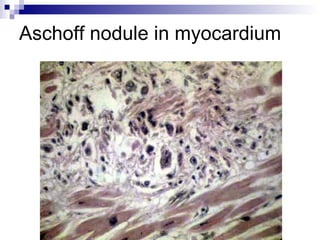
Ac rheumatic carditis: ASCHOFF NODULES best
seen in myocardial interstitium & centered around
a b.v.
L/M: ASCHOFF NODULE COMPOSED OF
GIANT CELLS & MONONUCLEAR CELLS
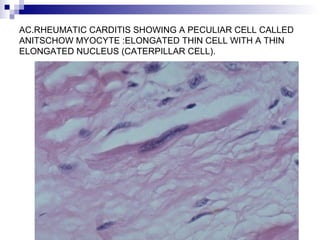
AC.RHEUMATIC CARDITIS SHOWING A PECULIAR CELL CALLED
ANITSCHOW MYOCYTE :ELONGATED THIN CELL WITH A THIN
ELONGATED NUCLEUS (CATERPILLAR CELL).
Aschoff nodule in myocardium
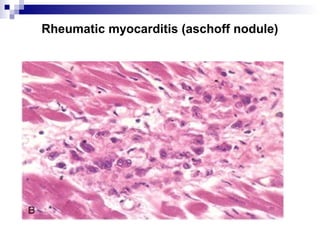
Rheumatic myocarditis (aschoff nodule)
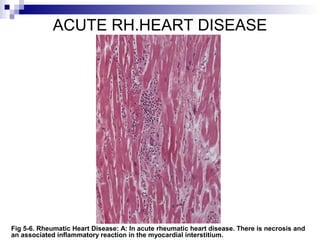
ACUTE RH.HEART DISEASE
Fig 5-6. Rheumatic Heart Disease: A: In acute rheumatic heart disease. There is necrosis and
an associated inflammatory reaction in the myocardial interstitium.
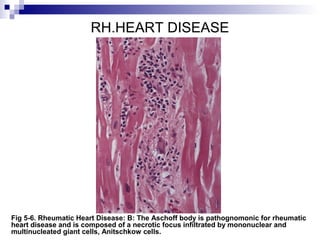
RH.HEART DISEASE
Fig 5-6. Rheumatic Heart Disease: B: The Aschoff body is pathognomonic for rheumatic
heart disease and is composed of a necrotic focus infiltrated by mononuclear and
multinucleated giant cells, Anitschkow cells.
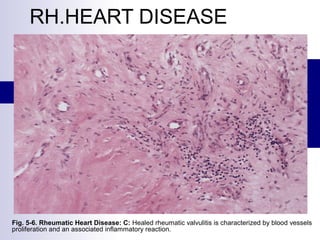
RH.HEART DISEASE
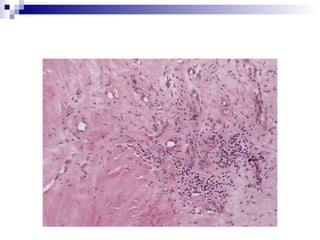
Fig. 5-6. Rheumatic Heart Disease: C: Healed rheumatic valvulitis is characterized by blood vessels
proliferation and an associated inflammatory reaction.
Rheumatic fever

Rheumatic fever

  • 1.
  • 2.
     Acute ,immunologically mediated, multisystem inflammatory disease.  Occurs 10 days to 6 weeks after an episode of group A streptococcal pharyngitis.  Affects usually children (5-15 yrs) but 20% cases can be seen in adults.  Active phase of RF may progress to chronic RHD.  RF does not occur after a streptococcal inf at other sites eg skin.
  • 3.
     Is animportant public health problem in poor socioeconomic localities  Incidence has < due to better living standards, rapid diagnosis, good drug therapy & unexplained < in virulence of gp A streptococci
  • 4.
    Systems involved are: -Heart esp cardiac valves, endocardium. - Joints esp large ones (migratory polyarthritis). - Skin (erythema marginatum). - Subcutaneous nodules. - Neurological disorder called SYNDENHAM CHOREA (involuntary purposeless rapid movements).
  • 5.
    Morphology  HEART LESIONS: -Acute RF: characterized by distinctive lesions called ASCHOFF BODIES in the myocardial interstitium. - They are circumscribed lesions consisting of a central focus of necrotic,swollen eosinophilic collagen surrounded by T-lymphocytes, occasional plasma cells & plump macrophages called Anitschkow cells (abundant cytoplasm central round to ovoid nuclei with chromatin disposed in a central, slender, wavy ribbon). - also called caterpillar cells - pathognomonic for RF. - some large macrophages become multinucleated Aschoff Giant Cells.
  • 6.
     During acuteRF, diffuse inflammation & Aschoff bodies may be found in all 3 layers of heart (PANCARDITIS) PERICARDIAL LESIONS:  Fibrinous or serofibrinous pericardial exudate called “bread & butter” pericarditis.  This generally resolves without any sequelae.
  • 7.
    MYOCARDIAL LESIONS: - Myocarditis Scattered Aschoff bodies within the interstitial connective tissue ENDOCARDIAL LESIONS:  Simultaneous involvement of endocardium & left sided cardiac valves by inflammatory foci causes fibrinoid necrosis of cusps or chordae tendinae.
  • 8.
     Small 1-2mm vegetations called “verruca” situated along the line of closure of the valves.  They are irregular & wart-like  Cause little disturbance in cardiac function  Formed due to precipitation of fibrin & collagen degeneration at sites of closure  Left atrium shows irregular, subendocardial lesions called MacCallum plaques
  • 9.
    PATHOGENESIS  Acute RFis a hypersensitivity reaction caused by gp A Streptococci  Antibodies against M protein of certain strains of streptococci cross-react with glycoprotein antigens in the heart, joints & other tissues  Streptococcal infection evokes an autoimmune response against self- antigens  Genetic suseptibility also plays a major role in pathogenesis of this disease
  • 10.
     Group Astreptococci elaborate the cytolytic toxins streptolysins S and O.  Streptolysin O induces persistently high antibody titers that provide a useful marker of group A streptococcal infection and its nonsuppurative complications (ASO Ab test).
  • 11.
     Rheumatogenic strainsoften are encapsulated mucoid strains rich in M proteins and resistant to phagocytosis.  The presence of the M protein in the cell wall is the most important virulence factor for group A streptococcal infection in humans.
  • 12.
    CHRONIC RHD  Characterizedby organization of acute inflammation & fibrosis  Permanent valvular deformity (esp mitral valve) due to retraction & thickening of leaflets  Mitral & tricuspid valves show leaflet thickening, commissural fusion, shortening, thickening & fusion of tendinous cords
  • 13.
    VALVULAR LESIONS ofCH.RHD  Mitral valve alone is affected in 65-70% cases of RHD.  RHD is responsible for 99% cases of mitral stenosis  Concomitant involvement of mitral & aortic valve is seen in 25% cases  Less severe damage may also occur in the tricuspid & pulmonary valves
  • 14.
     Fibrous bridging& calcification across valvular commissures creates “fish mouth” or “buttonhole” stenosis.  Mitral stenosis causes progressive left atrial dilatation, harbouring a mural thrombus in its appendage or along its wall.  Lungs show congestive changes ultimately leading to rt ventricular hypertrophy.  Left ventricle is essentially normal with isolated mitral stenosis
  • 15.
    Microscopy (RHD)  Diffuse& dense fibrosis.  Neovascularization of valves.  Aschoff bodies are replaced by fibrous scar therefore not seen in autopsy specimens of ch CHD
  • 16.
    Diagnosis of ARF JONESCRITERIA:-  Clinical features &  Lab investigations
  • 17.
    Major Criteria (JONES) 1.Migratory polyarthritis of large joints 2. Carditis 3. Subcutaneous nodules 4. Erythema marginatum of skin 5. Syndenham chorea
  • 18.
    JONES (Major Criteria) J =Joints (migratory polyarthritis).  O=(imagine heart shape) Carditis.  N=Nodules (s/c nodules), painless collections of collagen fibres on back of wrists, front of knees.  E= Erythema marginatum (long lasting rash that begins on trunk or arms.)  S= Syndenhams chorea ( rapid purposeless movements of limbs & face.)
  • 19.
    CANCER (Major Jones Criteria) C=Carditis  A= Arthritis  N=Nodules  C=Chorea  ER=ERythema marginatum.
  • 20.
    Minor Criteria (clinicalfeatures & Lab investigations) Nonspecific signs & symptoms: 1. Fever 2. Arthralgias - jt pain without swelling. 3. Lab abn -↑ESR, ↑CRP, ↑WBC. 4. ECG- prolonged PR interval. 5. Previous rheumatic fever. 6. Evidence of gpA Streptococcal inf:- + culture ↑ ASO titre
  • 21.
    DIAGNOSIS Jones criteria:- ***TWO MAJORMANIFESTATIONS OR ***ONE MAJOR & TWO MINOR CRITERIA in order to establish the diagnosis.
  • 22.
     Clinical features:arthritis & carditis - arthritis is more common in adults than children -begins as migratory polyarthritis accompanied with fever  One large joint is involved after another becomes painful & swollen for some days  Subsides spontaneously  Leaves no residual deformity
  • 23.
    Carditis: pancarditis  Pericardialfriction rubs  Weak heart sounds  Tachycardia & arrhythmias  New heart murmurs. other clinical features include epistaxis & abdominal pain.
  • 24.
     Myocarditis maycause cardiac dilatation leading to mitral valve insufficiency or even heart failure. PROGNOSIS In cases of primary attack is excellent with only 1% cases dying from fulminant RF
  • 25.
    COMPLICATIONS  RECURRENCES areliable to occur after each subsequent pharnygeal attack with similar clinical manifestations.  CARDITIS TENDS TO MORE SEVERE in recurrent episodes.  EMBOLIZATION from mural thrombi within atria or their appendages.  INFECTIVE ENDOCARDITIS superimposed on deformed valves.
  • 26.
     Ch rheumaticcarditis does not cause clinical manifestations for years or even decades after the initial episode of RF  CARDIAC MURMURS  CARDIAC HYPERTROPHY & DILATATION  HEART FAILURE  ARRHYTHMIAS LIKE ATRIAL FIBRILLATION
  • 27.
    Treatment  Surgical repairby incising the diseased mitral stenotic valve commissures & replacement by prosthetic devices has greatly improved the outcome of this disease.
  • 28.
  • 29.
    Acute Rheumatic Fever:small verrucous vegetations on line of closure of mitral valve
  • 30.
  • 31.
    Ch.rheumatic valvulitis affectingthe mitral valve & dev due to organization & fibrosis of ac endocardial inflammation. Note the shortened & thickened chordae tendinae
  • 32.
    Chronic rheumatic scarring:fish mouth deformity of mitral valve
  • 33.
  • 34.
  • 35.
  • 36.
  • 37.
    Ac rheumatic carditis:ASCHOFF NODULES best seen in myocardial interstitium & centered around a b.v.
  • 38.
    L/M: ASCHOFF NODULECOMPOSED OF GIANT CELLS & MONONUCLEAR CELLS
  • 39.
    AC.RHEUMATIC CARDITIS SHOWINGA PECULIAR CELL CALLED ANITSCHOW MYOCYTE :ELONGATED THIN CELL WITH A THIN ELONGATED NUCLEUS (CATERPILLAR CELL).
  • 41.
  • 42.
  • 43.
    ACUTE RH.HEART DISEASE Fig5-6. Rheumatic Heart Disease: A: In acute rheumatic heart disease. There is necrosis and an associated inflammatory reaction in the myocardial interstitium.
  • 44.
    RH.HEART DISEASE Fig 5-6.Rheumatic Heart Disease: B: The Aschoff body is pathognomonic for rheumatic heart disease and is composed of a necrotic focus infiltrated by mononuclear and multinucleated giant cells, Anitschkow cells.
  • 45.
    RH.HEART DISEASE Fig. 5-6.Rheumatic Heart Disease: C: Healed rheumatic valvulitis is characterized by blood vessels proliferation and an associated inflammatory reaction.