Rheumatic Fever & Rheumatic
Heart Disease
Akshai George Paul
•Rheumatic fever (RF) is an acute, immunologically
mediated, multisystem inflammatory disease that occurs a
few weeks following an episode of group A streptococcal
pharyngitis.
•Major involvement of systemic connective tissue, it often
violate connective tissue of heart, joint, skin, and
subcutaneous and vascular connective tissue. Key
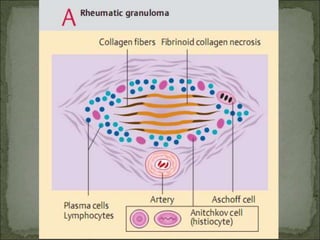
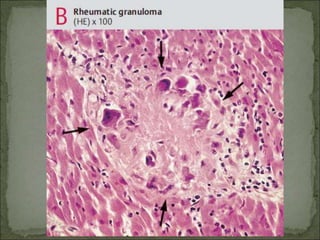
pathologic features is Rheumatic Granuloma.
•It occurs in children in age 5 to 15 years, 20% -adults
•The clinical course of rheumatic fever involves a
childhood infection with complications in adulthood
(cardiac defect).
Rheumatic Fever
Etiology and pathogenesis
It is an immune response associated with
streptococcal infection, but it is not caused
by bacteria directly effects.
1. There is a streptococcus infection history before
the onset of RF.
2. A variety of antibodies of the streptococcus and
its products can be detected in the onset phase.
serous "O" antibody in 95% patients is high, >
500 units.
3. Regional distribution consistent with area of
streptococcal infection.
4. Antibiotic prophylaxis treatment is effective.
The evidence related with group A β-hemolytic
streptococcus infection including:
The evidence which is not directly caused by
streptococcus infection including:
1. The disease is not appeared in infected at the
time, but in 2-3 weeks later, it is in line with
emergence period of the general immune
response.
• No evidence of direct invasion of organ by
streptococcus.
• Streptococcus has never been found in the RF
patient's blood .
• Not purulent inflammation, but the fibrinoid
necrosis.
Antigen and antibody cross-reactivity:
The antigens of streptococcus may stimulate
the immunological cross-reactivity in
patients.
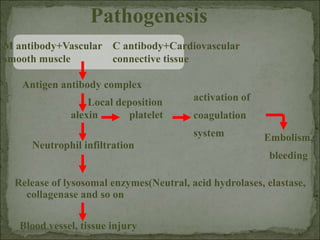
M antibody+Vascular
smooth muscle
C antibody+Cardiovascular
connective tissue
Pathogenesis
Antigen antibody complex
Local deposition
alexin platelet
activation of
coagulation
system Embolism,
bleeding
Neutrophil infiltration
Release of lysosomal enzymes(Neutral, acid hydrolases, elastase,
collagenase and so on
Blood vessel, tissue injury
Basic pathological changes
1. Exudative and degenerative phase
2. The proliferative phase (Granulomatous period)
3. Scar phase (healed phaseFibrosis phaseHardening
phase)
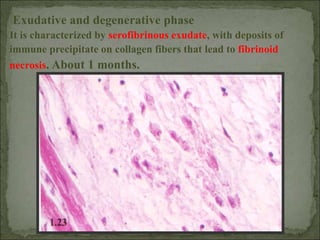
Exudative and degenerative phase
It is characterized by serofibrinous exudate, with deposits of
immune precipitate on collagen fibers that lead to fibrinoid
necrosis. About 1 months.
The proliferative phase (Granulomatous period)
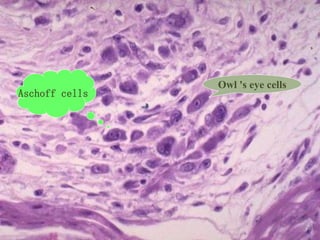
Aschoff Body:
Structure:
center: fibrinoid necrosis
around the center:Anitschkow cells , lymphocytes,
occasional plasma cells
Distribution:
Myocardial interstitial, subendocardial and subcutaneous
connective tissue. Epicardial, joints and blood vessels is
rare.
pathognomonic for RF
Anitschkow cells:
These distinctive cells have abundant cytoplasm
and central round-to-ovoid nuclei in which the
chromatin is disposed in a central, slender, wavy
ribbon (hence the designation "caterpillar cells“--
cross section named Owl 's eye cells).
Some of the larger macrophages become
multinucleated to form Aschoff cells(inflammatory
giant cells).
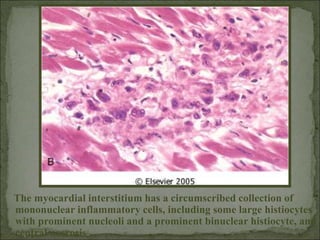
The myocardial interstitium has a circumscribed collection of
mononuclear inflammatory cells, including some large histiocytes
with prominent nucleoli and a prominent binuclear histiocyte, and
central necrosis
Owl 's eye cells
Aschoff cells
Scar phase
Emergence of fibroblasts and collagen
production, formation of small spindle scar, 2-3
months or so.
The above three stages repeated attacks, the
old and new lesions coexist.
The whole course about 4-6 months.
RF involves various organs
Rheumatic heart disease
Rheumatic arthritis
Rheumatic arteritis
Rheumatic disease of skin
Rheumatic disease of brain
Rheumatic heart disease
Divided into rheumatic endocarditis,
rheumatic myocarditis and rheumatic
pericarditis, often for rheumatic
pancarditis.
60% to 80% children associated with
pancarditis。
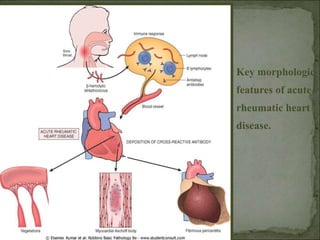
Key morphologic
features of acute
rheumatic heart
disease.
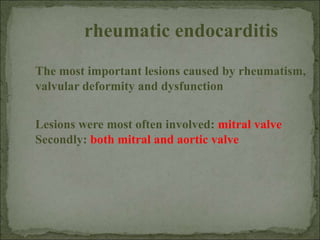
rheumatic endocarditis
Lesions were most often involved: mitral valve
Secondly: both mitral and aortic valve
The most important lesions caused by rheumatism,
valvular deformity and dysfunction
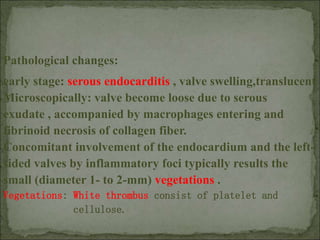
Pathological changes:
early stage: serous endocarditis , valve swelling,translucent
Microscopically: valve become loose due to serous
exudate , accompanied by macrophages entering and
fibrinoid necrosis of collagen fiber.
Concomitant involvement of the endocardium and the left-
sided valves by inflammatory foci typically results the
small (diameter 1- to 2-mm) vegetations .
Vegetations: White thrombus consist of platelet and
cellulose.
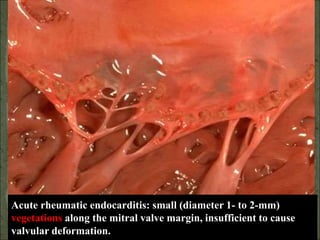
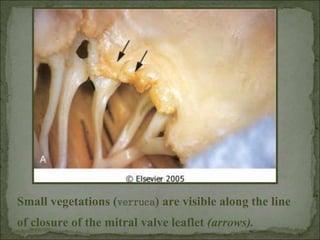
Acute rheumatic endocarditis: small (diameter 1- to 2-mm)
vegetations along the mitral valve margin, insufficient to cause
valvular deformation.
Small vegetations (verruca) are visible along the line
of closure of the mitral valve leaflet (arrows).
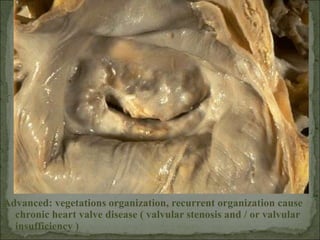
Advanced: vegetations organization, recurrent organization cause
chronic heart valve disease ( valvular stenosis and / or valvular
insufficiency )
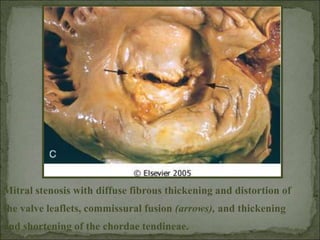
Mitral stenosis with diffuse fibrous thickening and distortion of
the valve leaflets, commissural fusion (arrows), and thickening
and shortening of the chordae tendineae.
rheumatic myocarditis
location:Myocardial interstitial
connective tissue
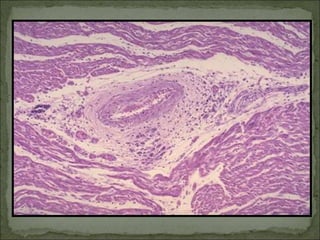
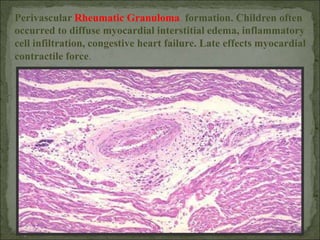
pathological changes: Rheumatic Granuloma
Perivascular Rheumatic Granuloma formation. Children often
occurred to diffuse myocardial interstitial edema, inflammatory
cell infiltration, congestive heart failure. Late effects myocardial
contractile force.
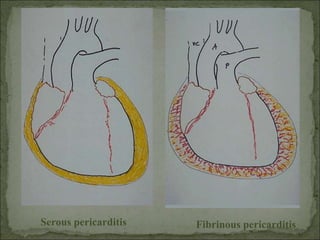
A serous or serous fibrinous inflammation. Can
form a pericardial effusion, trichocardia
and constrictive pericarditis.
rheumatic pericarditis
Serous pericarditis Fibrinous pericarditis
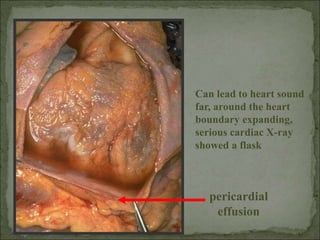
pericardial
effusion
Can lead to heart sound
far, around the heart
boundary expanding,
serious cardiac X-ray
showed a flask
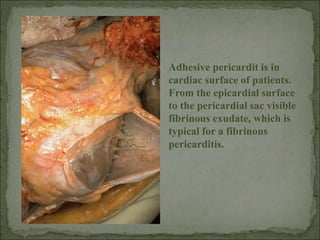
Adhesive pericardit is in
cardiac surface of patients.
From the epicardial surface
to the pericardial sac visible
fibrinous exudate, which is
typical for a fibrinous
pericarditis.
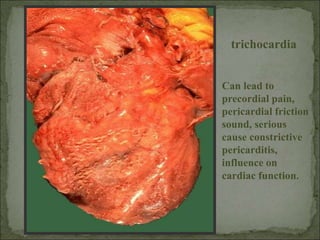
trichocardia
Can lead to
precordial pain,
pericardial friction
sound, serious
cause constrictive
pericarditis,
influence on
cardiac function.
 Rheumatoid arthritis
 predilection age: Adults
 predilection site: involving the large joints, most
commonly in the knee and ankle joint, followed
by the shoulder, wrist, elbow and other joints
 Lesion characteristics: migratory polyarthritis.
Local serous exudate, appear red, swelling, heat,
pain and dysfunction. As the heals , serous
exudate is absorbed, generally no sequela.
 Microscopic lesions mainly for serous
inflammation.
 lick the knee but bite the heart.
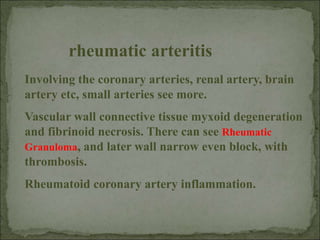
Involving the coronary arteries, renal artery, brain
artery etc, small arteries see more.
Vascular wall connective tissue myxoid degeneration
and fibrinoid necrosis. There can see Rheumatic
Granuloma, and later wall narrow even block, with
thrombosis.
Rheumatoid coronary artery inflammation.
rheumatic arteritis
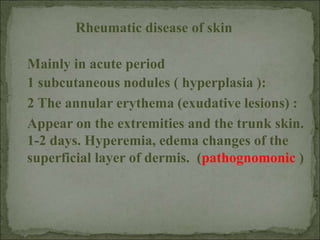
Mainly in acute period
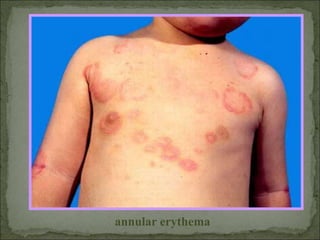
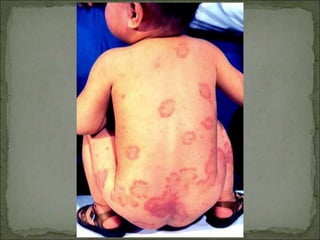
1 subcutaneous nodules ( hyperplasia ):
2 The annular erythema (exudative lesions) :
Appear on the extremities and the trunk skin.
1-2 days. Hyperemia, edema changes of the
superficial layer of dermis. (pathognomonic )
Rheumatic disease of skin
annular erythema
Mainly involving the cerebral cortex, basal
ganglia, thalamus and cerebellum cortex.
Lesions to rheumatic arteritis and
subcortical encephalitis.
In 5-12 years old children, girls see more.
Rheumatic disease of brain
Infective endocarditis, one of the most serious of all
infections, is characterized by colonization or
invasion of the heart valves or the mural
endocardium by a microbe, leading to the formation
of bulky, friable vegetations composed of thrombotic
debris and organisms, often associated with
destruction of the underlying cardiac tissues.
Infective endocarditis
(IE)
Traditionally, IE has been classified on
clinical grounds into acute and subacute forms.
1. Acute IE
2. Subacute IE
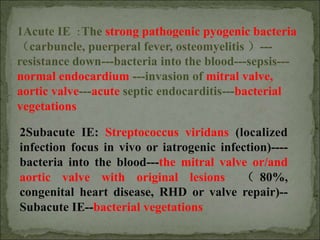
1Acute IE :The strong pathogenic pyogenic bacteria
(carbuncle, puerperal fever, osteomyelitis )---
resistance down---bacteria into the blood---sepsis---
normal endocardium ---invasion of mitral valve,
aortic valve---acute septic endocarditis---bacterial
vegetations
2Subacute IE: Streptococcus viridans (localized
infection focus in vivo or iatrogenic infection)----
bacteria into the blood---the mitral valve or/and
aortic valve with original lesions ( 80%,
congenital heart disease, RHD or valve repair)--
Subacute IE--bacterial vegetations
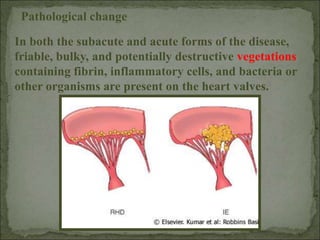
Pathological change
In both the subacute and acute forms of the disease,
friable, bulky, and potentially destructive vegetations
containing fibrin, inflammatory cells, and bacteria or
other organisms are present on the heart valves.
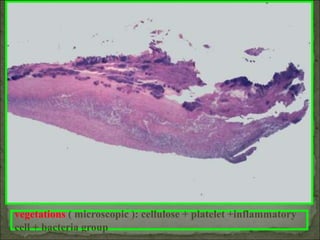
vegetations ( microscopic ): cellulose + platelet +inflammatory
cell + bacteria group
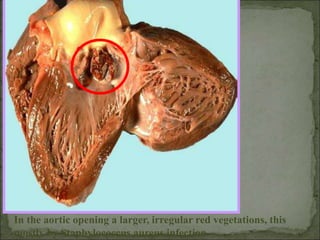
In the aortic opening a larger, irregular red vegetations, this
mostly by Staphylococcus aureus infection.
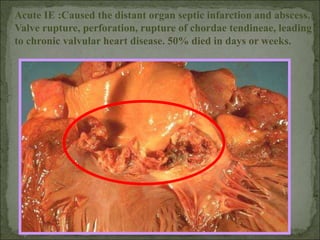
Acute IE :Caused the distant organ septic infarction and abscess.
Valve rupture, perforation, rupture of chordae tendineae, leading
to chronic valvular heart disease. 50% died in days or weeks.
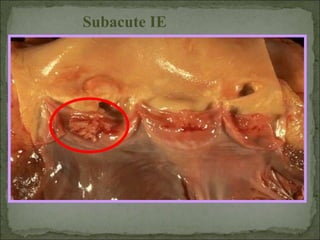
Subacute IE
End and complications:
1.Fever: it is the most consistent sign of IE. However, with
subacute disease, particularly in the elderly, fever
may be slight or absent, and the only manifestations
are sometimes nonspecific fatigue, loss of weight, and
a flulike syndrome. In contrast, acute endocarditis
has a stormy onset with rapidly developing fever,
chills, weakness, and lassitude.
2.Arterial embolization ( 20%-40% ): embolism of
brain ,heart, kidney, spleen, mesenteric, limbs and
pulmonary.
3.Chronic valvular disease
4.non-specific symptoms:
Splenomegaly (15%-50% )
Anemia
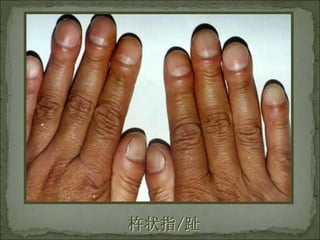
Clubbing finger / toe
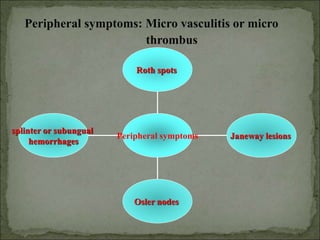
5. Peripheral symptoms
splinter or subungual
hemorrhages
Osler nodes
Janeway lesions
Roth spots
Peripheral symptoms
Peripheral symptoms: Micro vasculitis or micro
thrombus
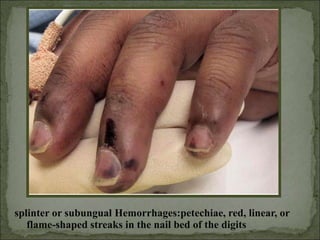
splinter or subungual Hemorrhages:petechiae, red, linear, or
flame-shaped streaks in the nail bed of the digits
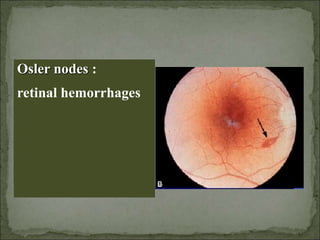
Osler nodes :
retinal hemorrhages
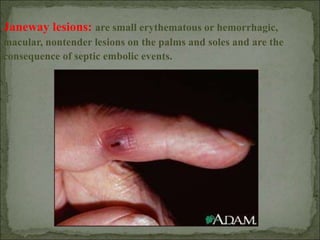
Janeway lesions: are small erythematous or hemorrhagic,
macular, nontender lesions on the palms and soles and are the
consequence of septic embolic events.
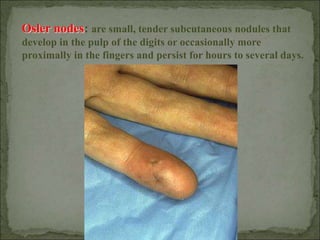
Osler nodes: are small, tender subcutaneous nodules that
develop in the pulp of the digits or occasionally more
proximally in the fingers and persist for hours to several days.
杵状指/趾
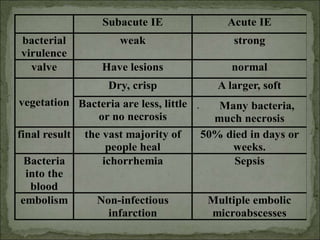
Subacute IE Acute IE
bacterial
virulence
weak strong
valve Have lesions normal
Dry, crisp A larger, soft
vegetation Bacteria are less, little
or no necrosis
 Many bacteria,
much necrosis
final result the vast majority of
people heal
50% died in days or
weeks.
Bacteria
into the
blood
ichorrhemia Sepsis
embolism Non-infectious
infarction
Multiple embolic
microabscesses
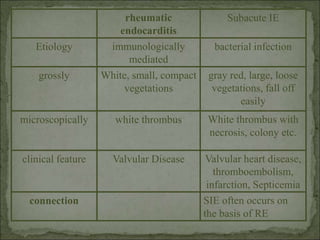
rheumatic
endocarditis
Subacute IE
Etiology immunologically
mediated
bacterial infection
grossly White, small, compact
vegetations
gray red, large, loose
vegetations, fall off
easily
microscopically white thrombus White thrombus with
necrosis, colony etc.
clinical feature Valvular Disease Valvular heart disease,
thromboembolism,
infarction, Septicemia
connection SIE often occurs on
the basis of RE

Rheumatic heart disease agp

  • 1.
    Rheumatic Fever &Rheumatic Heart Disease Akshai George Paul
  • 2.
    •Rheumatic fever (RF)is an acute, immunologically mediated, multisystem inflammatory disease that occurs a few weeks following an episode of group A streptococcal pharyngitis. •Major involvement of systemic connective tissue, it often violate connective tissue of heart, joint, skin, and subcutaneous and vascular connective tissue. Key pathologic features is Rheumatic Granuloma. •It occurs in children in age 5 to 15 years, 20% -adults •The clinical course of rheumatic fever involves a childhood infection with complications in adulthood (cardiac defect). Rheumatic Fever
  • 3.
    Etiology and pathogenesis Itis an immune response associated with streptococcal infection, but it is not caused by bacteria directly effects.
  • 4.
    1. There isa streptococcus infection history before the onset of RF. 2. A variety of antibodies of the streptococcus and its products can be detected in the onset phase. serous "O" antibody in 95% patients is high, > 500 units. 3. Regional distribution consistent with area of streptococcal infection. 4. Antibiotic prophylaxis treatment is effective. The evidence related with group A β-hemolytic streptococcus infection including:
  • 5.
    The evidence whichis not directly caused by streptococcus infection including: 1. The disease is not appeared in infected at the time, but in 2-3 weeks later, it is in line with emergence period of the general immune response. • No evidence of direct invasion of organ by streptococcus. • Streptococcus has never been found in the RF patient's blood . • Not purulent inflammation, but the fibrinoid necrosis.
  • 6.
    Antigen and antibodycross-reactivity: The antigens of streptococcus may stimulate the immunological cross-reactivity in patients.
  • 7.
    M antibody+Vascular smooth muscle Cantibody+Cardiovascular connective tissue Pathogenesis Antigen antibody complex Local deposition alexin platelet activation of coagulation system Embolism, bleeding Neutrophil infiltration Release of lysosomal enzymes(Neutral, acid hydrolases, elastase, collagenase and so on Blood vessel, tissue injury
  • 8.
    Basic pathological changes 1.Exudative and degenerative phase 2. The proliferative phase (Granulomatous period) 3. Scar phase (healed phaseFibrosis phaseHardening phase)
  • 9.
    Exudative and degenerativephase It is characterized by serofibrinous exudate, with deposits of immune precipitate on collagen fibers that lead to fibrinoid necrosis. About 1 months.
  • 10.
    The proliferative phase(Granulomatous period) Aschoff Body: Structure: center: fibrinoid necrosis around the center:Anitschkow cells , lymphocytes, occasional plasma cells Distribution: Myocardial interstitial, subendocardial and subcutaneous connective tissue. Epicardial, joints and blood vessels is rare. pathognomonic for RF
  • 11.
    Anitschkow cells: These distinctivecells have abundant cytoplasm and central round-to-ovoid nuclei in which the chromatin is disposed in a central, slender, wavy ribbon (hence the designation "caterpillar cells“-- cross section named Owl 's eye cells). Some of the larger macrophages become multinucleated to form Aschoff cells(inflammatory giant cells).
  • 14.
    The myocardial interstitiumhas a circumscribed collection of mononuclear inflammatory cells, including some large histiocytes with prominent nucleoli and a prominent binuclear histiocyte, and central necrosis
  • 16.
    Owl 's eyecells Aschoff cells
  • 17.
    Scar phase Emergence offibroblasts and collagen production, formation of small spindle scar, 2-3 months or so. The above three stages repeated attacks, the old and new lesions coexist. The whole course about 4-6 months.
  • 18.
    RF involves variousorgans Rheumatic heart disease Rheumatic arthritis Rheumatic arteritis Rheumatic disease of skin Rheumatic disease of brain
  • 19.
    Rheumatic heart disease Dividedinto rheumatic endocarditis, rheumatic myocarditis and rheumatic pericarditis, often for rheumatic pancarditis. 60% to 80% children associated with pancarditis。
  • 20.
    Key morphologic features ofacute rheumatic heart disease.
  • 21.
    rheumatic endocarditis Lesions weremost often involved: mitral valve Secondly: both mitral and aortic valve The most important lesions caused by rheumatism, valvular deformity and dysfunction
  • 22.
    Pathological changes: early stage:serous endocarditis , valve swelling,translucent Microscopically: valve become loose due to serous exudate , accompanied by macrophages entering and fibrinoid necrosis of collagen fiber. Concomitant involvement of the endocardium and the left- sided valves by inflammatory foci typically results the small (diameter 1- to 2-mm) vegetations . Vegetations: White thrombus consist of platelet and cellulose.
  • 23.
    Acute rheumatic endocarditis:small (diameter 1- to 2-mm) vegetations along the mitral valve margin, insufficient to cause valvular deformation.
  • 24.
    Small vegetations (verruca)are visible along the line of closure of the mitral valve leaflet (arrows).
  • 25.
    Advanced: vegetations organization,recurrent organization cause chronic heart valve disease ( valvular stenosis and / or valvular insufficiency )
  • 26.
    Mitral stenosis withdiffuse fibrous thickening and distortion of the valve leaflets, commissural fusion (arrows), and thickening and shortening of the chordae tendineae.
  • 27.
    rheumatic myocarditis location:Myocardial interstitial connectivetissue pathological changes: Rheumatic Granuloma
  • 28.
    Perivascular Rheumatic Granulomaformation. Children often occurred to diffuse myocardial interstitial edema, inflammatory cell infiltration, congestive heart failure. Late effects myocardial contractile force.
  • 29.
    A serous orserous fibrinous inflammation. Can form a pericardial effusion, trichocardia and constrictive pericarditis. rheumatic pericarditis
  • 30.
  • 31.
    pericardial effusion Can lead toheart sound far, around the heart boundary expanding, serious cardiac X-ray showed a flask
  • 32.
    Adhesive pericardit isin cardiac surface of patients. From the epicardial surface to the pericardial sac visible fibrinous exudate, which is typical for a fibrinous pericarditis.
  • 33.
    trichocardia Can lead to precordialpain, pericardial friction sound, serious cause constrictive pericarditis, influence on cardiac function.
  • 34.
     Rheumatoid arthritis predilection age: Adults  predilection site: involving the large joints, most commonly in the knee and ankle joint, followed by the shoulder, wrist, elbow and other joints  Lesion characteristics: migratory polyarthritis. Local serous exudate, appear red, swelling, heat, pain and dysfunction. As the heals , serous exudate is absorbed, generally no sequela.  Microscopic lesions mainly for serous inflammation.  lick the knee but bite the heart.
  • 35.
    Involving the coronaryarteries, renal artery, brain artery etc, small arteries see more. Vascular wall connective tissue myxoid degeneration and fibrinoid necrosis. There can see Rheumatic Granuloma, and later wall narrow even block, with thrombosis. Rheumatoid coronary artery inflammation. rheumatic arteritis
  • 36.
    Mainly in acuteperiod 1 subcutaneous nodules ( hyperplasia ): 2 The annular erythema (exudative lesions) : Appear on the extremities and the trunk skin. 1-2 days. Hyperemia, edema changes of the superficial layer of dermis. (pathognomonic ) Rheumatic disease of skin
  • 37.
  • 39.
    Mainly involving thecerebral cortex, basal ganglia, thalamus and cerebellum cortex. Lesions to rheumatic arteritis and subcortical encephalitis. In 5-12 years old children, girls see more. Rheumatic disease of brain
  • 40.
    Infective endocarditis, oneof the most serious of all infections, is characterized by colonization or invasion of the heart valves or the mural endocardium by a microbe, leading to the formation of bulky, friable vegetations composed of thrombotic debris and organisms, often associated with destruction of the underlying cardiac tissues. Infective endocarditis (IE)
  • 41.
    Traditionally, IE hasbeen classified on clinical grounds into acute and subacute forms. 1. Acute IE 2. Subacute IE
  • 42.
    1Acute IE :Thestrong pathogenic pyogenic bacteria (carbuncle, puerperal fever, osteomyelitis )--- resistance down---bacteria into the blood---sepsis--- normal endocardium ---invasion of mitral valve, aortic valve---acute septic endocarditis---bacterial vegetations 2Subacute IE: Streptococcus viridans (localized infection focus in vivo or iatrogenic infection)---- bacteria into the blood---the mitral valve or/and aortic valve with original lesions ( 80%, congenital heart disease, RHD or valve repair)-- Subacute IE--bacterial vegetations
  • 43.
    Pathological change In boththe subacute and acute forms of the disease, friable, bulky, and potentially destructive vegetations containing fibrin, inflammatory cells, and bacteria or other organisms are present on the heart valves.
  • 44.
    vegetations ( microscopic): cellulose + platelet +inflammatory cell + bacteria group
  • 45.
    In the aorticopening a larger, irregular red vegetations, this mostly by Staphylococcus aureus infection.
  • 46.
    Acute IE :Causedthe distant organ septic infarction and abscess. Valve rupture, perforation, rupture of chordae tendineae, leading to chronic valvular heart disease. 50% died in days or weeks.
  • 47.
  • 48.
    End and complications: 1.Fever:it is the most consistent sign of IE. However, with subacute disease, particularly in the elderly, fever may be slight or absent, and the only manifestations are sometimes nonspecific fatigue, loss of weight, and a flulike syndrome. In contrast, acute endocarditis has a stormy onset with rapidly developing fever, chills, weakness, and lassitude. 2.Arterial embolization ( 20%-40% ): embolism of brain ,heart, kidney, spleen, mesenteric, limbs and pulmonary.
  • 49.
    3.Chronic valvular disease 4.non-specificsymptoms: Splenomegaly (15%-50% ) Anemia Clubbing finger / toe 5. Peripheral symptoms
  • 50.
    splinter or subungual hemorrhages Oslernodes Janeway lesions Roth spots Peripheral symptoms Peripheral symptoms: Micro vasculitis or micro thrombus
  • 51.
    splinter or subungualHemorrhages:petechiae, red, linear, or flame-shaped streaks in the nail bed of the digits
  • 52.
  • 53.
    Janeway lesions: aresmall erythematous or hemorrhagic, macular, nontender lesions on the palms and soles and are the consequence of septic embolic events.
  • 54.
    Osler nodes: aresmall, tender subcutaneous nodules that develop in the pulp of the digits or occasionally more proximally in the fingers and persist for hours to several days.
  • 55.
  • 56.
    Subacute IE AcuteIE bacterial virulence weak strong valve Have lesions normal Dry, crisp A larger, soft vegetation Bacteria are less, little or no necrosis  Many bacteria, much necrosis final result the vast majority of people heal 50% died in days or weeks. Bacteria into the blood ichorrhemia Sepsis embolism Non-infectious infarction Multiple embolic microabscesses
  • 57.
    rheumatic endocarditis Subacute IE Etiology immunologically mediated bacterialinfection grossly White, small, compact vegetations gray red, large, loose vegetations, fall off easily microscopically white thrombus White thrombus with necrosis, colony etc. clinical feature Valvular Disease Valvular heart disease, thromboembolism, infarction, Septicemia connection SIE often occurs on the basis of RE