Hyperthyroidism
Objectives
• To understand types ,clinical features ,
investigation and management of
hyperthyroidism
Overview
• Definition
• Types
• clinical features
• Investigation
• Treatment
Hyperthyroidism
Disease process associated with increased
thyroid secretion result in predictable hyper
metabolic state
• Types:
Primary thyrotoxicosis
1. Diffuse toxic goitres- graves disease
Secondary thyrotoxicosis
2. Toxic nodular goitre
3. Toxic nodule
4. Hyperthyroidism due to rare cause
Hyperthyroidism
Diffuse toxic goitre (graves)
• Most common cause of hyperthyroidism
• Irish physician-Dr Robert Graves in 1835
• Common-young females(20 to 40)
• Whole gland involved
• 50% family h/o autoimmune endocrine disease
• Hypertrophy and hyperplasia-abnormal TSH –R
Ab bind to TSH receptor disproportionate and
prolonged effect
• Genetic susceptibility
Toxic nodular goitre
• Middle aged/elderly
• Eye signs –rare
• Secondary TT
• Nodules-inactive
• Internodular tissue - overactive
• Toxic adenoma-autonomous
Toxic nodule
• Solitary overactive nodule
• Part of generalised nodularity or two toxic
adenoma
• Autonomous
• TSH- suppressed by high T3 and T4
• Normal surrounding thyroid tissue –
suppressed and inactive
Histology
• Normal acini- with flattened cuboidal
epithelium and filled with homogenous colloid
• Hyperthyroid – acini hyperplasia
- lined by high columnar epi
- empty or vacuolated colloid
- characteristic scalloped pattern
adjacent to thyrocytes
Clinical Features
• Symptoms
– Tiredness
– Emotional liability
– Heat intolerance
– Weight loss
– Excessive appetite
– Palpitation
– Diarrhoea
– Amenorrhoea
– Blurring of vision or double vision
• Signs
– Tachycardia
– Hot moist palms
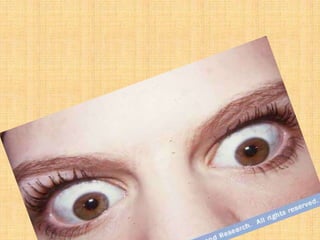
– Exophthalmos
– Lid lag retraction
– Agitation
– Thyroid swelling
– bruit
• Cardiac rhythm
• - Increased sleeping heart rate( sinus tachycardia)
- Arryhthmias, multiple extra systoles, paroxysmal
atrial tachycardia
- Paroxysmal atrial fibrillation
- Persistent atrial fibrillation, no response to digoxin
• Myopathy
– Proximal limb muscle weakness ( thyrotoxic
myopathy)
Eye Signs
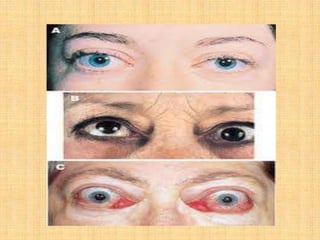
• Exophthalmos
– Unilateral or bilateral
– Infiltration of retrobulbar tissue with fluid and
round cells
• Retraction/spasm of upper eyelid
• Levator palpabre superiaris supplied partly by
sympathetic fibers
• Graves ophthalmopathy is autoimmune
disease
• Diplopia –weakness of elevator (inferior
oblique
• Papilloedema and corneal ulcer
• Malignant exophthalmos
• Graves ophthalmopathy-autoimmune disease-
Ab mediated effects on the ocular muscles
• Von Graefe's sign (lid lag sign)
• Dalrymple's sign
• Joffroy sign (absent creases in the forehead on
superior gaze)
• Möbius sign (poor convergence)
• Stellwag sign (incomplete and infrequent
blinking
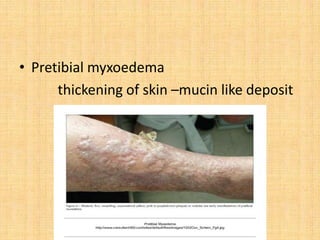
• Pretibial myxoedema
thickening of skin –mucin like deposit
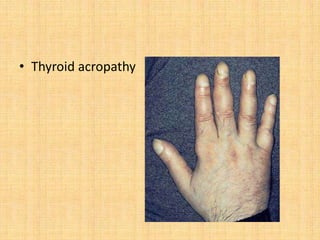
• Thyroid acropathy
• Thyrotoxicosis factitia:
thyroxine induced (0.2 -0.3 mg)
• Jod - basedow thyrotoxicosis
jod = iodine (german)
• Neonatal thyrotoxicosis : increased TSH Ab
subsides : 3-4 weeks
Diagnosis
1. Clinical
2. Thyroid profile
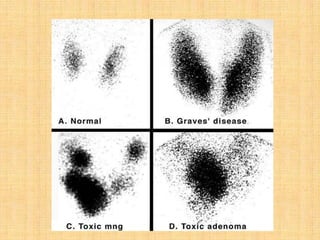
3. Thyroid scan-autonomous nodule
4. –children with growth spurt ,behaviour
problems or myopathy
- tachycardia /arryhthmia in elderly
- unexplained diarrhoea
- loss of weight
Treatment
1. Rest , Sedation
2. Antithyroid drugs
3. Surgery
4. Radioiodine
Drugs
1. Antithyriod drugs- <45yr small goitre
- carbimazole
- propylthiouracil
- oxidation and binding of Iodine to tyrosine
2. B Adrenergic blockers
-propranolol,nadolol
3. Iodides
• Advantages : no surgery
rapid control of thyrotoxicosis
• Disadvantages : treatment is prolonged
failure rate-50%
• SE : agranulocytosis / aplastic anemia
Dose :10mg 3-4 times/day
• Replacement – thyroxine 0.1 mg – 0.15 mg
Surgery
• <45 yr large goitre
• Toxic nodule
• Toxic nodular goitre
• Advantage: goitre removed
Cure rapid
Cure rate-high
• Disadvantage : recurrence - 5%
- risk of surgery
- hypothyroidism-20-45%
- hypoparathyroidism
Radio iodine
• Indictions : >45 yr
rec thyrotoxicosis after surgery
• Advantages : no surgery ,no drug
• Disadvantages : isotope facility must be
available
THANK YOU

Hyperthyroidism

  • 1.
  • 2.
    Objectives • To understandtypes ,clinical features , investigation and management of hyperthyroidism
  • 3.
    Overview • Definition • Types •clinical features • Investigation • Treatment
  • 4.
    Hyperthyroidism Disease process associatedwith increased thyroid secretion result in predictable hyper metabolic state
  • 5.
    • Types: Primary thyrotoxicosis 1.Diffuse toxic goitres- graves disease Secondary thyrotoxicosis 2. Toxic nodular goitre 3. Toxic nodule 4. Hyperthyroidism due to rare cause Hyperthyroidism
  • 6.
    Diffuse toxic goitre(graves) • Most common cause of hyperthyroidism • Irish physician-Dr Robert Graves in 1835 • Common-young females(20 to 40) • Whole gland involved • 50% family h/o autoimmune endocrine disease • Hypertrophy and hyperplasia-abnormal TSH –R Ab bind to TSH receptor disproportionate and prolonged effect • Genetic susceptibility
  • 7.
    Toxic nodular goitre •Middle aged/elderly • Eye signs –rare • Secondary TT • Nodules-inactive • Internodular tissue - overactive • Toxic adenoma-autonomous
  • 8.
    Toxic nodule • Solitaryoveractive nodule • Part of generalised nodularity or two toxic adenoma • Autonomous • TSH- suppressed by high T3 and T4 • Normal surrounding thyroid tissue – suppressed and inactive
  • 9.
    Histology • Normal acini-with flattened cuboidal epithelium and filled with homogenous colloid • Hyperthyroid – acini hyperplasia - lined by high columnar epi - empty or vacuolated colloid - characteristic scalloped pattern adjacent to thyrocytes
  • 10.
    Clinical Features • Symptoms –Tiredness – Emotional liability – Heat intolerance – Weight loss – Excessive appetite – Palpitation – Diarrhoea – Amenorrhoea – Blurring of vision or double vision
  • 11.
    • Signs – Tachycardia –Hot moist palms – Exophthalmos – Lid lag retraction – Agitation – Thyroid swelling – bruit
  • 12.
    • Cardiac rhythm •- Increased sleeping heart rate( sinus tachycardia) - Arryhthmias, multiple extra systoles, paroxysmal atrial tachycardia - Paroxysmal atrial fibrillation - Persistent atrial fibrillation, no response to digoxin • Myopathy – Proximal limb muscle weakness ( thyrotoxic myopathy)
  • 13.
    Eye Signs • Exophthalmos –Unilateral or bilateral – Infiltration of retrobulbar tissue with fluid and round cells • Retraction/spasm of upper eyelid • Levator palpabre superiaris supplied partly by sympathetic fibers • Graves ophthalmopathy is autoimmune disease
  • 14.
    • Diplopia –weaknessof elevator (inferior oblique • Papilloedema and corneal ulcer • Malignant exophthalmos • Graves ophthalmopathy-autoimmune disease- Ab mediated effects on the ocular muscles
  • 15.
    • Von Graefe'ssign (lid lag sign) • Dalrymple's sign • Joffroy sign (absent creases in the forehead on superior gaze) • Möbius sign (poor convergence) • Stellwag sign (incomplete and infrequent blinking
  • 18.
    • Pretibial myxoedema thickeningof skin –mucin like deposit
  • 19.
  • 20.
    • Thyrotoxicosis factitia: thyroxineinduced (0.2 -0.3 mg) • Jod - basedow thyrotoxicosis jod = iodine (german) • Neonatal thyrotoxicosis : increased TSH Ab subsides : 3-4 weeks
  • 21.
    Diagnosis 1. Clinical 2. Thyroidprofile 3. Thyroid scan-autonomous nodule 4. –children with growth spurt ,behaviour problems or myopathy - tachycardia /arryhthmia in elderly - unexplained diarrhoea - loss of weight
  • 23.
    Treatment 1. Rest ,Sedation 2. Antithyroid drugs 3. Surgery 4. Radioiodine
  • 24.
    Drugs 1. Antithyriod drugs-<45yr small goitre - carbimazole - propylthiouracil - oxidation and binding of Iodine to tyrosine 2. B Adrenergic blockers -propranolol,nadolol 3. Iodides
  • 25.
    • Advantages :no surgery rapid control of thyrotoxicosis • Disadvantages : treatment is prolonged failure rate-50% • SE : agranulocytosis / aplastic anemia Dose :10mg 3-4 times/day • Replacement – thyroxine 0.1 mg – 0.15 mg
  • 26.
    Surgery • <45 yrlarge goitre • Toxic nodule • Toxic nodular goitre • Advantage: goitre removed Cure rapid Cure rate-high
  • 27.
    • Disadvantage :recurrence - 5% - risk of surgery - hypothyroidism-20-45% - hypoparathyroidism
  • 28.
    Radio iodine • Indictions: >45 yr rec thyrotoxicosis after surgery • Advantages : no surgery ,no drug • Disadvantages : isotope facility must be available
  • 29.