MOKGWANE EUTLWETSE
4TH YEAR MED
14/07/2011
UWI, BAHAMAS CAMPUS
DEFINITION
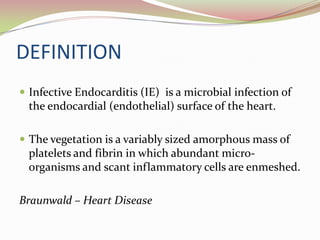
 Infective Endocarditis (IE) is a microbial infection of
the endocardial (endothelial) surface of the heart.
 The vegetation is a variably sized amorphous mass of
platelets and fibrin in which abundant micro-
organisms and scant inflammatory cells are enmeshed.
Braunwald – Heart Disease
CAUSES OF IE
-
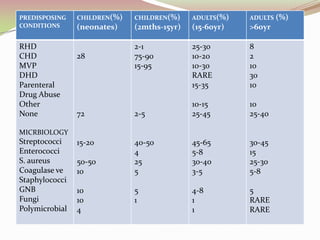
PREDISPOSING
CONDITIONS
CHILDREN(%)
(neonates)
CHILDREN(%)
(2mths-15yr)
ADULTS(%)
(15-60yr)
ADULTS (%)
>60yr
RHD
CHD
MVP
DHD
Parenteral
Drug Abuse
Other
None
MICRBIOLOGY
Streptococci
Enterococci
S. aureus
Coagulase ve
Staphylococci
GNB
Fungi
Polymicrobial
28
72
15-20
50-50
10
10
10
4
2-1
75-90
15-95
2-5
40-50
4
25
5
5
1
25-30
10-20
10-30
RARE
15-35
10-15
25-45
45-65
5-8
30-40
3-5
4-8
1
1
8
2
10
30
10
10
25-40
30-45
15
25-30
5-8
5
RARE
RARE
RISK FACTORS FOR SPECIFIC
PATHOGENS THAT CAUSE IE
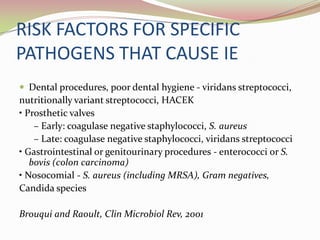
 Dental procedures, poor dental hygiene - viridans streptococci,
nutritionally variant streptococci, HACEK
• Prosthetic valves
– Early: coagulase negative staphylococci, S. aureus
– Late: coagulase negative staphylococci, viridans streptococci
• Gastrointestinal or genitourinary procedures - enterococci or S.
bovis (colon carcinoma)
• Nosocomial - S. aureus (including MRSA), Gram negatives,
Candida species
Brouqui and Raoult, Clin Microbiol Rev, 2001
PATHOGENESIS
Endothelium resistant to bacteria and thrombus formation
Endothelial injury and hypercoagulable state- high velocity jets, obstructive
lesions, aberrant flows, direct invasion by virulent pathogens can lead to non-
bacterial thrombotic embolism(NBTE)
Mitral regurgitation, Aortic stenosis, Aortic regurgitation, Ventricular Septal
Defect, complex congenital heart disease can create
NBTE
Most bacteria find NBTE a convenient site or nidus for
adherence
Virulent organisms- Staph. aureus, Strep. pyogenes, Strep. pneumoniae have
surface molecules which allow them to adhere to intact endothelium and to
exposed sub-endothelial tissues
If the adhering bacteria are able to survive serum cidal activity, peptides,
complement , antibody etc., they multiply – infective vegetation.
PATHOPHYSIOLOGY
The clinical manifestation IE result from:
1. The local destructive effects of intracardial infection;
2. The embolization of septic fragments of vegetations to
distant sites, resulting in infarction or infection;
3. The hematogenous seeding of remote sites during
continuous bacteremia and
4. An antibody response to the infecting organism with
subsequent tissue injury due to deposition of preformed
immune complexes.
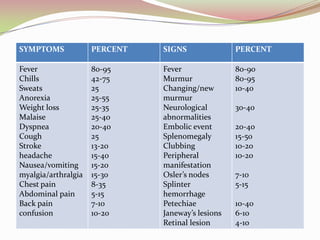
CLINICAL MANIFESTATIONSYMPTOMS PERCENT SIGNS PERCENT
Fever
Chills
Sweats
Anorexia
Weight loss
Malaise
Dyspnea
Cough
Stroke
headache
Nausea/vomiting
myalgia/arthralgia
Chest pain
Abdominal pain
Back pain
confusion
80-95
42-75
25
25-55
25-35
25-40
20-40
25
13-20
15-40
15-20
15-30
8-35
5-15
7-10
10-20
Fever
Murmur
Changing/new
murmur
Neurological
abnormalities
Embolic event
Splenomegaly
Clubbing
Peripheral
manifestation
Osler’s nodes
Splinter
hemorrhage
Petechiae
Janeway’s lesions
Retinal lesion
80-90
80-95
10-40
30-40
20-40
15-50
10-20
10-20
7-10
5-15
10-40
6-10
4-10
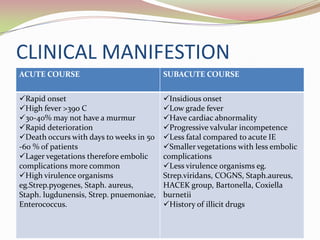
CLINICAL MANIFESTION
ACUTE COURSE SUBACUTE COURSE
Rapid onset
High fever >39o C
30-40% may not have a murmur
Rapid deterioration
Death occurs with days to weeks in 50
-60 % of patients
Lager vegetations therefore embolic
complications more common
High virulence organisms
eg.Strep.pyogenes, Staph. aureus,
Staph. lugdunensis, Strep. pnuemoniae,
Enterococcus.
Insidious onset
Low grade fever
Have cardiac abnormality
Progressive valvular incompetence
Less fatal compared to acute IE
Smaller vegetations with less embolic
complications
Less virulence organisms eg.
Strep.viridans, COGNS, Staph.aureus,
HACEK group, Bartonella, Coxiella
burnetii
History of illicit drugs
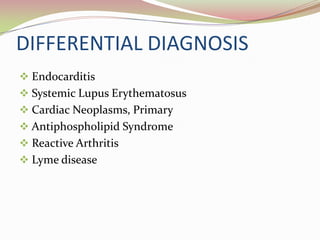
DIFFERENTIAL DIAGNOSIS
 Endocarditis
 Systemic Lupus Erythematosus
 Cardiac Neoplasms, Primary
 Antiphospholipid Syndrome
 Reactive Arthritis
 Lyme disease
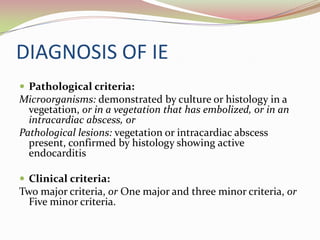
DIAGNOSIS OF IE
 Pathological criteria:
Microorganisms: demonstrated by culture or histology in a
vegetation, or in a vegetation that has embolized, or in an
intracardiac abscess, or
Pathological lesions: vegetation or intracardiac abscess
present, confirmed by histology showing active
endocarditis
 Clinical criteria:
Two major criteria, or One major and three minor criteria, or
Five minor criteria.
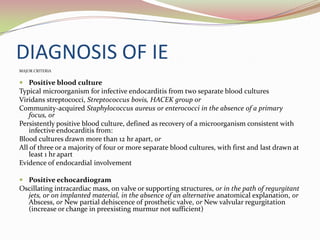
DIAGNOSIS OF IE
MAJOR CRITERIA
 Positive blood culture
Typical microorganism for infective endocarditis from two separate blood cultures
Viridans streptococci, Streptococcus bovis, HACEK group or
Community-acquired Staphylococcus aureus or enterococci in the absence of a primary
focus, or
Persistently positive blood culture, defined as recovery of a microorganism consistent with
infective endocarditis from:
Blood cultures drawn more than 12 hr apart, or
All of three or a majority of four or more separate blood cultures, with first and last drawn at
least 1 hr apart
Evidence of endocardial involvement
 Positive echocardiogram
Oscillating intracardiac mass, on valve or supporting structures, or in the path of regurgitant
jets, or on implanted material, in the absence of an alternative anatomical explanation, or
Abscess, or New partial dehiscence of prosthetic valve, or New valvular regurgitation
(increase or change in preexisting murmur not sufficient)
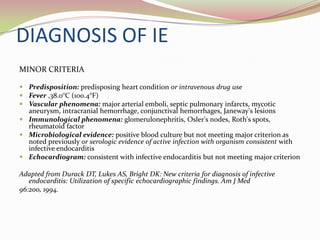
DIAGNOSIS OF IE
MINOR CRITERIA
 Predisposition: predisposing heart condition or intravenous drug use
 Fever ,38.0°C (100.4°F)
 Vascular phenomena: major arterial emboli, septic pulmonary infarcts, mycotic
aneurysm, intracranial hemorrhage, conjunctival hemorrhages, Janeway's lesions
 Immunological phenomena: glomerulonephritis, Osler's nodes, Roth's spots,
rheumatoid factor
 Microbiological evidence: positive blood culture but not meeting major criterion as
noted previously or serologic evidence of active infection with organism consistent with
infective endocarditis
 Echocardiogram: consistent with infective endocarditis but not meeting major criterion
Adapted from Durack DT, Lukes AS, Bright DK: New criteria for diagnosis of infective
endocarditis: Utilization of specific echocardiographic findings. Am J Med
96:200, 1994.
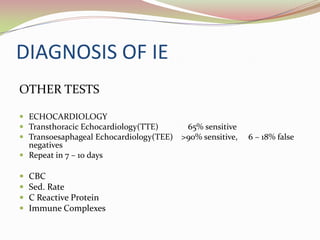
DIAGNOSIS OF IE
OTHER TESTS
 ECHOCARDIOLOGY
 Transthoracic Echocardiology(TTE) 65% sensitive
 Transoesaphageal Echocardiology(TEE) >90% sensitive, 6 – 18% false
negatives
 Repeat in 7 – 10 days
 CBC
 Sed. Rate
 C Reactive Protein
 Immune Complexes
TREATMENT
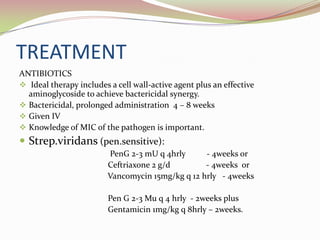
ANTIBIOTICS
 Ideal therapy includes a cell wall-active agent plus an effective
aminoglycoside to achieve bactericidal synergy.
 Bactericidal, prolonged administration 4 – 8 weeks
 Given IV
 Knowledge of MIC of the pathogen is important.
 Strep.viridans (pen.sensitive):
PenG 2-3 mU q 4hrly - 4weeks or
Ceftriaxone 2 g/d - 4weeks or
Vancomycin 15mg/kg q 12 hrly - 4weeks
Pen G 2-3 Mu q 4 hrly - 2weeks plus
Gentamicin 1mg/kg q 8hrly – 2weeks.
TREATMENT- ANTIBIOTICS
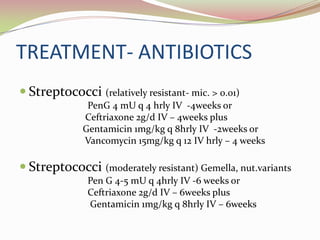
 Streptococci (relatively resistant- mic. > 0.01)
PenG 4 mU q 4 hrly IV -4weeks or
Ceftriaxone 2g/d IV – 4weeks plus
Gentamicin 1mg/kg q 8hrly IV -2weeks or
Vancomycin 15mg/kg q 12 IV hrly – 4 weeks
 Streptococci (moderately resistant) Gemella, nut.variants
Pen G 4-5 mU q 4hrly IV -6 weeks or
Ceftriaxone 2g/d IV – 6weeks plus
Gentamicin 1mg/kg q 8hrly IV – 6weeks
TREATMENT- ANTIBIOTICS
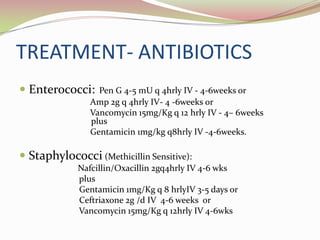
 Enterococci: Pen G 4-5 mU q 4hrly IV - 4-6weeks or
Amp 2g q 4hrly IV- 4 -6weeks or
Vancomycin 15mg/Kg q 12 hrly IV - 4– 6weeks
plus
Gentamicin 1mg/kg q8hrly IV -4-6weeks.
 Staphylococci (Methicillin Sensitive):
Nafcillin/Oxacillin 2gq4hrly IV 4-6 wks
plus
Gentamicin 1mg/Kg q 8 hrlyIV 3-5 days or
Ceftriaxone 2g /d IV 4-6 weeks or
Vancomycin 15mg/Kg q 12hrly IV 4-6wks
TREATMENT- ANTIBIOTICS
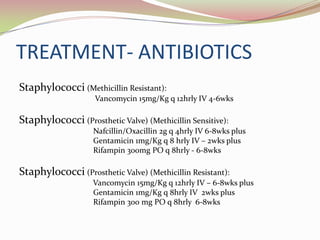
Staphylococci (Methicillin Resistant):
Vancomycin 15mg/Kg q 12hrly IV 4-6wks
Staphylococci (Prosthetic Valve) (Methicillin Sensitive):
Nafcillin/Oxacillin 2g q 4hrly IV 6-8wks plus
Gentamicin 1mg/Kg q 8 hrly IV – 2wks plus
Rifampin 300mg PO q 8hrly - 6-8wks
Staphylococci (Prosthetic Valve) (Methicillin Resistant):
Vancomycin 15mg/Kg q 12hrly IV – 6-8wks plus
Gentamicin 1mg/Kg q 8hrly IV 2wks plus
Rifampin 300 mg PO q 8hrly 6-8wks
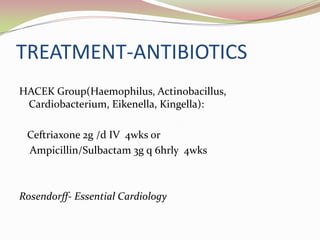
TREATMENT-ANTIBIOTICS
HACEK Group(Haemophilus, Actinobacillus,
Cardiobacterium, Eikenella, Kingella):
Ceftriaxone 2g /d IV 4wks or
Ampicillin/Sulbactam 3g q 6hrly 4wks
Rosendorff- Essential Cardiology
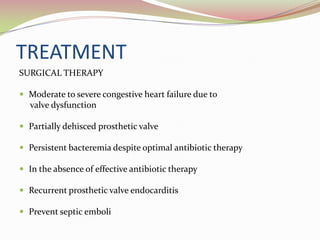
TREATMENT
SURGICAL THERAPY
 Moderate to severe congestive heart failure due to
valve dysfunction
 Partially dehisced prosthetic valve
 Persistent bacteremia despite optimal antibiotic therapy
 In the absence of effective antibiotic therapy
 Recurrent prosthetic valve endocarditis
 Prevent septic emboli
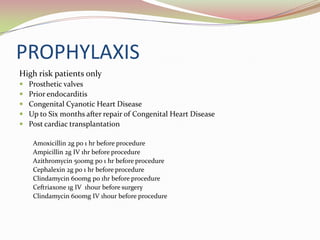
PROPHYLAXIS
High risk patients only
 Prosthetic valves
 Prior endocarditis
 Congenital Cyanotic Heart Disease
 Up to Six months after repair of Congenital Heart Disease
 Post cardiac transplantation
Amoxicillin 2g po 1 hr before procedure
Ampicillin 2g IV 1hr before procedure
Azithromycin 500mg po 1 hr before procedure
Cephalexin 2g po 1 hr before procedure
Clindamycin 600mg po 1hr before procedure
Ceftriaxone 1g IV 1hour before surgery
Clindamycin 600mg IV 1hour before procedure
REFERENCE
1. Braunwald: Heart Disease: A Textbook of Cardiovascular
Medicine, 6th ed: Copyright © 2001 W. B. Saunders Company
2. Hugh D. A.: et al: Moss and Adams' Heart Disease in Infants,
Children, and Adolescents Including the Fetus and Young Adult
6th ed (November 2000)
3. Robbins et al: Pathologic Basis of Disease: 6th ed: Copyright ©
1999 W.B. Saunders Company
4 . Rosendorff C: Essential Cardiology Principles and Practices: 2nd
ed: Copyright © 2005 Humana Press Inc.
END!!!

Infective Endocarditis

  • 1.
    MOKGWANE EUTLWETSE 4TH YEARMED 14/07/2011 UWI, BAHAMAS CAMPUS
  • 2.
    DEFINITION  Infective Endocarditis(IE) is a microbial infection of the endocardial (endothelial) surface of the heart.  The vegetation is a variably sized amorphous mass of platelets and fibrin in which abundant micro- organisms and scant inflammatory cells are enmeshed. Braunwald – Heart Disease
  • 3.
  • 4.
    - PREDISPOSING CONDITIONS CHILDREN(%) (neonates) CHILDREN(%) (2mths-15yr) ADULTS(%) (15-60yr) ADULTS (%) >60yr RHD CHD MVP DHD Parenteral Drug Abuse Other None MICRBIOLOGY Streptococci Enterococci S.aureus Coagulase ve Staphylococci GNB Fungi Polymicrobial 28 72 15-20 50-50 10 10 10 4 2-1 75-90 15-95 2-5 40-50 4 25 5 5 1 25-30 10-20 10-30 RARE 15-35 10-15 25-45 45-65 5-8 30-40 3-5 4-8 1 1 8 2 10 30 10 10 25-40 30-45 15 25-30 5-8 5 RARE RARE
  • 5.
    RISK FACTORS FORSPECIFIC PATHOGENS THAT CAUSE IE  Dental procedures, poor dental hygiene - viridans streptococci, nutritionally variant streptococci, HACEK • Prosthetic valves – Early: coagulase negative staphylococci, S. aureus – Late: coagulase negative staphylococci, viridans streptococci • Gastrointestinal or genitourinary procedures - enterococci or S. bovis (colon carcinoma) • Nosocomial - S. aureus (including MRSA), Gram negatives, Candida species Brouqui and Raoult, Clin Microbiol Rev, 2001
  • 6.
    PATHOGENESIS Endothelium resistant tobacteria and thrombus formation Endothelial injury and hypercoagulable state- high velocity jets, obstructive lesions, aberrant flows, direct invasion by virulent pathogens can lead to non- bacterial thrombotic embolism(NBTE) Mitral regurgitation, Aortic stenosis, Aortic regurgitation, Ventricular Septal Defect, complex congenital heart disease can create NBTE Most bacteria find NBTE a convenient site or nidus for adherence Virulent organisms- Staph. aureus, Strep. pyogenes, Strep. pneumoniae have surface molecules which allow them to adhere to intact endothelium and to exposed sub-endothelial tissues If the adhering bacteria are able to survive serum cidal activity, peptides, complement , antibody etc., they multiply – infective vegetation.
  • 7.
    PATHOPHYSIOLOGY The clinical manifestationIE result from: 1. The local destructive effects of intracardial infection; 2. The embolization of septic fragments of vegetations to distant sites, resulting in infarction or infection; 3. The hematogenous seeding of remote sites during continuous bacteremia and 4. An antibody response to the infecting organism with subsequent tissue injury due to deposition of preformed immune complexes.
  • 8.
    CLINICAL MANIFESTATIONSYMPTOMS PERCENTSIGNS PERCENT Fever Chills Sweats Anorexia Weight loss Malaise Dyspnea Cough Stroke headache Nausea/vomiting myalgia/arthralgia Chest pain Abdominal pain Back pain confusion 80-95 42-75 25 25-55 25-35 25-40 20-40 25 13-20 15-40 15-20 15-30 8-35 5-15 7-10 10-20 Fever Murmur Changing/new murmur Neurological abnormalities Embolic event Splenomegaly Clubbing Peripheral manifestation Osler’s nodes Splinter hemorrhage Petechiae Janeway’s lesions Retinal lesion 80-90 80-95 10-40 30-40 20-40 15-50 10-20 10-20 7-10 5-15 10-40 6-10 4-10
  • 9.
    CLINICAL MANIFESTION ACUTE COURSESUBACUTE COURSE Rapid onset High fever >39o C 30-40% may not have a murmur Rapid deterioration Death occurs with days to weeks in 50 -60 % of patients Lager vegetations therefore embolic complications more common High virulence organisms eg.Strep.pyogenes, Staph. aureus, Staph. lugdunensis, Strep. pnuemoniae, Enterococcus. Insidious onset Low grade fever Have cardiac abnormality Progressive valvular incompetence Less fatal compared to acute IE Smaller vegetations with less embolic complications Less virulence organisms eg. Strep.viridans, COGNS, Staph.aureus, HACEK group, Bartonella, Coxiella burnetii History of illicit drugs
  • 10.
    DIFFERENTIAL DIAGNOSIS  Endocarditis Systemic Lupus Erythematosus  Cardiac Neoplasms, Primary  Antiphospholipid Syndrome  Reactive Arthritis  Lyme disease
  • 11.
    DIAGNOSIS OF IE Pathological criteria: Microorganisms: demonstrated by culture or histology in a vegetation, or in a vegetation that has embolized, or in an intracardiac abscess, or Pathological lesions: vegetation or intracardiac abscess present, confirmed by histology showing active endocarditis  Clinical criteria: Two major criteria, or One major and three minor criteria, or Five minor criteria.
  • 12.
    DIAGNOSIS OF IE MAJORCRITERIA  Positive blood culture Typical microorganism for infective endocarditis from two separate blood cultures Viridans streptococci, Streptococcus bovis, HACEK group or Community-acquired Staphylococcus aureus or enterococci in the absence of a primary focus, or Persistently positive blood culture, defined as recovery of a microorganism consistent with infective endocarditis from: Blood cultures drawn more than 12 hr apart, or All of three or a majority of four or more separate blood cultures, with first and last drawn at least 1 hr apart Evidence of endocardial involvement  Positive echocardiogram Oscillating intracardiac mass, on valve or supporting structures, or in the path of regurgitant jets, or on implanted material, in the absence of an alternative anatomical explanation, or Abscess, or New partial dehiscence of prosthetic valve, or New valvular regurgitation (increase or change in preexisting murmur not sufficient)
  • 13.
    DIAGNOSIS OF IE MINORCRITERIA  Predisposition: predisposing heart condition or intravenous drug use  Fever ,38.0°C (100.4°F)  Vascular phenomena: major arterial emboli, septic pulmonary infarcts, mycotic aneurysm, intracranial hemorrhage, conjunctival hemorrhages, Janeway's lesions  Immunological phenomena: glomerulonephritis, Osler's nodes, Roth's spots, rheumatoid factor  Microbiological evidence: positive blood culture but not meeting major criterion as noted previously or serologic evidence of active infection with organism consistent with infective endocarditis  Echocardiogram: consistent with infective endocarditis but not meeting major criterion Adapted from Durack DT, Lukes AS, Bright DK: New criteria for diagnosis of infective endocarditis: Utilization of specific echocardiographic findings. Am J Med 96:200, 1994.
  • 14.
    DIAGNOSIS OF IE OTHERTESTS  ECHOCARDIOLOGY  Transthoracic Echocardiology(TTE) 65% sensitive  Transoesaphageal Echocardiology(TEE) >90% sensitive, 6 – 18% false negatives  Repeat in 7 – 10 days  CBC  Sed. Rate  C Reactive Protein  Immune Complexes
  • 15.
    TREATMENT ANTIBIOTICS  Ideal therapyincludes a cell wall-active agent plus an effective aminoglycoside to achieve bactericidal synergy.  Bactericidal, prolonged administration 4 – 8 weeks  Given IV  Knowledge of MIC of the pathogen is important.  Strep.viridans (pen.sensitive): PenG 2-3 mU q 4hrly - 4weeks or Ceftriaxone 2 g/d - 4weeks or Vancomycin 15mg/kg q 12 hrly - 4weeks Pen G 2-3 Mu q 4 hrly - 2weeks plus Gentamicin 1mg/kg q 8hrly – 2weeks.
  • 16.
    TREATMENT- ANTIBIOTICS  Streptococci(relatively resistant- mic. > 0.01) PenG 4 mU q 4 hrly IV -4weeks or Ceftriaxone 2g/d IV – 4weeks plus Gentamicin 1mg/kg q 8hrly IV -2weeks or Vancomycin 15mg/kg q 12 IV hrly – 4 weeks  Streptococci (moderately resistant) Gemella, nut.variants Pen G 4-5 mU q 4hrly IV -6 weeks or Ceftriaxone 2g/d IV – 6weeks plus Gentamicin 1mg/kg q 8hrly IV – 6weeks
  • 17.
    TREATMENT- ANTIBIOTICS  Enterococci:Pen G 4-5 mU q 4hrly IV - 4-6weeks or Amp 2g q 4hrly IV- 4 -6weeks or Vancomycin 15mg/Kg q 12 hrly IV - 4– 6weeks plus Gentamicin 1mg/kg q8hrly IV -4-6weeks.  Staphylococci (Methicillin Sensitive): Nafcillin/Oxacillin 2gq4hrly IV 4-6 wks plus Gentamicin 1mg/Kg q 8 hrlyIV 3-5 days or Ceftriaxone 2g /d IV 4-6 weeks or Vancomycin 15mg/Kg q 12hrly IV 4-6wks
  • 18.
    TREATMENT- ANTIBIOTICS Staphylococci (MethicillinResistant): Vancomycin 15mg/Kg q 12hrly IV 4-6wks Staphylococci (Prosthetic Valve) (Methicillin Sensitive): Nafcillin/Oxacillin 2g q 4hrly IV 6-8wks plus Gentamicin 1mg/Kg q 8 hrly IV – 2wks plus Rifampin 300mg PO q 8hrly - 6-8wks Staphylococci (Prosthetic Valve) (Methicillin Resistant): Vancomycin 15mg/Kg q 12hrly IV – 6-8wks plus Gentamicin 1mg/Kg q 8hrly IV 2wks plus Rifampin 300 mg PO q 8hrly 6-8wks
  • 19.
    TREATMENT-ANTIBIOTICS HACEK Group(Haemophilus, Actinobacillus, Cardiobacterium,Eikenella, Kingella): Ceftriaxone 2g /d IV 4wks or Ampicillin/Sulbactam 3g q 6hrly 4wks Rosendorff- Essential Cardiology
  • 20.
    TREATMENT SURGICAL THERAPY  Moderateto severe congestive heart failure due to valve dysfunction  Partially dehisced prosthetic valve  Persistent bacteremia despite optimal antibiotic therapy  In the absence of effective antibiotic therapy  Recurrent prosthetic valve endocarditis  Prevent septic emboli
  • 21.
    PROPHYLAXIS High risk patientsonly  Prosthetic valves  Prior endocarditis  Congenital Cyanotic Heart Disease  Up to Six months after repair of Congenital Heart Disease  Post cardiac transplantation Amoxicillin 2g po 1 hr before procedure Ampicillin 2g IV 1hr before procedure Azithromycin 500mg po 1 hr before procedure Cephalexin 2g po 1 hr before procedure Clindamycin 600mg po 1hr before procedure Ceftriaxone 1g IV 1hour before surgery Clindamycin 600mg IV 1hour before procedure
  • 22.
    REFERENCE 1. Braunwald: HeartDisease: A Textbook of Cardiovascular Medicine, 6th ed: Copyright © 2001 W. B. Saunders Company 2. Hugh D. A.: et al: Moss and Adams' Heart Disease in Infants, Children, and Adolescents Including the Fetus and Young Adult 6th ed (November 2000) 3. Robbins et al: Pathologic Basis of Disease: 6th ed: Copyright © 1999 W.B. Saunders Company 4 . Rosendorff C: Essential Cardiology Principles and Practices: 2nd ed: Copyright © 2005 Humana Press Inc.
  • 23.