THROMBOSIS, EMBOLISM
AND INFARCTION
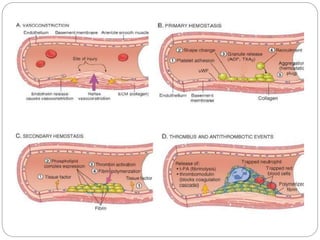
Normal Haemostasis
 Process of maintaining blood in a fluid, clot – free
state in normal vasculature
and
rapidly forming a localized haemostatic plug at
the site of vascular injury
 The pathologic opposite of haemostasis is
thrombosis
Thrombosis
 Formation of solid mass in circulation from the
constituents of flowing blood with intact
cardiovascular tree during life
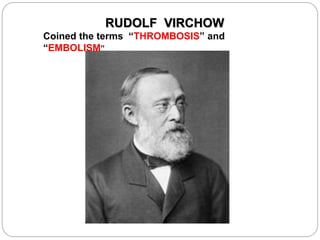
RUDOLF VIRCHOW
Coined the terms “THROMBOSIS” and
“EMBOLISM”
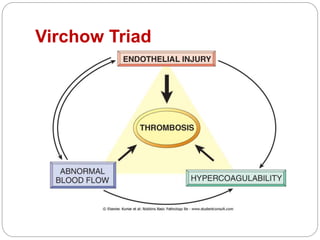
Virchow Triad
Endothelial Injury
 Main cause for thrombus formation in the heart
and the arterial circulation
 These are platelet – rich clots
 Inflammation
 Infection
 Toxins from cigarette smoking
 Hypercholesterolemia
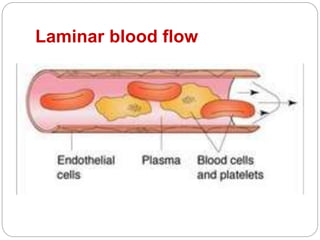
Laminar blood flow
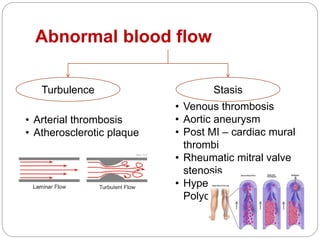
Abnormal blood flow
Turbulence Stasis
• Arterial thrombosis
• Atherosclerotic plaque
• Venous thrombosis
• Aortic aneurysm
• Post MI – cardiac mural
thrombi
• Rheumatic mitral valve
stenosis
• Hyperviscosity –
Polycythemia vera
Hypercoagulability
 Thrombophilia
 Any disorder of blood that predisposes to
thrombosis
 Hypercoagulable states are associated with
VENOUS THROMBOSIS
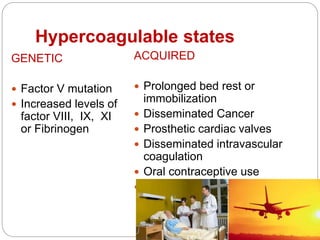
Hypercoagulable states
GENETIC
 Factor V mutation
 Increased levels of
factor VIII, IX, XI
or Fibrinogen
ACQUIRED
 Prolonged bed rest or
immobilization
 Disseminated Cancer
 Prosthetic cardiac valves
 Disseminated intravascular
coagulation
 Oral contraceptive use
 Pregnancy and post partum
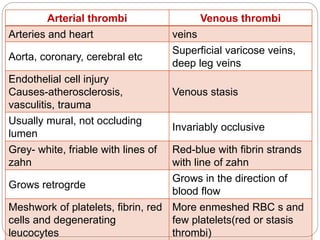
Arterial thrombi Venous thrombi
Arteries and heart veins
Aorta, coronary, cerebral etc
Superficial varicose veins,
deep leg veins
Endothelial cell injury
Causes-atherosclerosis,
vasculitis, trauma
Venous stasis
Usually mural, not occluding
lumen
Invariably occlusive
Grey- white, friable with lines of
zahn
Red-blue with fibrin strands
with line of zahn
Grows retrogrde
Grows in the direction of
blood flow
Meshwork of platelets, fibrin, red
cells and degenerating
leucocytes
More enmeshed RBC s and
few platelets(red or stasis
thrombi)
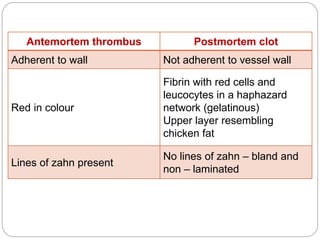
Antemortem thrombus Postmortem clot
Adherent to wall Not adherent to vessel wall
Red in colour
Fibrin with red cells and
leucocytes in a haphazard
network (gelatinous)
Upper layer resembling
chicken fat
Lines of zahn present
No lines of zahn – bland and
non – laminated
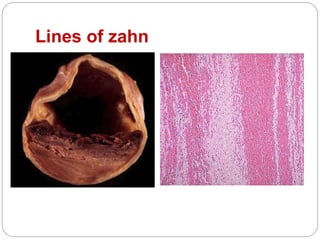
Lines of zahn
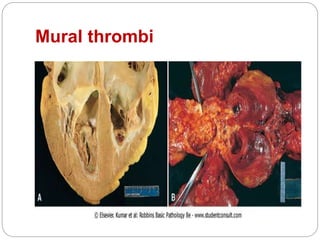
Mural thrombi
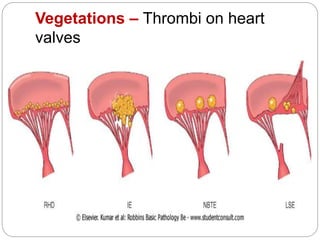
Vegetations – Thrombi on heart
valves
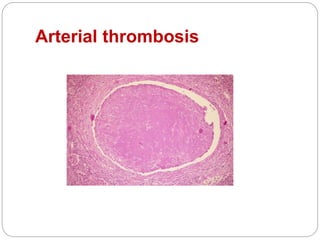
Arterial thrombosis
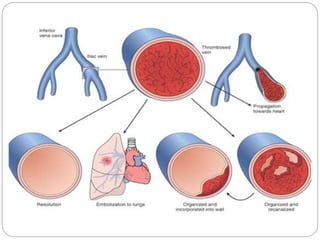
Fate of thrombus
 Propagation
 Embolization – thrombi dislodges and travels
to other sites in vasculature
 Dissolution – by fibrinolysis
 Organisation and recanalization
Older thrombi become organised by
ingrowth of endothelial cells, smooth muscle
cells and fibroblasts. Capillary channels
reestablish continuity of lumen
Embolism
 An embolus is a detached intravascular solid,
liquid or gaseous mass that is carried by the
blood to a site distant from origin.
Classification
 Thromboembolism (most common)
 Fat embolism
 Air embolism
 Amniotic fluid embolism
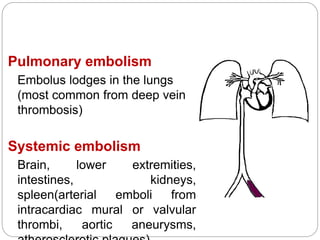
Pulmonary embolism
Embolus lodges in the lungs
(most common from deep vein
thrombosis)
Systemic embolism
Brain, lower extremities,
intestines, kidneys,
spleen(arterial emboli from
intracardiac mural or valvular
thrombi, aortic aneurysms,
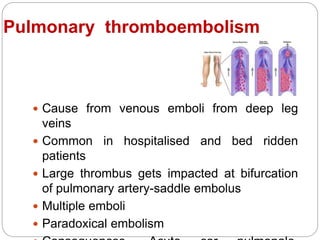
Pulmonary thromboembolism
 Cause from venous emboli from deep leg
veins
 Common in hospitalised and bed ridden
patients
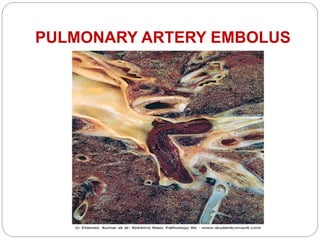
 Large thrombus gets impacted at bifurcation
of pulmonary artery-saddle embolus
 Multiple emboli
 Paradoxical embolism
PULMONARY ARTERY EMBOLUS
Fat embolism
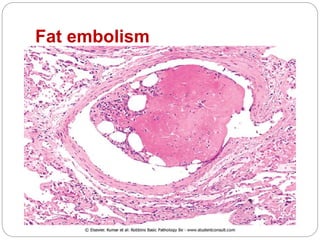
 Obstruction of arterioles and capillaries by fat
globules
 Fractures of long bones
 Trauma to soft tissue eg., adipose tissue
Clinical features
 Pulmonary insufficiency - tachypnea, dyspnea,
tachycardia
 Neurologic symptoms - irritability, restlessness to
delirium and coma
 Thrombocytopenia
Fat embolism
Air embolism
 Gas bubbles within the circulation can
coalesce to form frothy masses and obstruct
vascular flow
 Large volume of air (more than 100 cc) is
necessary to produce effect in pulmonary
circulation
 Small volume of air trapped in coronary artery
during bypass surgery
 Chest wall injury
 Obstetric or laproscopy procedures
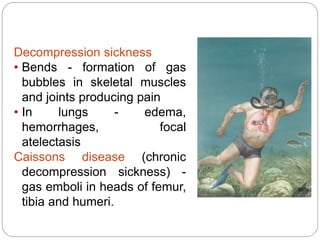
Decompression sickness
• Bends - formation of gas
bubbles in skeletal muscles
and joints producing pain
• In lungs - edema,
hemorrhages, focal
atelectasis
Caissons disease (chronic
decompression sickness) -
gas emboli in heads of femur,
tibia and humeri.
Amniotic fluid embolism
 During labour or immediate post partum
period
 Dyspnea, cyanosis, hypotensive shock,
seizure and coma
 Infusion of amniotic fluid or fetal tissue into
maternal circulation via tear in placental
membranes or rupture of uterine veins
INFARCT
Def: An infarct is an area of ischemic necrosis
caused by occlusion of either the arterial supply
or the venous drainage in a particular tissue.
Aetiology
Thrombosis or embolism
Venous outflow obstruction (single outflow organs)
Others : Hypotensive,local vasospasm, compression of,
vessel by hematoma or tumor, torsion
Infarction
 Tissue necrosis due to ischaemia
 vascular insufficiency of any cause
 usually arterial occlusion due to thrombosis/embolism
 Mainly due to oxygen deficiency, but toxin
accumulation & reperfusion injury may contribute
 Number of determining factors
 Size of vessel and size of vascular territory
 Partial / total vascular occlusion
 Duration of ischaemia
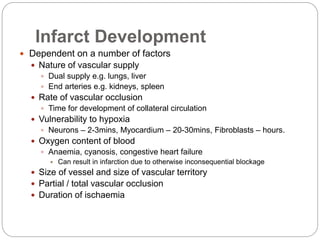
Infarct Development
 Dependent on a number of factors
 Nature of vascular supply
 Dual supply e.g. lungs, liver
 End arteries e.g. kidneys, spleen
 Rate of vascular occlusion
 Time for development of collateral circulation
 Vulnerability to hypoxia
 Neurons – 2-3mins, Myocardium – 20-30mins, Fibroblasts – hours.
 Oxygen content of blood
 Anaemia, cyanosis, congestive heart failure
 Can result in infarction due to otherwise inconsequential blockage
 Size of vessel and size of vascular territory
 Partial / total vascular occlusion
 Duration of ischaemia
Morphological Classification of
infarcts
 Colour-Pale/anemic/white
 Red (hemorrhagic) Infarct
Septic or bland
2nd Year Pathology 2010
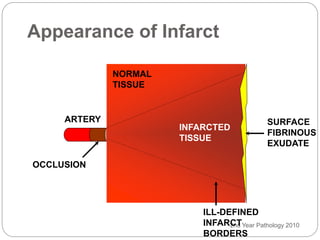
Appearance of Infarct
ARTERY
OCCLUSION
NORMAL
TISSUE
INFARCTED
TISSUE
SURFACE
FIBRINOUS
EXUDATE
ILL-DEFINED
INFARCT
BORDERS
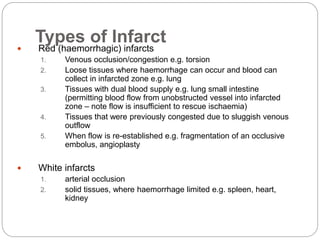
Types of Infarct
 Red (haemorrhagic) infarcts
1. Venous occlusion/congestion e.g. torsion
2. Loose tissues where haemorrhage can occur and blood can
collect in infarcted zone e.g. lung
3. Tissues with dual blood supply e.g. lung small intestine
(permitting blood flow from unobstructed vessel into infarcted
zone – note flow is insufficient to rescue ischaemia)
4. Tissues that were previously congested due to sluggish venous
outflow
5. When flow is re-established e.g. fragmentation of an occlusive
embolus, angioplasty
 White infarcts
1. arterial occlusion
2. solid tissues, where haemorrhage limited e.g. spleen, heart,
kidney
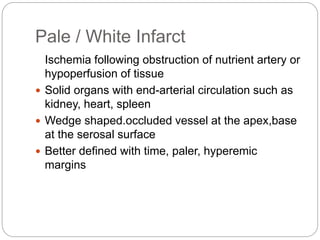
Pale / White Infarct
Ischemia following obstruction of nutrient artery or
hypoperfusion of tissue
 Solid organs with end-arterial circulation such as
kidney, heart, spleen
 Wedge shaped.occluded vessel at the apex,base
at the serosal surface
 Better defined with time, paler, hyperemic
margins
2nd Year Pathology 2010
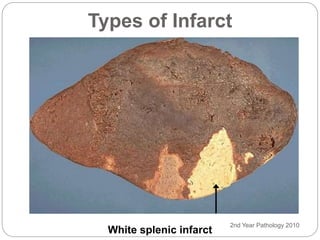
Types of Infarct
White splenic infarct
Microscopy
 Ischemic coagulative necrosis
 Demonstrable only >12-18 hrs.
 Inflammation in response to necrosis
 Phagocytosis of cellular debris by neutrophils &
macrophages 1-2 days
 Healing response
 Scar tissue (brain- liquefactive necrosis)
Red (hemorrhagic)infarcts
Sites :venous occlusion of organ with
single venous outflow e.g. testicular
torsion
Loose tissues- e.g. lung
Tissues with dual circulations: lung and
gut
Previously congested tissue
With reperfusion of previously infarcted
tissue
2nd Year Pathology 2010
Types of Infarct
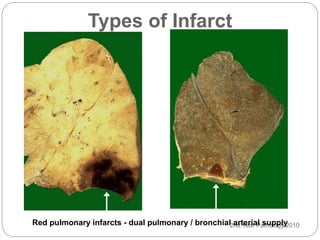
Red pulmonary infarcts - dual pulmonary / bronchial arterial supply
Pulmonary infarcts
 Ischemic necrosis of lung parenchyma following
pulmonary embolism & lack of blood from
bronchial arteries.
 When blood from bronchial arteries reperfuses
the ischemic area, blood leaks into the alveolar
spaces
 Appears triangular, red & airless.
 Becomes more firm &brown with time.
Septic infarct
 Following fragmentation of a bacterial vegetation
from a heart valve or following microbes seeding
a necrotic area.
 Converted into an abscess
 Greater inflammatory response
 scarring
Event Sequence
1. Coagulative necrosis
2. Infiltration by neutrophils
3. Infiltration by macrophages
4. Phagocytosis of debris
5. Granulation tissue formation
6. Scar formation
2nd Year Pathology
2010
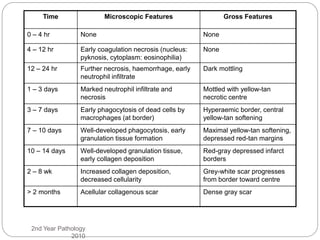
Time Microscopic Features Gross Features
0 – 4 hr None None
4 – 12 hr Early coagulation necrosis (nucleus:
pyknosis, cytoplasm: eosinophilia)
None
12 – 24 hr Further necrosis, haemorrhage, early
neutrophil infiltrate
Dark mottling
1 – 3 days Marked neutrophil infiltrate and
necrosis
Mottled with yellow-tan
necrotic centre
3 – 7 days Early phagocytosis of dead cells by
macrophages (at border)
Hyperaemic border, central
yellow-tan softening
7 – 10 days Well-developed phagocytosis, early
granulation tissue formation
Maximal yellow-tan softening,
depressed red-tan margins
10 – 14 days Well-developed granulation tissue,
early collagen deposition
Red-gray depressed infarct
borders
2 – 8 wk Increased collagen deposition,
decreased cellularity
Grey-white scar progresses
from border toward centre
> 2 months Acellular collagenous scar Dense gray scar
Thrombosis, embolism and infarction

Thrombosis, embolism and infarction

  • 1.
  • 2.
    Normal Haemostasis  Processof maintaining blood in a fluid, clot – free state in normal vasculature and rapidly forming a localized haemostatic plug at the site of vascular injury  The pathologic opposite of haemostasis is thrombosis
  • 4.
    Thrombosis  Formation ofsolid mass in circulation from the constituents of flowing blood with intact cardiovascular tree during life
  • 5.
    RUDOLF VIRCHOW Coined theterms “THROMBOSIS” and “EMBOLISM”
  • 6.
  • 7.
    Endothelial Injury  Maincause for thrombus formation in the heart and the arterial circulation  These are platelet – rich clots  Inflammation  Infection  Toxins from cigarette smoking  Hypercholesterolemia
  • 8.
  • 9.
    Abnormal blood flow TurbulenceStasis • Arterial thrombosis • Atherosclerotic plaque • Venous thrombosis • Aortic aneurysm • Post MI – cardiac mural thrombi • Rheumatic mitral valve stenosis • Hyperviscosity – Polycythemia vera
  • 10.
    Hypercoagulability  Thrombophilia  Anydisorder of blood that predisposes to thrombosis  Hypercoagulable states are associated with VENOUS THROMBOSIS
  • 11.
    Hypercoagulable states GENETIC  FactorV mutation  Increased levels of factor VIII, IX, XI or Fibrinogen ACQUIRED  Prolonged bed rest or immobilization  Disseminated Cancer  Prosthetic cardiac valves  Disseminated intravascular coagulation  Oral contraceptive use  Pregnancy and post partum
  • 12.
    Arterial thrombi Venousthrombi Arteries and heart veins Aorta, coronary, cerebral etc Superficial varicose veins, deep leg veins Endothelial cell injury Causes-atherosclerosis, vasculitis, trauma Venous stasis Usually mural, not occluding lumen Invariably occlusive Grey- white, friable with lines of zahn Red-blue with fibrin strands with line of zahn Grows retrogrde Grows in the direction of blood flow Meshwork of platelets, fibrin, red cells and degenerating leucocytes More enmeshed RBC s and few platelets(red or stasis thrombi)
  • 13.
    Antemortem thrombus Postmortemclot Adherent to wall Not adherent to vessel wall Red in colour Fibrin with red cells and leucocytes in a haphazard network (gelatinous) Upper layer resembling chicken fat Lines of zahn present No lines of zahn – bland and non – laminated
  • 14.
  • 15.
  • 16.
    Vegetations – Thrombion heart valves
  • 17.
  • 18.
    Fate of thrombus Propagation  Embolization – thrombi dislodges and travels to other sites in vasculature  Dissolution – by fibrinolysis  Organisation and recanalization Older thrombi become organised by ingrowth of endothelial cells, smooth muscle cells and fibroblasts. Capillary channels reestablish continuity of lumen
  • 20.
    Embolism  An embolusis a detached intravascular solid, liquid or gaseous mass that is carried by the blood to a site distant from origin.
  • 21.
    Classification  Thromboembolism (mostcommon)  Fat embolism  Air embolism  Amniotic fluid embolism
  • 22.
    Pulmonary embolism Embolus lodgesin the lungs (most common from deep vein thrombosis) Systemic embolism Brain, lower extremities, intestines, kidneys, spleen(arterial emboli from intracardiac mural or valvular thrombi, aortic aneurysms,
  • 23.
    Pulmonary thromboembolism  Causefrom venous emboli from deep leg veins  Common in hospitalised and bed ridden patients  Large thrombus gets impacted at bifurcation of pulmonary artery-saddle embolus  Multiple emboli  Paradoxical embolism
  • 24.
  • 25.
    Fat embolism  Obstructionof arterioles and capillaries by fat globules  Fractures of long bones  Trauma to soft tissue eg., adipose tissue Clinical features  Pulmonary insufficiency - tachypnea, dyspnea, tachycardia  Neurologic symptoms - irritability, restlessness to delirium and coma  Thrombocytopenia
  • 26.
  • 27.
    Air embolism  Gasbubbles within the circulation can coalesce to form frothy masses and obstruct vascular flow  Large volume of air (more than 100 cc) is necessary to produce effect in pulmonary circulation  Small volume of air trapped in coronary artery during bypass surgery  Chest wall injury  Obstetric or laproscopy procedures
  • 28.
    Decompression sickness • Bends- formation of gas bubbles in skeletal muscles and joints producing pain • In lungs - edema, hemorrhages, focal atelectasis Caissons disease (chronic decompression sickness) - gas emboli in heads of femur, tibia and humeri.
  • 29.
    Amniotic fluid embolism During labour or immediate post partum period  Dyspnea, cyanosis, hypotensive shock, seizure and coma  Infusion of amniotic fluid or fetal tissue into maternal circulation via tear in placental membranes or rupture of uterine veins
  • 30.
    INFARCT Def: An infarctis an area of ischemic necrosis caused by occlusion of either the arterial supply or the venous drainage in a particular tissue. Aetiology Thrombosis or embolism Venous outflow obstruction (single outflow organs) Others : Hypotensive,local vasospasm, compression of, vessel by hematoma or tumor, torsion
  • 31.
    Infarction  Tissue necrosisdue to ischaemia  vascular insufficiency of any cause  usually arterial occlusion due to thrombosis/embolism  Mainly due to oxygen deficiency, but toxin accumulation & reperfusion injury may contribute  Number of determining factors  Size of vessel and size of vascular territory  Partial / total vascular occlusion  Duration of ischaemia
  • 32.
    Infarct Development  Dependenton a number of factors  Nature of vascular supply  Dual supply e.g. lungs, liver  End arteries e.g. kidneys, spleen  Rate of vascular occlusion  Time for development of collateral circulation  Vulnerability to hypoxia  Neurons – 2-3mins, Myocardium – 20-30mins, Fibroblasts – hours.  Oxygen content of blood  Anaemia, cyanosis, congestive heart failure  Can result in infarction due to otherwise inconsequential blockage  Size of vessel and size of vascular territory  Partial / total vascular occlusion  Duration of ischaemia
  • 33.
    Morphological Classification of infarcts Colour-Pale/anemic/white  Red (hemorrhagic) Infarct Septic or bland
  • 34.
    2nd Year Pathology2010 Appearance of Infarct ARTERY OCCLUSION NORMAL TISSUE INFARCTED TISSUE SURFACE FIBRINOUS EXUDATE ILL-DEFINED INFARCT BORDERS
  • 35.
    Types of Infarct Red (haemorrhagic) infarcts 1. Venous occlusion/congestion e.g. torsion 2. Loose tissues where haemorrhage can occur and blood can collect in infarcted zone e.g. lung 3. Tissues with dual blood supply e.g. lung small intestine (permitting blood flow from unobstructed vessel into infarcted zone – note flow is insufficient to rescue ischaemia) 4. Tissues that were previously congested due to sluggish venous outflow 5. When flow is re-established e.g. fragmentation of an occlusive embolus, angioplasty  White infarcts 1. arterial occlusion 2. solid tissues, where haemorrhage limited e.g. spleen, heart, kidney
  • 36.
    Pale / WhiteInfarct Ischemia following obstruction of nutrient artery or hypoperfusion of tissue  Solid organs with end-arterial circulation such as kidney, heart, spleen  Wedge shaped.occluded vessel at the apex,base at the serosal surface  Better defined with time, paler, hyperemic margins
  • 37.
    2nd Year Pathology2010 Types of Infarct White splenic infarct
  • 38.
    Microscopy  Ischemic coagulativenecrosis  Demonstrable only >12-18 hrs.  Inflammation in response to necrosis  Phagocytosis of cellular debris by neutrophils & macrophages 1-2 days  Healing response  Scar tissue (brain- liquefactive necrosis)
  • 39.
    Red (hemorrhagic)infarcts Sites :venousocclusion of organ with single venous outflow e.g. testicular torsion Loose tissues- e.g. lung Tissues with dual circulations: lung and gut Previously congested tissue With reperfusion of previously infarcted tissue
  • 40.
    2nd Year Pathology2010 Types of Infarct Red pulmonary infarcts - dual pulmonary / bronchial arterial supply
  • 41.
    Pulmonary infarcts  Ischemicnecrosis of lung parenchyma following pulmonary embolism & lack of blood from bronchial arteries.  When blood from bronchial arteries reperfuses the ischemic area, blood leaks into the alveolar spaces  Appears triangular, red & airless.  Becomes more firm &brown with time.
  • 42.
    Septic infarct  Followingfragmentation of a bacterial vegetation from a heart valve or following microbes seeding a necrotic area.  Converted into an abscess  Greater inflammatory response  scarring
  • 43.
    Event Sequence 1. Coagulativenecrosis 2. Infiltration by neutrophils 3. Infiltration by macrophages 4. Phagocytosis of debris 5. Granulation tissue formation 6. Scar formation
  • 44.
    2nd Year Pathology 2010 TimeMicroscopic Features Gross Features 0 – 4 hr None None 4 – 12 hr Early coagulation necrosis (nucleus: pyknosis, cytoplasm: eosinophilia) None 12 – 24 hr Further necrosis, haemorrhage, early neutrophil infiltrate Dark mottling 1 – 3 days Marked neutrophil infiltrate and necrosis Mottled with yellow-tan necrotic centre 3 – 7 days Early phagocytosis of dead cells by macrophages (at border) Hyperaemic border, central yellow-tan softening 7 – 10 days Well-developed phagocytosis, early granulation tissue formation Maximal yellow-tan softening, depressed red-tan margins 10 – 14 days Well-developed granulation tissue, early collagen deposition Red-gray depressed infarct borders 2 – 8 wk Increased collagen deposition, decreased cellularity Grey-white scar progresses from border toward centre > 2 months Acellular collagenous scar Dense gray scar