Principles, Instrumentation and
Techniques in Atomic
Absorption/Emission
Spectroscopy
JOSE G. INTANO, JR.
Overview
• Introduction to the Principles of Atomic Spectroscopy
• Instrumentation in Atomic Spectroscopy
• Selection of the Proper Atomic Spectroscopic Technique
Atomic Spectroscopy
• technique for determining the elemental composition of an analyte
by its electromagnetic or mass spectrum
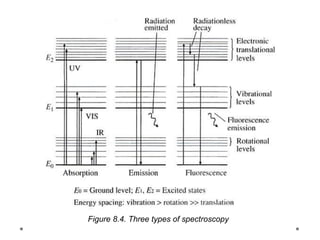
• atomic emission, atomic absorption, and atomic fluorescence
• understanding of the atom and the atomic process involved
Atomic Spectroscopy
Figure 8.4. Three types of spectroscopy
Atomic Spectroscopy
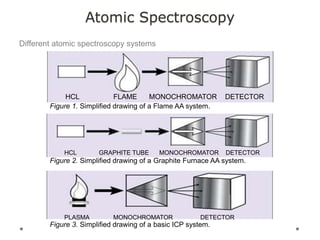
Different atomic spectroscopy systems
HCL FLAME MONOCHROMATOR DETECTOR
Figure 1. Simplified drawing of a Flame AA system.
HCL GRAPHITE TUBE MONOCHROMATOR DETECTOR
Figure 2. Simplified drawing of a Graphite Furnace AA system.
PLASMA MONOCHROMATOR DETECTOR
Figure 3. Simplified drawing of a basic ICP system.
Atomic Spectroscopy
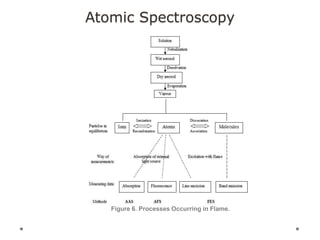
Figure 6. Processes Occurring in Flame.
Atomic Spectroscopy
Atomic Spectroscopy
Flame and Flameless Atomic Absorption
Quantitation and Qualification of Atomic Spectroscopy
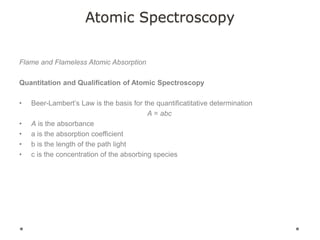
• Beer-Lambert’s Law is the basis for the quantificatitative determination
A = abc
• A is the absorbance
• a is the absorption coefficient
• b is the length of the path light
• c is the concentration of the absorbing species
Atomic Spectroscopy
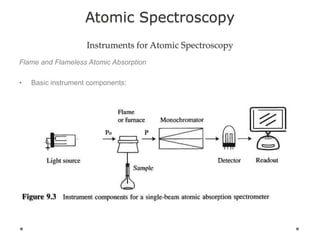
Instruments for Atomic Spectroscopy
Flame and Flameless Atomic Absorption
• Basic instrument components:
Atomic Spectroscopy
Flame and Flameless Atomic Absorption
• Basic instrument components:
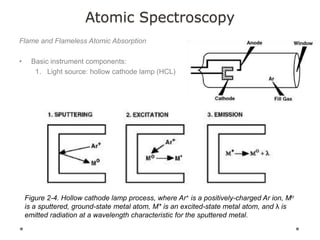
1. Light source: hollow cathode lamp (HCL)
Figure 2-4. Hollow cathode lamp process, where Ar+ is a positively-charged Ar ion, Mo
is a sputtered, ground-state metal atom, M* is an excited-state metal atom, and λ is
emitted radiation at a wavelength characteristic for the sputtered metal.
Atomic Spectroscopy
Flame and Flameless Atomic Absorption
• Basic instrument components:
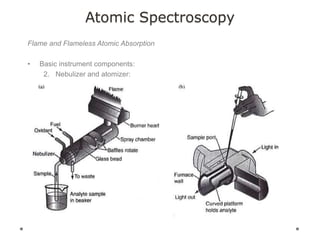
2. Nebulizer and atomizer:
Atomic Spectroscopy
Flame and Flameless Atomic Absorption
• Basic instrument components:
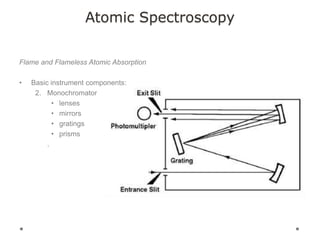
2. Monochromator
• lenses
• mirrors
• gratings
• prisms
.
Atomic Spectroscopy
Flame and Flameless Atomic Absorption
• Basic instrument components:
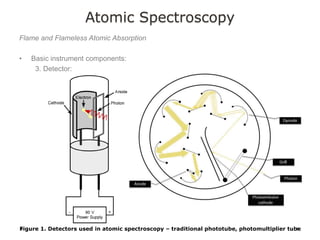
3. Detector:
Figure 1. Detectors used in atomic spectroscopy – traditional phototube, photomultiplier tube
Atomic Spectroscopy
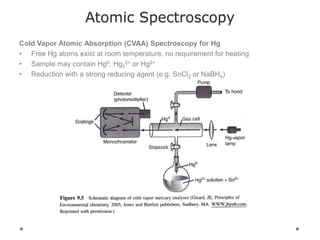
Cold Vapor Atomic Absorption (CVAA) Spectroscopy for Hg
• Free Hg atoms exist at room temperature, no requirement for heating
• Sample may contain Hg0, Hg2
2+ or Hg2+
• Reduction with a strong reducing agent (e.g. SnCl2 or NaBH4)
Atomic Spectroscopy
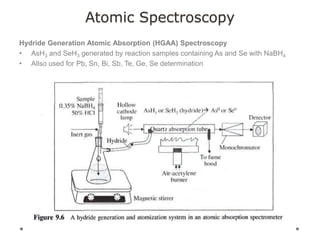
Hydride Generation Atomic Absorption (HGAA) Spectroscopy
• AsH3 and SeH3 generated by reaction samples containing As and Se with NaBH4
• Allso used for Pb, Sn, Bi, Sb, Te, Ge, Se determination
Atomic Spectroscopy
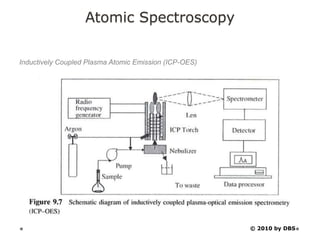
Inductively Coupled Plasma Atomic Emission (ICP-OES)
© 2010 by DBS
Atomic Spectroscopy
Inductively Coupled Plasma Atomic Emission (ICP-OES)
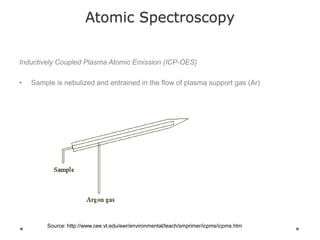
• Sample is nebulized and entrained in the flow of plasma support gas (Ar)
Source: http://www.cee.vt.edu/ewr/environmental/teach/smprimer/icpms/icpms.htm
Atomic Spectroscopy
Inductively Coupled Plasma Atomic Emission (ICP-OES)
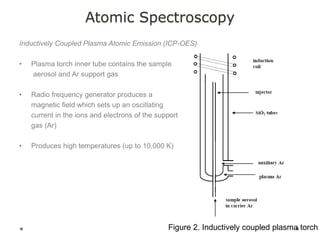
• Plasma torch inner tube contains the sample
aerosol and Ar support gas
• Radio frequency generator produces a
magnetic field which sets up an oscillating
current in the ions and electrons of the support
gas (Ar)
• Produces high temperatures (up to 10,000 K)
Figure 2. Inductively coupled plasma torch
Atomic Spectroscopy
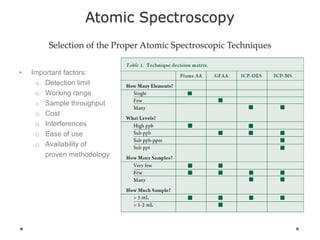
Selection of the Proper Atomic Spectroscopic Techniques
• Important factors:
o Detection limit
o Working range
o Sample throughput
o Cost
o Interferences
o Ease of use
o Availability of
proven methodology
Atomic Spectroscopy
Comparison of Detection Limits and Working Range
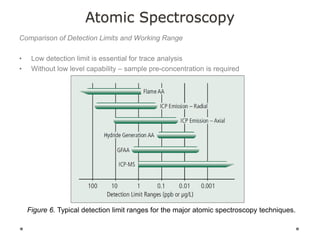
• Low detection limit is essential for trace analysis
• Without low level capability – sample pre-concentration is required
Figure 6. Typical detection limit ranges for the major atomic spectroscopy techniques.
Atomic Spectroscopy
Comparison of Detection Limits and Working Range
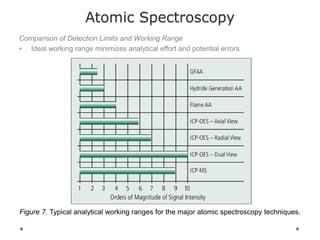
• Ideal working range minimizes analytical effort and potential errors
Figure 7. Typical analytical working ranges for the major atomic spectroscopy techniques.
Atomic Spectroscopy
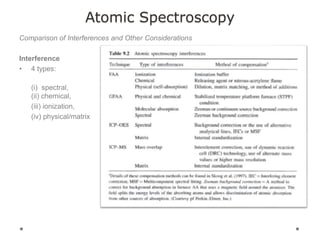
Comparison of Interferences and Other Considerations
Interference
• 4 types:
(i) spectral,
(ii) chemical,
(iii) ionization,
(iv) physical/matrix
Atomic Spectroscopy
Comparison of Interferences and Other Considerations
SPECTRAL INTERFERENCES
• caused by radiation overlap of absorption line/emission line
• e. g. V line is 3082.11 A and Al is at 3082.15 A. Choose a different Al line at 3092.7 A.
• scattering of the radiation source due to matrix impurities
• e.g. Refractory oxides formed by Ti, Zr, and W due to atomization of high
concentration solutions. Use a blank.
Atomic Spectroscopy
Comparison of Interferences and Other Considerations
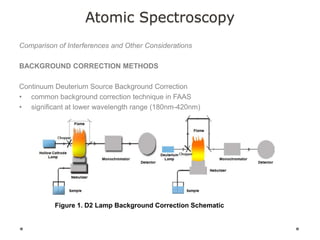
BACKGROUND CORRECTION METHODS
Continuum Deuterium Source Background Correction
• common background correction technique in FAAS
• significant at lower wavelength range (180nm-420nm)
Figure 1. D2 Lamp Background Correction Schematic
Atomic Spectroscopy
Comparison of Interferences and Other Considerations
BACKGROUND CORRECTION METHODS
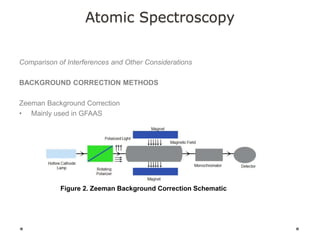
Zeeman Background Correction
• Mainly used in GFAAS
Figure 2. Zeeman Background Correction Schematic
Atomic Spectroscopy
Comparison of Interferences and Other Considerations
BACKGROUND CORRECTION METHODS
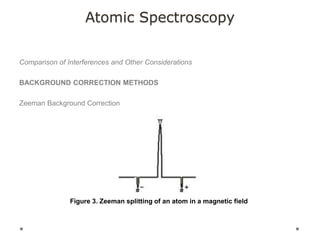
Zeeman Background Correction
Figure 3. Zeeman splitting of an atom in a magnetic field
Atomic Spectroscopy
Comparison of Interferences and Other Considerations
CHEMICAL INTERFERENCES
REFRACTORY COMPOUND FORMATION
• compounds that cannot be broken down in flame
• e.g. Ca signal is depressed due to formation of Ca sulfate or Ca phosphate
• e.g. Mg signal is depressed in the presence of Al. Al forms heat stable compound with
Mg.
Atomic Spectroscopy
Comparison of Interferences and Other Considerations
CHEMICAL INTERFERENCES
SOLUTION FOR REFRACTORY COMPOUND FORMATION
• Use of Hotter flame
• Use of Releasing agents such as chlorides of La and Sr.
• Use of Protective agent such as EDTA and 8-Hydroxyquinolone
Atomic Spectroscopy
Comparison of Interferences and Other Considerations
IONIZATION INTERFERENCES
• affects Group 1 and 2 elements (Ba, Ca, Sr, Na, K)
Solution: Use of Low Temperature Flame or Use of Ionization Buffer
• Ionization buffer/suppressor/suppressant prevents analyte ionization
• e.g. Addition of a 0.1% KCl soln to blank, standard, and sample.
Atomic Spectroscopy
Comparison of Interferences and Other Considerations
MATRIX INTERFERENCES
• a physical interference and can either suppress or enhance absorbance signal of
analyte.
Causes:
1. Differences in viscosity and surface tension.
2. Preparation in different solvents.
3. Measurement at different temperatures.
4. Presence of organic species.
5. Different atomization rate in flame.
Atomic Spectroscopy
Comparison of Interferences and Other Considerations
Other Considerations
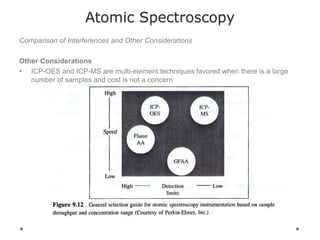
• Sample throughput, cost, ease of use, availability of proven methodology
• Single-element (FAAS and GFAA) vs. multi-element (ICP-OES/MS)
• Single:
o Change of lamp
o Run time ~1 min
• Multi:
o 10-40 elements per minute
© 2010 by DBS
Atomic Spectroscopy
Comparison of Interferences and Other Considerations
Other Considerations
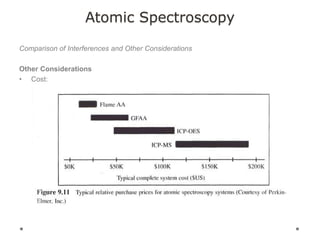
• Cost:
Atomic Spectroscopy
Comparison of Interferences and Other Considerations
Other Considerations
• ICP-OES and ICP-MS are multi-element techniques favored when there is a large
number of samples and cost is not a concern
Atomic Spectroscopy
Comparison of Interferences and Other Considerations
Other Considerations
• ICP-OES has become the dominant instrument for routine analysis of metals
• Compared to FAAS:
o Lower interferences (due to higher temperatures)
o Spectra for most elements can be recorded simultaneously under the same
conditions
o Higher temperature allows compounds (e.g. metal oxides) to be measured
o Determination of non metals (e.g. Cl, Br, I, S)
© 2010 by DBS
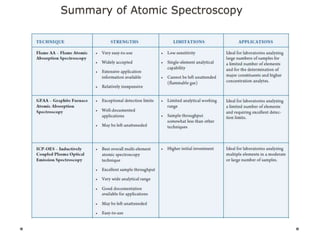
Summary of Atomic Spectroscopy
References
• Csuros, M. and Csuros, C. (2002) Environmental Sampling and Analysis for Metals. CRC
press, Boca Raton, Fl.
• Tatro, M.E. (2000) Optical Emission Inductively Coupled Plasma in Environmental
Analysis. Encyclopedia of Analytical Chemistry, Edited by Meyers, R.A. John Wiley &
Sons, West Sussex, UK.
• http://delloyd.50megs.com/moreinfo/AAinterferences.html
• http://lab-training.com/2013/05/08/background-correction-in-atomic-absorption-
spectroscopy/
• Thermo Elemental (2001). AAS, GFAAS, ICP or ICP-MS? Which technique should I use?
An elementary overview of elemental analysis.

Atomic spectroscopy

  • 1.
    Principles, Instrumentation and Techniquesin Atomic Absorption/Emission Spectroscopy JOSE G. INTANO, JR.
  • 2.
    Overview • Introduction tothe Principles of Atomic Spectroscopy • Instrumentation in Atomic Spectroscopy • Selection of the Proper Atomic Spectroscopic Technique
  • 3.
    Atomic Spectroscopy • techniquefor determining the elemental composition of an analyte by its electromagnetic or mass spectrum • atomic emission, atomic absorption, and atomic fluorescence • understanding of the atom and the atomic process involved
  • 4.
    Atomic Spectroscopy Figure 8.4.Three types of spectroscopy
  • 5.
    Atomic Spectroscopy Different atomicspectroscopy systems HCL FLAME MONOCHROMATOR DETECTOR Figure 1. Simplified drawing of a Flame AA system. HCL GRAPHITE TUBE MONOCHROMATOR DETECTOR Figure 2. Simplified drawing of a Graphite Furnace AA system. PLASMA MONOCHROMATOR DETECTOR Figure 3. Simplified drawing of a basic ICP system.
  • 6.
    Atomic Spectroscopy Figure 6.Processes Occurring in Flame.
  • 7.
  • 8.
    Atomic Spectroscopy Flame andFlameless Atomic Absorption Quantitation and Qualification of Atomic Spectroscopy • Beer-Lambert’s Law is the basis for the quantificatitative determination A = abc • A is the absorbance • a is the absorption coefficient • b is the length of the path light • c is the concentration of the absorbing species
  • 9.
    Atomic Spectroscopy Instruments forAtomic Spectroscopy Flame and Flameless Atomic Absorption • Basic instrument components:
  • 10.
    Atomic Spectroscopy Flame andFlameless Atomic Absorption • Basic instrument components: 1. Light source: hollow cathode lamp (HCL) Figure 2-4. Hollow cathode lamp process, where Ar+ is a positively-charged Ar ion, Mo is a sputtered, ground-state metal atom, M* is an excited-state metal atom, and λ is emitted radiation at a wavelength characteristic for the sputtered metal.
  • 11.
    Atomic Spectroscopy Flame andFlameless Atomic Absorption • Basic instrument components: 2. Nebulizer and atomizer:
  • 12.
    Atomic Spectroscopy Flame andFlameless Atomic Absorption • Basic instrument components: 2. Monochromator • lenses • mirrors • gratings • prisms .
  • 13.
    Atomic Spectroscopy Flame andFlameless Atomic Absorption • Basic instrument components: 3. Detector: Figure 1. Detectors used in atomic spectroscopy – traditional phototube, photomultiplier tube
  • 14.
    Atomic Spectroscopy Cold VaporAtomic Absorption (CVAA) Spectroscopy for Hg • Free Hg atoms exist at room temperature, no requirement for heating • Sample may contain Hg0, Hg2 2+ or Hg2+ • Reduction with a strong reducing agent (e.g. SnCl2 or NaBH4)
  • 15.
    Atomic Spectroscopy Hydride GenerationAtomic Absorption (HGAA) Spectroscopy • AsH3 and SeH3 generated by reaction samples containing As and Se with NaBH4 • Allso used for Pb, Sn, Bi, Sb, Te, Ge, Se determination
  • 16.
    Atomic Spectroscopy Inductively CoupledPlasma Atomic Emission (ICP-OES) © 2010 by DBS
  • 17.
    Atomic Spectroscopy Inductively CoupledPlasma Atomic Emission (ICP-OES) • Sample is nebulized and entrained in the flow of plasma support gas (Ar) Source: http://www.cee.vt.edu/ewr/environmental/teach/smprimer/icpms/icpms.htm
  • 18.
    Atomic Spectroscopy Inductively CoupledPlasma Atomic Emission (ICP-OES) • Plasma torch inner tube contains the sample aerosol and Ar support gas • Radio frequency generator produces a magnetic field which sets up an oscillating current in the ions and electrons of the support gas (Ar) • Produces high temperatures (up to 10,000 K) Figure 2. Inductively coupled plasma torch
  • 19.
    Atomic Spectroscopy Selection ofthe Proper Atomic Spectroscopic Techniques • Important factors: o Detection limit o Working range o Sample throughput o Cost o Interferences o Ease of use o Availability of proven methodology
  • 20.
    Atomic Spectroscopy Comparison ofDetection Limits and Working Range • Low detection limit is essential for trace analysis • Without low level capability – sample pre-concentration is required Figure 6. Typical detection limit ranges for the major atomic spectroscopy techniques.
  • 21.
    Atomic Spectroscopy Comparison ofDetection Limits and Working Range • Ideal working range minimizes analytical effort and potential errors Figure 7. Typical analytical working ranges for the major atomic spectroscopy techniques.
  • 22.
    Atomic Spectroscopy Comparison ofInterferences and Other Considerations Interference • 4 types: (i) spectral, (ii) chemical, (iii) ionization, (iv) physical/matrix
  • 23.
    Atomic Spectroscopy Comparison ofInterferences and Other Considerations SPECTRAL INTERFERENCES • caused by radiation overlap of absorption line/emission line • e. g. V line is 3082.11 A and Al is at 3082.15 A. Choose a different Al line at 3092.7 A. • scattering of the radiation source due to matrix impurities • e.g. Refractory oxides formed by Ti, Zr, and W due to atomization of high concentration solutions. Use a blank.
  • 24.
    Atomic Spectroscopy Comparison ofInterferences and Other Considerations BACKGROUND CORRECTION METHODS Continuum Deuterium Source Background Correction • common background correction technique in FAAS • significant at lower wavelength range (180nm-420nm) Figure 1. D2 Lamp Background Correction Schematic
  • 25.
    Atomic Spectroscopy Comparison ofInterferences and Other Considerations BACKGROUND CORRECTION METHODS Zeeman Background Correction • Mainly used in GFAAS Figure 2. Zeeman Background Correction Schematic
  • 26.
    Atomic Spectroscopy Comparison ofInterferences and Other Considerations BACKGROUND CORRECTION METHODS Zeeman Background Correction Figure 3. Zeeman splitting of an atom in a magnetic field
  • 27.
    Atomic Spectroscopy Comparison ofInterferences and Other Considerations CHEMICAL INTERFERENCES REFRACTORY COMPOUND FORMATION • compounds that cannot be broken down in flame • e.g. Ca signal is depressed due to formation of Ca sulfate or Ca phosphate • e.g. Mg signal is depressed in the presence of Al. Al forms heat stable compound with Mg.
  • 28.
    Atomic Spectroscopy Comparison ofInterferences and Other Considerations CHEMICAL INTERFERENCES SOLUTION FOR REFRACTORY COMPOUND FORMATION • Use of Hotter flame • Use of Releasing agents such as chlorides of La and Sr. • Use of Protective agent such as EDTA and 8-Hydroxyquinolone
  • 29.
    Atomic Spectroscopy Comparison ofInterferences and Other Considerations IONIZATION INTERFERENCES • affects Group 1 and 2 elements (Ba, Ca, Sr, Na, K) Solution: Use of Low Temperature Flame or Use of Ionization Buffer • Ionization buffer/suppressor/suppressant prevents analyte ionization • e.g. Addition of a 0.1% KCl soln to blank, standard, and sample.
  • 30.
    Atomic Spectroscopy Comparison ofInterferences and Other Considerations MATRIX INTERFERENCES • a physical interference and can either suppress or enhance absorbance signal of analyte. Causes: 1. Differences in viscosity and surface tension. 2. Preparation in different solvents. 3. Measurement at different temperatures. 4. Presence of organic species. 5. Different atomization rate in flame.
  • 31.
    Atomic Spectroscopy Comparison ofInterferences and Other Considerations Other Considerations • Sample throughput, cost, ease of use, availability of proven methodology • Single-element (FAAS and GFAA) vs. multi-element (ICP-OES/MS) • Single: o Change of lamp o Run time ~1 min • Multi: o 10-40 elements per minute © 2010 by DBS
  • 32.
    Atomic Spectroscopy Comparison ofInterferences and Other Considerations Other Considerations • Cost:
  • 33.
    Atomic Spectroscopy Comparison ofInterferences and Other Considerations Other Considerations • ICP-OES and ICP-MS are multi-element techniques favored when there is a large number of samples and cost is not a concern
  • 34.
    Atomic Spectroscopy Comparison ofInterferences and Other Considerations Other Considerations • ICP-OES has become the dominant instrument for routine analysis of metals • Compared to FAAS: o Lower interferences (due to higher temperatures) o Spectra for most elements can be recorded simultaneously under the same conditions o Higher temperature allows compounds (e.g. metal oxides) to be measured o Determination of non metals (e.g. Cl, Br, I, S) © 2010 by DBS
  • 35.
    Summary of AtomicSpectroscopy
  • 36.
    References • Csuros, M.and Csuros, C. (2002) Environmental Sampling and Analysis for Metals. CRC press, Boca Raton, Fl. • Tatro, M.E. (2000) Optical Emission Inductively Coupled Plasma in Environmental Analysis. Encyclopedia of Analytical Chemistry, Edited by Meyers, R.A. John Wiley & Sons, West Sussex, UK. • http://delloyd.50megs.com/moreinfo/AAinterferences.html • http://lab-training.com/2013/05/08/background-correction-in-atomic-absorption- spectroscopy/ • Thermo Elemental (2001). AAS, GFAAS, ICP or ICP-MS? Which technique should I use? An elementary overview of elemental analysis.