

Submitted by: B. Lakshmaiah
Ravikant Vinchurkar
Rushikesh Deshmukh
Ph.D. (1st Year)
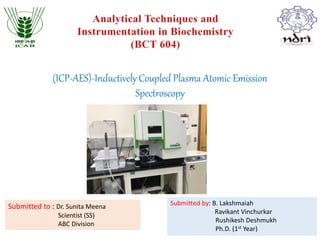
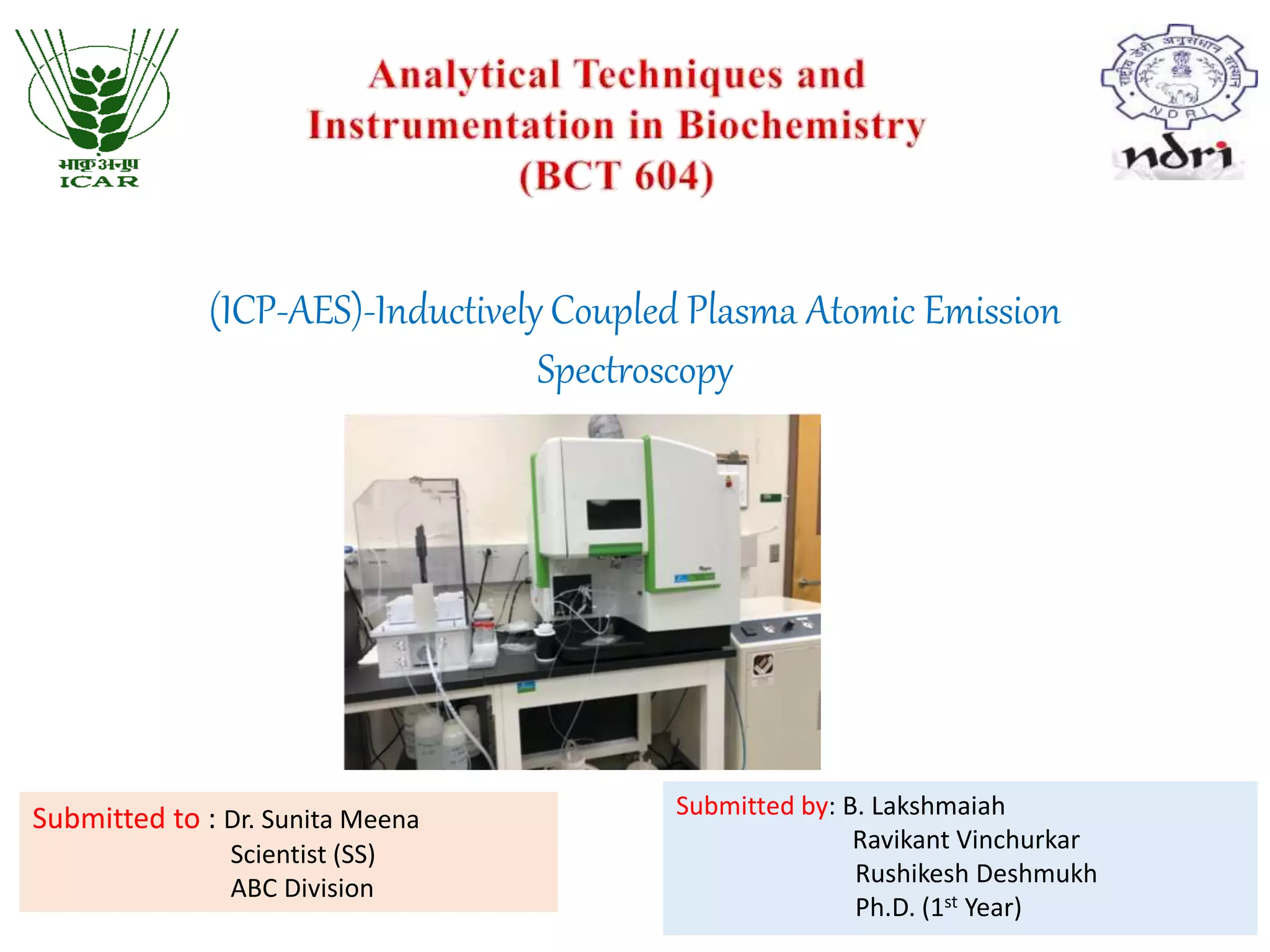
(ICP-AES)-Inductively Coupled Plasma Atomic Emission
Spectroscopy
Submitted to : Dr. Sunita Meena
Scientist (SS)
ABC Division
Learning Objectives
Elucidate the principle of Inductively Coupled Plasma
Atomic Emission Spectroscopy (ICP-AES)
Explain the instrumentation and working of ICP-AES
List out the applications of ICP-AES
To know about advantages and disadvantages of ICP-AES
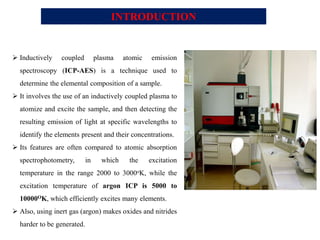
 Inductively coupled plasma atomic emission
spectroscopy (ICP-AES) is a technique used to
determine the elemental composition of a sample.
 It involves the use of an inductively coupled plasma to
atomize and excite the sample, and then detecting the
resulting emission of light at specific wavelengths to
identify the elements present and their concentrations.
 Its features are often compared to atomic absorption
spectrophotometry, in which the excitation
temperature in the range 2000 to 3000oK, while the
excitation temperature of argon ICP is 5000 to
10000OK, which efficiently excites many elements.
 Also, using inert gas (argon) makes oxides and nitrides
harder to be generated.
INTRODUCTION
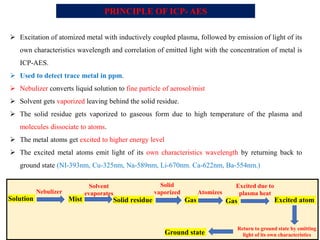
 Excitation of atomized metal with inductively coupled plasma, followed by emission of light of its
own characteristics wavelength and correlation of emitted light with the concentration of metal is
ICP-AES.
 Used to detect trace metal in ppm.
 Nebulizer converts liquid solution to fine particle of aerosol/mist
 Solvent gets vaporized leaving behind the solid residue.
 The solid residue gets vaporized to gaseous form due to high temperature of the plasma and
molecules dissociate to atoms.
 The metal atoms get excited to higher energy level
 The excited metal atoms emit light of its own characteristics wavelength by returning back to
ground state (NI-393nm, Cu-325nm, Na-589nm, Li-670nm. Ca-622nm, Ba-554nm.)
PRINCIPLE OF ICP- AES
Return to ground state by emitting
light of its own characteristics
Ground state
Solution Mist
Solid
vaporized
Solvent
evaporates
Gas Gas
Atomizes
Excited atom
Excited due to
plasma heat
Solid residue
Nebulizer
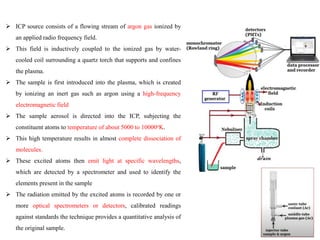
 ICP source consists of a flowing stream of argon gas ionized by
an applied radio frequency field.
 This field is inductively coupled to the ionized gas by water-
cooled coil surrounding a quartz torch that supports and confines
the plasma.
 The sample is first introduced into the plasma, which is created
by ionizing an inert gas such as argon using a high-frequency
electromagnetic field
 The sample aerosol is directed into the ICP, subjecting the
constituent atoms to temperature of about 5000 to 10000oK.
 This high temperature results in almost complete dissociation of
molecules.
 These excited atoms then emit light at specific wavelengths,
which are detected by a spectrometer and used to identify the
elements present in the sample
 The radiation emitted by the excited atoms is recorded by one or
more optical spectrometers or detectors, calibrated readings
against standards the technique provides a quantitative analysis of
the original sample.
• There are four basic components to an ICP-AES Instrument .
• An ICP-AES instrument consists of a sample delivery system, an IC plasma to generate the
signal, one or more optical spectrometers to measure the signal, and a computer for controlling
the analysis.
Sample delivery system
INSTRUMENTATION
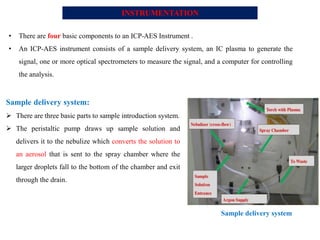
Sample delivery system:
 There are three basic parts to sample introduction system.
 The peristaltic pump draws up sample solution and
delivers it to the nebulize which converts the solution to
an aerosol that is sent to the spray chamber where the
larger droplets fall to the bottom of the chamber and exit
through the drain.
IC plasma
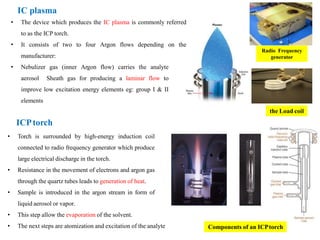
ICPtorch
• Torch is surrounded by high-energy induction coil
connected to radio frequency generator which produce
large electrical discharge in the torch.
• Resistance in the movement of electrons and argon gas
through the quartz tubes leads to generation of heat.
• Sample is introduced in the argon stream in form of
liquid aerosol or vapor.
• This step allow the evaporation of the solvent.
• The next steps are atomization and excitation of the analyte
• The device which produces the IC plasma is commonly referred
to as the ICP torch.
• It consists of two to four Argon flows depending on the
manufacturer:
• Nebulizer gas (inner Argon flow) carries the analyte
aerosol Sheath gas for producing a laminar flow to
improve low excitation energy elements eg: group I & II
elements
Radio Frequency
generator
Components of an ICPtorch
the Load coil
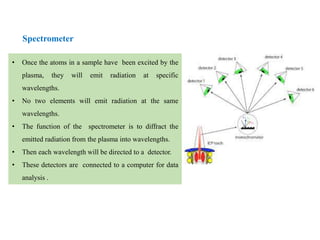
• Once the atoms in a sample have been excited by the
plasma, they will emit radiation at specific
wavelengths.
• No two elements will emit radiation at the same
wavelengths.
• The function of the spectrometer is to diffract the
emitted radiation from the plasma into wavelengths.
• Then each wavelength will be directed to a detector.
• These detectors are connected to a computer for data
analysis .
Spectrometer
APPLICATIONS
 Agriculture : Analysis of agricultural
products, food and soil samples.
 Biomedical : Determination of Al in
blood, Cu in brain, Se in liver, Na in
breast milk.
 Geology : Presence of lanthanides and
other elements in rock samples.
 Forensic : Crime scene food samples,
blood samples, soil analysis etc.
 Metallurgy : Analysis of trace elements in
metals and alloys.
 Environmental science : Waste water
analysis, metals in soil water etc.
 Beverages : Traces of metals like Ca, Cu,
Fe, Mn, Mg, P, K and Zn in beverages.
High sensitivity: ICP-AES is capable of detecting trace amounts of
elements, typically in the parts-per-billion (ppb) to parts-per-million
(ppm) range.
Wide dynamic range: ICP-AES can measure elements over a wide
range of concentrations, from trace levels to high concentrations.
Multi-element analysis: ICP-AES is capable of analyzing multiple
elements simultaneously, making it a highly efficient technique for
elemental analysis.
Low matrix effects: ICP-AES is less affected by matrix effects than
other analytical techniques, such as atomic absorption spectroscopy
(AAS) and inductively coupled plasma-mass spectrometry (ICP-
MS).
Accuracy and precision: ICP-AES provides accurate and precise
results, making it a reliable technique for elemental analysis.
Fast analysis time: ICP-AES provides rapid analysis, making it a
time-efficient technique for high-throughput analysis.
ADVANTAGES
Cost: ICP-AES instruments are expensive to purchase and maintain. The cost of the
instrument itself can range from tens to hundreds of thousands of dollars, and the
cost of operating the instrument can be high due to the need for specialized gases
and other consumables.
Sample preparation: Sample preparation for ICP-AES can be time-consuming and
complex. The sample must be completely dissolved in an appropriate solvent, which
can be difficult for some sample types. In addition, the sample must be free of any
particulate matter that could clog the instrument.
Matrix effects: The presence of other elements in the sample matrix can interfere
with the detection of the analyte of interest. This can lead to inaccurate results if not
properly accounted for.
Limited detection range: While ICP-AES is a powerful technique, it does have a
limited detection range. It is not well-suited for the detection of elements at very low
concentrations (parts-per-trillion or lower).
Requires skilled operator: ICP-AES requires a skilled operator to properly operate
and maintain the instrument. The operator must have a strong understanding of the
principles of the technique, as well as the ability to troubleshoot any issues that may
arise.
DISADVANTAGE
ICP-AES.pptx

ICP-AES.pptx

  • 1.
    Submitted by: B.Lakshmaiah Ravikant Vinchurkar Rushikesh Deshmukh Ph.D. (1st Year) (ICP-AES)-Inductively Coupled Plasma Atomic Emission Spectroscopy Submitted to : Dr. Sunita Meena Scientist (SS) ABC Division
  • 2.
    Learning Objectives Elucidate theprinciple of Inductively Coupled Plasma Atomic Emission Spectroscopy (ICP-AES) Explain the instrumentation and working of ICP-AES List out the applications of ICP-AES To know about advantages and disadvantages of ICP-AES
  • 3.
     Inductively coupledplasma atomic emission spectroscopy (ICP-AES) is a technique used to determine the elemental composition of a sample.  It involves the use of an inductively coupled plasma to atomize and excite the sample, and then detecting the resulting emission of light at specific wavelengths to identify the elements present and their concentrations.  Its features are often compared to atomic absorption spectrophotometry, in which the excitation temperature in the range 2000 to 3000oK, while the excitation temperature of argon ICP is 5000 to 10000OK, which efficiently excites many elements.  Also, using inert gas (argon) makes oxides and nitrides harder to be generated. INTRODUCTION
  • 4.
     Excitation ofatomized metal with inductively coupled plasma, followed by emission of light of its own characteristics wavelength and correlation of emitted light with the concentration of metal is ICP-AES.  Used to detect trace metal in ppm.  Nebulizer converts liquid solution to fine particle of aerosol/mist  Solvent gets vaporized leaving behind the solid residue.  The solid residue gets vaporized to gaseous form due to high temperature of the plasma and molecules dissociate to atoms.  The metal atoms get excited to higher energy level  The excited metal atoms emit light of its own characteristics wavelength by returning back to ground state (NI-393nm, Cu-325nm, Na-589nm, Li-670nm. Ca-622nm, Ba-554nm.) PRINCIPLE OF ICP- AES Return to ground state by emitting light of its own characteristics Ground state Solution Mist Solid vaporized Solvent evaporates Gas Gas Atomizes Excited atom Excited due to plasma heat Solid residue Nebulizer
  • 5.
     ICP sourceconsists of a flowing stream of argon gas ionized by an applied radio frequency field.  This field is inductively coupled to the ionized gas by water- cooled coil surrounding a quartz torch that supports and confines the plasma.  The sample is first introduced into the plasma, which is created by ionizing an inert gas such as argon using a high-frequency electromagnetic field  The sample aerosol is directed into the ICP, subjecting the constituent atoms to temperature of about 5000 to 10000oK.  This high temperature results in almost complete dissociation of molecules.  These excited atoms then emit light at specific wavelengths, which are detected by a spectrometer and used to identify the elements present in the sample  The radiation emitted by the excited atoms is recorded by one or more optical spectrometers or detectors, calibrated readings against standards the technique provides a quantitative analysis of the original sample.
  • 6.
    • There arefour basic components to an ICP-AES Instrument . • An ICP-AES instrument consists of a sample delivery system, an IC plasma to generate the signal, one or more optical spectrometers to measure the signal, and a computer for controlling the analysis. Sample delivery system INSTRUMENTATION Sample delivery system:  There are three basic parts to sample introduction system.  The peristaltic pump draws up sample solution and delivers it to the nebulize which converts the solution to an aerosol that is sent to the spray chamber where the larger droplets fall to the bottom of the chamber and exit through the drain.
  • 7.
    IC plasma ICPtorch • Torchis surrounded by high-energy induction coil connected to radio frequency generator which produce large electrical discharge in the torch. • Resistance in the movement of electrons and argon gas through the quartz tubes leads to generation of heat. • Sample is introduced in the argon stream in form of liquid aerosol or vapor. • This step allow the evaporation of the solvent. • The next steps are atomization and excitation of the analyte • The device which produces the IC plasma is commonly referred to as the ICP torch. • It consists of two to four Argon flows depending on the manufacturer: • Nebulizer gas (inner Argon flow) carries the analyte aerosol Sheath gas for producing a laminar flow to improve low excitation energy elements eg: group I & II elements Radio Frequency generator Components of an ICPtorch the Load coil
  • 8.
    • Once theatoms in a sample have been excited by the plasma, they will emit radiation at specific wavelengths. • No two elements will emit radiation at the same wavelengths. • The function of the spectrometer is to diffract the emitted radiation from the plasma into wavelengths. • Then each wavelength will be directed to a detector. • These detectors are connected to a computer for data analysis . Spectrometer
  • 9.
    APPLICATIONS  Agriculture :Analysis of agricultural products, food and soil samples.  Biomedical : Determination of Al in blood, Cu in brain, Se in liver, Na in breast milk.  Geology : Presence of lanthanides and other elements in rock samples.  Forensic : Crime scene food samples, blood samples, soil analysis etc.  Metallurgy : Analysis of trace elements in metals and alloys.  Environmental science : Waste water analysis, metals in soil water etc.  Beverages : Traces of metals like Ca, Cu, Fe, Mn, Mg, P, K and Zn in beverages.
  • 10.
    High sensitivity: ICP-AESis capable of detecting trace amounts of elements, typically in the parts-per-billion (ppb) to parts-per-million (ppm) range. Wide dynamic range: ICP-AES can measure elements over a wide range of concentrations, from trace levels to high concentrations. Multi-element analysis: ICP-AES is capable of analyzing multiple elements simultaneously, making it a highly efficient technique for elemental analysis. Low matrix effects: ICP-AES is less affected by matrix effects than other analytical techniques, such as atomic absorption spectroscopy (AAS) and inductively coupled plasma-mass spectrometry (ICP- MS). Accuracy and precision: ICP-AES provides accurate and precise results, making it a reliable technique for elemental analysis. Fast analysis time: ICP-AES provides rapid analysis, making it a time-efficient technique for high-throughput analysis. ADVANTAGES
  • 11.
    Cost: ICP-AES instrumentsare expensive to purchase and maintain. The cost of the instrument itself can range from tens to hundreds of thousands of dollars, and the cost of operating the instrument can be high due to the need for specialized gases and other consumables. Sample preparation: Sample preparation for ICP-AES can be time-consuming and complex. The sample must be completely dissolved in an appropriate solvent, which can be difficult for some sample types. In addition, the sample must be free of any particulate matter that could clog the instrument. Matrix effects: The presence of other elements in the sample matrix can interfere with the detection of the analyte of interest. This can lead to inaccurate results if not properly accounted for. Limited detection range: While ICP-AES is a powerful technique, it does have a limited detection range. It is not well-suited for the detection of elements at very low concentrations (parts-per-trillion or lower). Requires skilled operator: ICP-AES requires a skilled operator to properly operate and maintain the instrument. The operator must have a strong understanding of the principles of the technique, as well as the ability to troubleshoot any issues that may arise. DISADVANTAGE