Atomic Absorption Spectroscopy
BY- Dr. Mrs. P. S. Chaudhari
Dr. Maha Daghestani
Atomic Absorption Spectroscopy
• In analytical chemistry, Atomic absorption
spectroscopy is a technique for determining
the concentration of a particular metal
element in a sample. Atomic absorption
spectroscopy can be used to analyze the
concentration of over 62 different metals in a
solution.
Dr. Maha Daghestani
technique
• . The technique typically makes use of a flame
to atomize the sample, but other atomizers
such as a graphite furnace are also used.
Three steps are involved in turning a liquid
sample into an atomic gas:
Dr. Maha Daghestani
steps
• Three steps are involved in turning a liquid
sample into an atomic gas:
• Desolvation – the liquid solvent is
evaporated, and the dry sample remains
• Vaporisation – the solid sample vaporises to
a gas
• Volatilization – the compounds making up
the sample are broken into free atoms.
Introduction to the Principles of Atomic Spectroscopy
• Liquid sample is aspirated to become aerosols of fine particles (nebulization)
• Flame vaporizes the aerosols (atomization)
• Elevated temperatures in a flame or furnace changes the chemistry of atoms
• Temperature affects the ratio of excited and unexcited atoms
• Beer’s law is used to calculate concentration
Processes Occurring in Flame and Flameless Furnace
• Solution is introduced into a high-temperature flame or
furnace, molecules containing the elemental atoms become
gaseous atoms through a series of reactions
• Flame and flameless furnaces are two common radiation
sources used in atomic spectroscopy
Processes Occurring in Flame and Flameless Furnace
• e.g. Calcium present as a salt (CaCl2):
1. removal of water produces gaseous CaCl2
2. gaseous CaCl2 is further dissociated into gaseous Ca0 atoms
At elevated temperatures Ca can have other electronic states:
3/4. Ca0* (excited Ca atom),
5. Oxide/Hydroxide formation
6. Ca+ (ionic Ca),
7. Ca+* (ionic Ca with excited e-)
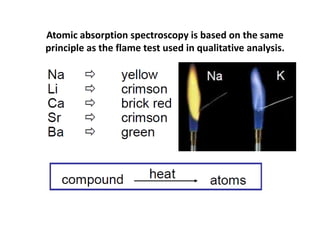
Atomic absorption spectroscopy is based on the same
principle as the flame test used in qualitative analysis.
 The high temperature of the flame excites a
valence electron to a higher-energy orbital.
 The atom then emits energy in the form of light as
the electron falls back into the lower energy
orbital (ground state).
The intensity of the absorbed light is proportional
to the concentration of the element in the flame.
Each element has a characteristic spectrum.
Example: Na gives a characteristic line at 589 nm.
Atomic spectra feature sharp bands.
There is little overlap between the spectral lines of different
elements.
Atomic Spectroscopy for Metal Analysis
Instruments for Atomic Spectroscopy
Flame and Flameless Atomic Absorption
• Basic instrument components:
Schematic diagram of an atomic absorption spectrometer
• Basic instrument components:
1. Light source: hollow cathode lamp (HCL) of the element being
measured. Provides the spectral line for the element of interest.
Working:
When a high voltage is applied across the anode and
cathode, gas particles are ionized. As voltage is increased,
gaseous ions acquire enough energy to eject metal atoms
from the cathode. Some of these atoms are in an excited
states and emit light with the frequency characteristic to
the metal.
Dr. Maha Daghestani
• The type of hollow cathode tube depends on
the metal being analyzed. For analyzing the
concentration of copper in an ore, a copper
cathode tube would be used, and likewise for
any other metal being analyzed. The electrons
of the atoms in the flame can be promoted to
higher orbitals for an instant by absorbing a
set quantity of energy (a quantum).
Hollow Cathode Lamp (Cont’d) a tungsten anode and a cylindrical
cathode
neon or argon at a pressure of 1 to
5 torr
The cathode is constructed of the
metal whose spectrum is desired or
served to support a layer of that
metal
Ionize the inert gas at a potential of ~ 300 V
Generate a current of ~ 5 to 15 mA as ions and electrons migrate to
the electrodes.
The gaseous cations acquire enough kinetic energy to dislodge some of the metal
atoms from the cathode surface and produce an atomic cloud.
A portion of sputtered metal atoms is in excited states and thus emits their
characteristic radiation as they return to the ground sate
Eventually, the metal atoms diffuse back to the cathode surface or to the glass
walls of the tube and are re-deposited
• It is important to note that both emission &
absorption lines for sodium occur at identical
wavelengths since transition involved are between
same energy levels.
• Band emission spectra: arise from excitation of
molecular species in the hot environment of the
flame.(diatomic molecules)
Hollow Cathode Lamp (Cont’d)
 High potential, and thus high currents lead to greater
intensities
 Doppler broadening of the emission lines from the lamp
 Self-absorption: the greater currents produce an
increased number of unexcited atoms in the cloud. The
unexcited atoms, in turn, are capable of absorbing the
radiation emitted by the excited ones. This self-
absorption leads to lowered intensities, particular at the
center of the emission band
Doppler broadening ?
Improvement…….
• Most direct method of obtaining improved lamps for the
emission of more intense atomic resonance lines is to
separate the two functions involving the production and
excitation of atomic vapor
• Boosted discharge hollow-cathode lamp (BDHCL) is
introduced as an AFS excitation source by Sullivan and
Walsh.
• It has received a great deal of attention and a number of
modifications to this type of source have been
conducted.
The Lamps
From bottom to top,
the lamps are for Mg,
Ca, K, and a
combination of Fe,
Co, Ni, Mn, Cu, and Cr.
Each element uses a
specific wavelength of
light.
What is a nebulizer?
SAMPLE
AEROSOL
Concentric Tube
Cross-flow
Fritted-disk
Babington
Understanding “Nebulization” and “Atomization” Process: Why
Higher Sensitivity is Achieved in Flameless GFAA Than Flame
FAA
• Nebulization
– In FAAS a liquid sample is nebulized – aspirated into small
liquid particles (aerosols), remaining larger droplets condense
out (only around 10 % of fine aerosols reach the burner)
• Atomization = conversion of element into atomic vapor
– In FAAS nebulization takes place prior to atomization making
the process far less efficient than GFAAS
– In GFAAS the entire sample is atomized inside the graphite
boat leading to lower detection limits
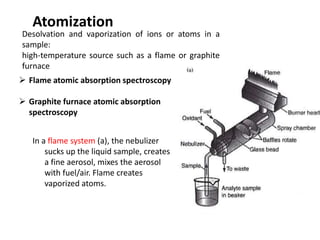
Atomization
In a flame system (a), the nebulizer
sucks up the liquid sample, creates
a fine aerosol, mixes the aerosol
with fuel/air. Flame creates
vaporized atoms.
Desolvation and vaporization of ions or atoms in a
sample:
high-temperature source such as a flame or graphite
furnace
 Flame atomic absorption spectroscopy
 Graphite furnace atomic absorption
spectroscopy
Dr. Maha Daghestani
flame
• The flame is arranged such that it is laterally
long (usually 10cm) and not deep. The height
of the flame must also be monitored by
controlling the flow of the fuel mixture. A
beam of light passes through this flame at its
longest axis (the lateral axis) and hits a
detector.
Process in a Flame AA
M* M+ + e_
Mo M*
MA Mo + Ao
Solid Solution
Ionization
Excitation
Atomization
Vaporization
• Two flames are normally used in AAS
Air-acetylene flame : slot length 100 mm, most commonly used ,
cooler flame 2500 K
Nitrous oxide-acetylene flame: slot length 50 mm, higher
burning velocity, hotter flame 3150 Kreserved for more
refractory elements e.g Al,
Limitations of Flame AAS
 Require large volumes of aqueous sample
 The residence time i.e. the length of time that the atom is
present in flame, is limited due to high burning velocity of the
gases, ths leading to high detection limits
 Inability to analyse solid samples directly
ElectroThermal AAS (ETAAS or GFAAS)
• A small discrete sample (5-100µl is introduced on to the inner surface of a
graphite tube through a small opening.
• Graphite tube is arranged so that light from HCl can pass directly through
the unit. The tube is 3-5 cm long, 3-8 mm diameter
• Pyrolytic graphite (heating tube in methane atmosphere) as it has low gas
permeability & resistant to chemical attack.
• The furnace is heated by passing an electrical current through it (thus, it is
electro thermal) via water cooled contacts at each end of the tube
• To prevent oxidation of the furnace, it is sheathed in gas (Ar usually)
• There is no nebulziation, etc. The sample is introduced as a drop (usually
5-20 uL), slurry or solid particle (rare)
• The furnace goes through several heating steps…
– Drying (usually just above 110 ˚C. for 30s):to remove residual solvent
– Ashing (up to 350-1200 ˚C for 45 s)
– Atomization (Up to 2000-3000 ˚C for 2-3 s)
– Cleaning (quick ramp up to 3500 C or so). Removal of residual material
there is an internal flow of inert gas N2 or Ar during drying & ashing
stages to remove extraneous material
• The light from the source (HCL) passes through the furnace
and absorption during the atomization step is recorded over
several seconds. This makes ETAAS more sensitive than FAAS
for most elements.
ElectroThermal AAS (ETAAS or GFAAS)
• flameless graphite furnace system:
• both liquid and solid samples are deposited into a graphite boat
using a syringe inserted through a cavity. Graphite furnace can
hold an atomized sample in the optical path for several seconds,
compared with a fraction of a second for a flame system
• – results in higher sensitivity of the GFAA compared to FAA
Sample holder: graphite tube
 Samples are placed directly in the graphite furnace which is
then electrically heated.
 Beam of light passes through the tube.
1- Flame atomic absorption spectroscopy:
Sample introduction:
Basic Graphite Furnace Program
THGA
Three stages:
1. drying of sample
2. ashing of organic matter
3. vaporization of analyte atoms
to burn off organic
species that would
interfere with the
elemental analysis.
transversely heated graphite atomizer
Graphite Flame
Advantages Solutions, slurries and solid samples
can be analyzed.
Much more efficient atomization
greater sensitivity
Smaller quantities of sample
(typically 5 – 50 µL)
Provides a reducing environment for
easily oxidized elements
Inexpensive (equipment,
day-to-day running)
High sample throughput
Easy to use
High precision
Disadvanta-
ges
Expensive
Low precision
Low sample throughput
Requires high level of operator skill
Only solutions can be
analyzed
Relatively large sample
quantities required (1 – 2
mL)
Less sensitivity (compared
to graphite furnace)
Colors Produced by Different Ions
The following slides show the colors of different
ions in the flame. The differences in intensity
of the colors is, in part, due to differences in
concentration.
The Calcium Flame
The calcium
flame is
red. This is
intensely
red
because
the calcium
content is
high.
The Copper Flame
The Potassium Flame
The Manganese Flame
The Cobalt Flame
Atomic Spectroscopy
Instruments for Atomic Spectroscopy
3. Monochromator:
Isolates photons of various wavelengths that pass through
the flame or furnace.
Similar to the monochromator in UV-VIS spectroscopy in that
it uses slits, lenses, mirrors and gratings/prisms.
4. Detector:
The PMT detector determines the intensity of photons in the
analytical line exiting the monochromator
Atomic Spectroscopy
Instruments for Atomic Spectroscopy
3. Detector:
The PMT detector determines the intensity of photons in
the analytical line exiting the monochromator.
Before an analyte is atomized, a measured signal is
generated by the PMT as light from the HCL passes through
the flame/furnace. When analyte atoms are present –
some part of that light is absorbed by those atoms. This
causes a decrease in PMT signal that is proportional to the
amount of analyte.
Spectral line broadening
• Resolution (Width) Lines Spectra Atomic spectral lines have
finite widths with factors to line broadening due to:
• Natural Broadening - The lifetime of the excited states lead to
uncertainty leading to broadening due to shorter excited state
lifetimes. Lifetimes of 10-8 s lead to width of 10-5 nm.
• Collisional Broadening - Also referred to as Pressure
Broadening is the result of collision of the excited state leads
to shorter lifetimes and broadening of the spectral lines
Doppler Broadening - When molecules are moving towards a
detector or away from a detector the frequency will be offset
by the net speed the radiation hits the detector. This is also
known as the Doppler effect and the true frequency will ether
be red shifted (if the chemical is moving away from the
detector) or blue shifted (if the chemical is moving towards
the detector)
Applications of Atomic Absorption Spectroscopy
 water analysis (e.g.Ca, Mg, Fe, Si, Al, Ba content)
 food analysis; analysis of animal feedstuffs ( e.g. Mn, Fe, Cu, Cr, Se, Zn)
 analysis of additives in lubricating oils and greases (Ba,Ca, Na, Li, Zn,
Mg)
 analysis of soils
 clinical analysis (blood samples: whole blood, plasma, serum; Ca, Mg, Li,
Na, K, Fe)
Detection Limits
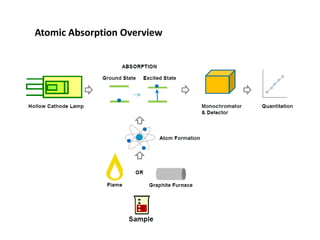
Atomic Absorption Overview

Atomic absorption spectroscopy

  • 1.
    Atomic Absorption Spectroscopy BY-Dr. Mrs. P. S. Chaudhari
  • 2.
    Dr. Maha Daghestani AtomicAbsorption Spectroscopy • In analytical chemistry, Atomic absorption spectroscopy is a technique for determining the concentration of a particular metal element in a sample. Atomic absorption spectroscopy can be used to analyze the concentration of over 62 different metals in a solution.
  • 5.
    Dr. Maha Daghestani technique •. The technique typically makes use of a flame to atomize the sample, but other atomizers such as a graphite furnace are also used. Three steps are involved in turning a liquid sample into an atomic gas:
  • 6.
    Dr. Maha Daghestani steps •Three steps are involved in turning a liquid sample into an atomic gas: • Desolvation – the liquid solvent is evaporated, and the dry sample remains • Vaporisation – the solid sample vaporises to a gas • Volatilization – the compounds making up the sample are broken into free atoms.
  • 7.
    Introduction to thePrinciples of Atomic Spectroscopy • Liquid sample is aspirated to become aerosols of fine particles (nebulization) • Flame vaporizes the aerosols (atomization) • Elevated temperatures in a flame or furnace changes the chemistry of atoms • Temperature affects the ratio of excited and unexcited atoms • Beer’s law is used to calculate concentration
  • 8.
    Processes Occurring inFlame and Flameless Furnace • Solution is introduced into a high-temperature flame or furnace, molecules containing the elemental atoms become gaseous atoms through a series of reactions • Flame and flameless furnaces are two common radiation sources used in atomic spectroscopy
  • 9.
    Processes Occurring inFlame and Flameless Furnace • e.g. Calcium present as a salt (CaCl2): 1. removal of water produces gaseous CaCl2 2. gaseous CaCl2 is further dissociated into gaseous Ca0 atoms At elevated temperatures Ca can have other electronic states: 3/4. Ca0* (excited Ca atom), 5. Oxide/Hydroxide formation 6. Ca+ (ionic Ca), 7. Ca+* (ionic Ca with excited e-)
  • 11.
    Atomic absorption spectroscopyis based on the same principle as the flame test used in qualitative analysis.
  • 12.
     The hightemperature of the flame excites a valence electron to a higher-energy orbital.  The atom then emits energy in the form of light as the electron falls back into the lower energy orbital (ground state). The intensity of the absorbed light is proportional to the concentration of the element in the flame.
  • 13.
    Each element hasa characteristic spectrum. Example: Na gives a characteristic line at 589 nm. Atomic spectra feature sharp bands. There is little overlap between the spectral lines of different elements.
  • 17.
    Atomic Spectroscopy forMetal Analysis Instruments for Atomic Spectroscopy Flame and Flameless Atomic Absorption • Basic instrument components:
  • 18.
    Schematic diagram ofan atomic absorption spectrometer
  • 24.
    • Basic instrumentcomponents: 1. Light source: hollow cathode lamp (HCL) of the element being measured. Provides the spectral line for the element of interest. Working: When a high voltage is applied across the anode and cathode, gas particles are ionized. As voltage is increased, gaseous ions acquire enough energy to eject metal atoms from the cathode. Some of these atoms are in an excited states and emit light with the frequency characteristic to the metal.
  • 25.
    Dr. Maha Daghestani •The type of hollow cathode tube depends on the metal being analyzed. For analyzing the concentration of copper in an ore, a copper cathode tube would be used, and likewise for any other metal being analyzed. The electrons of the atoms in the flame can be promoted to higher orbitals for an instant by absorbing a set quantity of energy (a quantum).
  • 26.
    Hollow Cathode Lamp(Cont’d) a tungsten anode and a cylindrical cathode neon or argon at a pressure of 1 to 5 torr The cathode is constructed of the metal whose spectrum is desired or served to support a layer of that metal Ionize the inert gas at a potential of ~ 300 V Generate a current of ~ 5 to 15 mA as ions and electrons migrate to the electrodes. The gaseous cations acquire enough kinetic energy to dislodge some of the metal atoms from the cathode surface and produce an atomic cloud. A portion of sputtered metal atoms is in excited states and thus emits their characteristic radiation as they return to the ground sate Eventually, the metal atoms diffuse back to the cathode surface or to the glass walls of the tube and are re-deposited
  • 28.
    • It isimportant to note that both emission & absorption lines for sodium occur at identical wavelengths since transition involved are between same energy levels. • Band emission spectra: arise from excitation of molecular species in the hot environment of the flame.(diatomic molecules)
  • 29.
    Hollow Cathode Lamp(Cont’d)  High potential, and thus high currents lead to greater intensities  Doppler broadening of the emission lines from the lamp  Self-absorption: the greater currents produce an increased number of unexcited atoms in the cloud. The unexcited atoms, in turn, are capable of absorbing the radiation emitted by the excited ones. This self- absorption leads to lowered intensities, particular at the center of the emission band Doppler broadening ?
  • 30.
    Improvement……. • Most directmethod of obtaining improved lamps for the emission of more intense atomic resonance lines is to separate the two functions involving the production and excitation of atomic vapor • Boosted discharge hollow-cathode lamp (BDHCL) is introduced as an AFS excitation source by Sullivan and Walsh. • It has received a great deal of attention and a number of modifications to this type of source have been conducted.
  • 31.
    The Lamps From bottomto top, the lamps are for Mg, Ca, K, and a combination of Fe, Co, Ni, Mn, Cu, and Cr. Each element uses a specific wavelength of light.
  • 33.
    What is anebulizer? SAMPLE AEROSOL
  • 34.
  • 35.
  • 36.
  • 37.
  • 39.
    Understanding “Nebulization” and“Atomization” Process: Why Higher Sensitivity is Achieved in Flameless GFAA Than Flame FAA • Nebulization – In FAAS a liquid sample is nebulized – aspirated into small liquid particles (aerosols), remaining larger droplets condense out (only around 10 % of fine aerosols reach the burner) • Atomization = conversion of element into atomic vapor – In FAAS nebulization takes place prior to atomization making the process far less efficient than GFAAS – In GFAAS the entire sample is atomized inside the graphite boat leading to lower detection limits
  • 42.
    Atomization In a flamesystem (a), the nebulizer sucks up the liquid sample, creates a fine aerosol, mixes the aerosol with fuel/air. Flame creates vaporized atoms. Desolvation and vaporization of ions or atoms in a sample: high-temperature source such as a flame or graphite furnace  Flame atomic absorption spectroscopy  Graphite furnace atomic absorption spectroscopy
  • 44.
    Dr. Maha Daghestani flame •The flame is arranged such that it is laterally long (usually 10cm) and not deep. The height of the flame must also be monitored by controlling the flow of the fuel mixture. A beam of light passes through this flame at its longest axis (the lateral axis) and hits a detector.
  • 45.
    Process in aFlame AA M* M+ + e_ Mo M* MA Mo + Ao Solid Solution Ionization Excitation Atomization Vaporization
  • 46.
    • Two flamesare normally used in AAS Air-acetylene flame : slot length 100 mm, most commonly used , cooler flame 2500 K Nitrous oxide-acetylene flame: slot length 50 mm, higher burning velocity, hotter flame 3150 Kreserved for more refractory elements e.g Al, Limitations of Flame AAS  Require large volumes of aqueous sample  The residence time i.e. the length of time that the atom is present in flame, is limited due to high burning velocity of the gases, ths leading to high detection limits  Inability to analyse solid samples directly
  • 49.
    ElectroThermal AAS (ETAASor GFAAS) • A small discrete sample (5-100µl is introduced on to the inner surface of a graphite tube through a small opening. • Graphite tube is arranged so that light from HCl can pass directly through the unit. The tube is 3-5 cm long, 3-8 mm diameter • Pyrolytic graphite (heating tube in methane atmosphere) as it has low gas permeability & resistant to chemical attack. • The furnace is heated by passing an electrical current through it (thus, it is electro thermal) via water cooled contacts at each end of the tube • To prevent oxidation of the furnace, it is sheathed in gas (Ar usually) • There is no nebulziation, etc. The sample is introduced as a drop (usually 5-20 uL), slurry or solid particle (rare)
  • 50.
    • The furnacegoes through several heating steps… – Drying (usually just above 110 ˚C. for 30s):to remove residual solvent – Ashing (up to 350-1200 ˚C for 45 s) – Atomization (Up to 2000-3000 ˚C for 2-3 s) – Cleaning (quick ramp up to 3500 C or so). Removal of residual material there is an internal flow of inert gas N2 or Ar during drying & ashing stages to remove extraneous material • The light from the source (HCL) passes through the furnace and absorption during the atomization step is recorded over several seconds. This makes ETAAS more sensitive than FAAS for most elements. ElectroThermal AAS (ETAAS or GFAAS)
  • 53.
    • flameless graphitefurnace system: • both liquid and solid samples are deposited into a graphite boat using a syringe inserted through a cavity. Graphite furnace can hold an atomized sample in the optical path for several seconds, compared with a fraction of a second for a flame system • – results in higher sensitivity of the GFAA compared to FAA Sample holder: graphite tube  Samples are placed directly in the graphite furnace which is then electrically heated.  Beam of light passes through the tube.
  • 56.
    1- Flame atomicabsorption spectroscopy: Sample introduction:
  • 57.
    Basic Graphite FurnaceProgram THGA Three stages: 1. drying of sample 2. ashing of organic matter 3. vaporization of analyte atoms to burn off organic species that would interfere with the elemental analysis. transversely heated graphite atomizer
  • 58.
    Graphite Flame Advantages Solutions,slurries and solid samples can be analyzed. Much more efficient atomization greater sensitivity Smaller quantities of sample (typically 5 – 50 µL) Provides a reducing environment for easily oxidized elements Inexpensive (equipment, day-to-day running) High sample throughput Easy to use High precision Disadvanta- ges Expensive Low precision Low sample throughput Requires high level of operator skill Only solutions can be analyzed Relatively large sample quantities required (1 – 2 mL) Less sensitivity (compared to graphite furnace)
  • 59.
    Colors Produced byDifferent Ions The following slides show the colors of different ions in the flame. The differences in intensity of the colors is, in part, due to differences in concentration.
  • 60.
    The Calcium Flame Thecalcium flame is red. This is intensely red because the calcium content is high.
  • 61.
  • 62.
  • 63.
  • 64.
  • 69.
    Atomic Spectroscopy Instruments forAtomic Spectroscopy 3. Monochromator: Isolates photons of various wavelengths that pass through the flame or furnace. Similar to the monochromator in UV-VIS spectroscopy in that it uses slits, lenses, mirrors and gratings/prisms. 4. Detector: The PMT detector determines the intensity of photons in the analytical line exiting the monochromator
  • 70.
    Atomic Spectroscopy Instruments forAtomic Spectroscopy 3. Detector: The PMT detector determines the intensity of photons in the analytical line exiting the monochromator. Before an analyte is atomized, a measured signal is generated by the PMT as light from the HCL passes through the flame/furnace. When analyte atoms are present – some part of that light is absorbed by those atoms. This causes a decrease in PMT signal that is proportional to the amount of analyte.
  • 71.
  • 72.
    • Resolution (Width)Lines Spectra Atomic spectral lines have finite widths with factors to line broadening due to: • Natural Broadening - The lifetime of the excited states lead to uncertainty leading to broadening due to shorter excited state lifetimes. Lifetimes of 10-8 s lead to width of 10-5 nm. • Collisional Broadening - Also referred to as Pressure Broadening is the result of collision of the excited state leads to shorter lifetimes and broadening of the spectral lines Doppler Broadening - When molecules are moving towards a detector or away from a detector the frequency will be offset by the net speed the radiation hits the detector. This is also known as the Doppler effect and the true frequency will ether be red shifted (if the chemical is moving away from the detector) or blue shifted (if the chemical is moving towards the detector)
  • 73.
    Applications of AtomicAbsorption Spectroscopy  water analysis (e.g.Ca, Mg, Fe, Si, Al, Ba content)  food analysis; analysis of animal feedstuffs ( e.g. Mn, Fe, Cu, Cr, Se, Zn)  analysis of additives in lubricating oils and greases (Ba,Ca, Na, Li, Zn, Mg)  analysis of soils  clinical analysis (blood samples: whole blood, plasma, serum; Ca, Mg, Li, Na, K, Fe)
  • 74.
  • 75.